Construction
Anchor pull testing and site safety rounds, with certificates that end the argument.
Detail →
Dev Station builds digital inspection platforms, industrial IoT systems and the software around connected equipment. Our clients are in the UK, the US and Australia.
Across all of them the job has the same shape. Capture a check in the field, then prove it later to somebody who was not standing there. What changes is the standard behind the check and the instrument in the hand.
A lift shaft, a basement loading bay and a steel-framed unit all kill mobile data. So every app we ship writes to the device first, then drains a queue the user can see.
If a product already on the market covers your process, we say so on the first call and lose the build.
An ERP or CMMS that has to receive the result. An instrument with its own SDK. A rule the vendor will not add. Two hundred field users on one tenant.
One workflow, or one device integration. The team grows when the roadmap needs it.
Inspection and field operations are the specialism. The rest came through the same engineering team as custom software. Seventeen sectors are written up in full, starting with construction software development.
Anchor pull testing and site safety rounds, with certificates that end the argument.
Detail →In-line quality checks on the cell, non-conformance trails and vision checks where the defect is visible.
Detail →Walkaround, DVIR and service lane inspections, with video the customer can watch.
Detail →Thorough examination scheduling per unit, and an engineer app that keeps working in a shaft.
Detail →Apps that pair with pull testers and torque wrenches over Bluetooth and hold the calibration record.
Detail →Dispatch consoles and driver apps that keep writing when the signal drops.
Detail →Inspection rounds on dispersed assets, with evidence that survives an audit years later.
Detail →Network asset inspection, drone capture pipelines and meter telemetry feeding one record.
Detail →Planned rounds across a portfolio, with remedial actions tracked to a contractor and a date.
Detail →Visibility from dock to delivery, with exceptions raised before the customer rings.
Detail →Soil and crop sensing, field records and the dashboards that turn a reading into a decision.
Detail →Clinical workflow tools and patient facing apps, built around privacy rules from the first sprint.
Detail →Payment flows, onboarding and ledger work, with compliance written into the design.
Detail →Online banking journeys, internal tooling and the integrations into core systems.
Risk, compliance and planning tools for firms that answer to a regulator.
ERP, CRM and workflow automation shaped to how your teams already work.
Detail →Automated bookkeeping flows, reconciliation and the reporting pack at period end.
Store systems and stock visibility built to survive a busy Saturday.
Storefronts, checkout and the integrations sitting behind them.
Detail →Learning platforms, assessment and the admin systems around them.
Detail →Listings, viewings and property condition reports with photo evidence.
Detail →Booking flows, itinerary tools and supplier integrations.
Matching, dispatch and payment for services booked in the moment.
Publishing pipelines and delivery that holds up at a traffic spike.

Proof-load and torque checks ran on spreadsheets and email. We built the dashboard, the field app that reads testers over Bluetooth, and the certificate that carries GPS, timestamps and readings.
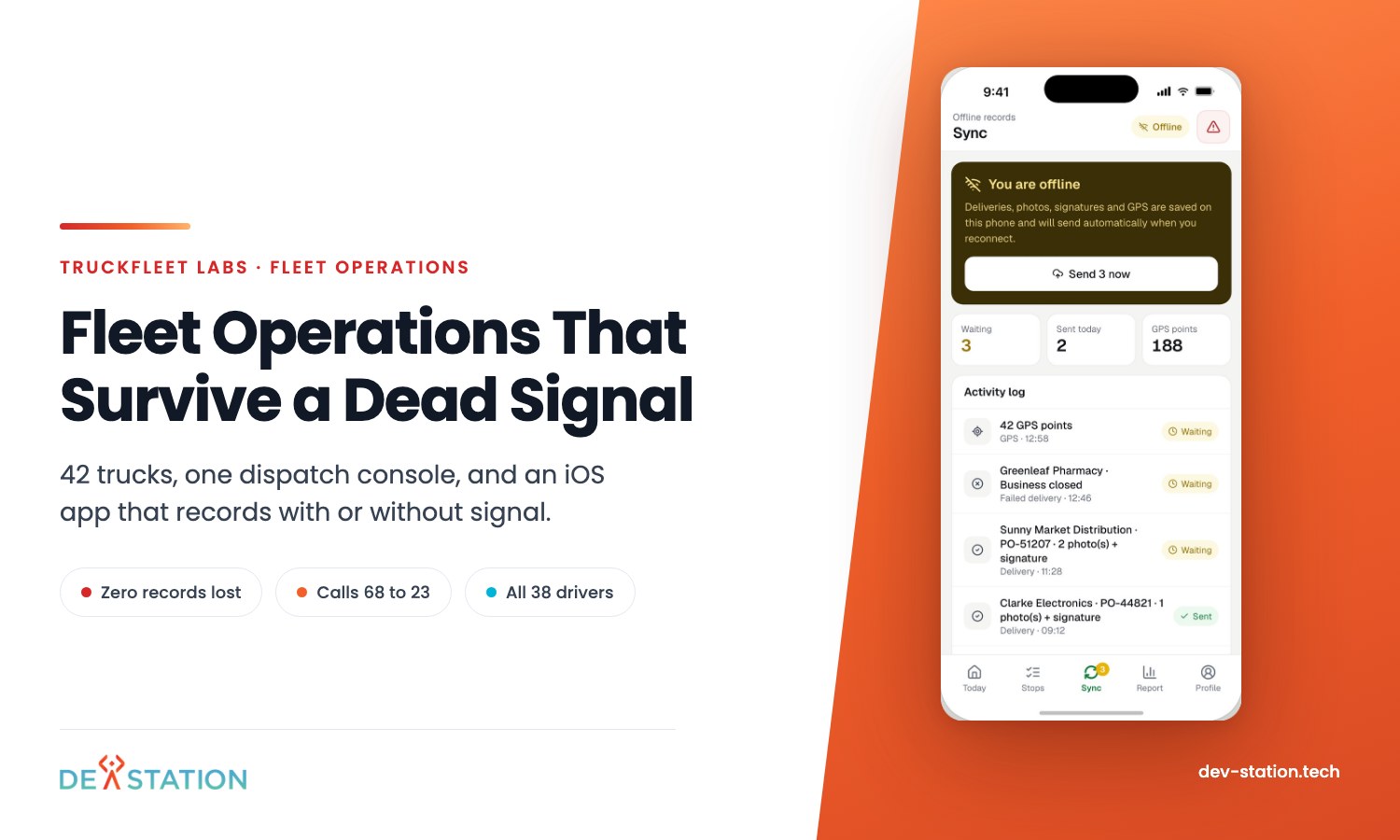
Forty-two trucks ran from a spreadsheet with nine tabs. We built a dispatch console and an iOS driver app where every record is written to the phone first.
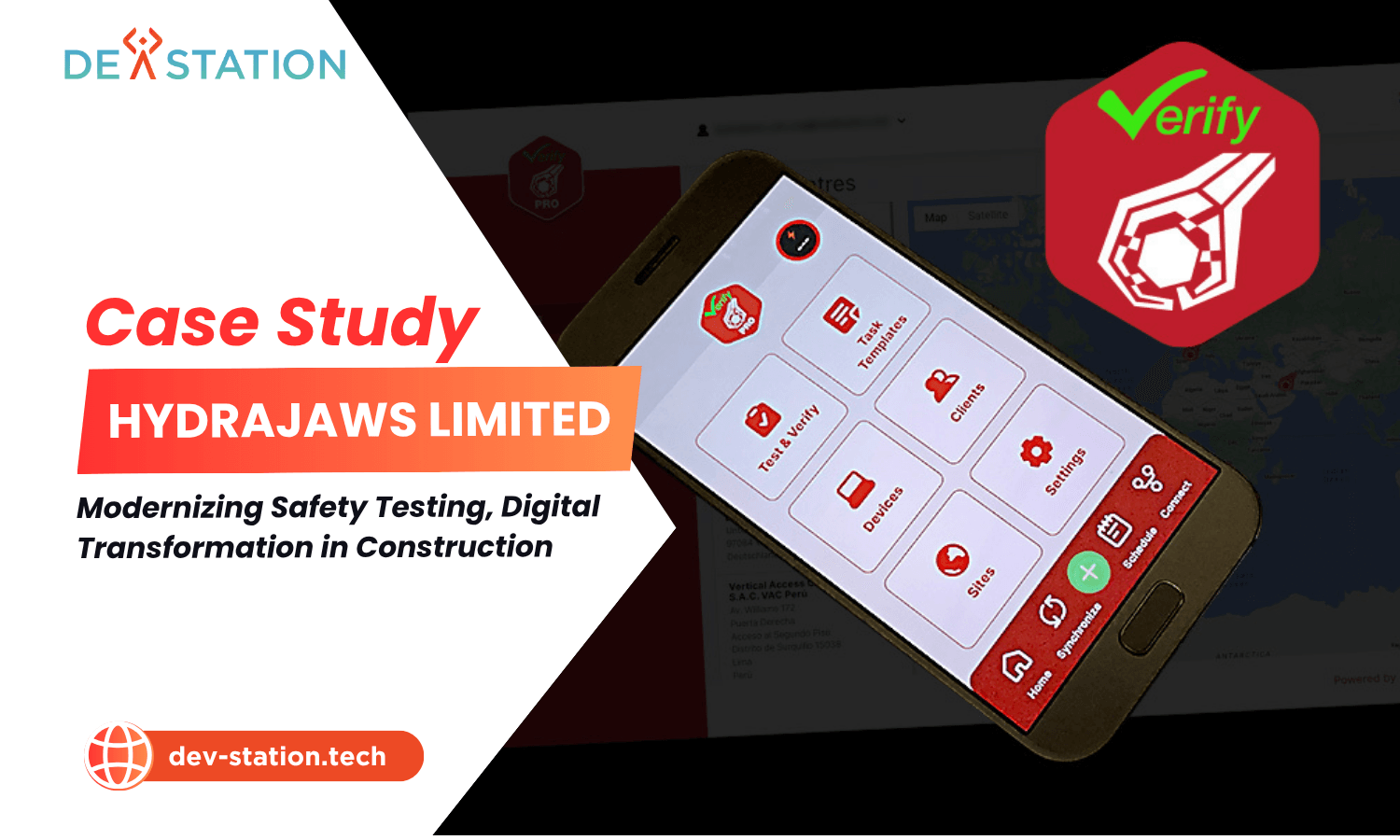
A maker of portable pull testers arrived with an application nobody had documented. We rebuilt the environments, then shipped a free and a paid version with digital torque through the KTC SDK.





















Yes, when the shape of the problem matches. The test is whether somebody outside your company ever asks you to produce the record, and whether the person producing it works where the signal drops.
Usually yes, over BLE or a gateway. Where the maker provides an SDK we integrate against it, as we did with KTC for digital torque on the Hydrajaws platform. Send us the model numbers and we will tell you which ones we can read.
We build. Dev Station is an engineering team, not a licence. If a product already on the market covers your inspection process, we will say so on the first call and lose the build.
One workflow, or one device integration. Most engagements start that way and the team grows when the roadmap needs it.
You do, from the first commit. Repositories and cloud accounts stay in your name, so leaving us never needs a migration project.
Thirty minutes with the engineers on the system you run now and the integrations around it. If a product on the market fits better, you will hear that on the call.