












Digital inspection platforms
Checklists bound to an asset, evidence attached, and a certificate at the end that a client can accept.
Detail →
Dev Station builds digital inspection platforms and industrial IoT systems. These are the technologies those systems run on, taken from work in production.
What we build has to keep working for years on a device somebody carries onto a site. That narrows the field fast. Where a client already runs a stack, we work in it, and only argue when the choice will cost them later.
Every field app writes to the device first, then drains a queue the user can watch. Basements and lift shafts kill mobile data.
Bluetooth LE, a gateway or the maker SDK. A reading off the tool beats a number typed from memory.
Repositories and cloud accounts stay in your name from the first commit.
Two back ends carry most of the work. ASP.NET Core sits under the platforms that started on the Microsoft side, Python with FastAPI under the newer services, and a broker behind both because readings arrive faster than a request cycle tolerates.
Native iOS and Android where the app holds a Bluetooth session and a local database at once. Cross-platform through .NET MAUI, which is where Xamarin work now goes.
Azure most often, because the platforms we took over were already there, with Azure SQL, Blob Storage and AD B2C behind sign-in. AWS and Google Cloud where the client already runs on them.
Pipelines in Azure DevOps or GitHub Actions, containers where the load justifies them, infrastructure described in code. On a recovered project the first job is usually rebuilding the environments.






Vision models for defect and presence checks, trained on your own images. Where a threshold and a rule would do the job, we say so and skip the model.


















Ask any agency what they use and you get a logo wall. These are the positions behind ours.
Microsoft ended support on 1 May 2024. Two platforms we maintain started on Xamarin, so the migration is live work. If you run a Xamarin app today, the question is when, not whether.
A system that needs a live connection at the moment of the check loses records exactly where the check matters. SQLite on the phone, a queue the user can see, and no closing a record without the evidence.
Where the maker publishes an SDK we integrate against it, as we did with KTC for digital torque on the Hydrajaws platform. Otherwise Bluetooth LE or a gateway. Send model numbers and we will say which ones we can read.
Position and engine data arrive faster and less reliably than a request cycle tolerates. MQTT ingest with a broker in front keeps the console responsive when a hundred units report at once. Anything with a location goes in PostGIS.
Checklists bound to an asset, evidence attached, and a certificate at the end that a client can accept.
Detail →Sensors, gateways and the pipeline that turns a stream of readings into something a person can act on.
Detail →Offline-first apps for people working where the signal drops, with a queue they can watch drain.
Detail →The ERP, the CMMS or the client portal that has to receive the result before the job is finished.
Detail →
React dashboard, ASP.NET Core on Azure, a .NET MAUI field app reading testers over Bluetooth, Power BI on top.
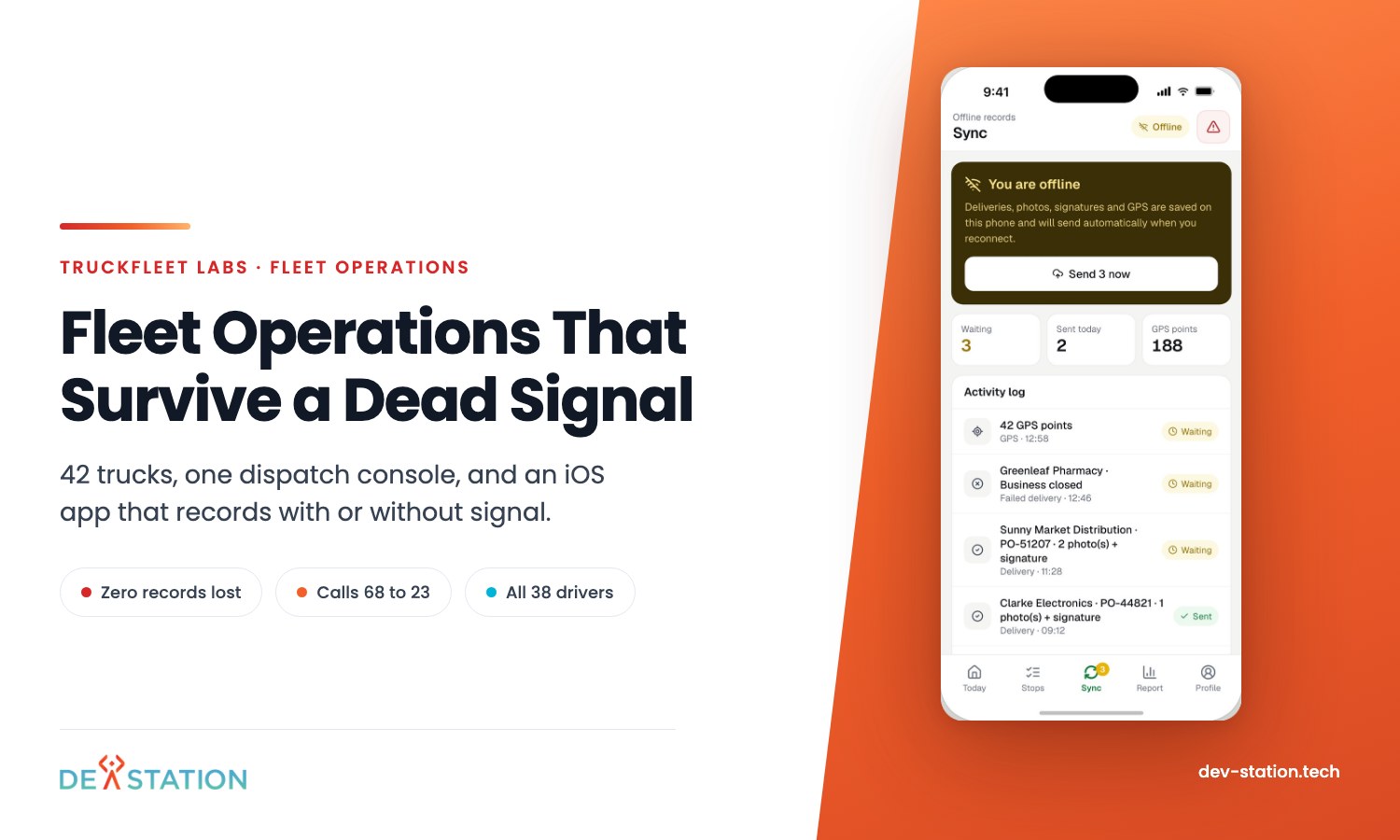
React 18 console, FastAPI behind it, PostGIS for stops and geofences, Redis for the queue, MQTT for telematics, native iOS for drivers.
Our engineers have delivered for Karcher GmbH, Topicus Finance, Team Assurance and Standard Chartered Bank, alongside the equipment makers and inspection providers who make up most of the order book.
Usually yes. Most of our work starts inside a system somebody else built, and the first job is to document it before changing anything.
Support ended on 1 May 2024, so you are running without updates until a store requirement or an OS release stops it. The upgrade path is .NET MAUI, and we have taken it on platforms we maintain.
Usually yes, over BLE or a gateway, or against the maker SDK where there is one. Send the model numbers and we will say which ones we can read.
You do, from the first commit. Repositories and cloud accounts stay in your name, so leaving us never needs a migration project.
Thirty minutes with the engineers on what you run, what it talks to and where it hurts. If the answer is to leave it alone, you will hear that.