Key Takeaway
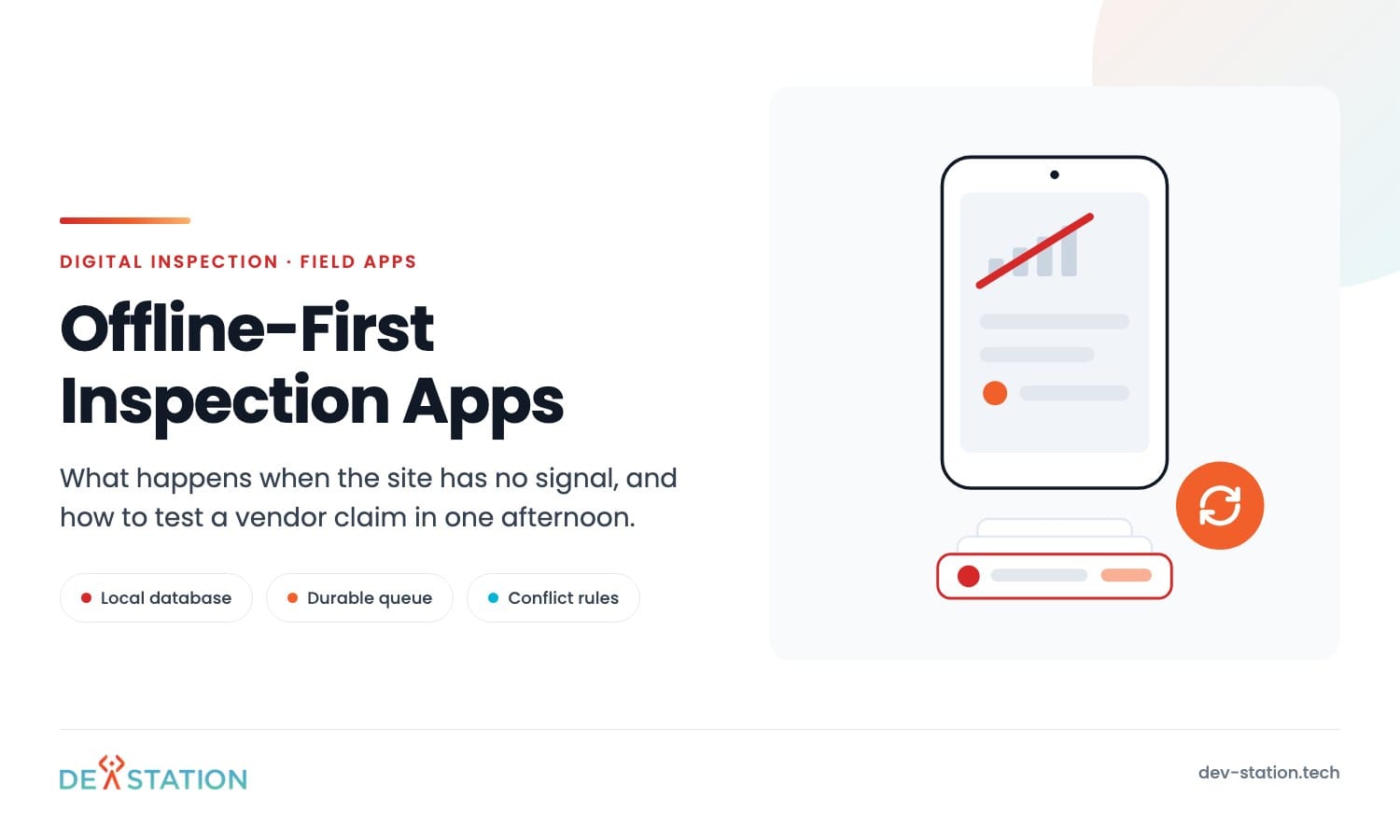
- “Offline” means three different things. Offline-tolerant survives a lift ride. Offline-capable holds what you opened. Offline-first treats the phone as the source of truth.
- Offline-first is an architecture choice, not a setting. It needs a local database, IDs made on the phone, a queue that survives a crash, a separate path for photos, and a written rule for conflicts.
- Photos break sync more than anything else. One inspector can capture 100 MB of evidence in a shift, and the phone pauses uploads while it sits in a pocket.
- Five failures cause most lost work: paused uploads, logins expiring offline, full storage, wrong timestamps, and reports issued before their photos arrive.
- One afternoon settles any vendor claim. Flight mode, a full inspection, force quit, reboot, reconnect, then count what survived.
Overview
01
Signal blackspots are where inspection apps die
Plant rooms have concrete walls. So do lift shafts, basements, tank farms and half-built floors.
In those places a phone stops being a connected device and becomes a notepad with a camera. Inspectors work there. That is the job.
Every vendor says their app works offline. Almost all of them mean something different, and you find out which one after rollout.
A team looking for a safety inspection app that works without internet is really asking one question. Will a full day of work survive a full day with no signal?
Definitions
02
Three things vendors mean by “works offline”
Sort every product into one of these first. The pricing page will not tell you which one you are buying.
Offline-tolerant. The form you are filling in stays on screen when the signal drops. Close the app or flatten the battery and the work is gone.
Offline-capable. Work you opened while connected is saved on the phone and syncs later. It fails when a job is assigned to someone who is already out of signal, because that job never reached the phone.
Offline-first. The phone holds the truth and the server catches up later. There is no offline mode to switch on, because there is no online mode to leave.
| Ask the vendor | Offline-tolerant | Offline-capable | Offline-first |
|---|---|---|---|
| Force quit mid-inspection | Work lost | Work kept | Work kept |
| Job assigned while out of signal | Not available | Not available | Arrives at next sync |
| A full shift with no connection | No | Only what was pre-loaded | Yes, new records included |
| Search past reports on site | No | Cached views only | Yes, from local data |
| Where the truth lives | Server | Server, with a copy | Phone, synced to server |
Most teams need offline-capable and buy offline-tolerant. Anyone doing statutory work needs offline-first, because a lost record means a second site visit and sometimes a compliance gap.
Architecture
03
What offline-first needs underneath
These six pieces separate an app that survives a bad day from one that quietly drops work. They are also where the build cost sits, which is why few products have all six.
A real local database
Not a cache, and not the browser storage a web wrapper gets by default. The phone needs a proper database holding records, jobs, reference data and history. Ask what it is and whether it is encrypted.
IDs created on the phone
An inspection made offline has to link to an asset, a defect and eight photos before the server has seen any of it. If the app waits for the server to hand out an ID, it cannot create anything new while disconnected.
A queue that survives a crash
Finished work goes into a queue written to disk, not held in memory. It has to survive a force quit, a flat battery and a reboot. A queue that lives in the running app takes the shift with it when the app dies.
A separate path for photos
A photo is a thousand times bigger than the record it belongs to. Photos need their own queue and uploads that resume where they stopped. Treating a 4 MB image like a form field is the most common mistake here.
A written rule for conflicts
Two people will edit the same asset while both are offline. Someone has to decide up front which edit wins and whether the other one is kept. A product with no documented answer still has an answer, usually last phone to reconnect.
Versioned forms
A checklist edited in the office on Tuesday reaches a phone that went offline on Monday. The phone has to finish the version it holds, submit against that version, and update later. Every record should carry the form version it was captured under.
Where the data sits is part of this decision, not a separate one. Records live on the handset until they sync, so device encryption and the region the server writes to belong in the same conversation.
Teams under SOC 2 or HIPAA in the United States, and under GDPR and ISO 27001 in the United Kingdom, should settle this while the sync model is being chosen, not after the first audit.
Conflicts
04
How conflicting edits get settled
There are three workable answers and one that destroys evidence. Pick before you build, or before you sign.
Last answer wins, field by field. Two inspectors rarely answer the same question, so the later answer replaces that one field and everything else merges. The failure case is small and easy to explain to an auditor.
The server decides. The phone proposes, the server accepts or rejects, and a rejected edit comes back to the inspector as a task. It costs more to build and it is the only model that holds up when a record has legal weight.
Nothing is edited. Every observation is a new entry and the current state is read back from the history. Good for defect logs and asset histories, heavy for a daily checklist.
The one to refuse: last write wins across the whole record. One phone uploads at 16:05 and wipes a colleague’s photos, notes and signature from 15:40, with no trace. Ask to see this tested on two handsets. Slides are not a demonstration.
Media
05
Photos are what actually break the sync
A forty point inspection is a few kilobytes of text. The photos attached to it are not.
A phone camera writes roughly 3 to 5 MB per photo. Twenty five photos in a shift is around 100 MB from one inspector, in one day, before any video.
Now multiply that by a crew and a bad week. Each phone is holding gigabytes, the first connection is hotel wifi or a phone tethered in a van, and a basic uploader pushes it as one request that times out at 90 percent and starts again.
Four things fix it. Compress at capture. Upload in chunks that resume where they stopped.
Give photos their own queue so one stuck image never blocks the record. Attach each photo to a line item, not to the whole report, so a partial upload still makes sense.
Ask for numbers: the largest queue the app has been tested with, in megabytes and records, and what happens when a 64 GB handset runs out of space.
Field Failures
06
Five ways offline sync fails in practice
None of these show up in a demo. All of them show up in week three.
- The phone pauses the upload. iOS and Android both limit what an app does in the background. The phone goes in a pocket, nobody opens the app again until morning, and a sync the inspector thought had finished never started.
- The login expires while offline. The token times out on Tuesday, the app treats it as a logout on Wednesday, and the logout clears local storage. Good work is deleted by the app’s own housekeeping. Never clear local data on a failed login.
- Storage runs out mid-capture. A full phone fails to save a photo, the record saves without it, and nobody notices until review. The app should check free space and refuse loudly instead of carrying on.
- Timestamps are written at sync. Three days of inspections all arrive stamped Thursday afternoon. For statutory work a wrong audit trail is worse than no record. Capture time belongs to the phone, with the sync time kept beside it.
- The record arrives without its photos. Text syncs in seconds and photos take hours, so a report can be approved and issued while half the evidence is still on a handset. Reports should stay pending until their photos land.
Each one is cheap to prevent and expensive to find in production. They also make a fair interview. A team that has run an offline quality inspection app at scale will know all five and usually tell you which one bit them.
Action
07
Test the claim in one afternoon
Use a real handset, a real form and real photos, before the contract. It takes about two hours.
- Sync, then cut the connection. Sync fully on wifi, switch to flight mode, and stay there for the whole test.
- Do a full inspection. Forty points, twenty photos, a signature, one defect. Then try to start a second inspection on an asset the phone has never seen.
- Be hostile. Force quit mid-form, reboot the phone, lock it for twenty minutes, then reopen. Everything should still be there with its photos.
- Create a conflict on purpose. Two phones, same asset, different answers, both offline. Reconnect one, then the other, and see what the server keeps and what the second inspector is told.
- Reconnect badly. One bar of mobile data, phone locked in a pocket for ten minutes. Count records and photos against what you captured, then check the timestamps.
Anything that survives that has a real offline model. Anything that does not is offline-tolerant with a good marketing page, which is still fine if your inspectors are never far from signal.
Dev Station builds inspection apps where the offline model comes first, and just as often we build only the capture and sync layer under a product a client already owns. If you are still weighing buying against building, see our guide to choosing a mobile inspection app.
Our engineers work from Vietnam with overlap into US Eastern, US Pacific and UK GMT hours, and we invoice in USD or GBP. Send us what went missing in your test and we will tell you whether it is configuration, a product limit or architecture.
FAQ
08
Frequently asked questions
What teams ask before they run the afternoon test.
Can a safety inspection app work without internet?
Yes, if it saves work in a database on the phone and queues it for upload. What varies is how much it holds, whether you can create new records offline, and whether photos survive with the record. Test it in flight mode instead of trusting the feature list.
What does offline-first mean in an inspection app?
The phone holds the truth and the server catches up when a connection appears, so the app behaves the same either way. Offline-capable products work from a copy of whatever was downloaded while connected.
How long can an offline quality inspection app stay disconnected?
Days or weeks, if it was built for it. The real limits are handset storage, which photos eat quickly, and any login that expires while the phone is away. Ask for the longest outage the vendor has tested.
What happens if two inspectors edit the same asset offline?
It depends on a rule someone chose. Field level merging keeps both sets of answers, server authority sends the losing edit back as a task, and whole record overwriting quietly discards one inspector’s work. Ask which one applies, then ask to see it on two phones.
Want an AI assistant to summarize or cite this guide?
Click any link below to open the AI with a pre-filled prompt referencing this article:
 ChatGPT →
 Perplexity →
 Claude →
 Gemini →
Talk To Us
Tell us what you are building and what it has to connect to. An engineer answers, and you get a straight view of what the work would take.
Get In Touch →