Key Takeaway
- The rate a vendor quotes is the smallest part of what an offshore development centre costs you. It is also the only part most comparisons look at.
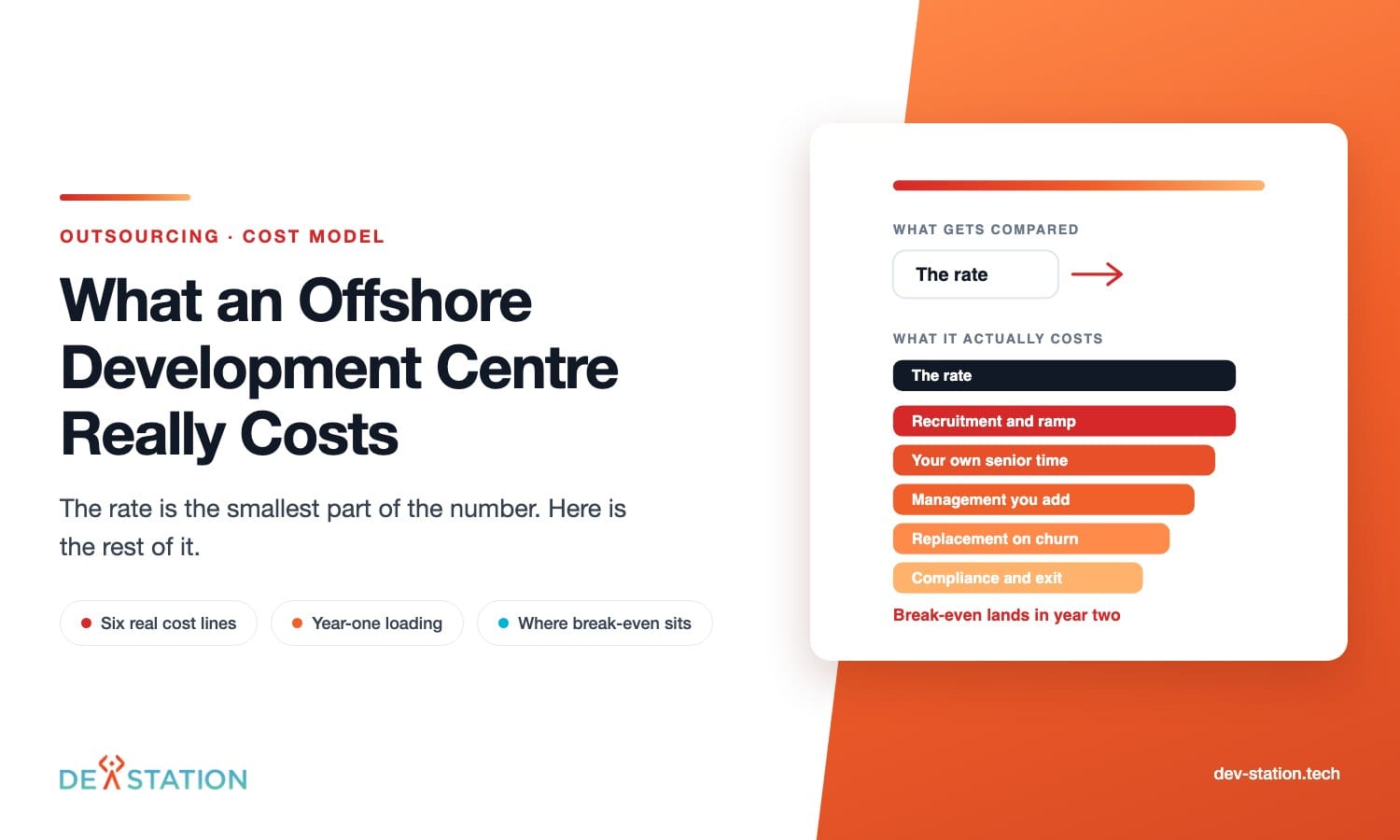
- Four costs sit outside the rate card: recruitment and ramp, the time your own senior people spend teaching, the replacement cost when someone leaves, and the management you add on your side.
- Build the comparison against what the work costs you today, loaded, not against a salary figure you found in a market report.
- An offshore centre rarely pays back inside twelve months. If your planning horizon is shorter than that, buy capacity by the project instead.
- Ask a vendor for the attrition figure before you ask for the rate. It moves the total more than the rate does.
Overview
01
Why the rate card is the wrong place to start
Most offshore comparisons begin with a number per engineer per month. It is the easiest number to get and the least useful one to reason with.
A rate tells you what you pay a supplier. It does not tell you what the arrangement costs your company, because a large part of that cost lands on your own team and never appears on an invoice.
This page is the arithmetic rather than the sales case. It covers what goes into the real figure, which parts only appear in the first year, and where the break-even sits. If you want our version of the service and what it includes, that lives on our offshore development centre page.
One thing worth settling first. An offshore development centre is a permanent engineering site that works only for you, not a project team and not a pool of contractors. If what you need has an end date, most of what follows does not apply.
Components
02
Six things that make up the real cost
Put every one of these in the model, including the ones you cannot price precisely. A rough number in the right place beats a precise number in the wrong one.
The monthly rate
What the supplier invoices per person. Ask what it includes: desk, laptop, payroll, HR, recruitment, management. Two rates that look far apart often include different things.
Recruitment and ramp
The weeks between signing and useful output. Count the seat as paid from the day it is filled and productive from some later date, then write down what you assumed that gap to be.
Your own senior time
Somebody has to explain the product, review the work and answer questions. That person is usually your most expensive engineer, and this is the cost companies forget most reliably.
Replacement when people leave
Every departure restarts recruitment and ramp for that seat. Multiply the ramp cost by the attrition rate and you have a recurring line most models leave out entirely.
Management you add
A centre past roughly ten people needs someone on your side whose job includes it. Either you promote somebody or you hire, and both are real money.
Compliance and exit
Security review, data terms, and the cost of unwinding if it does not work. Cheap to agree at the start and expensive to negotiate at the end.
Year One
03
The costs that only appear in the first year
Three of the six above are front loaded. Treating them as ongoing makes offshore look worse than it is, and ignoring them makes the first year look better than it will be.
| Cost | When it lands | What reduces it |
|---|---|---|
| Recruitment and ramp | Months one to three per seat, and again on every replacement | Hiring in one wave rather than trickling, and having the brief written before hiring starts |
| Handover of product knowledge | Heaviest in the first quarter, never quite zero | Time in the same room early, and writing down what was explained |
| Process friction | First two or three releases | Running one release end to end before changing anything |
| Management overhead | Ongoing, rises with headcount | A lead on the supplier side who joins your planning rather than receiving it |
| Replacement cost | Ongoing, driven by attrition | Retention at the supplier, which is the one number worth asking for early |
Look at the last row for a moment. Attrition is the only line here that compounds, because a team that keeps replacing people never finishes paying the handover cost.
Ask for the retention figure before you ask for the rate. What proportion of engineers have been with the supplier more than two years is the single most predictive number you can get, and it moves the total cost more than a difference of a few percent on the rate ever will.
Comparison
04
Build the comparison against your own loaded cost
The common mistake is comparing an offshore rate to a local salary. Those are not the same kind of number.
A salary is what lands in someone bank account. What an engineer costs your company is that plus employer taxes, pension, benefits, software, recruitment amortised over their tenure, office space where you still have it, and the share of management their existence creates.
Work out that loaded figure for one engineer you already employ. It is tedious, your finance team can usually produce it in an afternoon, and without it every comparison you make is decorative.
Then compare like for like. An offshore rate that includes recruitment, HR, payroll, desk and equipment is closer to your loaded figure than it looks, and the gap is usually narrower than the headline suggests. It is also still a gap.
Break Even
05
Where the break-even actually sits
Offshore engineering is a second year decision dressed up as a first year one.
In year one you pay the rate plus recruitment, ramp, handover and the friction of a process meeting a new team. The saving against your loaded cost is real but a good part of it goes back out through those lines.
In year two the same people are still there, they know the product, and the front loaded costs are behind you. That is when the arithmetic starts to look like the one in the pitch deck.
Which gives a plain test. If you cannot see eighteen months of work for this team, the model is wrong for you and a bounded project is the cheaper answer. If you can, the question moves from whether to who.
Questions
06
Five questions that change the number
Ask these before the commercial conversation, because the answers reshape the model more than any negotiation on rate.
- What proportion of your engineers have been here more than two years? A vague answer is an answer. This drives the replacement line, which is the only one that compounds.
- What exactly is inside the rate? Recruitment, HR, payroll, equipment, office, management. Get the list in writing and compare lists rather than numbers.
- Who interviews and who decides? If you do not interview every candidate you are buying headcount rather than a team, and the ramp cost will be higher than quoted.
- What happens in month one if this goes wrong? Notice period, what you keep, what happens to the code and documentation. Agree it while everyone is optimistic.
- Who owns the code and the tooling built for us? The answer should be you, in the contract, from day one rather than at the end.
If the eventual plan is to own the entity yourself rather than rent the capability, the terms are different again and we covered those on our build, operate and transfer page.
Working With Us
07
How Dev Station prices this
We run offshore centres from Ho Chi Minh City, and we publish what sits inside the monthly figure rather than leaving you to discover it later.
Our position on the arithmetic above is simple. We would rather you built the model properly and decided against us than signed on a rate comparison that falls apart in month four. Where the work has an end date, we say so and quote a project instead.
Our engineers work with overlap into UK GMT and US Eastern and Pacific hours, and we invoice in GBP or USD. Send us the roles you are trying to fill and we will give you a monthly figure with the inclusions listed, so it can go straight into the model you just built.
The service itself, the models and what each phase involves are on our offshore development centre page. If you want engineers without an entity or a centre, the dedicated development teams page covers that arrangement.
FAQ
08
Frequently asked questions
What finance and engineering ask when the model is being built.
What is an offshore development centre?
A permanent engineering site in another country that works only for your company. The people are hired against your roles, follow your engineering standards and stay across releases, which is what separates it from a project team or a pool of contractors.
How long before an offshore development centre pays for itself?
Usually into the second year. The first year carries recruitment, ramp and handover, and those are the costs that make a twelve month comparison misleading in both directions.
What is the difference between an offshore development centre and an offshore R and D centre?
Mostly what the team is pointed at. A development centre extends delivery capacity on a roadmap you already have. An R and D centre is set up to investigate, prototype and prove things, so it is judged on what it learns rather than on what it ships.
Should we compare the rate to a local salary?
No. Compare it to your loaded cost per engineer, which includes employer taxes, benefits, software, recruitment and the management their existence creates. Comparing a rate to a salary overstates the saving.
What size does a first centre need to be?
Ten to twenty people is the usual range where the operation around the team starts to earn its keep. Below that, a dedicated team without the centre around it is normally the cheaper structure.