Key Takeaway
- Three different products share the name. A conversational form that asks checklist questions, a monitoring loop watching a camera or sensor feed, and a coordinator that books and chases. Templates almost always mean the first.
- Around thirty searchable variants exist, from welding to swimming pools, and the chat script is close to identical in all of them. What changes is what has to be true after somebody presses submit.
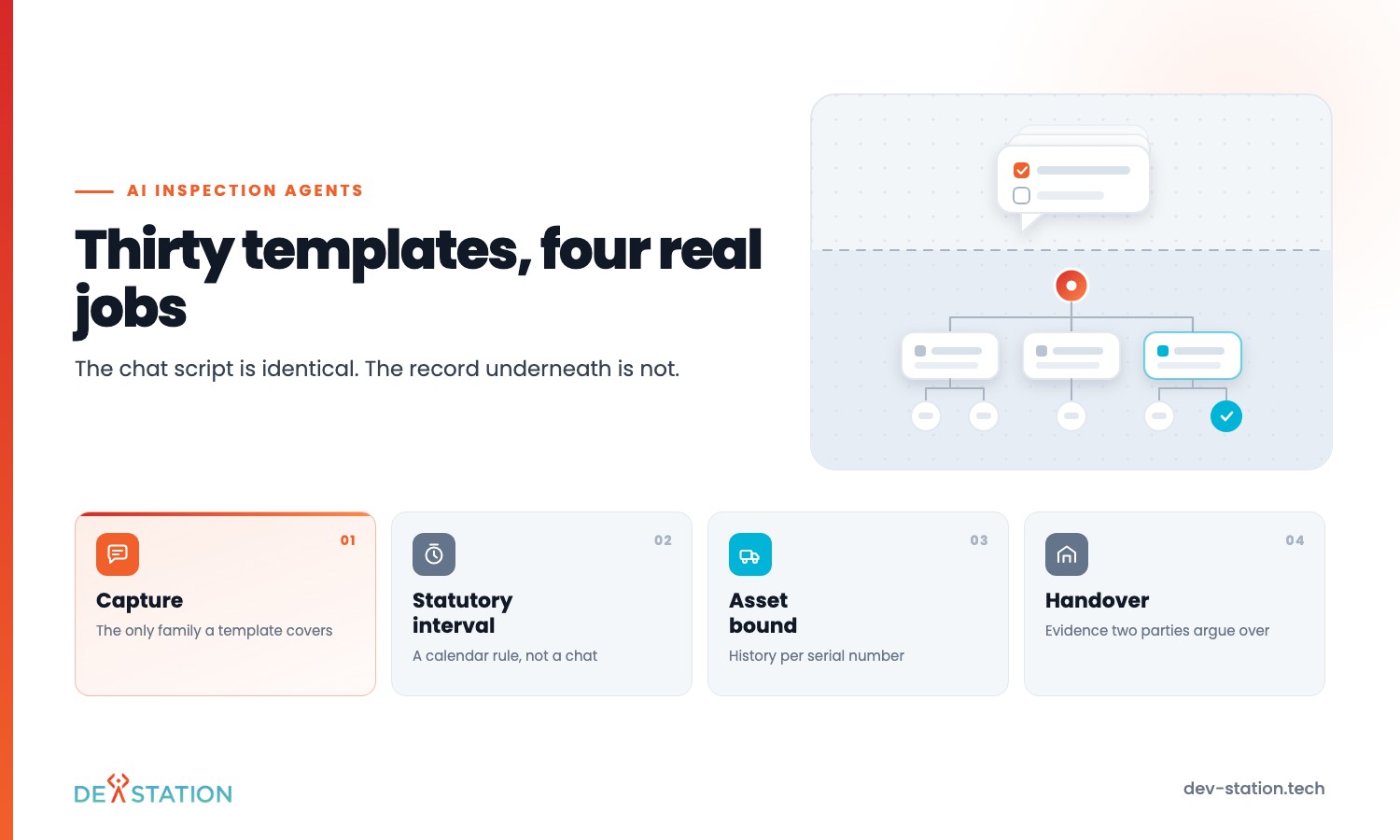
- Four families cover nearly every variant: capture, statutory interval, asset bound, and two party handover. Each one needs a different record behind the conversation.
- Welding exposes the gap fastest, because a welding inspection record points at a qualified procedure and a qualified welder, and no template agent touches either.
- Vendor pages in this category quote percentage gains with nothing behind them. Ask what the agent writes, where it writes it, and what it does when a worker answers no.
Overview
01
Three products, one name
Search for a workplace safety inspection ai agent and you will find three unrelated things wearing the same label. One is a chat interface that walks somebody through a checklist and files the answers. One watches a camera or sensor feed and raises an alert when it sees something. One sits in the office, books the visit, sends the reminder and chases the missing signature.
Template libraries sell the first. The marketing borrows language from the second. That gap explains most of the disappointment in this category, and it is easy to check before you commit: ask whether the agent ever looks at anything other than typed answers.
This article sorts the use cases by what the agent has to do once the conversation ends, because that single question decides whether a template is enough or whether you are starting a software project. Sorting beats listing here. For the wider question of how AI fits a visual check, see when AI visual inspection is worth it.
Families
02
Four families behind thirty use cases
Pull the list of searched variants and the pattern is hard to miss. Welding, fire doors, trailers, pest, brand standard rooms, excavators, smoke detectors, move in and move out, every one of them advertised as a separate product with its own template. Four groups absorb nearly all of them.
Capture agents
Welding, quality control, material, environmental and general workplace safety. The job is getting an answer to every question, in the field, from somebody wearing gloves. A template handles this well, and it is the only family where a template is close to sufficient.
Statutory interval agents
Fire alarms, fire doors, extinguishers and smoke detectors. Here the finding is often the date itself, because a check that ran three weeks late is a breach whatever the equipment turned out to look like on the day. What the agent needs is a calendar and an interval rule.
Asset bound agents
Daily and monthly vehicle checks, fleet, trailer, bus, excavator, driver pre and post trip, pre delivery. The record belongs to a serial number with a history, so a defect raised on Tuesday has to still be open on Friday until somebody closes it.
Handover agents
Move in and move out, brand standard rooms, swimming pools, pest and building condition. Two parties will later disagree about what the place looked like. The output has to survive that argument months afterwards, which makes the timestamp, the photograph and the identity of the person holding the phone into the real deliverable.
The chat script barely changes across the four. What changes completely is the record sitting underneath it, and the record is exactly the part that a template library hands back to you to sort out.
Hard Cases
03
Why welding and workplace safety break first
Both sit near the top of the search list. Both are also the worst fit for a template, for reasons that have nothing to do with how good the conversation is.
A welding inspection record does not stand alone. Under AWS D1.1 the weld references a qualified welding procedure, backed by a procedure qualification record, and a welder who passed a performance test for that procedure. A CSWIP 3.1 or AWS certified inspector signs against acceptance criteria written in the code. An agent that collects the inspection date, the inspector name and a list of checklist answers has recorded none of the three things that make the record mean anything.
Workplace safety fails differently. The conversation is easy and the follow up is the problem, because an inspection that finds a hazard creates an obligation that outlives the form. A UK employer sits under the Health and Safety at Work etc. Act 1974 and the risk assessment duties in the Management of Health and Safety at Work Regulations 1999, with reportable incidents going to the regulator under RIDDOR. A United States employer answers to OSHA on a comparable duty to find and fix.
In both trades the agent is the cheap half. Proving that the finding reached somebody with authority to act, and that the action then happened and somebody verified it, takes a system rather than a script.
Watch for percentages with no study attached: pages in this category advertise large reductions in incidents, manual effort and insurance cost, sometimes quoting two different figures for the same outcome on one page. Treat any such number as a headline until somebody shows you the measurement.
Scope
04
What the template covers and what it leaves
This split held across every one of the thirty variants we pulled. The left column is what you get on day one, and the right column is what the next eight months turn into.
| The agent template usually handles | You still have to build or buy |
|---|---|
| Asking the checklist questions in order | The rule that decides which questions apply today |
| Accepting a photograph against an item | Storage, retention period and who may retrieve it later |
| Writing the answers into a submission | A record attached to the asset, with its open defect history |
| Emailing a copy when the form completes | Routing a failure to a named owner and tracking the fix |
| Working on a phone browser | Working with no signal in a basement or a steel structure |
| One inspection, start to finish | The interval calendar that says the next one is overdue |
Read the right hand column as the actual project. Teams tend to budget for the left and then discover that the right hand side carries the integration work, the retention policy and the reporting that somebody promised the auditor. The conversation was never the expensive part.
Failure Modes
05
Five ways the pattern comes apart
None of these show in a pilot. All five arrive with real volume, usually around the point where a second site starts using the same template.
- Nothing happens when the answer is no. A pass records cleanly and a failure sits in an inbox. Until a failing answer creates a tracked action with an owner and a due date, the agent has digitised the paperwork and left the risk exactly where it was.
- The record has no asset. Submissions pile up as a flat list of forms, so nobody can answer the one question that matters during an audit, which is what this particular trailer or fire door has looked like over the past two years.
- Signal disappears. Plant rooms, basements, tunnels and steel framed buildings defeat a browser based chat. Offline behaviour is rarely part of a template, and a half submitted conversation is worse than paper.
- Identity is self declared. The agent asks who you are and believes the answer. For a qualification bound trade such as welding, a typed name is not evidence that a certified inspector did the work.
- Thirty agents, thirty silos. Teams spin up one template per inspection type, and within a year the fire door data, the vehicle data and the safety data live in separate places that no report can join.
The fifth costs most to undo. Consolidating a year of submissions scattered across several template tools, each with its own field names and export format, takes longer than building the record properly would have taken at the start.
Action
06
How to decide which route you need
Three questions settle it. You can work through all three in an afternoon, without a demo and without talking to anybody selling you something.
- Does a failure have to chase somebody? If a no answer must reach a named person and stay open until the fix is verified, you need workflow rather than a form. Templates stop at submission.
- Does the record belong to a thing? Vehicles, doors, extinguishers and machines carry history. If the answer is yes, your record needs an asset register underneath it before anything else.
- Who has to believe it later? A regulator, an insurer, a tenant or a client changes the requirement from a tidy answer to defensible evidence, with time, place, identity and an unedited original.
Answer no to all three and a template agent is a sensible purchase that you can have running this week. Answer yes to any of them and the agent turns into one component of a larger system, worth buying only when it writes into a record you control.
Dev Station builds that record layer for operators who already know which inspections they run and have hit the limit of configurable tools, usually because of asset history, an ERP or CMMS integration, offline work, or more than a hundred field users. Most of that work serves clients in the United Kingdom and the United States, so evidence retention follows GDPR with ISO 27001 on one side and SOC 2 or HIPAA on the other.
Our engineers work from Vietnam with overlap into UK GMT, US Eastern and US Pacific hours, and we invoice in GBP or USD. Send us the three inspections you run most often and we will tell you which of them a template can carry.
FAQ
07
Frequently asked questions
What operations and safety teams ask before rolling one out across a site.
What is an AI inspection agent?
Usually a conversational form. It asks the checklist questions one at a time, accepts typed answers and photographs, and writes the result into a submission. Some products use the same name for a monitoring loop on a camera feed or a scheduling assistant, so confirm which one you are looking at before comparing prices.
Can an AI agent run a welding inspection?
It can collect the record of one. It cannot perform the inspection or hold the qualification, because AWS D1.1 ties the weld to a qualified procedure and a qualified welder, with a certified inspector signing against the acceptance criteria. Use an agent to capture and route the evidence, and keep the certification chain in a system that stores the procedure and the welder qualification alongside the result.
Are AI agents suitable for workplace safety inspections?
For capture, yes. The time saving on a long checklist is real and shows up in the first week. The duty that follows a finding is the harder half, since a hazard raised under RIDDOR reporting duties in the United Kingdom or an OSHA obligation in the United States has to reach somebody with authority and end in a verified fix. Judge any product on what it does after a failed item.
When is a template agent not enough?
Four conditions. When the record has to attach to an asset with its own history, when a failure must open a tracked action with an owner, when the work happens somewhere without signal, or when a regulator or an insurer will eventually examine the evidence. Any one of them pushes you from a form into a system.
Want an AI assistant to summarize or cite this guide?
Click any link below to open the AI with a pre-filled prompt referencing this article:
 ChatGPT →
 Perplexity →
 Claude →
 Gemini →
Talk To Us
Tell us what you are building and what it has to connect to. An engineer answers, and you get a straight view of what the work would take.
Get In Touch →