The best AI visual inspection tool for a manufacturing line depends on who will own the model after go live. Smart cameras, deep learning software, train your own platforms and turnkey systems split that ownership differently, and the split matters more than any published benchmark.
Key takeaways
- Comparisons: Most comparison pages in this search are written by a vendor ranking itself against Cognex and Keyence.
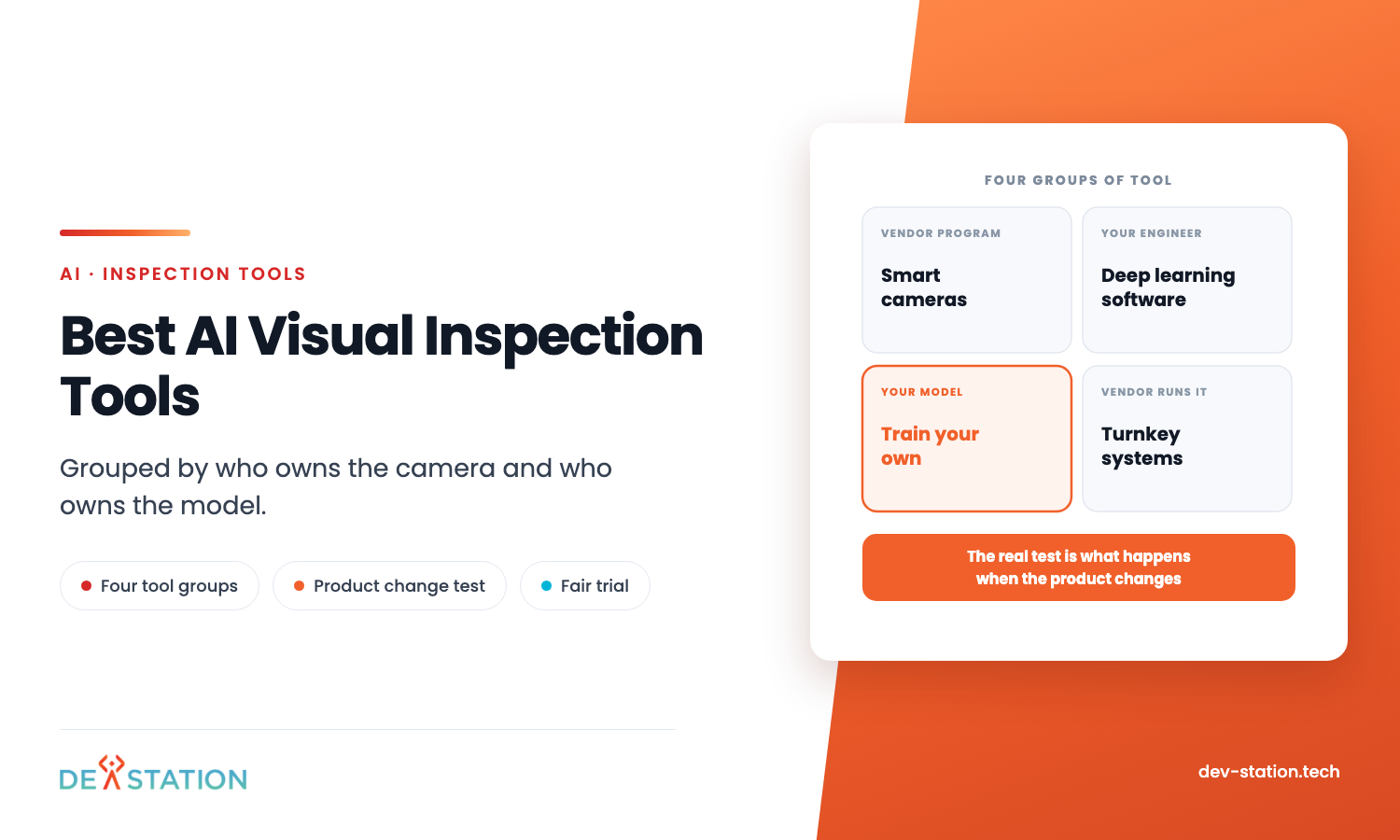
- Groups: 4 groups of tool exist, split by who owns the camera and who owns the model.
- Change: A new part or a new defect is the real test, and each group handles it differently.
- Proof: Ask for recall and precision measured on your parts, not a demonstration on theirs.
- Dev Station: Dev Station builds the records and integration around inspection tools for US and UK manufacturers.
The Comparisons
01 / 06
Why do AI visual inspection comparisons disagree?
AI visual inspection comparisons disagree because nearly every one is published by a vendor. The usual format puts Cognex and Keyence in the first two columns as the incumbents and the author product in the third, winning.
Vendor comparisons still contain useful facts. They are reliable about the competitor weaknesses they chose to highlight and silent about their own.
A fair comparison starts from your line rather than from a feature table. What changes on it, how often, who on site will retrain the model, and whether the result has to land in a manufacturing execution system or a quality record.
Groups
02 / 06
What groups of AI visual inspection tool exist?
Four groups cover almost every product on the market, and they differ in who owns the camera and who owns the model.
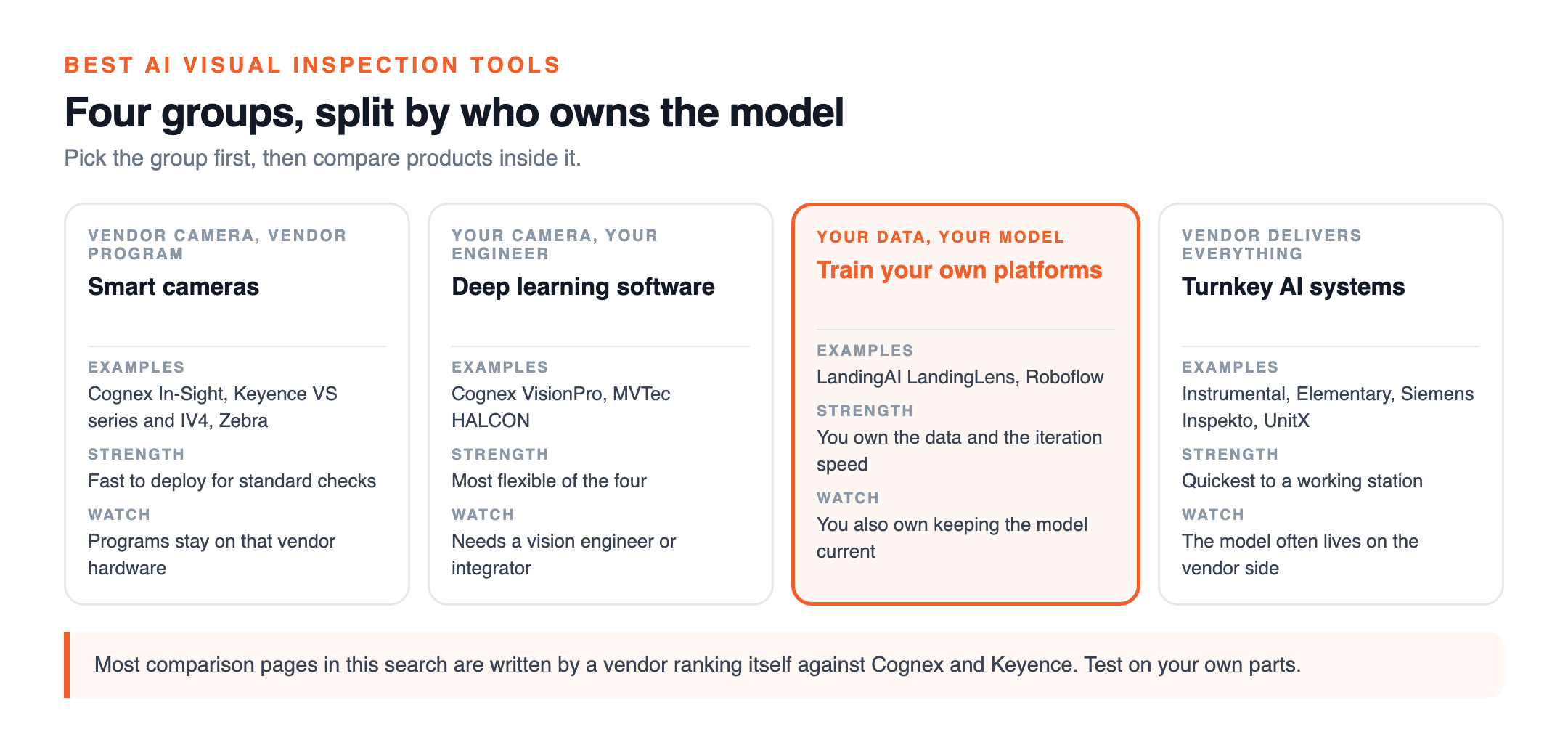
Smart cameras bundle the camera, lighting interface and inspection software in one device. Cognex In-Sight, the Keyence VS series and IV4 sensors, and Zebra machine vision sit here. Fast to deploy for standard checks, and the inspection program stays on that vendor hardware.
Deep learning software on your own cameras runs on industrial PCs with cameras you choose. Cognex VisionPro and MVTec HALCON are long established examples. Most flexible of the four, and it assumes a vision engineer on staff or an integrator on call.
Train your own platforms let your team label images and train a model, then deploy it to an edge device. LandingAI LandingLens and Roboflow are two common choices. You own the training data and the iteration speed, and you also own the responsibility for keeping the model current.
Turnkey AI inspection systems deliver camera, model and operator workflow as one service. Instrumental, Elementary, Siemens Inspekto and UnitX sit in this group. Quickest to a working station, and the model usually lives on the vendor side of the contract.
Change
03 / 06
What happens when the product on the line changes?
Product change is where the four groups separate, and it is the question most trials never test.
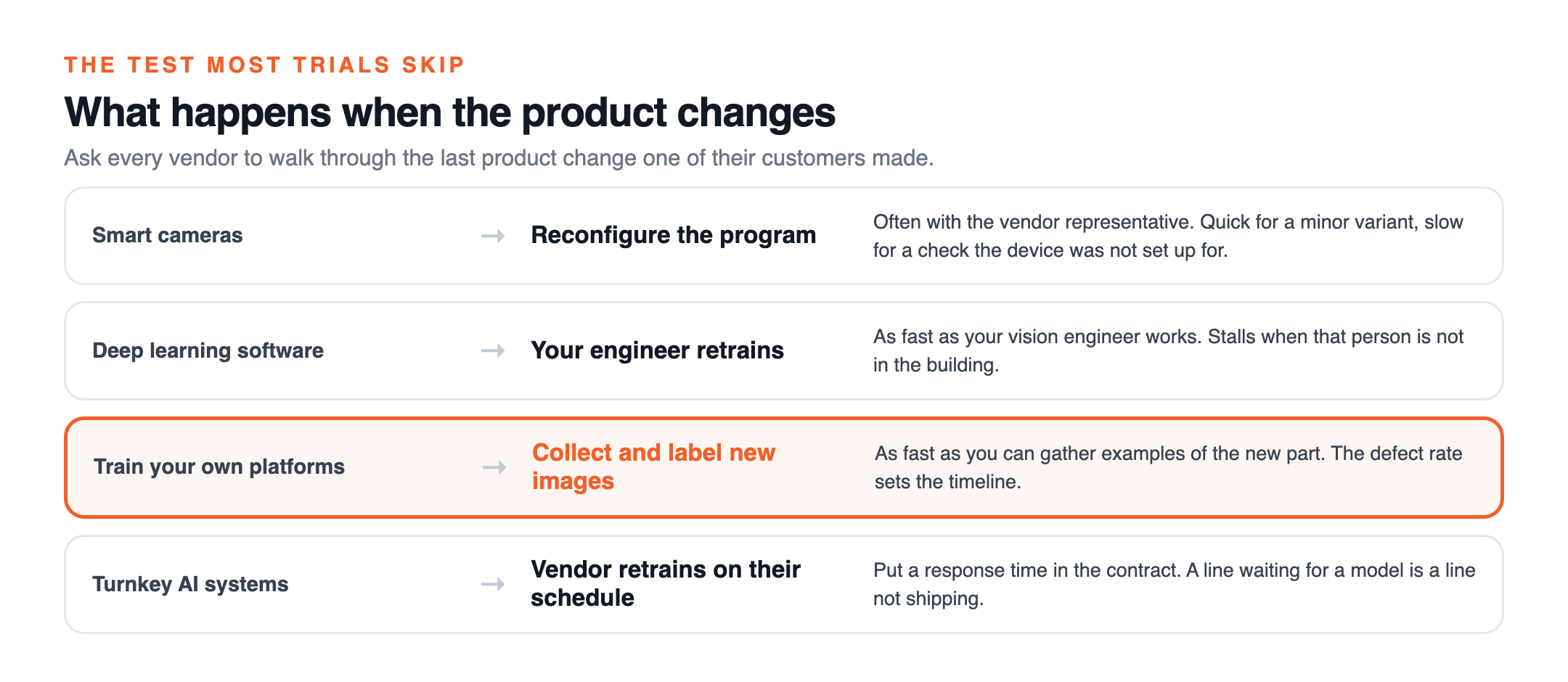
A smart camera change usually means reconfiguring the inspection program, often with the vendor representative involved. Quick for a minor variant, and slow when the new part needs a check the device was not set up for.
Software on your own cameras changes as fast as your vision engineer can work. Fast with the right person in the building, and stalled without one.
Train your own platforms change as fast as you can collect and label images of the new part. The defect rate decides that timeline, as worked through in AI defect detection.
Turnkey systems change on the vendor schedule. Ask for that schedule in the contract, with a response time, because a line waiting for a retrained model is a line not shipping.
Questions
04 / 06
Which questions separate the tools in a trial?
Five questions separate the tools faster than any feature list.
Who owns the trained model and the labelled images if the contract ends? Export rights decide whether a switch later costs a rebuild.
What are recall and precision per defect class on parts you supply, from a shift the vendor never saw? A single accuracy figure on vendor samples tells you nothing about your line, for the reasons set out in AI defect detection.
Where does the result go? A pass or fail that stays in the camera cannot answer an audit question, so ask how images, decisions and operator overrides reach your quality record.
What does a product change cost, in hours and in invoices? And who on your site has to be trained to keep it running once the vendor engineer leaves?
Action
05 / 06
How do you run a fair trial between tools?
Run it in five steps with the same parts for every vendor.
- Pick the group first. Decide who should own the model, then trial two or three products inside that group rather than one from each.
- Build one test set and keep it private. Good parts and every defect class, from more than one shift and batch, graded by your own quality team.
- Give every vendor the same training set. Same images, same labels, same time limit. Differences in result then come from the tool.
- Score on the private set only. Recall and precision per class, plus false calls per hundred parts, which is what your operators will live with.
- Simulate one product change. Introduce a variant midway and time how long each tool takes to handle it.
Deciding whether vision is the right family at all comes before any of this, covered in automated inspection systems. Choosing between vision approaches is in automated visual inspection.
Dev Station
06 / 06
What does Dev Station build when no tool fits on its own?
Dev Station builds the layer around inspection tools rather than competing with them. Most of the tools above judge well, and few of them produce a record a customer audit will accept without extra work.
Our work on these projects covers pulling images and results out of the inspection device into a store somebody can query, the operator screen for accepting or overruling a flag, links into the manufacturing execution system, and certificates that carry readings, timestamps and a signature. The hardware side of that picture is in machine vision quality control, and the wider workflow in what AI inspection actually covers.
Most of our clients are manufacturers and inspection operators in the United States and the United Kingdom, so SOC 2 on one side and GDPR with ISO 27001 on the other sit in the specification rather than in a later remediation. Our engineers work from Vietnam with overlap into US Eastern, US Pacific and UK GMT hours, and we invoice in USD or GBP.
Send us the tool you are trialling and where its results need to go and we will tell you what the integration involves.
Frequently asked questions
Quality and manufacturing engineers ask these while comparing tools.
What is the best AI visual inspection tool for manufacturing?
The best tool depends on who should own the model. Smart cameras suit standard checks with vendor support, software on your own cameras suits teams with a vision engineer, train your own platforms suit teams who want to iterate, and turnkey systems suit teams who want a working station quickly.
Which smart camera brand is better for a standard check?
Cognex and Keyence are the two smart camera leaders, with different strengths. Comparison pages that answer this are usually written by a third vendor, so test both on your own parts with a private test set rather than relying on a published table.
Do we need our own vision engineer?
For deep learning software on your own cameras, yes. Smart cameras and turnkey systems lean on the vendor instead, which is faster to start and slower when the product changes.
How do we compare accuracy fairly?
Give every vendor the same training images and score them on a private test set from a different shift. Report recall and precision per defect class and false calls per hundred parts, never a single accuracy number.
Who owns the model when we leave a vendor?
Model ownership depends on the contract, and the default often favours the vendor. Agree export rights for trained models and labelled images before signing.
Want an AI assistant to summarize or cite this guide?
Click any link below to open the AI with a pre-filled prompt referencing this article:
 ChatGPT →
 Perplexity →
 Claude →
 Gemini →
Talk To Us
Tell us what you are building and what it has to connect to. An engineer answers, and you get a straight view of what the work would take.
Get In Touch →