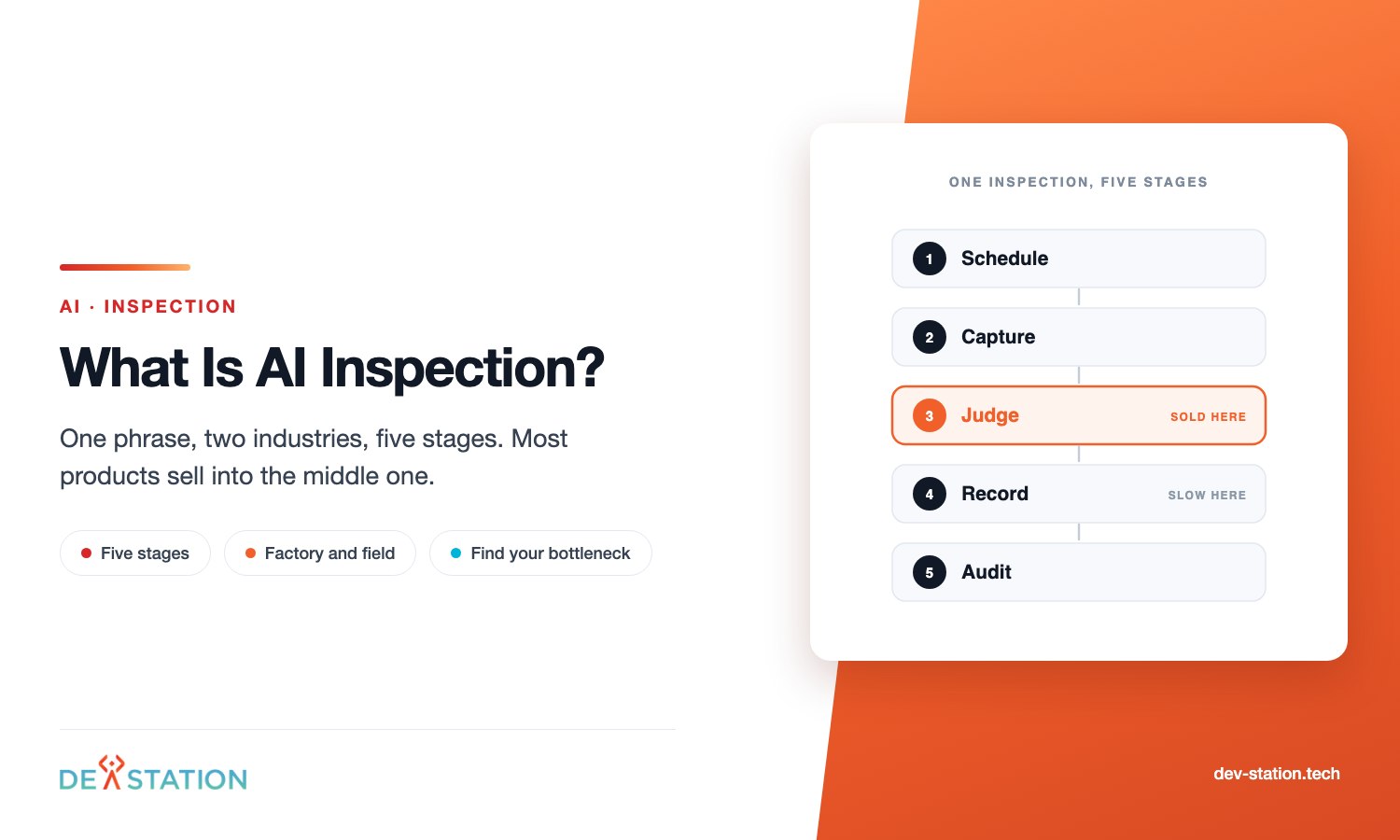
AI inspection is the use of machine learning inside an inspection workflow, and it means two different purchases: a camera station judging parts on a production line, or software that reads photographs and forms from field inspections.
Key takeaways
- Two purchases: The phrase covers a camera station on a production line and a software layer over field inspection work.
- Five stages: Every inspection runs in 5 stages, and most products sell into stage 3, the judgement.
- Slow stages: The hours are usually lost in stage 4, record, and stage 5, act and audit.
- Signature: A model produces a suggestion and a record, and a named person still signs.
- Dev Station: Dev Station builds inspection software across all 5 stages, starting with the slow ones.
The Term
01
What does AI inspection mean in manufacturing and in field work?
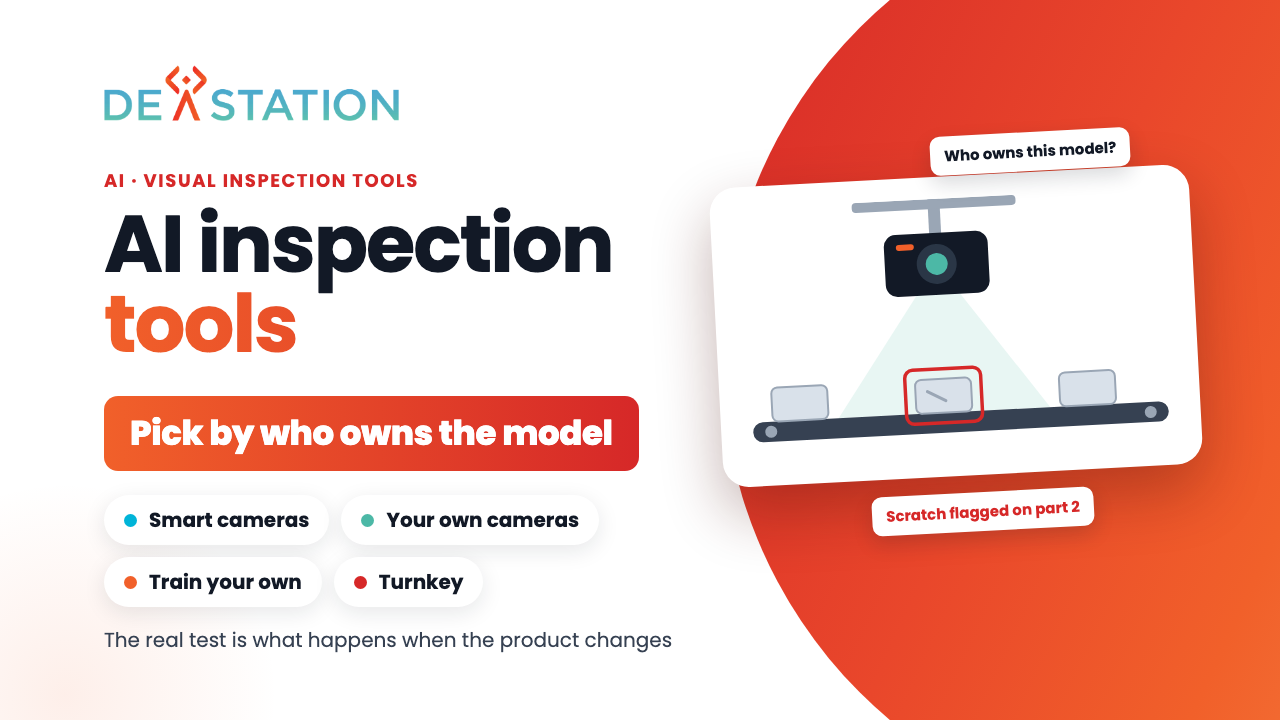
In manufacturing, AI inspection means a camera and a trained model judging parts on a line, while in field inspection it means software that reads photographs and forms.
Type AI inspection into a search box and the results split cleanly down the middle.
One half comes from factory automation. A camera, a lighting rig, a model trained on good and bad parts, mounted over a conveyor and deciding at line speed. The other half comes from field inspection software, where an engineer walks an asset with a phone, fills in a form, attaches photographs, and a model reads what was captured and flags what looks wrong.
The two share the word and very little else. One is capital equipment with a fixed field of view and a part that arrives in the same position every time, and the other is software over unpredictable photographs taken in poor light by somebody who wants to get to the next job.
Working out which one you mean is the first useful step. Enquiries arrive here for both, and the second question is never the same.
Two related phrases cause their own confusion. An AI inspector is marketing shorthand for the model, not for a role that replaces anybody. And in manufacturing, online inspection has meant in-line inspection since long before the internet, so a search for it returns conveyor belts rather than remote video calls.
The Workflow
02
What are the five stages of an inspection?
The five stages are schedule and dispatch, capture, judge, record, and act and audit.
Factory or field, regulated or internal, the sequence is the same. Mapping your own programme onto it takes about ten minutes and it changes what you shop for.
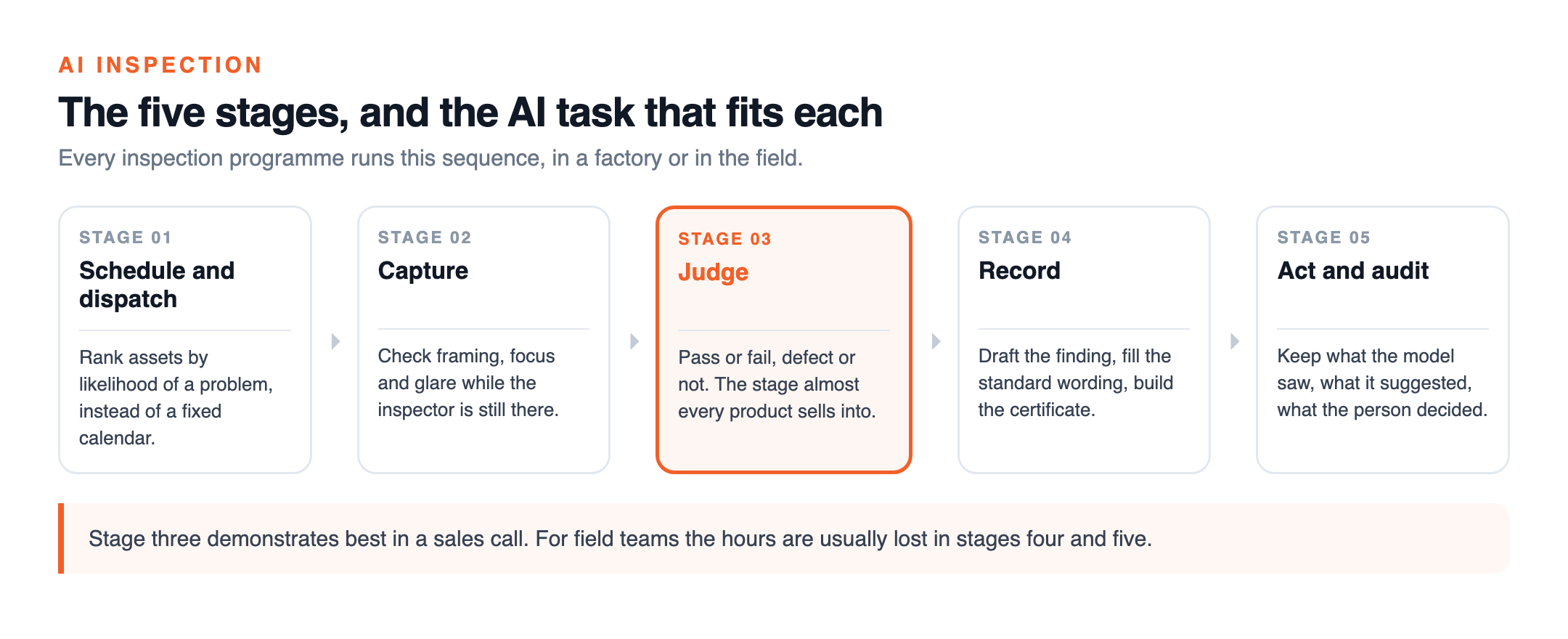
Schedule and dispatch decides what gets inspected, when, and by whom. This is an optimisation problem rather than a vision one, and the useful version of AI here predicts which assets are worth a visit instead of running a fixed calendar.
Capture is the camera, the sensor, the form. In a factory the capture conditions are built and controlled. In the field they are whatever the weather allows, which is why field capture needs guidance built into the app rather than a better model afterwards.
Judge is the stage everybody means by AI inspection. Pass or fail, defect or not, within tolerance or outside it.
Record turns the judgement into a document somebody can act on: a certificate, a report, a work order, an entry in an asset history. Act and audit is what happens next, and whether you can still explain the decision a year later when somebody asks.
The Mismatch
03
Which inspection stage gets sold, and which one is slow?
Vendors sell into the judge stage, while most of the time goes into record and into act and audit.
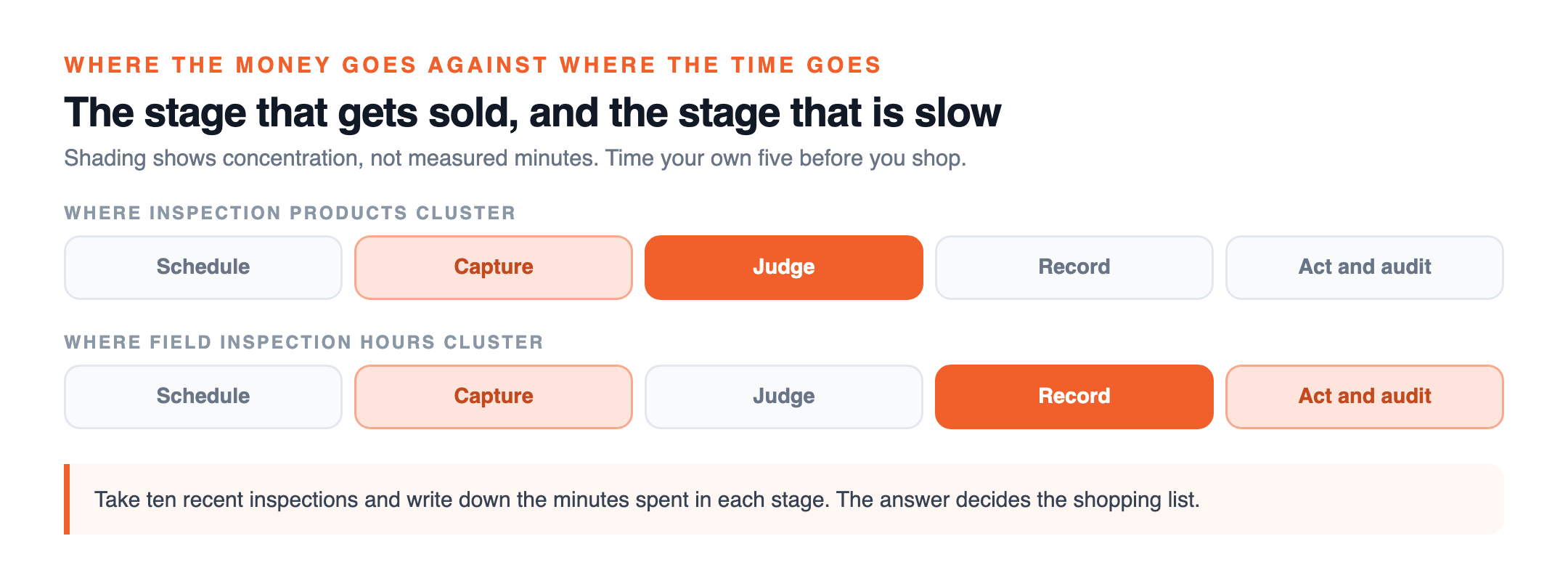
Stage three sells well because it demonstrates well. A model finding a crack in a photograph is a good thirty seconds of a sales call, and the other four stages are spreadsheets and PDFs.
Field inspection teams usually lose their time somewhere else. The site visit takes as long as it takes, and the hours disappear afterwards into writing up, chasing a missing photograph, formatting a certificate, and sending it to somebody who needs it before Friday.
On a digital testing platform we built for work at height anchor systems, the reporting cycle came down by 70 percent. The cause was automated certificate generation with the readings, timestamps and GPS already attached, and no model judged anything. The detail is in the digital testing platform case study.
Time the stages before you shop: take ten recent inspections and write down the minutes spent in each of the five. Teams who do this often find that the judgement they were about to automate takes four minutes, and the write-up takes fifty.
By Stage
04
What does the AI actually do at each stage?
Each stage is a different technical problem with a different data requirement. Treating them as one project is how budgets get set wrong.
Schedule: ranking, not seeing
Needs inspection history and failure outcomes, not images. Works when you already hold a few years of records, and fails when the only history is in paper folders.
Capture: guiding the human
Checks framing, focus, glare and whether the required shot is present, while the inspector is still standing there. Cheap to build and it raises the quality of everything downstream.
Judge: the labelled set
Needs examples of every condition you want flagged, including the rare ones. This is the stage with the long data collection tail, covered in AI defect detection.
Record: text, not vision
Drafting findings, filling the standard wording, assembling the certificate. Language models are good at this and the risk is low because a person reads it before it leaves.
Audit: the decision log
Not a model at all. It is the record of what the model saw, what it suggested, and what the inspector decided, written as the work happens rather than reconstructed later.
The pattern across these five is consistent. Capture and record pay back quickly and need little data, judgement pays back slowly and needs a lot, and scheduling needs a history most teams have not digitised yet.
Limits
05
Can an AI inspector sign an inspection report?
No. In regulated inspection the signature carries liability, and liability needs a competent person behind it. Under the UK lifting equipment rules a thorough examination is carried out by a competent person, and a model is not one. The same logic runs through pressure systems, electrical certification and structural sign off.
The liability rule shapes the realistic ambition. The model narrows what a person has to look at and writes down what it found, and the person decides and signs. Where the model is wrong, the record shows what it was shown and who overruled it, which is the only version an auditor can work with.
Two other limits are worth saying plainly. A model trained on one site rarely transfers to another without new examples, because the lighting, the equipment, the shift patterns and the local habits all differ. And a model that stops being retrained gets quietly worse as the asset base changes, which is the failure mode behind most abandoned pilots.
Action
06
How do you find your own slow stage?
Finding the slow stage takes a week and no budget.
- Write down your five stages as they run today. Who does what, in what tool, and what gets handed over between them. Most teams find a stage that exists only as an email.
- Time ten real inspections per stage. Minutes, from the same ten jobs. Where there is an argument about the number, that stage is the one to measure properly.
- Count what you could train on. How many labelled examples of each condition you already hold, in a form a machine can read. This usually decides whether stage three is a project this year or next.
- Pick the slowest stage, not the most interesting one. If the answer is the write up, the shopping list is report automation rather than a vision model.
- Check readiness before committing. Data, ownership, integration and the retraining question are set out in the AI readiness assessment.
Where to go next depends on which half of the term you landed in. For the factory version, start with automated visual inspection and the component view in machine vision quality control. For the field version, the practical route is digitising field inspection forms and then offline first inspection apps, because connectivity breaks more pilots than accuracy does.
Dev Station
07
How does Dev Station build across the five stages?
Most of what we are asked for starts as a request for stage three and turns out to be a stage four and five problem. The inspection happens fine, and the evidence takes three days to turn into something a client will accept.
Dev Station builds inspection and field data systems where the record is the deliverable, so the certificate, the readings, the photographs and the audit trail come out of the work rather than out of an evening afterwards. Bluetooth capture from torque and pull testers, offline operation on sites with no signal, barcode and asset lookup, and automated PDF certification are the parts we have built most often, across lifting equipment, manufacturing QC and vehicle inspection.
Much of our work is for operators in the United States and the United Kingdom, so SOC 2 on one side and GDPR with ISO 27001 on the other sit in the specification rather than in a later remediation. Our engineers work from Vietnam with overlap into US Eastern, US Pacific and UK GMT hours, and we invoice in USD or GBP.
Send us the five stages as they run today and we will tell you which one is worth automating first. The build side sits in AI and ML development.
FAQ
08
Frequently asked questions
Buyers ask these questions most often when they first scope AI inspection.
What is AI inspection?
The use of machine learning inside an inspection workflow, which in practice means one of two different things. In manufacturing it is a camera and a trained model judging parts on a line, and in field inspection it is software that reads photographs and forms captured by an inspector and flags what needs attention.
Does AI replace the inspector?
No, and in regulated work it cannot. Certification regimes require a named competent person to sign, so the model narrows what has to be looked at and records what it found, and the decision stays with the inspector.
What does online inspection mean?
In manufacturing it means in-line inspection, carried out on the production line while parts are moving, as opposed to offline inspection in a separate lab or station. Inspecting something over the internet is a separate thing, usually called remote inspection.
Which stage should we automate first?
The slowest one, which for field teams is usually reporting rather than judgement. Time ten real inspections across all five stages before deciding, because the stage that demonstrates best in a sales call is rarely the stage costing you the most hours.
How much data do we need to start?
Capture guidance and report drafting need almost none. A judgement model needs labelled examples of every condition you want flagged, including rare ones, and collecting the rare cases is what sets the timeline.
Want an AI assistant to summarize or cite this guide?
Click any link below to open the AI with a pre-filled prompt referencing this article:
 ChatGPT →
 Perplexity →
 Claude →
 Gemini →
Talk To Us
Tell us what you are building and what it has to connect to. An engineer answers, and you get a straight view of what the work would take.
Get In Touch →