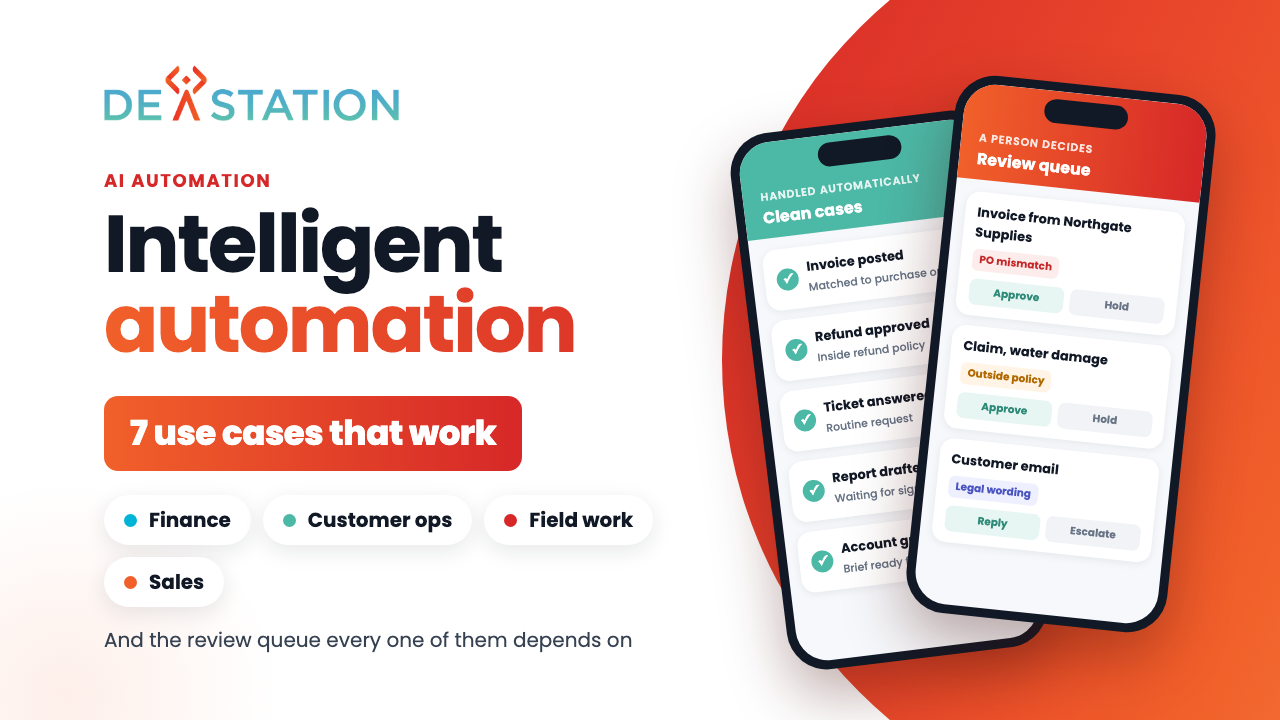
Intelligent automation use cases share one shape: software reads something messy, checks it against a system of record, makes a bounded decision, and sends the doubtful cases to a person. Invoice capture, claims intake, email triage and inspection reporting all follow that pattern.
Key takeaways
- Shape: Every working example reads, checks, decides and routes doubtful cases to a named person.
- Examples: 7 examples below cover finance, customer operations, field work and sales.
- Review queue: The screen where a person resolves exceptions is the product, not an afterthought.
- Proof: Time minutes per case before and after, on the same week of real work.
- Dev Station: Dev Station builds intelligent automation into inspection and field data systems for US and UK operators.
The Shape
01 / 07
What makes an automation example intelligent?
An automation example is intelligent when part of it involves judgement on input that varies. Robotic process automation moves data along a fixed path between screens, and intelligent automation adds a step that reads, classifies or decides before that path runs.

Most published lists of examples skip the fork at the end. Clean cases flow through automatically and doubtful ones go to a person, and the share that goes to a person decides whether the project pays back.
Choosing which processes survive that test is a separate question, set out in AI business process automation. The examples below are processes that usually pass it.
Finance
02 / 07
Which intelligent automation examples work in finance?
Accounts payable invoice capture is the most common working example in finance. Invoices arrive as PDFs and scans in dozens of layouts, which is exactly where fixed templates break.
Example 1, invoice capture and matching. A model reads supplier, amount, date and purchase order number from each invoice. A rule checks those fields against the purchase order and the goods receipt in the finance system. Matched invoices post, and mismatches go to a clerk with the conflicting fields highlighted.
Example 2, refund and credit note handling. A model reads the customer request and the attached evidence, and a rule checks the original transaction and the refund policy. Requests inside policy are approved and paid, and anything outside it goes to a person with the reason attached.
Both examples work for the same reason. The decision is bounded by a document that already exists, so a wrong extraction gets caught by the match rather than paid.
Customer Operations
03 / 07
Which examples work in customer operations?
Customer operations examples work when the volume is high and the input is mostly text. Three appear in almost every serious programme.
Example 3, claims intake. A model reads the claim form, photographs and attached reports, then classifies the claim type and checks policy cover. Simple claims inside cover move to settlement, and complex or suspicious ones go to an adjuster with a summary already written.
Example 4, onboarding and identity document checks. A model extracts fields from identity and proof of address documents, and a rule checks them against the application and the screening lists. Clean applications proceed and mismatches go to a compliance officer.
Example 5, email and ticket triage. A model classifies each incoming message by intent and urgency and drafts a first reply. Routine requests are answered or routed automatically, and anything angry, legal or unusual goes straight to a person.
Field Operations
04 / 07
Which examples work in field and inspection work?
Field work examples tend to sit after the site visit rather than during it. The inspection happens at human speed, and the hours disappear afterwards into writing up and certifying.
Example 6, inspection reporting and certification. Readings arrive from connected test devices with timestamps and GPS, photographs are attached to the right step, and a draft report and certificate are assembled for the engineer to check and sign. On a digital testing platform Dev Station built for work at height anchor systems, the reporting cycle came down by 70 percent, as described in the digital testing platform case study.
The intelligent part in that example is small. Most of the gain came from capturing data in a form a machine could assemble, with the engineer still signing every certificate.
The same pattern runs through most inspection programmes, which is the argument made in what AI inspection actually covers.
Sales
05 / 07
Which examples work in sales and account research?
Sales examples work when the research question is narrow and the answer has to be checkable. Open ended research produces long documents nobody acts on.
Example 7, account research that ends in a grade. Dev Station built Sales OS after our own team found itself spending about forty minutes an account answering one question by hand. The engine crawls the prospect site, enriches the record, verifies UK companies against Companies House, and returns a brief that ends in a grade from A+ down to D.
The grade breaks down into six axes, so a person reviewing a surprising result can see which axis pulled it there. The build is described in the Sales OS case study and the product in Sales OS account research.
Choosing
06 / 07
How do you pick the first use case to build?
Pick the example where a system of record already exists to check against. Seven examples side by side show the pattern.

- Find the record the decision is checked against. Purchase order, policy, application, test standard. No record usually means no bounded decision.
- Count a week of real cases. How many arrive, how many are clean, how many are exceptions, and how long a person spends on each kind.
- Design the review queue before the model. Who sees the doubtful case, what they see, and what one click does. This screen decides adoption.
- Decide what gets recorded. Input, model output, human decision and the name behind it, as covered in the AI governance framework.
- Measure the same week again after launch. Minutes per case and exception share, against the baseline from step two.
Readiness questions such as data access and ownership sit before all of this, in the AI readiness assessment. Choosing who builds it is covered in intelligent automation companies.
Dev Station
07 / 07
What does Dev Station build in intelligent automation?
Dev Station builds the integration and the review layer: connecting the automation to the system that holds the record, the screen where a person resolves an exception, and the audit trail that shows what was automated and who decided the rest.
Two of the seven examples above are our own work, one for a client and one for ourselves. Both were judged on minutes saved per case, measured against a baseline taken before the build started.
Most of our clients are operators in the United States and the United Kingdom, so SOC 2 on one side and GDPR with ISO 27001 on the other sit in the specification rather than in a later remediation. Our engineers work from Vietnam with overlap into US Eastern, US Pacific and UK GMT hours, and we invoice in USD or GBP.
Send us one process and a week of its cases and we will tell you which part is automatable and what the review queue needs. The build side sits in AI and ML development.
Frequently asked questions
Operations teams building an internal case for automation ask these first.
What is an example of intelligent automation?
Accounts payable invoice capture is the standard example. A model reads each invoice, a rule checks it against the purchase order, matched invoices post automatically and mismatches go to a clerk with the conflict highlighted.
How is intelligent automation different from RPA?
Robotic process automation follows a fixed path and breaks when the input varies. Intelligent automation adds a step that reads, classifies or decides on varied input before the fixed path runs.
Which use case should we start with?
Start where a system of record already exists to check the decision against, such as purchase orders or a policy schedule. A bounded decision with a record behind it is easier to automate safely and easier to measure.
How do we prove an automation worked?
Count a week of real cases before the build, with minutes per case and the share of exceptions. Repeat the same count after launch, on similar volume, and compare the two.
Does intelligent automation remove people from the process?
Rarely, and the examples that work do not try to. People move from handling every case to resolving the doubtful ones, which is why the review screen matters as much as the model.
Want an AI assistant to summarize or cite this guide?
Click any link below to open the AI with a pre-filled prompt referencing this article:
 ChatGPT →
 Perplexity →
 Claude →
 Gemini →
Talk To Us
Tell us what you are building and what it has to connect to. An engineer answers, and you get a straight view of what the work would take.
Get In Touch →