Choosing an intelligent automation company means choosing twice, because the software platform and the team that implements it are separate purchases. Nearly every selection guide online is published by one of the two and quietly answers for the other.
Key takeaways
- Two purchases: Buying the software and buying the delivery team are separate decisions with separate risks.
- Bias: Most selection checklists online are written by a seller on one side of that split.
- Label: Ask what the intelligent part does, since some platforms supply a container and leave the model to you.
- Shortlist: Score suppliers on 6 things and weight the demonstration least.
- Dev Station: Dev Station builds the integration and record layer for operators in the United States and the United Kingdom.
The Split
01 / 06
What are you actually buying from an intelligent automation company?
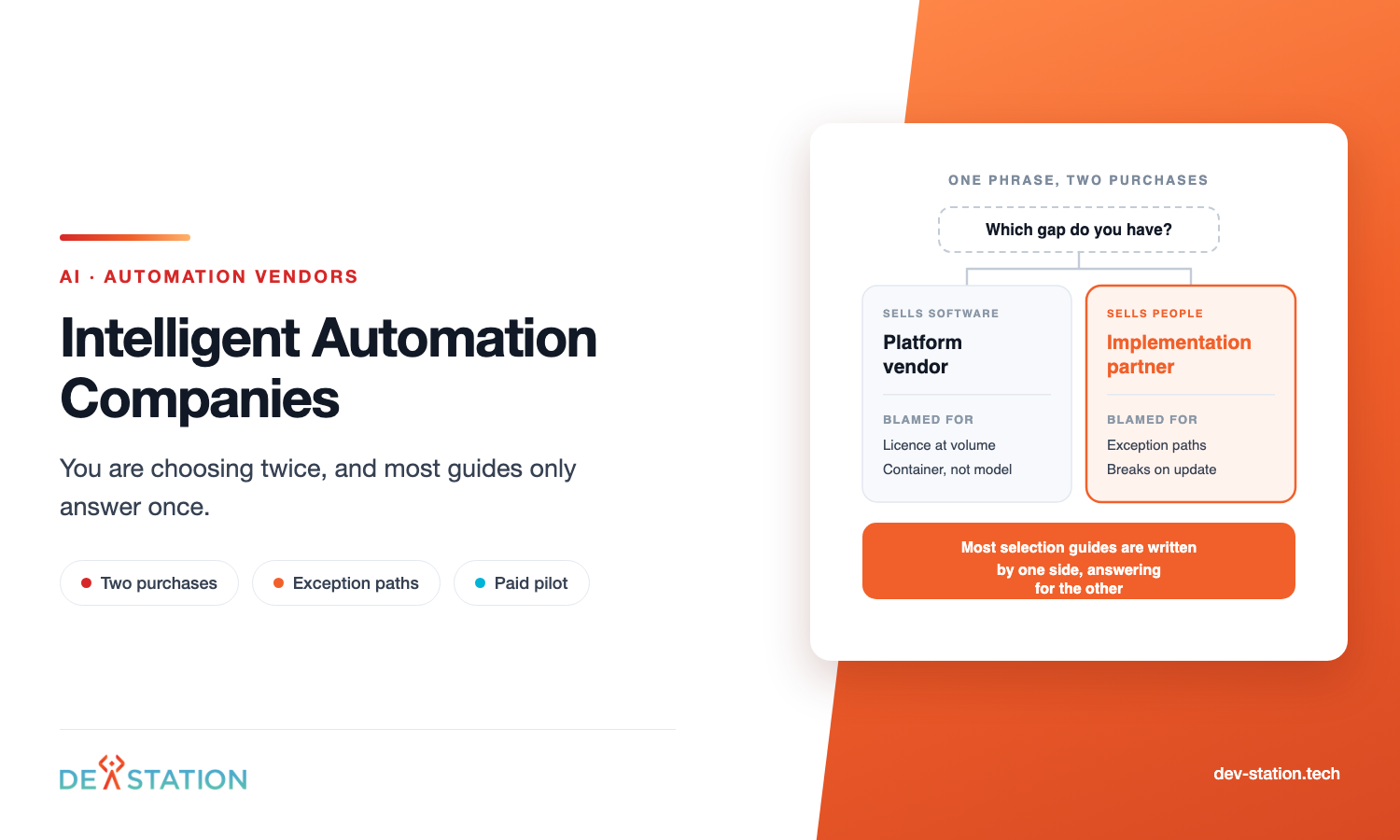
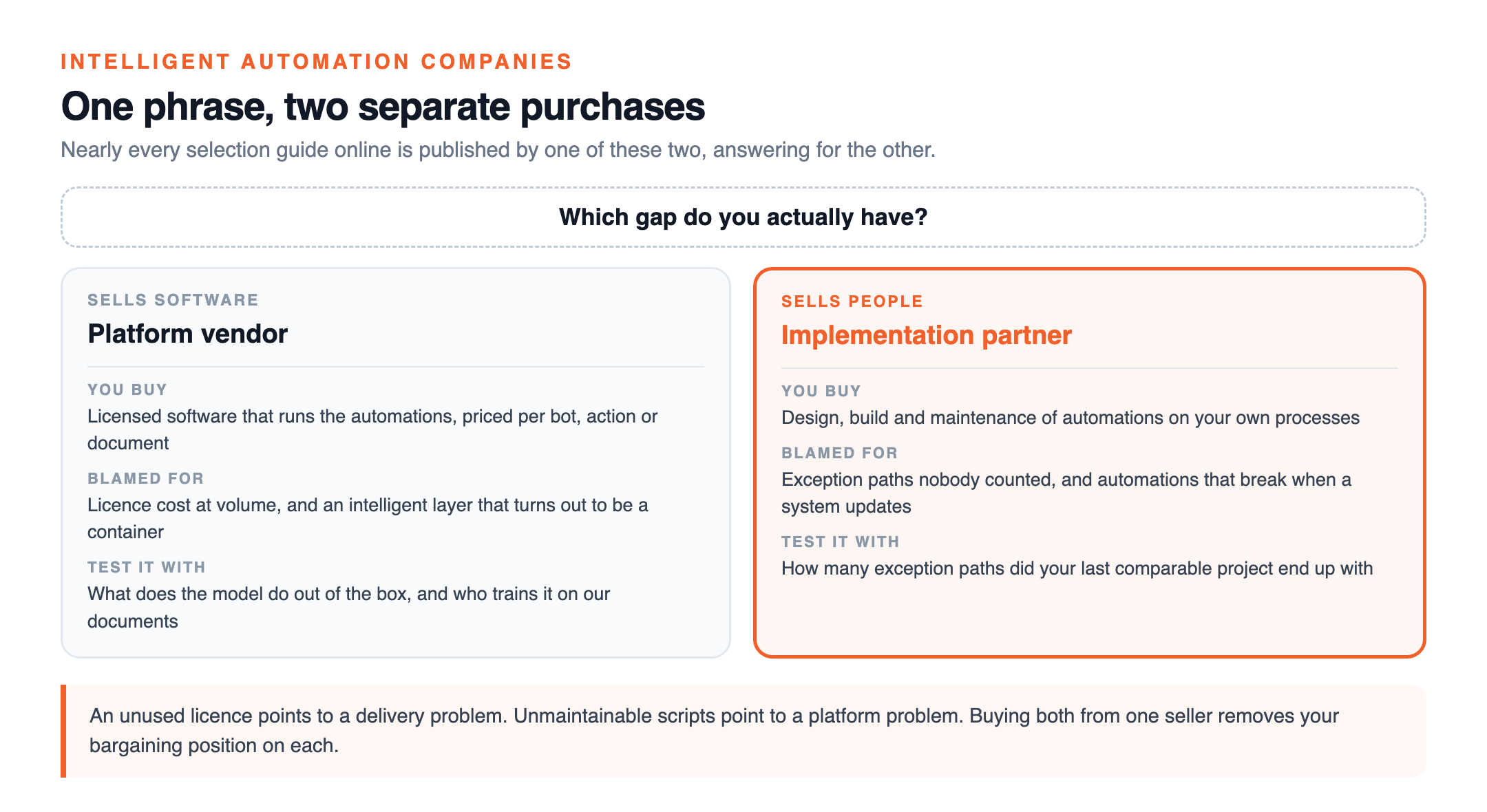
Two different things travel under one phrase. A platform vendor sells licensed software that runs automations, and a services partner sells the people who design, build and maintain them on your processes.
Search results blur the two, because both sides publish selection guides. A platform vendor writing about how to choose a partner, and a partner writing about how to choose a platform, each steer towards a decision they do not have to live with.
Deciding which gap you have comes first. A team with a licensed platform sitting unused has a delivery problem, and a team automating spreadsheets with scripts that nobody can maintain has a platform problem.
Claims
02 / 06
How do you test whether the intelligent part is real?
Ask what happens to a document the system has never seen before. Robotic process automation moves data between screens along a fixed path, and that path breaks the moment the input varies.
Intelligent automation is supposed to add judgement on top: reading an unstructured invoice, classifying an email, deciding which exception a human needs to see. A recurring criticism inside the industry is that several platforms deliver a hosting container and leave you to supply the model, which is a materially different purchase from one that ships working document understanding.
Three questions separate the two quickly. What exactly does the model do out of the box, who trains it on our documents, and what does the licence cost once volumes rise. A supplier who answers the first question with a partner name is reselling somebody else.
Exceptions
03 / 06
Why do automation projects stall after the first process?
Exceptions stall them. A demonstration runs the clean path, and the clean path is the small part of any real process.
Invoices arrive as photographs of printouts. A supplier changes their reference format. A customer emails an amendment after approval. Each case needs a decision about whether the automation handles it, queues it for a person, or stops.
Scoping that work before signing is the single most useful thing a buyer can do. Ask the supplier to price exception handling as its own line, and ask how many exception paths their last comparable project ended up with.
Choosing which processes survive this test at all is a separate question, set out in AI business process automation.
Criteria
04 / 06
What should the shortlist be scored on?
Score suppliers on six things, and give the demonstration the least weight of the six.
Evidence on your process
A paid pilot on one of your real processes, with your real documents. A demonstration on sample data proves the software runs, nothing more.
Exception handling priced
A separate line in the quote, with a count of exception paths from a comparable job. Suppliers who have delivered know this number.
Who maintains it
Named people, a response time, and what happens when the underlying system updates. Automations break when something upstream changes.
Access and governance
An automation holds credentials into finance or operations systems. Ask how permissions are scoped and what the audit trail records.
What you own at the end
Source, configuration, documentation and the right to hire someone else. Ask this before signing rather than during a dispute.
Licence cost at volume
Per bot, per action or per document pricing behaves very differently at ten times the volume. Model it at your year three numbers.
Action
05 / 06
How do you run the selection without a long RFP?
Run it in four steps over about six weeks.
- Write down one process end to end, exceptions included. Every branch, with how often each occurs. This document does more filtering than any vendor questionnaire.
- Send the same document to three suppliers. Ask each for hours, exception paths and a fixed price on a pilot. Answers diverge in ways that are immediately informative.
- Pay for the pilot on your own data. A small fee buys a real result and the right to walk away. Free pilots run on the supplier terms.
- Score against your document, not their deck. Did the pilot handle the branches you listed, and what did it do with the ones it could not.
Readiness is worth testing before any of this, because many stalls are data and ownership problems rather than supplier problems. The four gates are in the AI readiness assessment.
Dev Station
06 / 06
Where does Dev Station fit in this market?
Dev Station sits on the implementation side and does not resell a platform. That means no licence margin shaping our advice, and it also means we are the wrong call if you want a single throat to choke for both software and delivery.
The work we take on is integration heavy: connecting an automation to the systems that actually hold the data, building the screens where a person resolves an exception, and writing the audit record that shows what was automated and what a human decided. The governance side of that record is set out in the AI governance framework.
Most of our clients are operators in the United States and the United Kingdom, so SOC 2 on one side and GDPR with ISO 27001 on the other sit in the specification rather than in a later remediation. Our engineers work from Vietnam with overlap into US Eastern, US Pacific and UK GMT hours, and we invoice in USD or GBP.
Send us one process with its exceptions written down and we will tell you what is automatable and what is not. The build side sits in AI and ML development.
Frequently asked questions
Operations and IT buyers ask these while shortlisting.
What is an intelligent automation company?
Either a platform vendor licensing software that runs automations, or a services partner that designs and builds them on your processes. The phrase covers both, and they are separate purchases with separate risks.
How is intelligent automation different from RPA?
Robotic process automation follows a fixed path between screens and breaks when the input varies. Intelligent automation adds judgement on top, such as reading an unstructured document or deciding which exception a person should see.
Should we pick the platform or the partner first?
Pick whichever addresses your actual gap. An unused licence points to a delivery problem and unmaintainable scripts point to a platform problem, and buying both from one seller removes your bargaining position on each.
Why did our first automation project stall?
Exceptions, in most cases. The demonstration ran the clean path, and the real process turned out to have branches that nobody counted before signing.
Is a free pilot worth taking?
A free pilot runs on the supplier terms, with their data and their success criteria. Paying a small fee for a pilot on your own process buys a real result and the freedom to walk away.
Want an AI assistant to summarize or cite this guide?
Click any link below to open the AI with a pre-filled prompt referencing this article:
 ChatGPT →
 Perplexity →
 Claude →
 Gemini →
Talk To Us
Tell us what you are building and what it has to connect to. An engineer answers, and you get a straight view of what the work would take.
Get In Touch →