Key Takeaway
- A company wide readiness percentage decides nothing. Two teams in the same business can be ready and not ready on the same day, because readiness belongs to a use case rather than to an organisation.
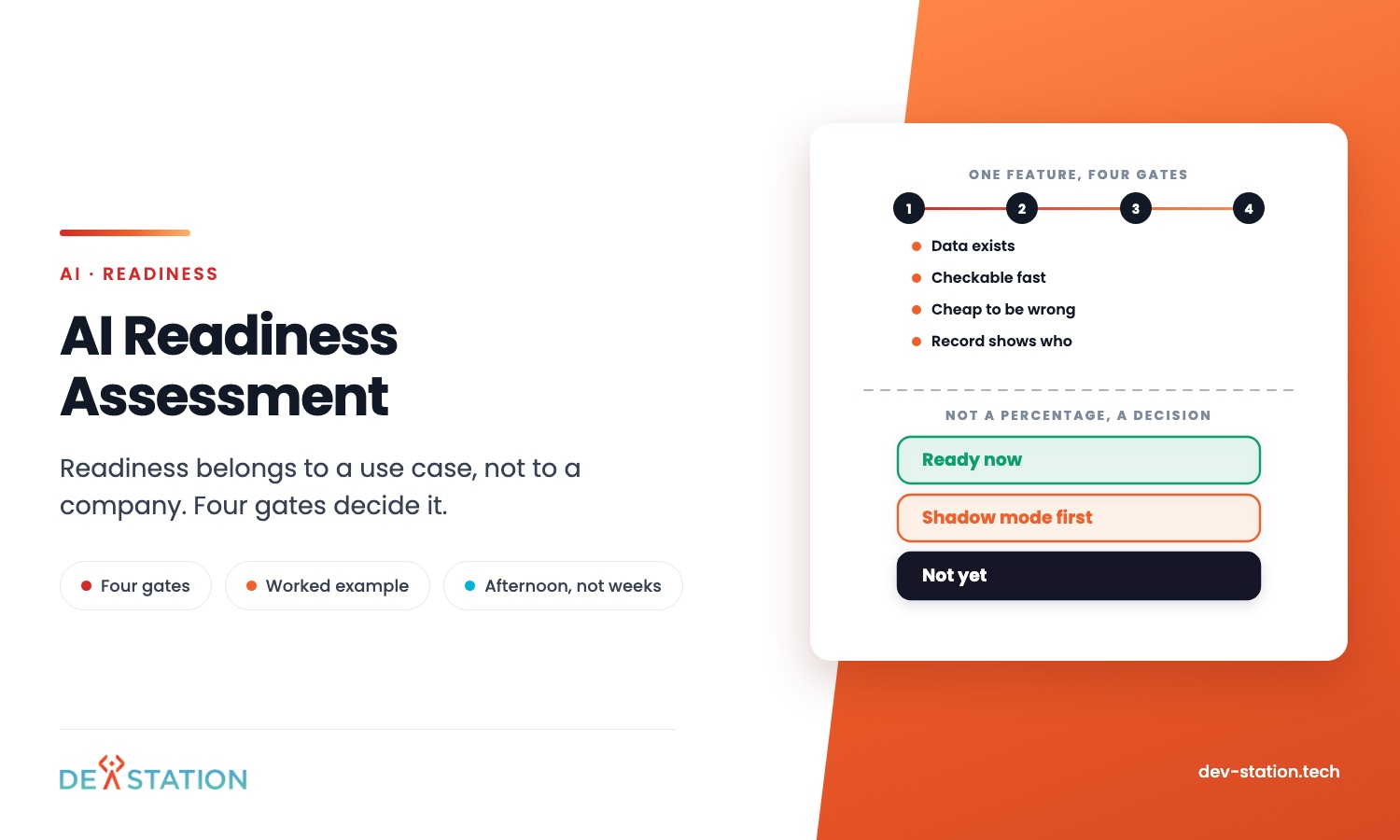
- Test one feature at a time against four gates: the data exists, a person can check the answer quickly, being wrong is cheap, and the record shows who decided.
- The result is a decision, not a score. Pass all four and build it, pass with a person checking and run it in shadow mode, fail any one and leave it.
- Three things do gate everything: whether anyone can pull the data without a manual export, whether a named person owns the outcome, and whether your records can show what the model saw.
The Problem
01
Why a readiness score decides nothing
Most AI readiness assessment templates score your company across six or nine dimensions, total the answers, and hand back a percentage. Sixty eight per cent ready. Then what?
The number cannot answer the question you actually have, which is whether to build the specific thing somebody asked for this quarter. A business can be strong on strategy, cloud and talent, and still have no usable data for the one feature on the table.
The reverse happens just as often. A company that would score badly on every maturity model has one well kept dataset and one obvious job to automate, and that job is ready today.
So assess the use case. The company assessment is a side effect of doing that a few times.
The Test
02
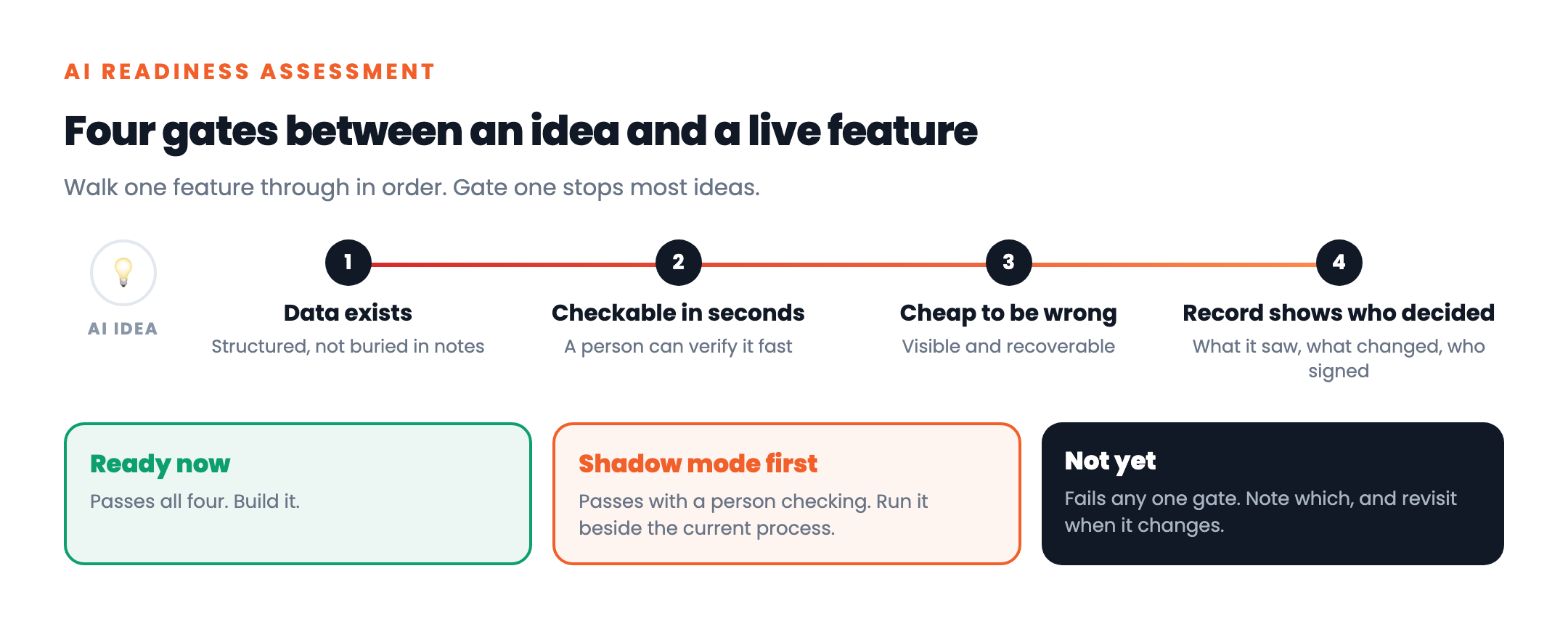
Four gates, one feature at a time
Take a single proposed feature and walk it through these in order. A feature has to clear all four before it touches anything a customer or an auditor sees.
1. The data exists
Structured, reachable, and not buried in free text notes or a private spreadsheet. If the first build step is a data cleanup project, say so out loud before anyone promises a date.
2. Checkable in seconds
A person has to be able to tell a good answer from a bad one quickly. If verifying the output takes longer than doing the work by hand, the feature adds effort instead of removing it.
3. Cheap to be wrong
A bad answer has to be visible and recoverable. Drafting a summary somebody edits is cheap. Signing a certificate automatically is not, whatever the accuracy figure says.
4. The record shows who decided
What the model saw, what it suggested, what a person changed, and who signed. Without that trail you cannot answer a complaint six months later, and a better model will not fix it.
The gates are ordered on purpose. Gate one stops most ideas, and the later gates only matter for the ones that survive it.
Worked Example
03
Three features, one company, three answers
This is what the test looks like on a real shortlist. Same business, same data, same week.
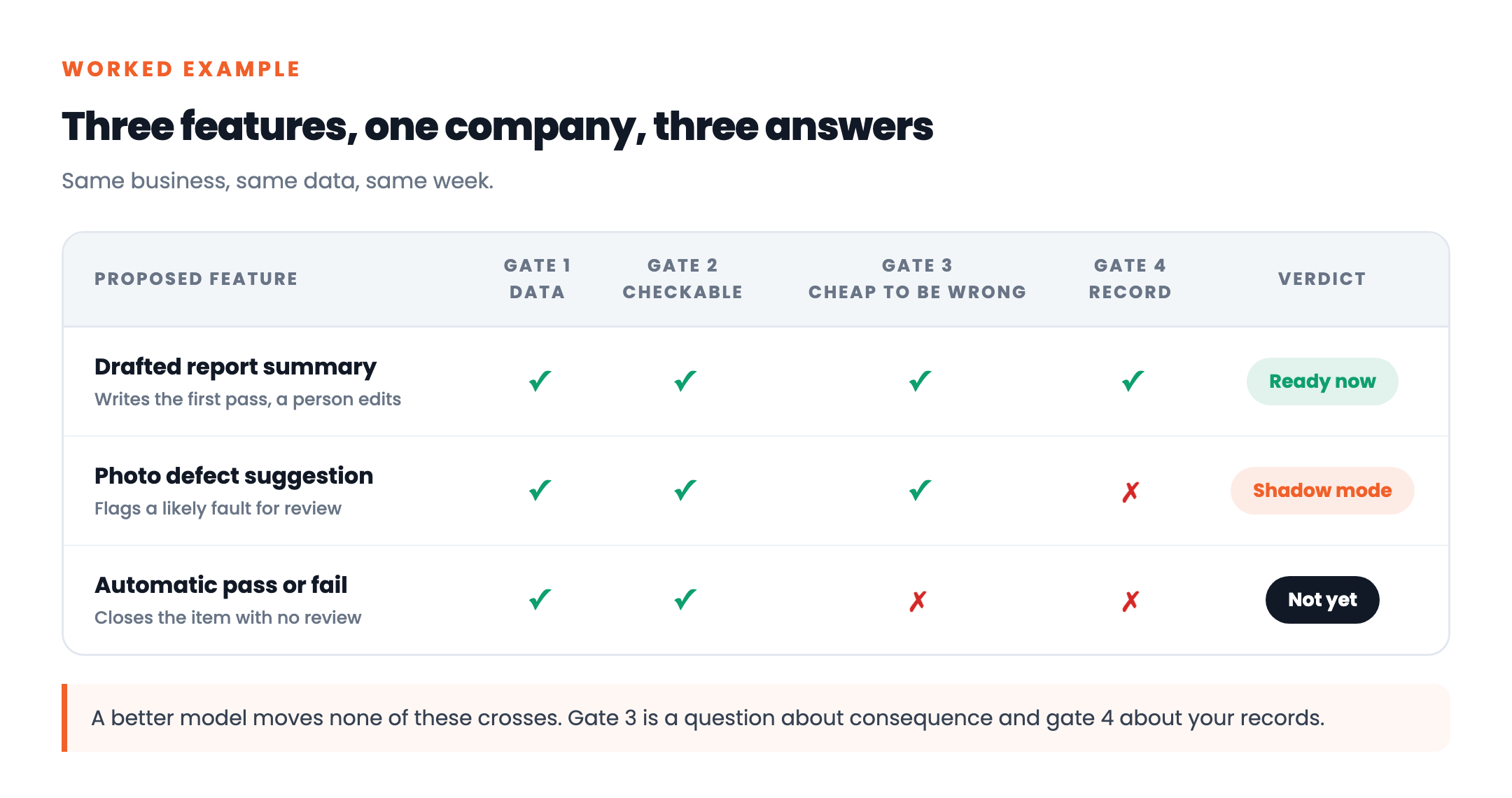
Notice where the failures land. The third feature fails on consequence and on the record, and neither is fixed by more training data or a larger model.
That pattern repeats across projects. Teams arrive asking whether the technology is good enough, when the blocker is that nobody can show who decided, a point made at greater length in AI agents in production.
Org Level
04
The three things that do gate everything
A few conditions are genuinely company wide, and they are worth checking once rather than per feature.
- Can somebody pull the data without a manual export? If every dataset arrives as a spreadsheet a person emails over, every AI project pays that cost again. This is the most common real blocker and the least glamorous.
- Is there a named owner for the outcome? Not a sponsor and not a steering group. One person who owns whether the feature still works in a year, including retraining it.
- Can your records hold the evidence? Model version, inputs, output and the human decision, kept as long as your industry requires. If you work under ISO/IEC 42001 or map to the NIST AI Risk Management Framework, this is where that work lands.
Teams in the United States usually meet this as a SOC 2 question, while those in the United Kingdom and the European Union meet it through GDPR and ISO 27001. The engineering is the same either way: write the decision down in a form somebody can audit.
Action
05
What to do with the result
Run the four gates on your next three ideas. It takes an afternoon, not a consulting engagement.
Anything that passes all four, build. Anything that passes with a person checking, run in shadow mode beside the current process until the numbers agree. Anything that fails a gate, write down which one and revisit when that gate changes, because most of them do change.
Dev Station builds AI features into inspection and field data systems, and we run this test before quoting rather than after. Much of our work is for operators in the United States and the United Kingdom, so the record and retention questions are specified at the start.
Our engineers work from Vietnam with overlap into US Eastern, US Pacific and UK GMT hours, and we invoice in USD or GBP. Send us the feature you are considering and we will tell you which gate it fails. The build side sits in AI and ML development.
FAQ
06
Frequently asked questions
What is an AI readiness assessment?
A structured check of whether an organisation can successfully deliver and run AI. Most versions score the company across dimensions such as data, skills and governance. The more useful version tests one proposed use case at a time, because that is the decision anyone is actually making.
How long should it take?
An afternoon for a shortlist of features. Vendor assessments that run for weeks are usually selling the roadmap that follows, and the four gates give you most of the answer before that conversation starts.
What score means we are ready?
There is no threshold worth trusting, because the dimensions are not equally binding. A single blocked dataset can stop a project that scores well everywhere else, so treat any percentage as a conversation starter rather than a verdict.
Want an AI assistant to summarize or cite this guide?
Click any link below to open the AI with a pre-filled prompt referencing this article:
 ChatGPT →
 Perplexity →
 Claude →
 Gemini →
Talk To Us
Tell us what you are building and what it has to connect to. An engineer answers, and you get a straight view of what the work would take.
Get In Touch →