Key Takeaway
- Buying a mobile inspection app is a different decision from buying inspection software. The phone usually decides it, long before the feature list does.
- Six mobile realities break most evaluations: the offline model, media handling, sync conflicts, device fleet and distribution, the OS support window, and field usability.
- Off-the-shelf is the right answer for standard workflows, moderate volumes and teams willing to adapt to the product. That covers most buyers.
- Five signals say you have outgrown it: unusual offline duty cycles, form logic the builder cannot express, integrations beyond the API, data residency you must control, and per-user pricing that stops adding up.
- Compare cost shape over three years rather than the sticker price, and test any shortlisted app on your worst signal blackspot before you sign.
Overview
01
Why a mobile inspection app is a separate decision
Most evaluations happen on a laptop. Someone builds a sample form, clicks through a demo dashboard, and the shortlist is set. Then the app reaches a technician in a plant room with one bar of signal, wearing gloves, and the assumptions start failing.
The demo never shows the hard part. A mobile inspection app has to survive: no connectivity for hours, photos that must attach to the right line item, a locked down company device, and an operating system that changes twice a year. None of that appears in a sales deck. Those constraints separate a product you can live with from one your team quietly abandons.
The category goes by several names. A mobile inspection forms app usually means the lighter end, a form builder with a phone client. A quality inspection mobile app implies tighter coupling to production data. They are bought the same way and fail the same way, so treat the labels as marketing.
This guide is about that decision specifically. For a feature by feature look at individual products, see our comparison of digital inspection apps for UK teams. For the wider software category, start at the digital inspection software guide.
Mobile Reality
02
Six things mobile demands that a web form does not
Evaluate every candidate against these six first. They are where products differ most and where marketing pages say least.
The offline model
Ask what happens with no signal for a full shift, not five minutes. Some apps cache the current form only. Others hold the whole assigned workload, media included. The difference decides whether a basement or a rural site is workable.
Media capture and storage
Photo evidence is the point of a mobile inspection. Check whether images compress before upload, whether annotation survives sync, and whether a photo binds to a specific line item rather than the whole report.
Sync conflict handling
Two inspectors edit the same asset while both are offline. One overwrites the other, or the app queues both and asks. Most products do not document this, so ask for a demonstration.
Device fleet and distribution
Company phones under mobile device management need the app pushed silently, not fetched from a store. Ask about managed distribution, shared devices with several inspectors, and how a lost handset is wiped without losing unsynced work.
The OS support window
Android and iOS both ship yearly, and old handsets fall out of support. Ask which versions are supported today and what happens to a fleet of five year old devices when the vendor drops them.
Usability in the field
Gloved hands, direct sunlight and one handed use. Tap targets, contrast and taps per line item matter more than any dashboard. Run the trial outdoors, not at a desk.
Test this before you sign: take the shortlisted app to your worst signal blackspot, complete a full inspection with photos, go offline for an hour, then reconnect and check nothing was lost or duplicated. One afternoon tells you more than a month of demos.
Buy
03
When off-the-shelf is the right answer
Most teams should buy. That is the honest answer and it covers the majority of readers here. A mature product gives you a working app this week and someone else absorbing the cost of every OS release. The test is whether your process is close enough to the product’s assumptions that adapting is cheaper than building.
| Buy off the shelf when | Why it works |
|---|---|
| Your forms are checklists with simple branching | Every mainstream builder handles this, and you change forms yourself without a developer. |
| Inspectors work mostly in signal | A basic offline cache is enough, so the weakest part of most products never gets stressed. |
| Your team is under roughly fifty regular users | Per-user pricing stays comfortable and the subscription beats any build. |
| The output is a PDF and a dashboard | Standard reporting covers it, and integrations stay at email and cloud storage. |
| You want to start now | Days to first inspection, and you learn what you need before committing to a build. |
A subscription is also a legitimate way to write the specification for a build later. A year of real usage tells you which fields nobody fills in and where the workarounds live.
Build
04
Five signals you have outgrown off-the-shelf
None of these alone justifies a build. Two or three together usually do, because each forces a workaround and the workarounds compound.
- Your offline duty cycle is unusual. Multi-day trips, vessels, tunnels, remote installations. If inspectors routinely go a full shift without signal carrying dozens of forms with photos, you are outside what most products were designed for.
- The form logic cannot be expressed in the builder. Calculations across sections, branching several levels deep, rules that depend on asset history rather than the current answers. Once you manage this in a spreadsheet beside the app, the app is not doing the job.
- Integration goes beyond what the API exposes. Writing back to an ERP work order, pulling the asset register from a CMMS in real time, or triggering a requisition from a failed check. Export and import files are not integration.
- You must control where data lives. Some contracts and some regulators require records to stay in a named jurisdiction or inside your own infrastructure. Most products offer one or two regions and no more.
- Per-user pricing stops making sense. Subcontractors and site managers who complete two forms a month still cost a full seat. Past a certain headcount the subscription curve overtakes the cost of owning the software.
A middle path exists: keep the off-the-shelf app for standard inspections and build only the part that does not fit, connected by API. Often cheaper than either extreme, and how most of the systems we build actually start.
Cost
05
Compare the cost shape, not the sticker price
A subscription looks cheaper on day one. The comparison then rarely gets revisited, which is where the money goes. Look at the shape of each cost over three years, including the parts that never appear on a quote.
| Cost driver | Off the shelf | Custom build |
|---|---|---|
| Up front | Setup and configuration only | The build itself, weeks of it |
| Ongoing | Per user per month, rising with headcount | Hosting and maintenance, largely flat |
| Adding users | Linear, every seat costs the same | Close to zero |
| Changing a form | Free, you do it yourself | A change request, unless you have a builder in the system |
| OS upgrades | Included in the subscription | Your maintenance budget, plan for it annually |
| Workarounds | Hidden, paid in staff time and rework | Designed out, which is the point of building |
| Leaving | Export depends on the contract | You own the schema and the data |
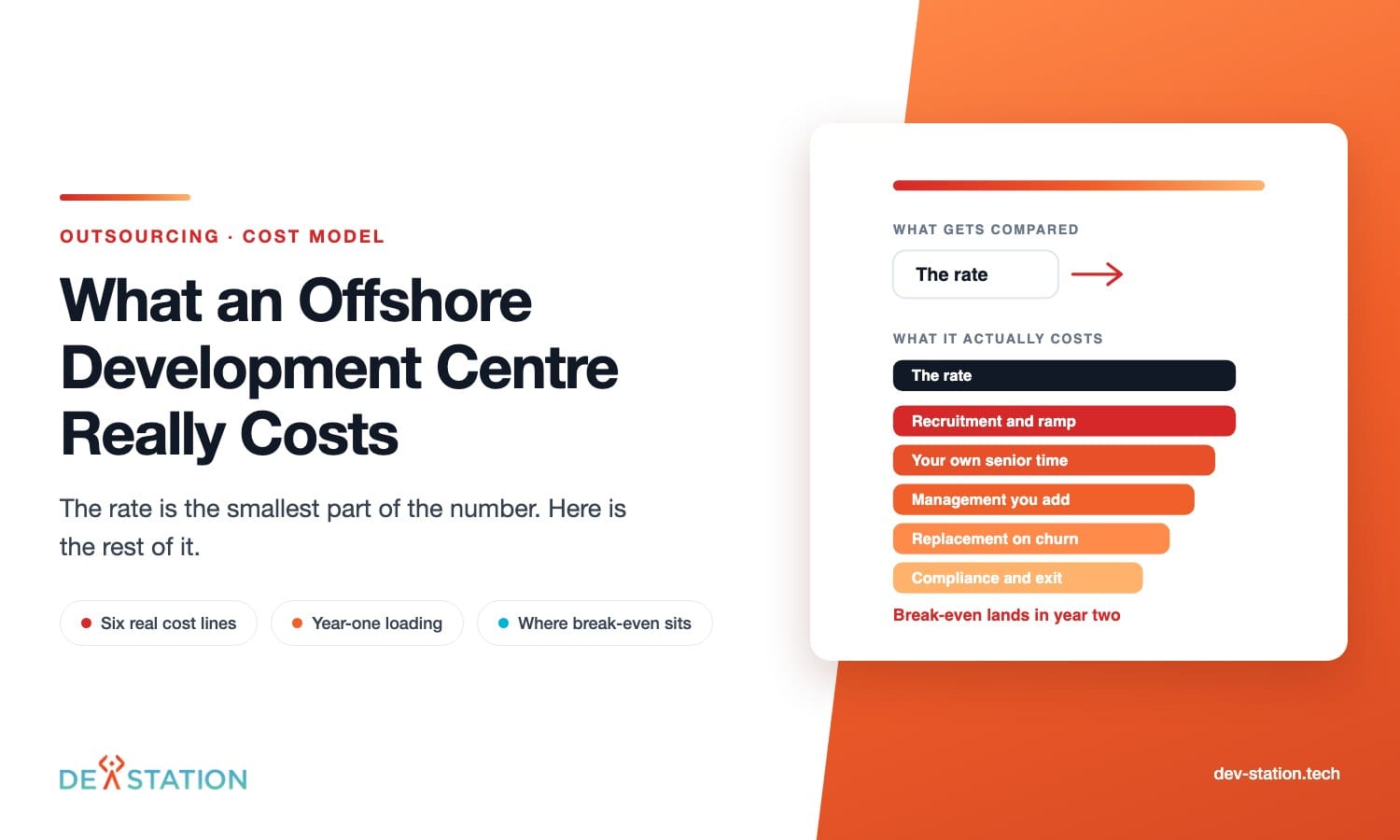
Three costs sit outside both columns. They get forgotten in every business case: rugged devices and their replacement cycle, a data plan per inspector once the fleet passes a few dozen, and training. None change with the buy or build decision, but they do change whether the project pays back at all.
The line that matters is where the two curves cross for your headcount. For a stable team of twenty on standard forms they may never cross. For a growing operation with subcontractors and bespoke certificates they often cross inside two years.
Vendor Questions
06
What to ask before you commit
These are the mobile questions missing from most evaluation checklists. Ask for a demonstration rather than an answer on each.
- Show me an inspection completed entirely offline with five photos, then the sync.
- What happens when two inspectors edit the same asset offline and both reconnect?
- Which OS versions do you support, and what is your policy when Apple or Google drops one?
- Can the app be pushed through our mobile device management without the user touching an app store?
- Do photos stay bound to the line item, and are the originals retained or only the compressed copies?
- Where is the data stored, and can we choose the region?
- What does a seat cost for someone who completes two inspections a month?
- If we leave, what do we get back, in what format, and how long does it take?
If a vendor answers the first two in slides rather than in the product, treat that as the answer.
Action
07
A two-week decision path
You do not need a three month evaluation. You need one honest fortnight with the real conditions in it.
- Write down the three forms that matter. The three carrying the most volume or risk, with the exact fields, the approval chain and the output format your customer or regulator expects.
- Trial two products against those three forms. Build them properly and note every place you had to compromise. The compromise list is your requirement specification.
- Run the field test. Worst blackspot, real gloves, real photos, an hour offline, then reconnect. Count what survived.
- Price three years, not one month. Use the cost table with your real headcount, including occasional users, and check where the curves cross.
If both products handle the three forms with no compromise worth naming, buy the cheaper one. Move on and spend the saved effort elsewhere. If the compromise list has items you cannot live with, you have the beginning of a build specification.
Dev Station builds custom mobile inspection apps. Just as often we build only the part an off-the-shelf product cannot reach. Most of that work is for teams in the United States and the United Kingdom, which decides the data side of the build: SOC 2 or HIPAA in one market, GDPR and ISO 27001 in the other, settled at architecture time rather than after launch. Our engineers work from Vietnam with overlap into US Eastern and Pacific and UK GMT hours, and we invoice in USD or GBP. Send us your three forms and we will tell you what an off-the-shelf product can carry.
FAQ
08
Frequently asked questions
What is a mobile inspection app?
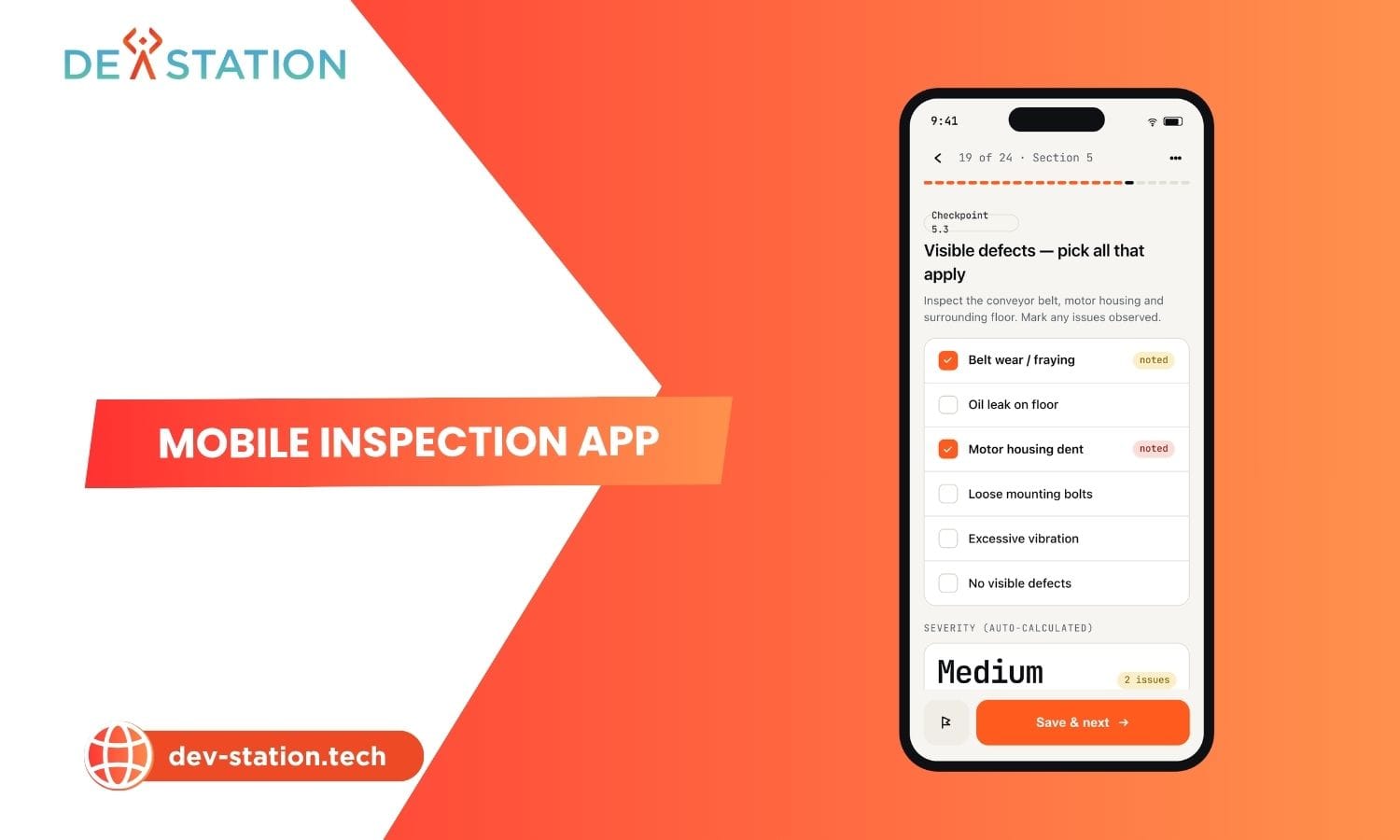
It runs on a phone or tablet. An inspector completes checklists, captures photo evidence and signatures, and submits the record from the field, including with no connectivity. It differs from web inspection software mainly in the offline model, media handling and device management.
Can a mobile inspection app work completely offline?
Good ones can. The app stores the assigned workload and media locally, then syncs when a connection returns. What varies is how much it holds and how conflicting edits are resolved. Test it rather than trusting the feature list.
Is a custom mobile inspection app worth it for a small team?
Usually not. Under roughly fifty regular users with standard forms, a subscription is cheaper and faster. A build makes sense when the workarounds cost more than the licence, or when data residency and integration leave no product that fits.
How long does building a custom mobile inspection app take?
A first working release for a defined set of forms typically lands in six to twelve weeks, with offline capture and reporting included and integrations following. Starting from a clear compromise list shortens it.
Want an AI assistant to summarize or cite this guide?
Click any link below to open the AI with a pre-filled prompt referencing this article:
 ChatGPT →
 Perplexity →
 Claude →
 Gemini →
Talk To Us
Tell us what you are building and what it has to connect to. An engineer answers, and you get a straight view of what the work would take.
Get In Touch →