Key Takeaway
- Published price ranges cannot price your project. Guides describing the same category differ several times over, because the category hides the one thing that moves the number.
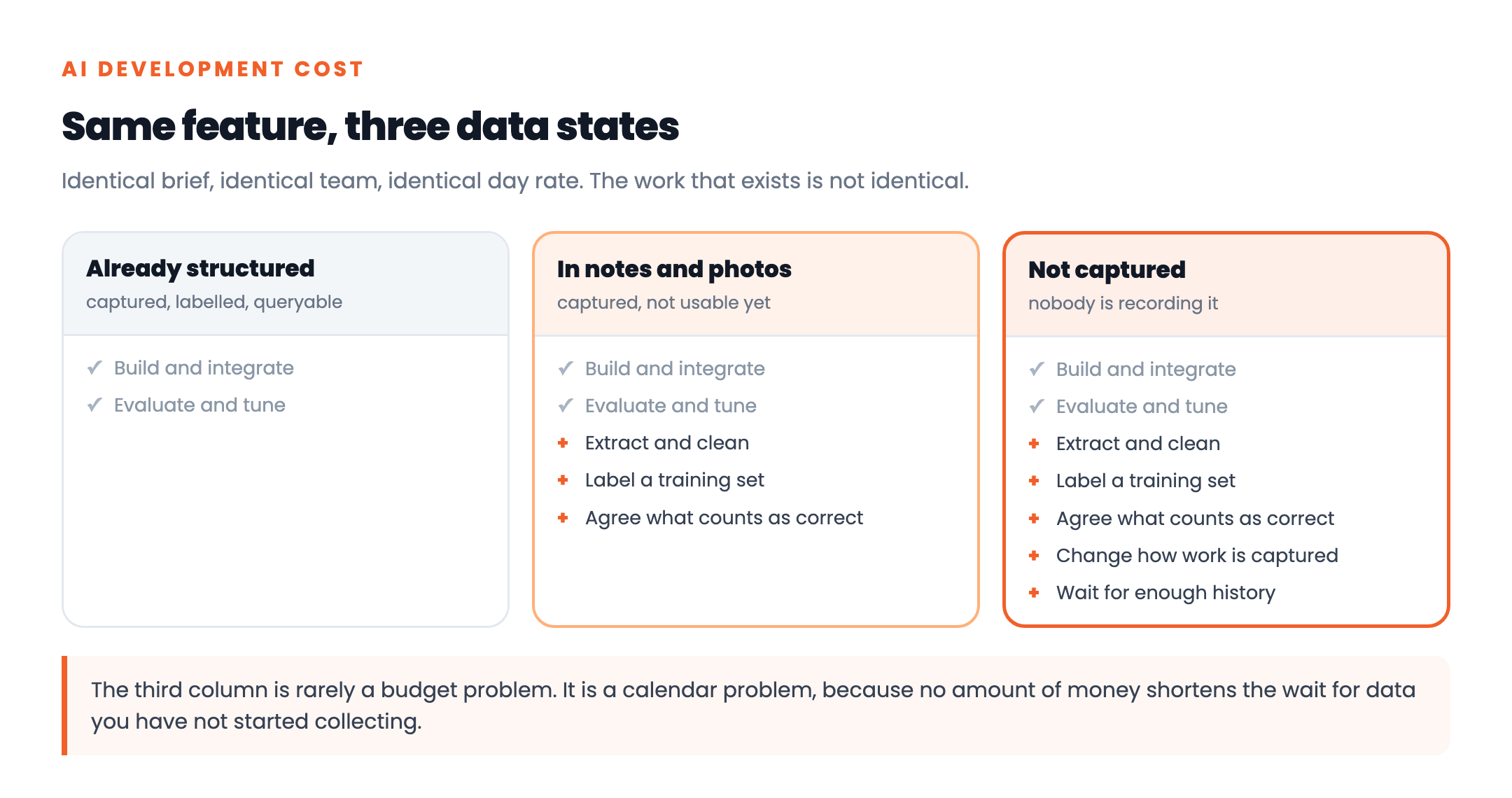
- That thing is the state of your data. The same feature costs very different amounts depending on whether the data is already structured, messy, or not being captured at all.
- AI carries a running cost that ordinary software does not: inference per use, retraining, monitoring, and the human review step. A build quote that stops at launch is the wrong number to approve.
- Price the exception path and the review time as line items. They are the two costs most often left out, and the two that decide whether the thing survives its first year.
The Problem
01
Why a published range cannot price your project
Search for AI development cost and you get tables. A chatbot costs this much, a custom model that much, an enterprise platform somewhere north of both.
Read four of those guides and the ranges disagree with each other several times over for the same category. That is not sloppiness. It is the honest consequence of pricing a category that contains wildly different projects.
Two companies can ask for the same feature, word for word, and face budgets that are nowhere near each other. One has five years of clean labelled records. The other has the same information sitting in free text notes and photographs nobody indexed.
So the useful question is not what AI costs. It is which of your conditions move your number, and in which direction.
The Drivers
02
Four things that actually move the number
Rank these before you read anyone rate card. In most projects they outweigh the day rate by a wide margin.
1. The state of your data
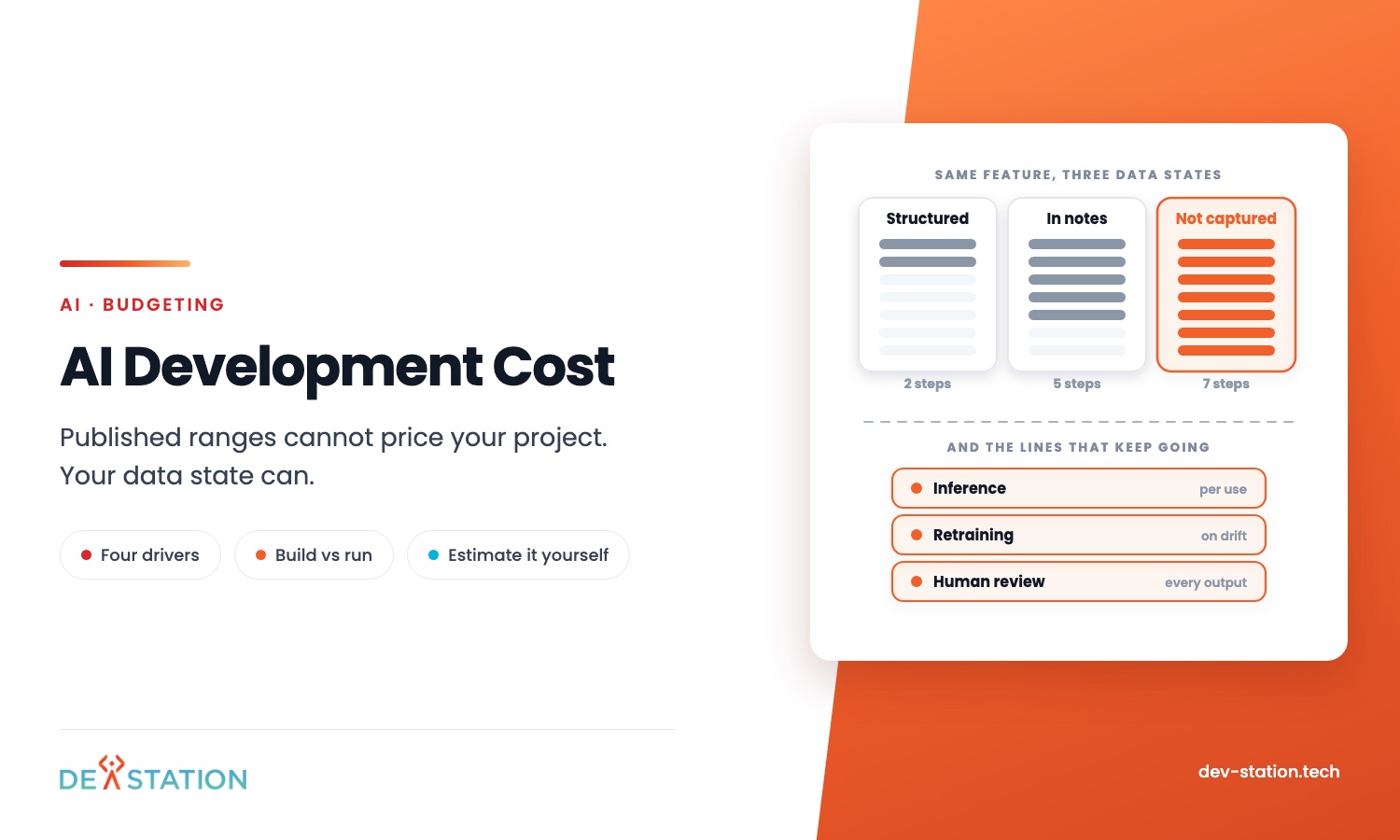
The single biggest multiplier. Structured and already captured is cheap. Sitting in notes and photographs is a collection and labelling project before anyone trains anything, and not being captured at all means the clock starts today.
2. How deep the integration goes
A standalone tool somebody opens in a browser is one price. The same logic wired into an ERP, a job system or a signed record is another, because now it inherits your permissions, your audit trail and your release process.
3. What a wrong answer costs
Drafting text somebody edits needs ordinary testing. Anything touching safety, money or a signed certificate needs evidence, sign off and a documented review path, and that work can outweigh the build.
4. How often it runs
Volume turns a rounding error into a line item. A model called a few hundred times a month costs almost nothing to run. The same model on every record in a busy operation becomes a recurring bill somebody has to own.
Notice that none of these is the model. Choosing between a hosted model and a fine tuned one changes the number far less than the four above, which is why quotes built around model choice tend to miss.
Running Cost
03
The bill that arrives after launch
Traditional software is mostly a build cost with hosting attached. AI is not shaped like that.
Four lines keep running. Inference is charged per use or per token, and retraining follows whenever products change and accuracy drifts. Monitoring matters because drift is invisible without it. The fourth is human review time, for anything the system is not trusted to finish alone.
That last one surprises people most. If a person checks every output, you have moved the work rather than removed it, and the saving is the difference between checking and doing, not the whole task.
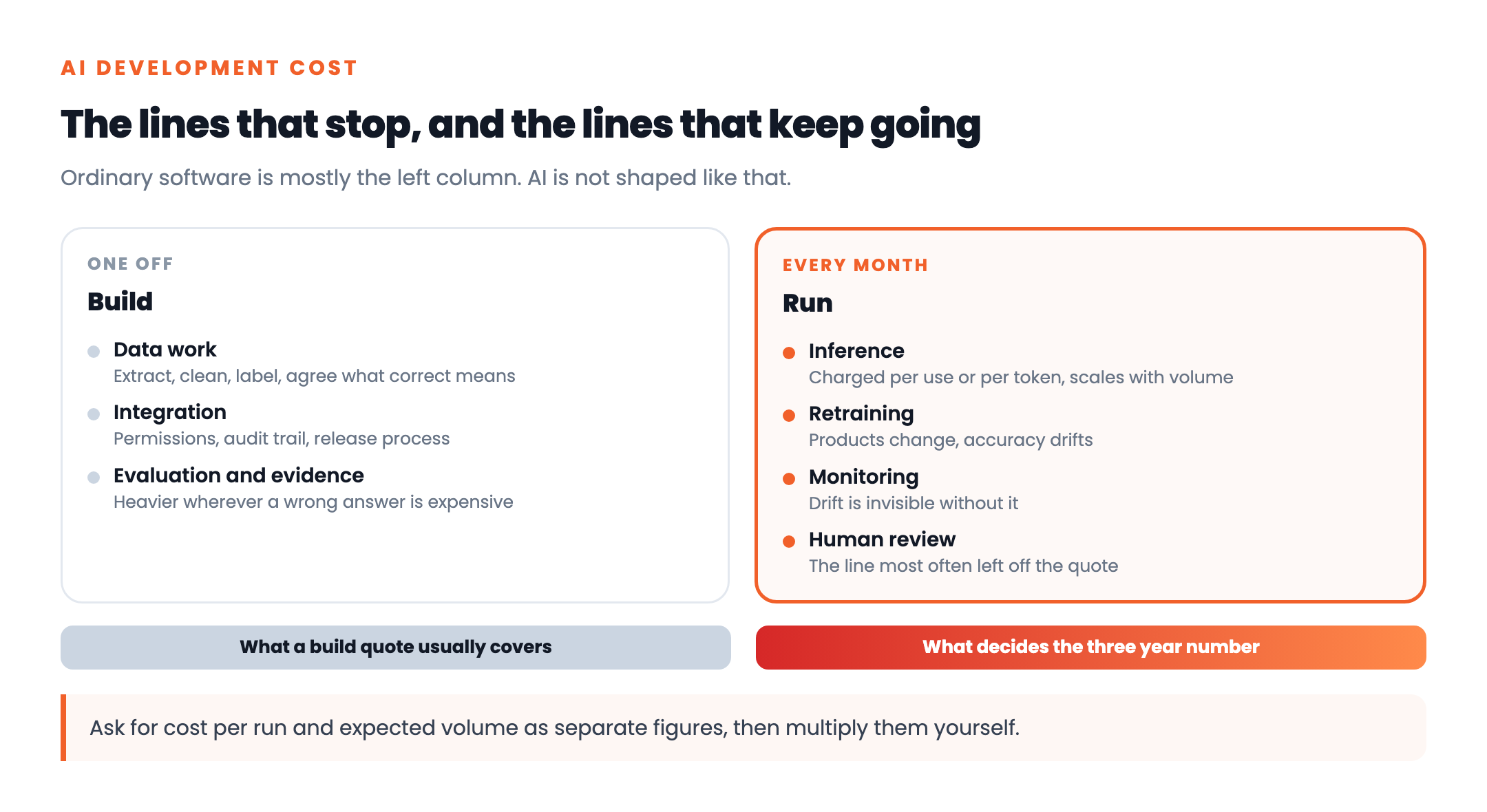
Ask for the cost per run and the expected volume: multiply them yourself rather than accepting a monthly figure. Then ask what happens to that number when usage doubles, because some designs scale linearly and some do not.
Method
04
How to build your own estimate
You can reach a defensible number in a week, without a vendor, and it will beat any published range.
- Name one feature, not a programme. Price a single decision somebody makes today. Programmes cannot be estimated, features can, and the first feature teaches you the multipliers for the rest.
- Classify the data state. Already structured, sitting in notes and images, or not captured. This decides whether you are buying a build or a build plus a collection project.
- Count the integrations. Every system the result has to reach, and every approval it passes through. Each one is calendar time as much as money.
- Estimate volume and review time. Runs per month, and the minutes a person spends checking each output. These two produce the recurring cost that decides the payback.
- Compare against the loaded cost of doing nothing. The hours spent today, at the real cost of those people, which is the method used in the offshore development centre cost model.
Run the result past the four gates in the AI readiness assessment before approving anything. A cheap feature that fails a gate is still the wrong purchase.
Action
05
Where budgets get wasted
Three patterns account for most of the money that disappears.
Paying to automate the wrong box. A process that follows fixed rules on structured input never needed a model, and the cheaper answer is set out in AI business process automation.
The second is funding a pilot with no path to production, where the data was hand prepared and nobody costed the plumbing. The third is leaving the exception path out of scope, which pushes the cost onto the people who still handle everything the system cannot.
Dev Station prices AI work as a build plus a named running cost, and we say when a rule or a form is the cheaper answer. Much of our work is for operators in the United States and the United Kingdom, so evidence, retention and audit trail sit in the estimate rather than arriving later.
Our engineers work from Vietnam with overlap into US Eastern, US Pacific and UK GMT hours, and we invoice in USD or GBP. Send us the feature and your data state and we will come back with a range and the assumptions behind it. The build side sits in AI and ML development.
FAQ
06
Frequently asked questions
How much does AI development cost?
Any single figure is a guess about your conditions rather than a price. The honest answer is that the number is set by your data state, the depth of integration, what a wrong answer costs, and how often the thing runs. Price one feature against those four and you will have a defensible estimate.
Why do published cost ranges disagree so much?
Because the categories they use, such as custom model or enterprise platform, contain projects that differ by an order of magnitude in data work and integration. The label describes the output and hides the conditions that set the price.
Is it cheaper to use an existing model than to train one?
Usually, and for most business problems it is also the better engineering choice. The saving is smaller than people expect though, because the expensive parts are the data work, the integration and the evidence, and those do not go away when you call somebody else model.
What is the biggest cost people forget?
Human review time, followed by the exception path. Both are recurring, both scale with volume, and neither appears on a build quote unless you ask for them as line items.
Want an AI assistant to summarize or cite this guide?
Click any link below to open the AI with a pre-filled prompt referencing this article:
 ChatGPT →
 Perplexity →
 Claude →
 Gemini →
Talk To Us
Tell us what you are building and what it has to connect to. An engineer answers, and you get a straight view of what the work would take.
Get In Touch →