Key Takeaway
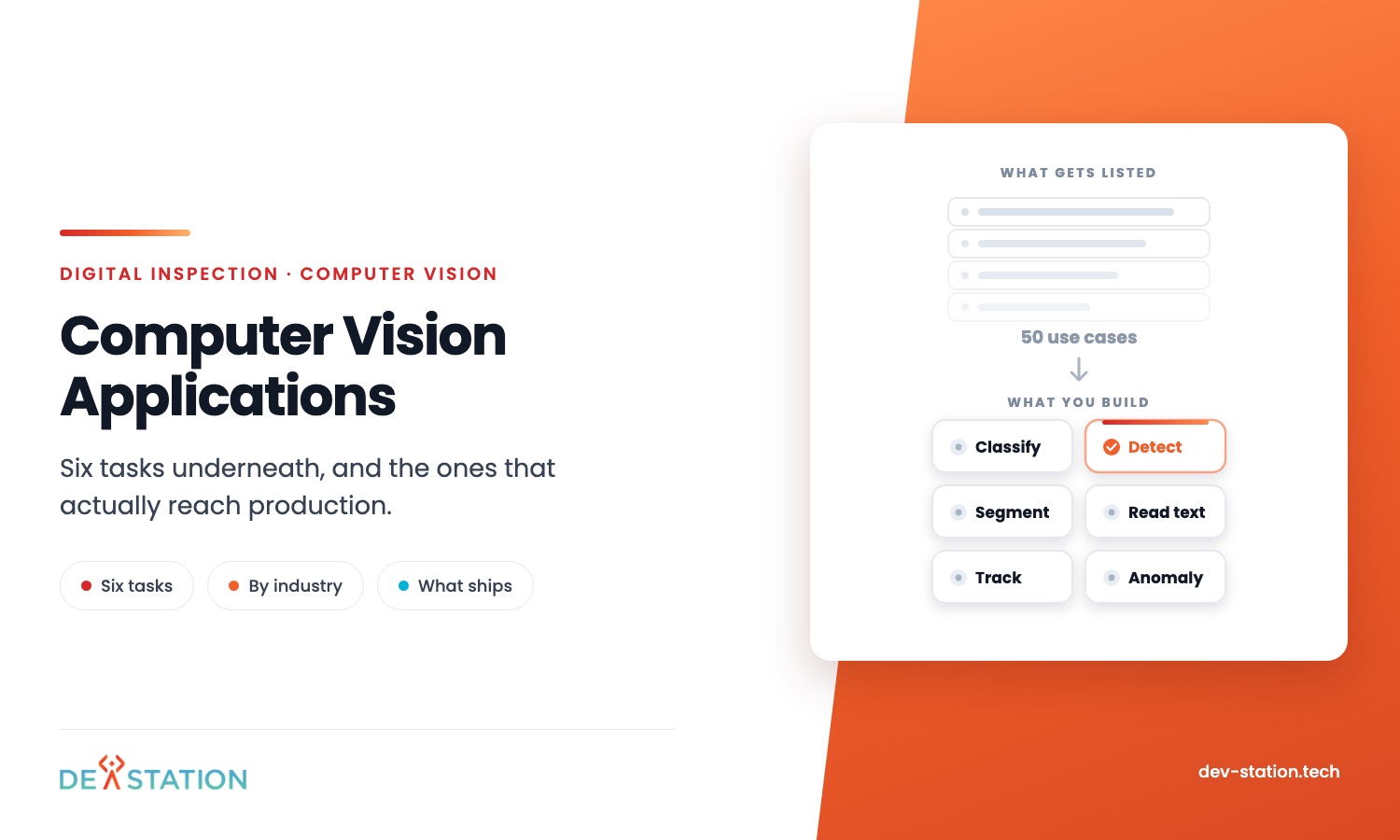
- Almost every computer vision application is one of six tasks underneath: classification, detection, segmentation, text reading, tracking, anomaly detection. Learn the six and a list of fifty use cases collapses into something you can reason about.
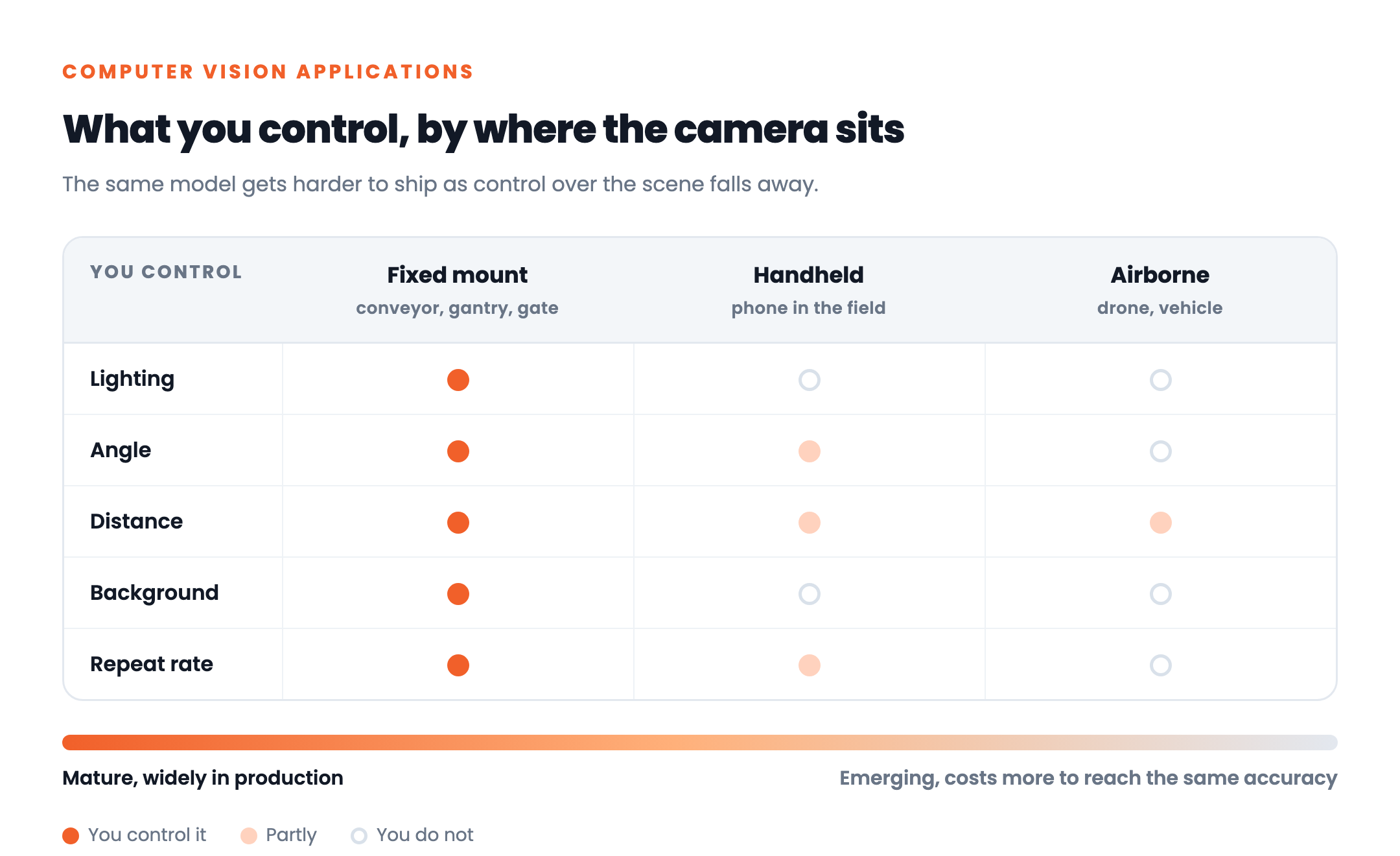
- Where the camera sits predicts success better than the industry does. A fixed camera over a conveyor is a solved problem. The same model behind a handheld phone out in the rain is not.
- Healthcare is the most regulated and the most proven. The FDA has authorized over 1,600 AI-enabled medical devices, around three quarters of them in radiology.
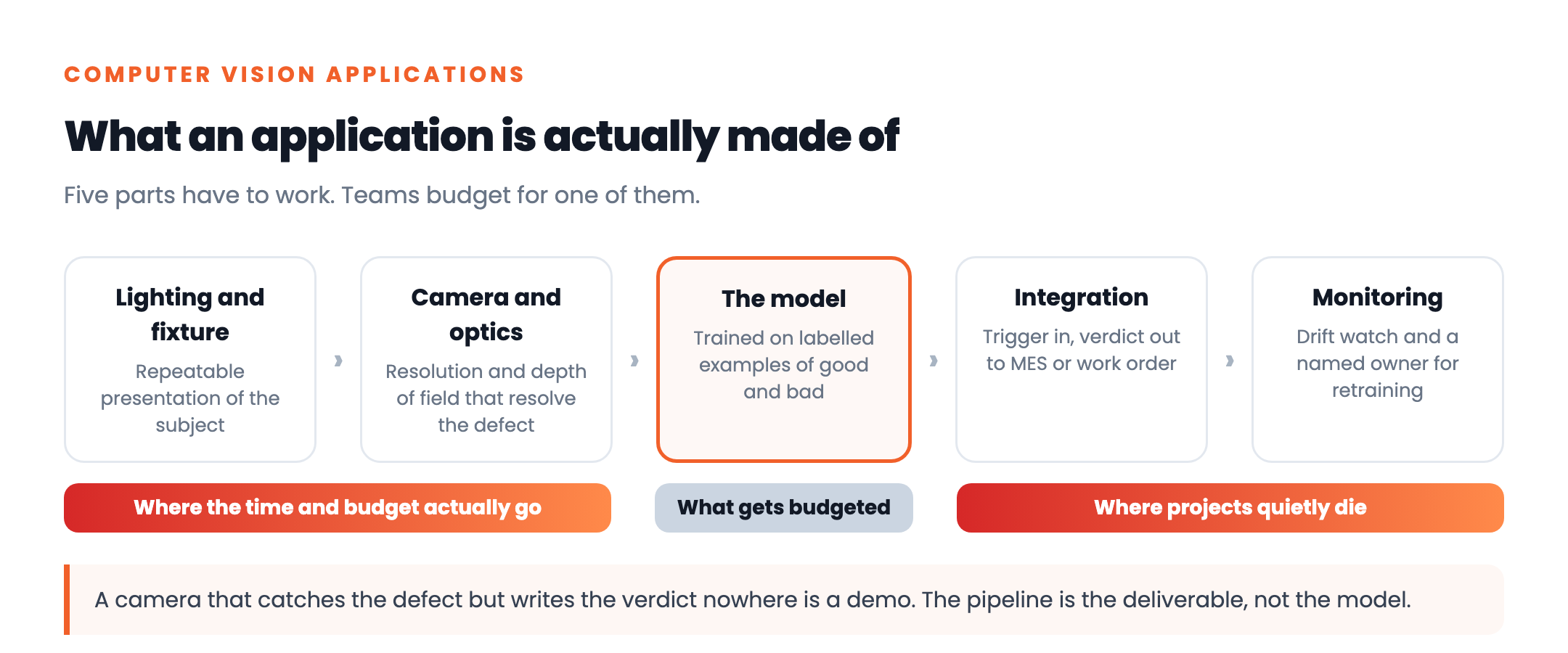
- The model is the cheap part. Lighting, mounting, labelled examples and the integration into whatever system acts on the verdict take the budget and the calendar.
- Pick the application where the view repeats and a miss costs real money. The rest make good demos.
Overview
01
What a computer vision application actually is
A camera produces pixels. A computer vision application turns those pixels into a decision something else can act on: reject this part, flag this scan for a radiologist, open the gate, count the pallets.
That last clause carries the weight. Recognising a defect is a research result. Writing the verdict somewhere the line can read it, within the cycle time, every shift, is an application.
Most published lists of computer vision applications skip that distinction, which is why they run to fifty items and leave you no wiser about which one to fund.
So this is organised differently. First the six tasks every application is assembled from, then where they earn their keep by industry, then an honest read on which ones reach production.
Building Blocks
02
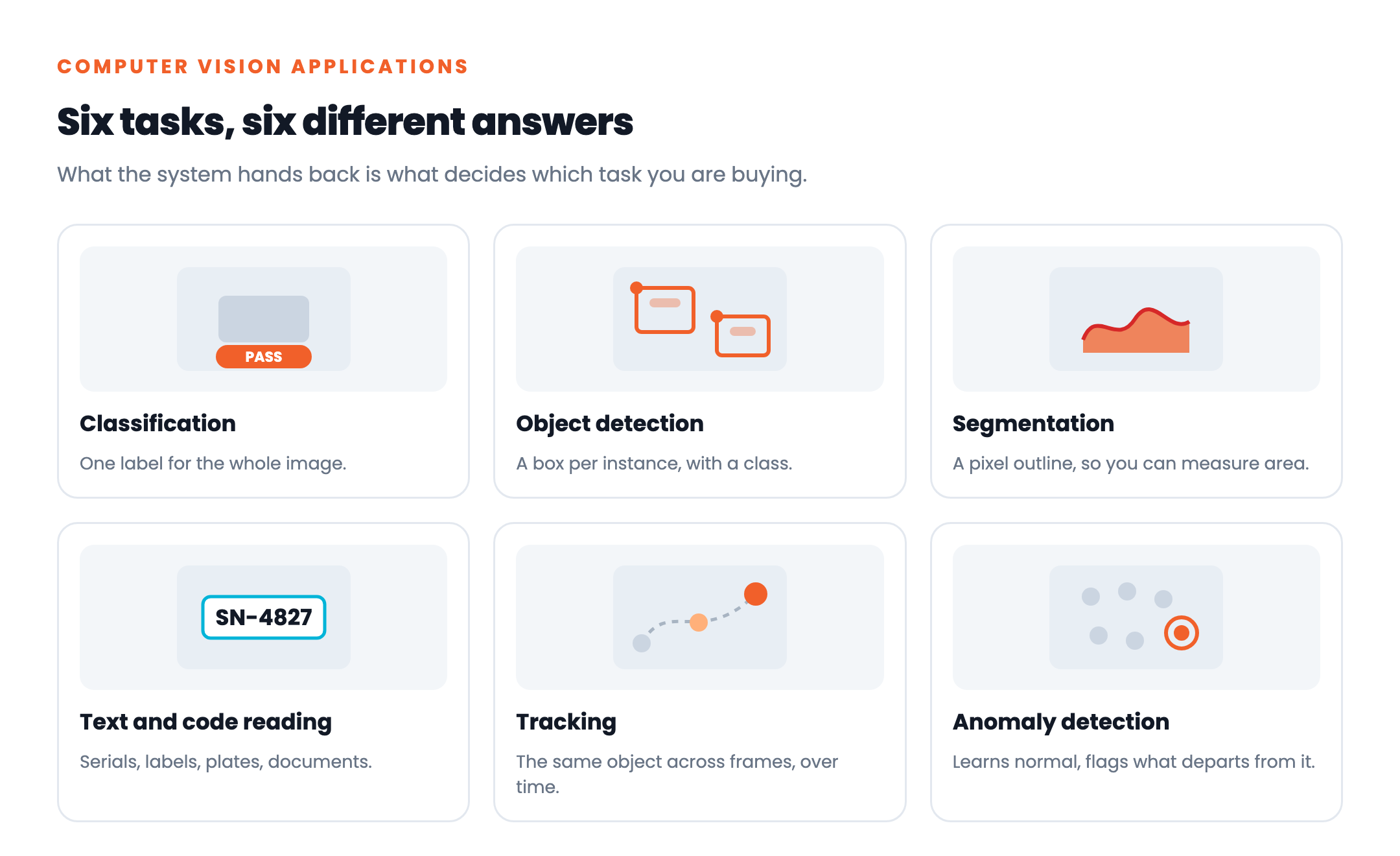
The six tasks behind every application
Vendors describe applications by subject matter. Engineers describe them by task. The second list is short.
Classification
One label for the whole image. Pass or fail, which product, which grade. The cheapest task to train and the easiest to oversell, because a single label cannot tell you where the problem is.
Object detection
What, and where, as a box around each instance. This is the workhorse. Counting items, checking a component is present, spotting people in an exclusion zone, guiding a robot to a pick point.
Segmentation
An outline at pixel level rather than a box. You need it when the answer is an area or a shape: how much of this surface is corroded, how much canopy covers this field, where exactly does the tumour boundary fall.
Text and code reading
Optical character recognition, plus barcodes and data matrix codes. Serial numbers, date codes, number plates, invoices, identity documents. Generic engines do clean print well and struggle with damage or handwriting.
Tracking
Recognising that the thing in this frame is the thing from the last frame. Dwell time, queue length, throughput counts, traffic flow. Detection gives you a number per frame, and tracking turns it into a story over time.
Anomaly detection
Learn what normal looks like, then flag whatever departs from it. The appeal is that you need no catalogue of defect types, which suits processes where new faults keep appearing. The cost is a vaguer answer about what went wrong.
When a vendor advertises fifty applications, they are pointing these six tasks at fifty subjects. The engineering effort tracks the task and the conditions, not the subject.
That is useful when you price a project. Two jobs described in completely different language, reading date codes on cartons and reading plates at a barrier, are close relatives and reuse most of the same work.
By Industry
03
Where cameras earn their keep
Below is where these tasks pay for themselves today, with the caveat that maturity varies enormously inside a single industry.
Manufacturing and quality control
This is the oldest commercial use and still the densest. Surface defect detection on metal, glass, textiles and moulded parts. Verification that a component is present and correctly seated before the next station. Print and label checks on packaging lines.
The reason manufacturing leads is unglamorous: the part arrives in the same place, at the same angle, under lighting somebody controls. Those three conditions do more for accuracy than any model choice.
Before funding one, it is worth reading the fit test in when AI visual inspection is worth it, and when it is not, because a good share of inspection cases fail it and the cheap answer is a gauge or a rule. The rule-based alternative has its own breakdown in machine vision quality control, and the factory view sits in AI vision quality control.
Healthcare and medical imaging
Radiology is the most proven application of computer vision anywhere, and the only field where the evidence bar is set by a regulator rather than a vendor. The FDA list of AI-enabled medical devices passed 1,600 authorisations for the United States market by September 2026, and roughly three quarters of them fall under the radiology panel.
In practice that means triage and detection support on X-ray, CT and MRI, measurement of things a human counts slowly, and screening programmes such as diabetic retinopathy where volume outstrips specialist time.
Note what the clearances are for. Most assist a clinician rather than replace one, and the approval covers a specific indication on specific equipment. Nothing about this category transfers to an unregulated build.
Transport, fleet and roads
Driver assistance put detection and segmentation in millions of cars: lane boundaries, signs, vehicles, pedestrians. Number plate recognition runs tolling, car parks and access control, and it is close to commodity.
Fleet operators use cameras for two separate jobs that often get confused. One watches outward for events worth keeping. The other records vehicle condition, which is a documentation problem more than a perception one, covered in vehicle inspection app requirements alongside the DVIR rules that govern it.
Damage capture at handover is where vision and records meet. A photograph proves condition at a moment in time, and the value sits in the audit trail around it rather than in the model that scores the dent.
Retail
Shelf monitoring reads stock levels and planogram compliance from fixed cameras or a camera on a trolley. Checkout-free formats combine overhead detection and tracking with weight sensors, and remain expensive per store.
Queue measurement and footfall are the quiet winners here. They need no per-person identity, which keeps them clear of the privacy problems that stall face recognition projects in both the United States and the United Kingdom.
Agriculture
Cameras on booms and drones separate crop from weed so a sprayer can target individual plants, which cuts chemical use rather than labour. Fruit counting supports yield forecasting, and disease spotting catches outbreaks while they are still local.
Field conditions are brutal for vision: sun angle moves, dust coats lenses, plants occlude each other. Dev Station has built this category, and the detail sits in AI vision for crop protection and IoT in agriculture.
Construction, energy and field inspection
Drone imagery of roofs, towers, solar arrays and bridges turns an access problem into an image problem. Segmentation then measures corrosion coverage or panel soiling as an area, which is exactly the task segmentation is good at.
Site safety is the other strand: personal protective equipment checks and exclusion zone monitoring from fixed cameras. The useful ones alert a supervisor, because a camera that logs a violation nobody reads changes nothing.
Volume is the trap. Flights multiply faster than anyone can review footage, which is the argument in drone inspection data, and the workflow questions appear again in AI inspection agent use cases.
Insurance and financial services
Vehicle and property damage assessment from customer photographs shortens claims, with a human reviewing anything expensive or odd. Document extraction pulls fields from invoices, statements and identity papers, and identity verification matches a selfie against a document photograph.
These are mostly text reading and classification wearing a financial costume. The hard parts are fraud attempts and the audit trail, not perception.
Logistics and warehousing
Parcel dimensioning, label reading at sortation speed, pallet and case counting, damage photographs at handover. Throughput is the binding constraint, so the engineering goes into capture and triggering rather than into a better classifier.
Reality Check
04
Which applications actually reach production
Demos are not deployments. This is a straight read on maturity, based on what holds up after the pilot.
| Application | Where it stands | What makes it hard |
|---|---|---|
| Code and label reading | Commodity | Damaged print, handwriting, odd fonts |
| Surface defects on a fixed line | Widely in production | Rare defect types, lighting drift over months |
| Number plate recognition | Widely in production | Weather, angles, plate variation across regions |
| Radiology triage and detection | Cleared and deployed under regulation | Evidence, approval, fitting clinical workflow |
| Drone asset inspection | Production for imagery, weaker on review | Volume of footage, consistent capture |
| Checkout-free retail | Live in limited formats | Cost per store, occlusion, edge cases |
| Phone-based field inspection | Emerging | No fixturing, any light, any angle |
| Open-world autonomous driving | Unsolved | The long tail of rare situations |
Read the pattern down the middle column. Everything near the top has a camera in a known position looking at a constrained scene, and everything near the bottom does not.
Build Reality
05
Why the model is the cheap part
Teams budget for the algorithm. The algorithm is usually a known quantity, sometimes a download.
Capture decides the project. Controlled, repeatable lighting plus a fixture that presents the subject the same way each time will rescue a mediocre model. Neither can be bought later as a patch.
Data is the next bill. Labelled examples of good and bad take weeks of work from somebody, and the defects that matter most are the ones you have fewest pictures of. Two inspectors who disagree about what counts as a fault will produce a training set that contradicts itself.
Then the deployment question: edge or cloud. A model on the device keeps working when the signal dies and keeps images off the network, which matters for both bandwidth and data protection. A model in the cloud is easier to update and retrain.
Last is where the verdict goes. An inspection result has to land in the MES, the work order, the asset record or the claim file, with the image attached and a timestamp that survives an audit. That plumbing is the deliverable.
Ask for the false call rate on your own images: a quoted accuracy of 99 percent is meaningless until you know which direction the errors fall. If they land on good parts, the line stops; if they land on bad parts, your customer finds them. Send a vendor your photographs, not their demo set.
Records, retention and model versioning follow whichever regime applies. For clients in the United States that usually means SOC 2, and HIPAA where images are clinical. For the United Kingdom and the rest of Europe it means GDPR with ISO 27001, which also constrains how long you keep footage of identifiable people.
Action
06
Choosing your first application
One narrow application that works beats a platform that nearly does. Five steps, in order.
- Name the decision, not the technology. Write one sentence saying what a person looks at today and what they decide as a result. If you cannot write it, there is no application yet, only an interest in cameras.
- Identify the task. Match it to one of the six above. This tells you roughly what the work costs and whether anyone has solved it already.
- Photograph a week of reality. In the conditions the job actually runs, not in a lightbox. If you cannot see the thing in your own photographs, no model will.
- Price the whole loop. Optics, lighting, mounting, edge hardware, integration and annual maintenance. The software licence is a line item, not the budget.
- Compare against the dull option. A second pair of eyes, a barcode, a gauge, a better form. Hold the dull option to the same payback maths and let it win when it wins.
Dev Station builds custom inspection and field data systems where computer vision is one component beside capture, records, offline sync and reporting. Much of our work is for manufacturers and inspection operators in the United States and the United Kingdom, and we will tell you when a rule, a gauge or a cheaper form of capture is the better answer.
Our engineers work from Vietnam with overlap into US Eastern, US Pacific and UK GMT hours, and we invoice in USD or GBP. Send us the decision you want automated and a folder of real images and we will come back with a straight read on feasibility. The wider service view sits in digital quality inspection and AI and ML development.
FAQ
07
Frequently asked questions
The questions that come up when teams start scoping a first project.
What are the main applications of computer vision?
The densest commercial uses are quality inspection in manufacturing, medical imaging, driver assistance and number plate recognition, retail shelf and queue monitoring, crop and livestock monitoring in agriculture, asset inspection from drones, and document and damage assessment in insurance. Underneath, nearly all of them are classification, object detection, segmentation, text reading, tracking or anomaly detection.
What is the difference between computer vision and machine vision?
Machine vision usually describes an industrial system following rules an engineer sets, such as a brightness threshold or a dimensional check against a calibrated reference. Computer vision is the wider field, and in current usage it implies a model learned from examples. The rule-based route is cheaper, explains its decisions and is often the correct choice.
Which industry uses computer vision the most?
Manufacturing has the longest history and the most installed systems, because the conditions on a production line suit cameras. Healthcare has the strongest regulatory evidence behind it, with over 1,600 AI-enabled devices authorised in the United States and radiology accounting for most of them.
How many images does a computer vision application need?
Any single figure is a sales number. The honest answer depends on how varied the subject looks and how many classes you need to separate, and the binding constraint is almost always the rare class where you have a handful of examples. Plan for deliberate sample collection rather than hoping the pilot period produces enough.
Can computer vision run offline or on a phone?
Yes. Modern detection and classification models run on phone hardware and on small edge devices, which is what makes field inspection practical where there is no signal. The trade is model size against accuracy, and you still need a plan for syncing results and images once a connection returns.
Want an AI assistant to summarize or cite this guide?
Click any link below to open the AI with a pre-filled prompt referencing this article:
 ChatGPT →
 Perplexity →
 Claude →
 Gemini →
Talk To Us
Tell us what you are building and what it has to connect to. An engineer answers, and you get a straight view of what the work would take.
Get In Touch →