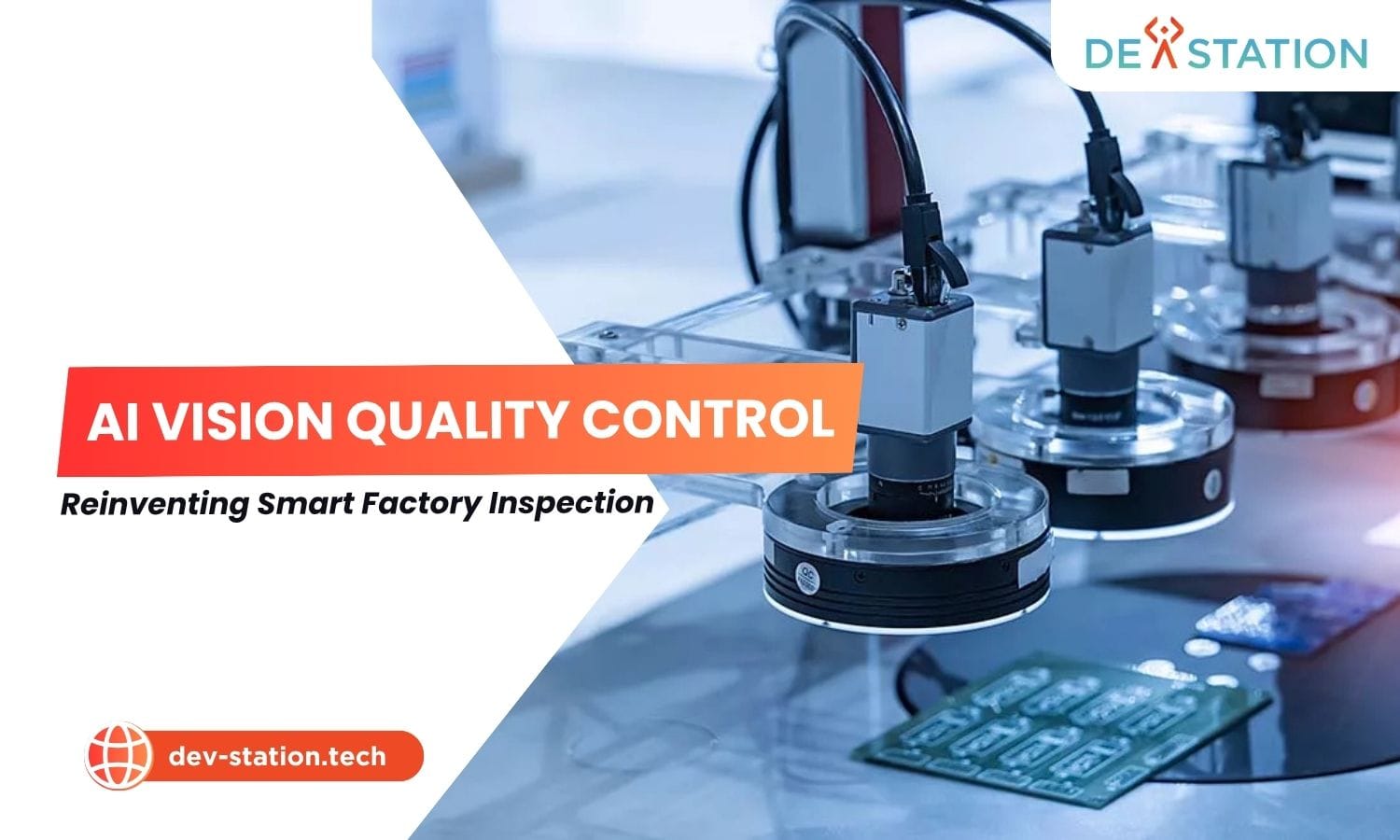
AI vision quality control in smart factories fuses deep learning models with high-resolution industrial cameras to inspect, classify, and triage defects in real time, replacing subjective, fatigue-prone human inspection with objective, data-driven precision. Where traditional machine vision relies on brittle hand-tuned rules, modern AI vision systems learn from thousands of annotated defect images, adapt to new failure modes, and close the loop with manufacturing execution systems so every captured frame becomes an actionable quality signal. Dev Station Technology designs and deploys these automated visual inspection systems end-to-end, helping manufacturers achieve near-perfect first-pass yield, 24/7 throughput, and a complete digital record of product integrity from line to load-out.
Key Takeaway
What it is: AI vision quality control combines convolutional and transformer-based neural networks with industrial cameras and edge/cloud compute to detect, classify, and localize manufacturing defects automatically.
Why it matters: Human inspectors exhibit 20 to 30% error rates on repetitive tasks; AI vision sustains >99% accuracy without fatigue, at hundreds of parts per minute.
What it detects: Surface flaws, dimensional deviations, missing/misaligned components, label and print errors, and spectroscopic or thermal anomalies invisible to the eye.
How it works: Image acquisition → preprocessing → AI inference (classification/detection/segmentation) → verdict & routing → closed-loop feedback to MES/SCADA.
Business impact: 40 to 60% lower scrap, 25 to 50% reduction in customer returns, and full traceability for ISO/IATF compliance, with payback often under 12 months.
1What AI Vision Quality Control Actually Means
AI vision quality control is the application of computer vision and machine learning to the automated inspection of manufactured goods. Unlike rule-based machine vision, which requires a programmer to hand-code thresholds for every conceivable defect, an AI vision system is trained on labeled images of both good and defective parts. The model learns the statistical signature of each defect class and generalizes to new, previously unseen examples. This shift from explicit programming to learned representation is what allows the same platform to handle a scratched automotive panel today and a misaligned PCB component tomorrow, with only a retraining cycle rather than a rewrite.
Key distinction: Traditional machine vision asks “does this pixel match a fixed rule?” AI vision asks “does this image look like a known defect pattern?” The former breaks when lighting drifts or a new product variant appears; the latter adapts.
In a smart factory context, the AI vision node is not an isolated box. It is a connected citizen of the Industrial Internet of Things (IIoT). Inspection verdicts flow into the Manufacturing Execution System (MES), feed OEE dashboards, and can trigger automated diverters that route bad parts out of the line before value is added downstream. This closed-loop architecture is what turns inspection from a cost center into a process-improvement engine.
2Why Manual and Rule-Based Inspection Fall Short
Before understanding where AI adds value, it helps to be precise about where legacy approaches fail. Two regimes dominate shop floors today, and both have structural limits.
Human Visual Inspection
Error rate 20 to 30% on repetitive tasks as attention degrades across a shift.
Subjective standards: what one inspector flags, another passes.
Throughput ceiling: one part at a time, creating a bottleneck on high-speed lines.
Blind to the invisible: cannot see sub-millimeter cracks, IR signatures, or UV fluorescence.
Rule-Based Machine Vision
Brittle to variation: new product SKUs require new rule sets and re-commissioning.
Lighting-sensitive: drift in illumination or part presentation causes false rejects.
Binary logic: struggles with “acceptable but borderline” cosmetic defects.
No learning: a defect never seen at commissioning is never caught.
3How AI Vision Inspection Works: The Five-Stage Pipeline
Every AI vision quality control system, regardless of vendor, moves a part through a deterministic five-stage pipeline. Understanding each stage clarifies where latency, accuracy, and integration decisions are made.
Image Acquisition. Industrial cameras (area-scan, line-scan, multispectral, or 3D) capture the part under controlled, repeatable lighting. Triggering is synchronized to the line encoder so the same physical location is imaged every cycle.
Preprocessing & Normalization. Frames are de-warped, white-balanced, denoised, and cropped to the region of interest. Defect-agnostic augmentation (rotation, contrast jitter) is often applied at training time so the model tolerates presentation variance.
AI Inference. A trained neural network, typically a CNN (ResNet, EfficientNet) or transformer-based detector (DETR, YOLO variant), runs on an edge GPU or cloud accelerator. Depending on the task, the model outputs a classification label, a bounding box per defect, or a pixel-level segmentation mask.
Verdict & Routing. A decision engine thresholds the model’s confidence against an acceptance policy. Conforming parts continue; non-conforming parts are flagged, sorted by defect type, and diverted by a reject mechanism, all in milliseconds.
Closed-Loop Feedback. Verdicts, defect images, and metadata stream to the MES/SCADA layer. Trend analytics surface process drift (e.g., a rising scratch rate upstream), enabling corrective action before scrap accumulates.
Latency budget: For a line running 120 parts/minute, the full acquire→infer→route cycle must complete in under 500 ms. Edge inference on modern GPUs routinely delivers 5 to 20 ms per frame for detection models, leaving comfortable headroom for mechanical actuation.
4What Defects AI Vision Can Automatically Detect
One of the strongest arguments for AI vision is breadth: a single trained platform can surface defect classes that would otherwise require separate, specialized gauges. The table below maps the major defect categories to representative examples and the industries where they dominate.
Color mismatch, gloss inconsistency, texture defects
Textiles, automotive paint, cosmetics
Classification
5Measurable Impact: What Manufacturers Actually See
The value of AI vision quality control is not abstract. Across deployments Dev Station Technology has instrumented, a consistent set of KPIs moves within the first 90 days of go-live.
99.2%
Inspection accuracy sustained across shifts, vs. 70 to 80% for human-only lines.
−50%
Scrap reduction as early defect detection prevents downstream value-add on bad parts.
120 ppm
Parts-per-million defect leakage, down from 2,000+ ppm on legacy inspection.
< 12 mo
Typical payback period when scrap savings and recall avoidance are combined.
6Where AI Vision Fits in the Smart Factory Stack
AI vision does not replace the rest of the quality stack. It integrates with it. The detail cards below show how an inspection node connects to the broader manufacturing IT landscape and what each integration point delivers.
Edge Inference Node
The GPU-equipped IPC at the line runs the trained model with single-digit-millisecond latency. It owns the real-time verdict and reject actuation, operating even if the plant network is down.
MES / SCADA Integration
Verdicts and defect images publish to the MES via OPC UA or REST. This gives supervisors live OEE and first-pass-yield visibility and ties each part’s serial number to its inspection record.
Data Lake & Retraining
Captured images accumulate in a searchable data lake. New defect classes discovered in production are labeled and folded into periodic model retraining, so the system gets sharper over time without a rip-and-replace.
Compliance & Traceability
Every part carries a digitally signed inspection record: image, verdict, model version, timestamp. This satisfies IATF 16949, ISO 9001, and FDA 21 CFR Part 11 traceability requirements out of the box.
7AI Vision vs. Alternative Inspection Approaches
Choosing an inspection technology is rarely binary, but the trade-offs are well-defined. The comparison below frames AI vision against the two most common alternatives so engineering and operations leaders can scope where each belongs.
Criterion
Human Inspection
Rule-Based Machine Vision
AI Vision Quality Control
Sustained accuracy
70 to 80% (degrades with fatigue)
90 to 95% (stable, but narrow)
>99% (stable across shifts)
Throughput
1 part / few seconds
High, line-speed
High, line-speed
Adaptation to new defects
Requires retraining operators
Requires reprogramming rules
Requires model retraining (hours to days)
Tolerance to lighting/presentation drift
Moderate
Low (brittle)
High (learned)
Detects never-before-seen defects
Only if obvious
No
Yes, via anomaly detection
Per-part cost at scale
High (labor)
Low
Lowest (amortized compute)
Traceability record
Manual, sparse
Structured logs
Full image + metadata per part
8Implementation Path: From Pilot to Production
Deploying AI vision quality control is an engineering project, not a software purchase. Dev Station Technology follows a phased path that de-risks each step before the next begins, keeping capital exposure low until the business case is proven on the customer’s own line.
Discovery & feasibility. Audit the line, catalog defect types and their cost, and capture a representative image set. A feasibility model trained on this set predicts achievable accuracy before any hardware is committed.
Pilot deployment. Install cameras, lighting, and an edge inference node on a single line segment. Run in “shadow mode”, inspecting but not rejecting, to validate accuracy against ground truth without risking throughput.
Model hardening. Expand the training set with edge cases captured during shadow mode, tune the acceptance policy against the customer’s cost-of-false-accept vs. cost-of-false-reject, and lock the model version.
Production cutover. Enable automated reject routing, wire verdicts to the MES, and hand off to operations with documented runbooks. A 30-day hyper-care window ensures stability.
Continuous improvement. Schedule periodic retraining on newly captured defect images, monitor for drift, and expand to additional lines or product families using the now-proven reference architecture.
Common pitfall: Treating model accuracy as the finish line. A 99% model is worthless if the reject actuator is too slow, the lighting drifts over a week, or the MES integration is a manual export. The pipeline, not the model, is the deliverable.
9
10The Bottom Line
AI vision quality control is the inspection layer of the smart factory: it converts light into decisions, decisions into routed parts, and routed parts into a continuously improving process. By replacing fatigue-prone, subjective human inspection and brittle rule-based vision with learned, adaptive models, manufacturers gain sustained accuracy above 99%, full per-part traceability, and a feedback loop that compounds quality gains over time. The technology is mature, the integration patterns are proven, and the payback, typically under a year, is measurable in scrap avoided, recalls prevented, and yield recovered. For operations leaders evaluating where Industry 4.0 investment delivers the fastest, most defensible return, automated visual inspection is consistently the first line to cross.
Dev Station Technology delivers these systems as turnkey projects, from feasibility study and pilot through production cutover and continuous retraining, so manufacturers capture the quality, throughput, and traceability gains without building an internal computer vision team. Send us your defect types and sample part images and we will come back with a feasibility view. Most of that work is for manufacturers in the United States and the United Kingdom. Validation packs are written to whatever the client auditor asks for, and where SOC 2, HIPAA or UK GDPR evidence is needed we build the controls those frameworks require. Our engineers work from Vietnam with overlap into US Eastern, US Pacific and UK GMT hours, and we invoice in USD or GBP.
Ask an AI about this
Want an AI assistant to summarize or cite this guide?
Click any link below to open the AI with a pre-filled prompt referencing this article:
 ChatGPT →
 Perplexity →
 Claude →
 Gemini →