Key takeaway
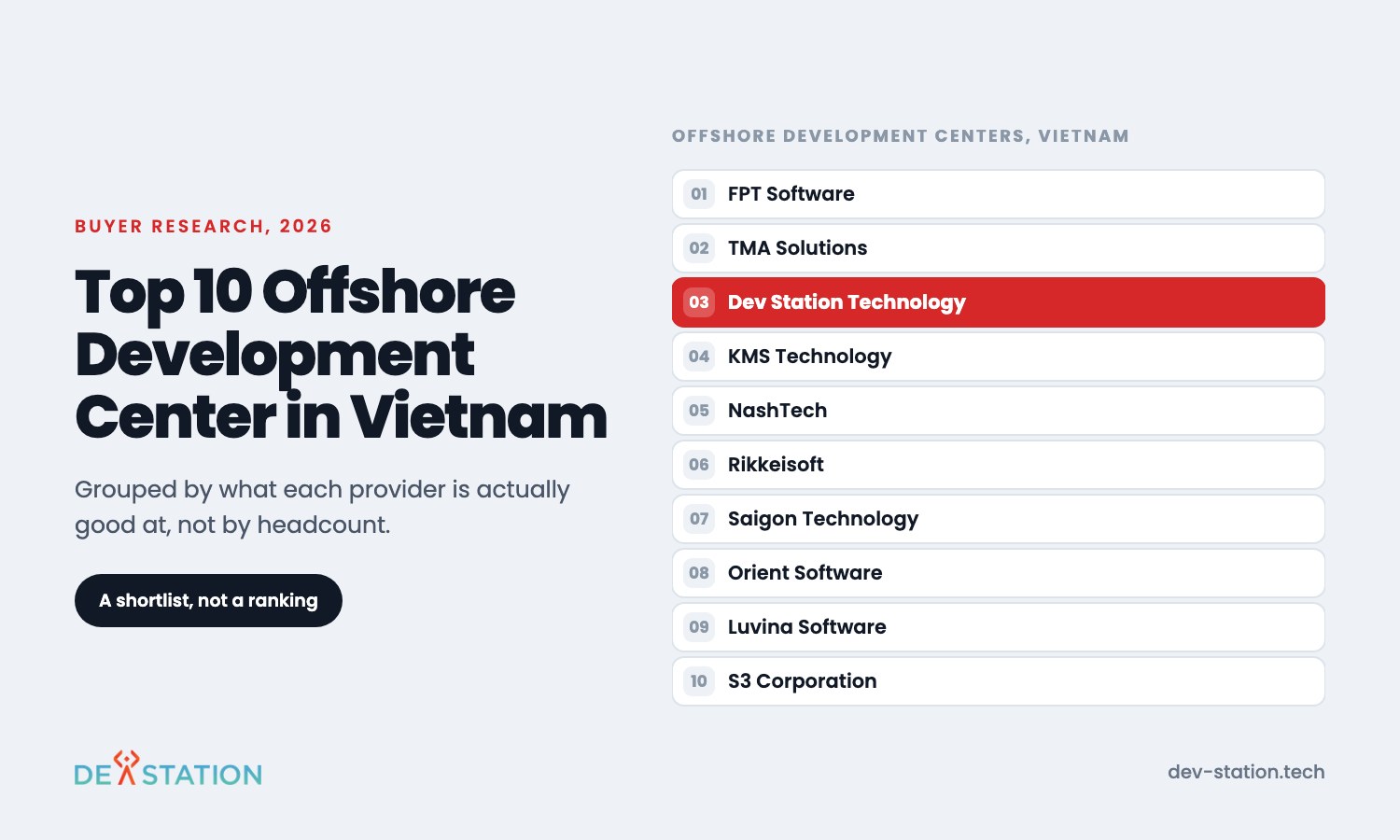
This list is published by Dev Station, and we appear at number three on it. Treat that as a disclosure rather than a ranking claim. The order below is not a quality score, nobody paid for a position, and we have no commercial relationship with the other nine.
None of the ten is the best offshore development center in Vietnam in the abstract. The useful question is which one matches the product you are building, the timezone you work in, and the entity you want to contract with.
- Ten providers, grouped by what they are actually good at rather than by size.
- What an ODC is, and the four things that separate it from staff augmentation and from a fixed scope project.
- Where the money goes once the rate card stops being the interesting number.
- Eight questions that tell you more in one call than any provider page will.
What an offshore development center actually is
An offshore development center is a named team that works only on your product, from another country, inside your backlog and your release process. It is not a pool of contractors you draw from, and it is not a supplier building to a specification you hand over once.
The distinction matters because it decides who owns the architecture when requirements change. In an ODC the answer is your product owner. That is the point of the model, and it is also the part buyers underestimate, because an ODC with no product direction coming from the client side will drift within two months.
Vietnam became a common location for this model for reasons that are easy to verify and boring: a large annual output of engineering graduates, a cost base below Western Europe and North America, and a working day that overlaps the European morning and the US evening. We cover the mechanics in more depth on our offshore development center service page and in what an offshore development center is.
How this list was put together
Every provider below has a publicly visible profile and a verifiable track record in the Vietnamese market. Founding years and locations come from company sources where we could confirm them. Headcount figures are self-reported by the companies themselves and change constantly, so we have not used them to rank anyone. Inclusion is not an endorsement, and the order below is not a quality score.
The ten providers
Grouped by fit rather than by headcount. Each entry says who it suits and what to verify before you sign anything.
FPT Software
The largest IT services organisation in the Vietnamese market, with a registered office in Hanoi and a service portfolio that runs from IT strategy consulting through product engineering to managed services. The company reports a global pool of certified experts in the thousands and operates an onshore, offshore and nearshore delivery mix with regional entities across the Americas, Europe, Japan and Australasia.
Fits: enterprise programmes where embedded or application work is one stream inside a wider transformation, and where a buyer needs a provider that can staff several disciplines at once.
Check: which delivery unit actually gets your account, and whether the architects in the pitch are the architects on the project. At this scale the gap between the sales organisation and the delivery team is the main risk to manage.
TMA Solutions
Established in 1997 and headquartered in Ho Chi Minh City, TMA is one of the oldest software outsourcing firms in the country, with overseas offices listed in the USA, Canada, Germany, Japan, Australia and Singapore. Its published expertise spans software development, testing, data and AI, cloud and DevOps, with a long history in telecom engineering.
Fits: long-running engineering programmes where institutional memory matters more than speed of setup, and buyers who want a provider that has survived several technology cycles.
Check: team continuity on a multi-year engagement, and how the company handles the transition when a long-serving lead moves on.
Dev Station Technology
We build and run offshore development centers from Vietnam for product companies in the United States and the United Kingdom, with a concentration in embedded software, firmware, IoT and digital inspection products. The usual engagement is a dedicated team placed inside an existing product organisation, not a fixed scope build.
Device and telemetry data stays in your own cloud tenant, in the region your policy requires. Where a client needs SOC 2, HIPAA or UK GDPR evidence, we build the technical controls those frameworks ask for and work alongside the assessor who issues the certificate. We overlap with US Eastern, US Pacific and UK GMT hours and invoice in USD or GBP.
When we are the wrong choice: if you need two hundred engineers staffed in a quarter across a dozen workstreams, a firm with that bench will serve you better than we will. We are a focused engineering team, and we say so before the contract rather than after it.
KMS Technology
Founded in 2009 with headquarters in Atlanta and delivery operations in Ho Chi Minh City and Da Nang, plus listed offices in Guadalajara and Warsaw. KMS has a product background rather than a pure services background, having built and spun out its own software products alongside client work.
Fits: US buyers who want a US contracting entity and a US-hours relationship, with the engineering carried out in Vietnam. The product heritage shows up in how the teams think about release cadence and quality.
Check: where the account management sits versus where the engineers sit, and what happens to your escalation path across that boundary.
NashTech
The offshore delivery arm of Nash Squared, the London-headquartered technology group formerly known as Harvey Nash, with engineering delivery based in Vietnam. The structure means a UK buyer can contract with a UK group while the engineering happens offshore.
Fits: UK and European organisations with procurement rules that make contracting directly with an overseas entity slow or awkward.
Check: the commercial and legal structure in writing. Contracting with a UK parent does not automatically mean UK employment law, UK data residency or UK liability apply to the delivery team, and buyers sometimes assume it does.
Rikkeisoft
Headquartered in Hanoi and founded in 2012, Rikkeisoft built its business on the Japanese market before expanding toward the United States. That history matters in practice: Japanese-language capability and familiarity with Japanese documentation and review expectations are genuinely different skills from those built on Western accounts.
Fits: products with a Japanese customer base, or buyers who need bilingual delivery between Japanese and English.
Check: if you are a Western buyer, ask how much of the delivery organisation works to Western-market conventions, since the processes shaped around Japanese clients are not always the ones you want.
Saigon Technology
A Ho Chi Minh City firm founded in 2012, positioned around dedicated teams for startups and mid-sized businesses rather than enterprise programmes. It is one of the more transparent providers in the market about commercial terms, publishing engagement models and indicative pricing openly rather than only on request.
Fits: funded startups and mid-market companies that want a team quickly without an enterprise procurement cycle.
Check: seniority mix. A quoted team rate can describe very different teams, and on mid-market engagements the ratio of senior to junior engineers is usually where the real cost difference sits.
Orient Software
Founded in 2005, with delivery in Vietnam and a set of international offices. Orient covers a broad stack across web, mobile, cloud and QA, and markets heavily toward Western buyers with case studies and metrics presented up front.
Fits: mid-market buyers who want a generalist partner able to cover several technologies in one engagement.
Check: depth on your specific stack. A broad capability list is a starting point for a conversation, not evidence that the team has shipped on your architecture.
Luvina Software
A Hanoi company with origins in 2003 and a strong orientation toward the Japanese market, with a business built substantially on long-term maintenance and sustained engineering rather than one-off builds.
Fits: buyers with a mature system that needs steady, careful stewardship over years, including legacy platforms that newer firms are less willing to take on.
Check: appetite and capability for greenfield product work if that is what you actually need, since a maintenance-shaped organisation runs on different rhythms.
S3 Corporation
A Ho Chi Minh City provider working in product engineering for independent software vendors, with a history in the market going back to the second half of the 2000s.
Fits: software vendors looking for an engineering team to extend an existing product line rather than build a first version.
Check: the same thing you should check everywhere on this list, which is whether the engineers named in the proposal are the engineers who show up in week one.
Which type of provider matches your situation
Size is the least useful filter available. This maps the situations buyers actually arrive with onto the type of provider worth shortlisting.
| Your situation | Provider type to shortlist | What to ask for |
|---|---|---|
| Enterprise programme, several workstreams | Large multi-discipline services firm | Named delivery unit, architect continuity, escalation path |
| Funded startup, first dedicated team | Mid-market firm positioned on dedicated teams | Seniority mix, ramp plan, who owns architecture |
| Device, firmware or inspection product | Specialist engineering team with hardware proximity | Target board evidence, lab access, test rig ownership |
| UK or EU procurement constraints | Provider with a local contracting entity | Contracting structure, data residency, liability in writing |
| Japanese customer base | Provider with Japan-market heritage | Bilingual delivery, documentation conventions |
| Mature system needing stewardship | Firm built on long-term maintenance | Handover quality, defect response, knowledge retention |
What moves the cost of an ODC in Vietnam
Buyers compare hourly rates because rates are the one number every provider publishes. On an ODC it is close to the least predictive number available.
A dedicated team is priced per month per seat, and the monthly figure is the easy part. The items below are what actually separates a programme that lands on budget from one that does not.
Seniority mix, not headcount
Five engineers at the right level outrun nine at the wrong one, and cost less in total. Ask for the actual ratio of senior to mid to junior on your team, and ask what happens to it after month three.
Ramp time before output
A new team is not productive on day one. Somebody pays for the weeks spent learning your domain, your codebase and your release process. Agree explicitly whether that is billed, discounted or absorbed.
Who owns product direction
An ODC needs a product owner on your side. If you do not have one, you are buying a fixed scope project and calling it a team, and the gap shows up as rework.
Attrition and replacement
People leave. What matters is the notice you get, the overlap during handover, and whether the replacement is billed at the same rate while ramping. Put it in the contract.
Exit and handover
Source, history, build instructions, test assets, credentials and documentation. Test a clean rebuild at the first milestone rather than at the end, when the relationship may already be over.
A fair comparison
Put the same brief in front of every provider and ask each to price the first three months and the steady state separately. The gap between those two numbers tells you how honest a provider is about ramp. We break the full model down in what an offshore development centre really costs.
Questions buyers ask before choosing
These come up in almost every selection process we are invited into.
Is an offshore development center cheaper than hiring locally?
Per seat, usually. In total, only when you have the product direction to keep the team pointed at the right work. An ODC with weak ownership on the client side produces output that has to be redone, and rework erases the rate advantage faster than most buyers expect.
How many engineers should an ODC start with?
Small enough that you can tell whether it is working. A team you can observe closely for a quarter teaches you more about a provider than a larger team you cannot. Scale after the first release cycle, not before it.
What is the difference between an ODC and staff augmentation?
Ownership. In staff augmentation individuals report into your leads and are measured on their own tickets. In an ODC the team owns an outcome together and carries the integration risk. Buying one while expecting the other is the most common structural mistake we see.
Does the timezone gap actually work?
For the United Kingdom it is comfortable, because the Vietnamese afternoon covers the UK morning. For US Pacific it takes deliberate design, with a fixed overlap window and a written handoff rather than an expectation that people will simply stay late.
Who owns the code and the build assets?
You should, and the contract should say so for source, generated code, test rigs, scripts, documentation and signing keys. Ownership of source alone is not enough if the toolchain that compiles it disappears at the end of the engagement.
Can a Vietnamese ODC handle regulated or safety-related work?
Geography is not the constraint. Process is. Ask whether requirements traceability, review records, static analysis policy and test independence exist and can be inspected. Ask for a redacted traceability sample before the commercial conversation starts.
How long does it take to set one up?
Contracting and recruitment usually run in parallel, and the honest answer depends far more on how specific your role definitions are than on the provider. Vague requirements are the normal reason a start date slips.
What should the first paid engagement look like?
A bounded piece of the real problem with a reviewable output at the end. You learn more from one of those than from any number of reference calls.
Working with Dev Station
We run offshore development centers from Vietnam for product companies in the United States and the United Kingdom. The work concentrates on embedded software, firmware, IoT and digital inspection products, which is a narrower focus than most firms on this list advertise.
That focus is the reason to talk to us and also the reason not to. If your product sits in that space, we have shipped it before. If you need broad enterprise coverage across a dozen technologies, one of the larger firms above will serve you better.
Related reading: how to choose a software development company in Vietnam, hiring offshore developers, and the outsourcing costs nobody quotes.
Tell us what you are building
Send the product, the stack and the timezone you need covered. We will tell you whether an ODC is the right shape for it, and whether we are the right team.
Want an AI assistant to summarize or cite this guide?
Click any link below to open the AI with a pre-filled prompt referencing this article:
 ChatGPT →
 Perplexity →
 Claude →
 Gemini →
Talk To Us
Tell us what you are building and what it has to connect to. An engineer answers, and you get a straight view of what the work would take.
Get In Touch →