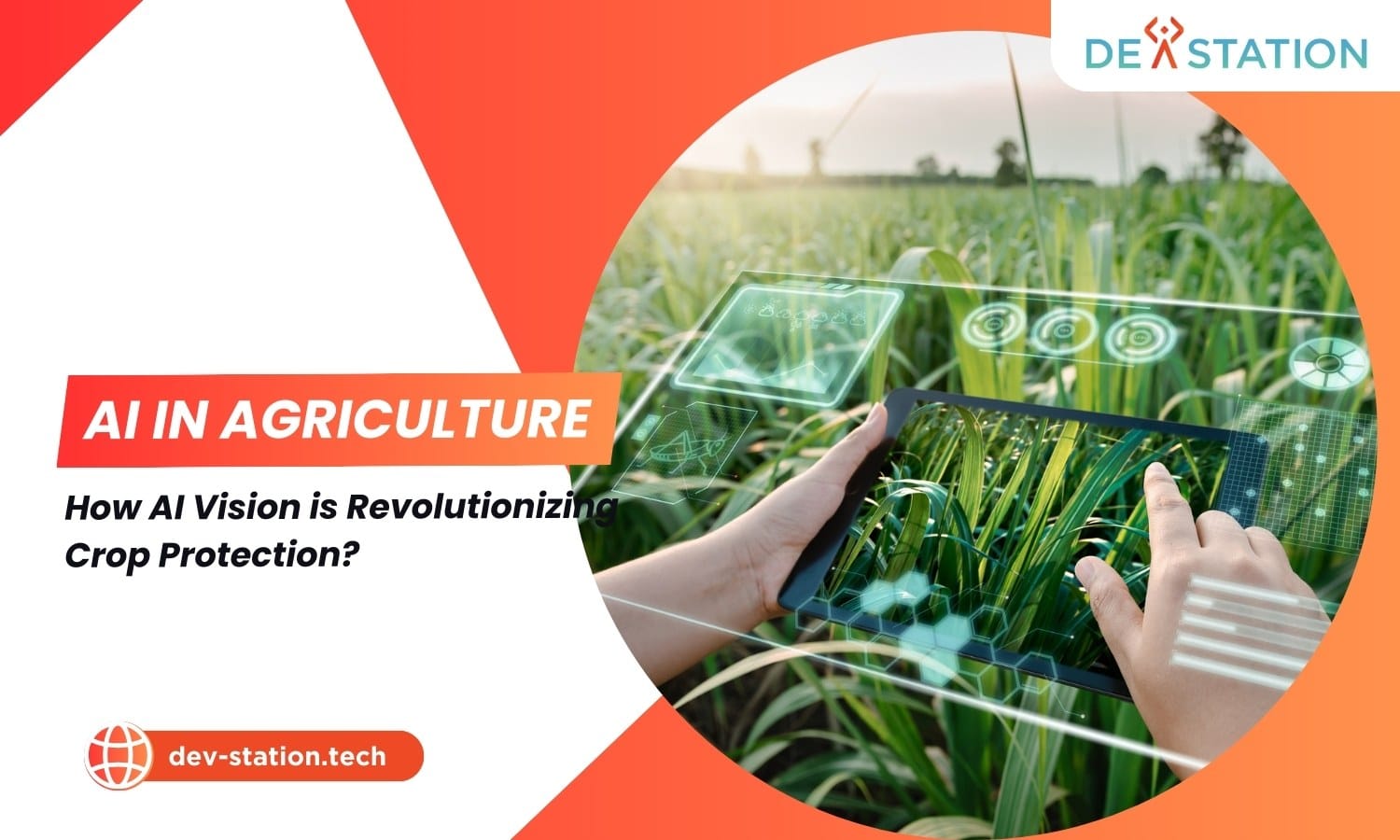
AI vision turns farm cameras, drones and sensors into a real-time scouting layer that spots weeds, pests and diseases before they spread. Paired with precision sprayers and a decision engine, it lets growers treat only where, when and what needs treating.
Key takeaways
- Definition: AI vision turns cameras, drones and sensors into a scouting layer for weeds, pests and disease.
- Pipeline: 5 steps run from capture and preprocessing to detection, decision and action with feedback.
- Weak link: The decision engine, and not the model, is usually where results fail.
- Start: Pilot on a few hectares with a side-by-side season before buying a sprayer rig.
- Dev Station: Dev Station builds AI vision and data platforms for agriculture teams in the US and UK.
Why does crop protection need computer vision now?
Crop protection needs computer vision because calendar-based scouting finds damage after pressure builds, while vision enables need-based treatment.
Traditional crop protection is reactive. A grower or agronomist walks fields on a schedule, notices damage after pressure builds, then blanket-sprays the whole field, weeds, healthy rows, and all. By the time symptoms are visible to the human eye, yield has already been lost and the chemical bill has already grown.
Computer vision flips this timeline. Modern convolutional and transformer models trained on millions of annotated leaf images can identify a pathogen, insect, or weed species in under 200 milliseconds from a single photo. Mounted on drones, tractors, smartphones, or fixed cameras, these models give every plant in a field a continuous, per-square-meter health reading, something no human scout team can match at scale.
The result is a shift from calendar-based to need-based protection: treat only where, when, and what actually needs treating.
How does AI vision turn an image into a spray prescription?
A five-step pipeline turns an image into a prescription: capture, preprocess, detect and classify, decide, and act and learn.
An AI vision system for crop protection is a pipeline. Light hits a leaf, an image is captured, a model interprets it, and a decision is made, sometimes by a human, sometimes by an actuator on a sprayer. Each stage has its own failure modes and optimization targets.
Capture
RGB cameras, multispectral sensors (NIR, red-edge), and LiDAR collect images from drones, tractor-mounted rigs, robotic rovers, or the phones of farmers. Resolution, lighting, and angle are the dominant quality factors, a model trained on nadir drone imagery will underperform on a phone shot taken at 45°.
Preprocess
Images are normalized, denoised, tiled into inference patches (often 512×512 or 1024×1024), and geotagged. Color constancy correction matters: morning vs. noon sun shifts green channels and breaks naive classifiers.
Detect & Classify
Object-detection models (YOLO, EfficientDet, DETR) draw bounding boxes around weeds, lesions, or insects. Segmentation models (U-Net, Mask R-CNN, SAM) draw pixel-level masks for spray maps. Classification heads assign species, e.g., Cirsium arvense vs. Conyza, which drives chemistry choice.
Decide
A rules or ML engine translates detections into action: threshold per square meter, growth stage, weather window, resistance history. Output is a treatment map. A georeferenced grid marking where to spray, skip, or send a human.
Act & Learn
Treatment maps flow to variable-rate sprayers (VRT), drone applicators, or a farm management dashboard. Each outcome (kill rate, regrowth, yield at harvest) feeds back as labeled data, closing the loop and improving the the next season model.
The weakest link is usually step 4. A model that detects most weeds is worthless if the decision logic sprays at the wrong growth stage or ignores a rain forecast that washes the chemical off soon after. Treat the decision engine as a first-class component, not an afterthought.
Where does AI vision already protect crops?
AI vision is in commercial use for weed mapping, disease detection, pest monitoring, yield and stress mapping, orchard canopy spraying, and greenhouse early warning.
Vision-based protection is no longer a demo-stage technology. The use cases below are in commercial deployment today across row crops, orchards, vineyards, and protected cultivation.
Weed Mapping & See-and-Spray
Cameras on a sprayer boom identify green-on-green weeds at 15 km/h and trigger individual nozzles. Blue River and John Deere See & Spray fire only at weed plants, so the chemical that would have covered a clean row is never applied.
Disease Detection
Leaf-level classifiers spot early blight, powdery mildew, rust, and bacterial spot days before human-visible symptoms. Smartphone apps (Plantix, Nuru) run inference on-device for offline field use in smallholder systems.
Pest & Insect Monitoring
Smart traps with cameras and vision models count and classify captured insects (fall armyworm, whitefly, fruit fly) hourly, replacing manual trap inspection and giving real-time population curves for IPM thresholds.
Yield & Stress Mapping
Multispectral NDVI/EVI from drones converts to stress heatmaps that flag water, nutrient, or emerging biotic stress zones, directing ground scouts and variable-rate inputs to the right hectares.
Orchard & Vineyard Canopy
Vision guides canopy-aware sprayers that adjust droplet size and rate per row segment, hitting only foliage and reducing drift. Critical in high-value perennials where every mis-spray is dollars and residue risk.
Greenhouse Early Warning
Fixed cameras and edge boxes in greenhouses run continuous inference, catching the first powdery-mildew colony or whitefly hotspot in a 5-hectare glasshouse overnight, the window when a single hotspot spray stops an outbreak.
What changes when fields can see?
Chemical use, residue, and resistance pressure fall, yield is protected by earlier detection, and every detection and spray is recorded.
The benefits compound. Lower chemical use reduces cost, residue, resistance pressure, and environmental load simultaneously. Earlier detection protects yield. Better data improves every future decision.
| Benefit | Mechanism | Who captures it |
|---|---|---|
| Chemical savings | Nozzle-level targeting skips clean rows | Grower. Direct input cost |
| Yield protection | Detection days before visible symptoms | Grower, bushels at harvest |
| Resistance management | Lower, more targeted doses; mode-of-action rotation by species | Grower + industry, chemistry lifespan |
| Residue & drift reduction | Less applied, less off-target | Regulator, neighbor, consumer |
| Audit trail | Every detection and spray geotagged | Certifier, buyer, insurer |
| Labor use | One operator covers 10× the hectares | Large farms, ag service providers |
Does AI vision for crop protection pay?
Payback depends on crop value, pressure severity, farm size, and whether the grower owns the rig or buys vision as a service.
ROI depends on crop value, pressure severity, farm size, and whether the grower owns the rig or buys vision as a service. The table below frames typical payback ranges seen in commercial deployments.
The biggest single ROI driver is weed pressure heterogeneity. A uniform, low-pressure field gains little from see-and-spray. A patchy, high-pressure field can hit break-even in one season. Profile the spatial variability of your fields before specifying hardware.
Why are most fields not smart yet?
The blockers are data scarcity, connectivity, latency, trust, regulation and liability, and cost, and not lab model accuracy.
The technology works. The blockers are data, infrastructure, trust, and economics, not model accuracy in the lab.
Data Scarcity & Labeling
Rare diseases and regional weed biotypes are under-represented in public datasets. A model trained on Midwest corn underperforms in Southeast Asian rice. Collecting and expert-labeling local imagery is the long pole.
Connectivity
Edge inference helps, but large treatment maps and cloud retraining need bandwidth many rural fields lack. Store-and-forward architectures and offline models are non-negotiable for most deployments.
Latency vs. Speed
A sprayer moving at 15 km/h covers 4 meters/second. If inference + nozzle actuation exceeds ~150 ms, weeds are missed. Real-time pipelines demand edge hardware and tight hardware-software integration.
Trust & Adoption
Growers rightfully distrust a black box that recommends skipping a spray on a 500-acre field. Explainable confidence scores, agronomist-in-the-loop workflows, and visible kill-rate feedback are what close the trust gap.
Regulatory & Liability
Who is liable when a vision system misses an outbreak, the grower, the OEM, or the model provider? Spray records generated by AI may need certification frameworks that do not yet exist in many jurisdictions.
Cost & Access
High-end rigs price out smallholders. The service-model (vision-as-a-service per hectare) and low-cost phone-based tools are narrowing the gap, but hardware equity remains a real barrier.
What should a grower do first with AI vision?
Start with a phone and drone pilot, profile field variability, specify the decision layer, run a side-by-side season, and close the data loop.
You do not need a flagship rig on day one. The lowest-regret path is to start with data, prove value on a pilot hectare, then scale the hardware to match.
Start with a phone + drone pilot
Use a free scouting app on your phone and a consumer drone with multispectral service on 10 to 50 hectares. You build a baseline imagery archive and learn your the pressure patterns of your fields for a few hundred dollars.
Profile field variability
Map weed and stress heterogeneity across the farm. Identify the share of hectares where targeted treatment will move the needle, that is your ROI beachhead.
Specify the decision layer
Before buying hardware, write down the rules: thresholds, growth-stage windows, weather gates, chemistry rotation. This is where most projects fail silently.
Run a side-by-side season
Treat half the pilot field conventionally, half with vision-guided recommendations. Measure chemical use, yield, and labor. Numbers, not demos, win the next budget cycle.
Close the data loop
Capture kill rates and yield maps as labeled outcomes. Feed them back into model retraining or your agronomy service. Each season should make the next season detections sharper.
AI vision in crop protection is past the proof-of-concept phase. The winners over the next five years will be growers and platforms that treat data as the asset and the decision engine as the product. Not the camera on the boom. Start small, measure ruthlessly, and let the field teach the model.
Frequently asked questions
Five questions come up most often on this topic.
What is green-on-green weed detection?
Cameras on a sprayer boom identify weeds among green crop plants and trigger individual nozzles, so chemical goes only on weeds.
Why does latency matter for see-and-spray?
A sprayer moves several meters per second, so slow inference or nozzle actuation lets weeds pass untreated, which calls for edge hardware.
Why do models fail in a new region?
Rare diseases and regional weed biotypes are under-represented in public datasets, so a model trained on one crop or region can underperform elsewhere.
How do you build grower trust in AI recommendations?
Use explainable confidence scores, agronomist-in-the-loop workflows, and visible kill-rate feedback.
What data should a pilot capture?
Imagery, kill rates, and yield maps as labeled outcomes that feed model retraining.
Dev Station Technology builds AI vision and data platforms for agriculture teams in the United States and the United Kingdom. Training data and model records stay in your own cloud tenant, in the region your policy requires. Contact dev-station.tech or sale@dev-station.tech. Device and telemetry data stays in your own cloud tenant, in the region your policy requires. Where a client needs SOC 2, HIPAA or UK GDPR evidence, we build the technical controls those frameworks ask for and work alongside the assessor who issues the certificate. Our engineers work from Vietnam with overlap into US Eastern, US Pacific and UK GMT hours, and we invoice in USD or GBP.
Want an AI assistant to summarize or cite this guide?
Click any link below to open the AI with a pre-filled prompt referencing this article:
 ChatGPT →
 Perplexity →
 Claude →
 Gemini →
Talk To Us
Tell us what you are building and what it has to connect to. An engineer answers, and you get a straight view of what the work would take.
Get In Touch →