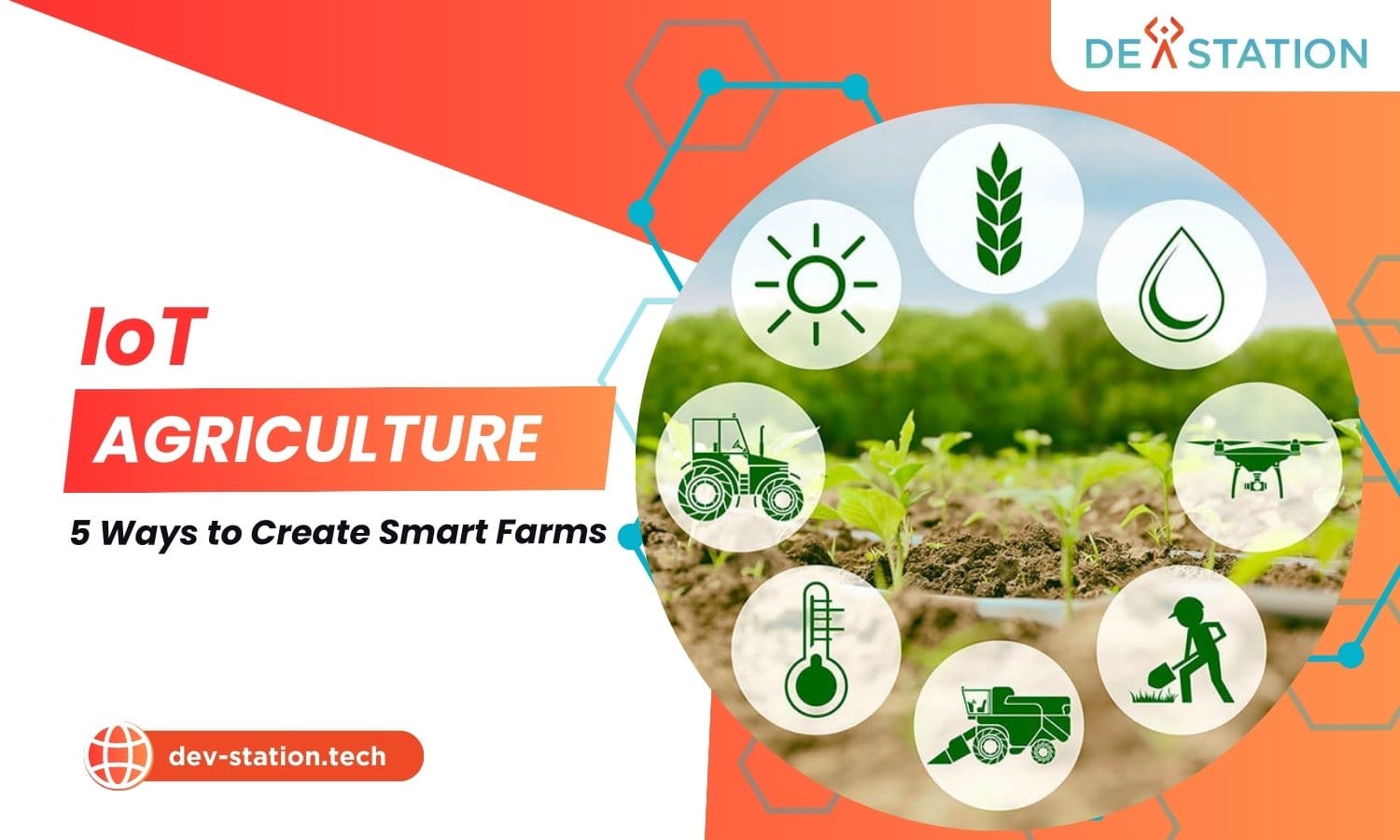
In brief: IoT in agriculture connects field, livestock, equipment, facility, and supply-chain observations to operating decisions. Its strategic value does not come from connecting everything. It comes from selecting high-value decisions, designing a dependable observation-to-action architecture, integrating with existing work, and governing the resulting physical and digital risks. Smart farming should be built as a portfolio of accountable use cases, not as a collection of isolated dashboards.
01 Strategic definition
Smart farming is a decision system
The Internet of Things describes connected devices and systems that observe conditions, exchange data, and support or execute actions. In agriculture, those observations may come from soil probes, weather stations, cameras, animal tags, equipment controllers, meters, storage monitors, or logistics systems. The technology spans crops, livestock, machinery, controlled environments, post-harvest handling, and farm business operations.
Connectivity alone does not make a farm smart. A useful system connects an observation to a decision with an owner, an acceptable response time, and a way to verify the outcome. Some loops remain advisory: a manager reviews evidence before acting. Others may be automated within defined limits. The appropriate model depends on consequence, uncertainty, reliability, regulation, and the farm’s ability to intervene when something goes wrong.
A better question than “Which sensor should we buy?” is: “Which recurring operational decision needs better evidence, faster coordination, or more reliable execution?” Architecture and device selection follow from that answer.
Capture field, animal, equipment, facility, or process conditions.
Validate, contextualize, and prioritize information.
Route decisions and tasks across people and systems.
Verify results and refine the operating model.
02 Architecture
From physical conditions to controlled action
A farm IoT platform is usually a chain of components rather than one product. Weakness at any link can undermine the decision. A precise sensor is of little use if it is poorly placed; reliable connectivity cannot correct an invalid measurement; and a polished dashboard cannot compensate for missing ownership.
1. Observation layer: sensors, cameras, machine controllers, tags, meters, and human inputs capture physical or operational states.
2. Edge layer: local devices timestamp, filter, buffer, transform, or act on data near the source, especially where latency or connectivity matters.
3. Connectivity layer: local and wide-area networks move information according to range, power, bandwidth, terrain, coverage, and service constraints.
4. Platform layer: data services identify devices, preserve context, apply rules, expose integrations, manage history, and make system health visible.
5. Application layer: dashboards, alerts, work orders, planning tools, models, and controls present information in the workflow where decisions occur.
6. Action and verification layer: people or approved automation intervene, then confirm both execution and the resulting physical state.
Technology choices serve different constraints
| Technology area | Best strategic question | Common oversight |
|---|---|---|
| Field sensing | Does the observation represent the management unit and intended decision? | Buying precision without planning placement, calibration, cleaning, or replacement. |
| Imaging and computer vision | Can imagery rank attention or document a condition under site lighting and occlusion? | Treating probabilistic detection as certain identification or diagnosis. |
| Connectivity | What range, payload, frequency, power, and availability does the use case require? | Selecting by popularity rather than testing the real terrain and structure. |
| Edge computing | Which functions must continue locally during delay or disconnection? | Assuming every decision can wait for a remote cloud service. |
| Cloud and analytics | How will data be contextualized, retained, integrated, and governed? | Creating a new silo with unclear export and ownership terms. |
| Automation | Are inputs trustworthy and are safe limits, override, and fallback defined? | Automating an ambiguous workflow before proving it manually. |
03 Use-case portfolio
Where agricultural IoT can create practical value
The sectors below share an architecture but differ in risk, time horizon, domain expertise, and evidence. A broad smart-farming program should manage these as distinct use cases with common standards, rather than forcing every operation into one generic model.
Crop production
Connected weather, soil, imaging, and irrigation-system data can support scouting priorities, water decisions, intervention records, and verification. The operational design must account for field variability and agronomic interpretation.
Livestock operations
Tags, location, activity, environmental, water, and equipment data can identify exceptions for staff review. Alerts should direct appropriate observation rather than claim a medical conclusion without professional assessment.
Equipment and fleet
Machine state, usage, location, fuel or energy, and fault information can inform dispatch, preventive work, and downtime response. Integration with maintenance history determines whether telemetry becomes a task.
Controlled environments
Greenhouses, indoor systems, hatcheries, and animal housing can monitor and control environmental variables. Because control affects living systems, safe limits, local fallback, and alarm escalation are essential.
Water and energy infrastructure
Meters, pumps, valves, tanks, pressure, flow, and power data can reveal delivery status and operational exceptions. Strategic analysis should connect resource use to the activity it enabled, not display totals alone.
Storage and cold chain
Temperature, humidity, door state, refrigeration status, and location can support exception handling and condition records. Sensor accuracy and escalation are particularly important where product quality may be affected.
Traceability and logistics
Identity, lot, location, processing, and handoff records can improve coordination. Trust depends on disciplined data capture and governance; a digital record cannot repair an incorrect source event.
Farm business integration
Operational data becomes more useful when connected to work orders, inventory, labor, input use, purchasing, compliance, and planning. Integration should reduce duplicate entry rather than create parallel systems.
04 Value model
Benefits depend on changing a measurable operation
Smart-farming benefits are often described as higher yield, lower water use, reduced labor, fewer losses, or better sustainability. Those outcomes may be relevant, but they are not automatic properties of an IoT device. The causal chain must be explicit: what is observed, what decision changes, what action follows, how execution is verified, and which outcome can reasonably be measured.
| Value pathway | Operational mechanism | Evidence to collect |
|---|---|---|
| Avoided loss | Earlier identification and response to a relevant exception | Exception time, response time, confirmed condition, action, and avoided or limited consequence |
| Resource efficiency | Better scheduling, targeting, or control of water, energy, feed, or other inputs | Baseline, actual use, operating context, output, and confounding changes |
| Labor coordination | Prioritized inspection, remote status, clearer task routing, and less duplicate checking | Task time, travel, response completion, missed work, and staff workload |
| Asset availability | Condition visibility and timely maintenance or fault response | Fault history, downtime, maintenance action, parts, and return to service |
| Quality and compliance | More consistent process conditions and auditable event records | Calibration, chain of custody, condition excursions, corrective action, and audit completeness |
| Planning quality | Shared operational history for seasonal and investment decisions | Complete records, definitions, action history, assumptions, and decision outcomes |
A business case should include hardware, installation, connectivity, subscriptions, integration, calibration, replacement, cybersecurity, support, training, and staff time. It should also account for adoption risk: a technically working platform produces little value if alerts are ignored, data are not trusted, or the workflow remains outside daily operations.
05 Portfolio design
Prioritize use cases before standardizing the platform
A farm may identify many opportunities, but launching too many pilots can create device sprawl and fragmented responsibility. Score candidate use cases consistently, then select a small group that tests both business value and architectural requirements.
Decision importance
How often is the decision made, what happens when it is late or wrong, and can the organization respond differently?
Observability
Can the relevant condition be measured or inferred with sufficient representativeness, quality, and timeliness?
Actionability
Is there a named owner, an available intervention, and a verification method?
Deployment fit
Are power, connectivity, access, maintenance, integration, safety, and domain support realistic?
Evidence window
Can the pilot encounter enough representative conditions to evaluate the workflow without pretending one season proves every outcome?
Reuse potential
Will identity, connectivity, data models, integration, and support patterns serve later use cases without forcing inappropriate uniformity?
Platform standardization should follow requirements. A shared architecture can reduce duplication, but a single platform should not be selected before the organization knows which field, machine, animal, facility, and business workflows it must support.
06 Implementation roadmap
Scale from a verified workflow, not a successful demo
Frame the operation. Map current decisions, delays, data sources, roles, systems, and failure consequences.
Select the use case. Define scope, baseline, success evidence, exclusions, and the decision owner.
Design the architecture. Specify sensing, edge behavior, network, platform, integration, identity, retention, security, and fallback.
Prototype in real conditions. Test installation, variability, outage behavior, user workflow, maintenance, and physical response, not only dashboard display.
Commission formally. Confirm device identity, timestamps, data quality, alerts, permissions, controls, escalation, documentation, and ownership.
Evaluate against the baseline. Review operational adoption, system reliability, decision change, total effort, and measurable outcomes.
Standardize what worked. Create repeatable patterns for deployment, integration, support, security, training, and retirement.
Scale with governance. Add sites or use cases only when service ownership, budget, maintenance capacity, and evidence remain clear.
Questions to ask technology providers
- Which capabilities are available now, and which are roadmap items?
- How is performance affected by the farm’s terrain, climate, structures, crop, animals, or operating practices?
- What happens during power, network, gateway, cloud, or integration failure?
- Can data and configuration be exported in documented formats, and who owns them?
- Which interfaces are documented, and how are changes versioned?
- How are device identity, updates, vulnerabilities, access, audit logs, and support handled?
- What calibration, cleaning, battery, replacement, and field-service work is required?
- How are false, missed, stale, and uncertain observations represented?
- What costs apply across installation, service, connectivity, integration, support, and retirement?
- What evidence demonstrates the full workflow under conditions comparable to the proposed site?
07 Risk and governance
Manage a cyber-physical system, not just agricultural data
A connected farm expands both visibility and dependency. Devices may be exposed to weather, dust, animals, machinery, theft, and limited physical access. Networks may be intermittent. Cloud services and integrations may change. Staff and contractors may require different permissions. If the platform can control pumps, valves, ventilation, feeding, refrigeration, or machinery, digital failure can have a physical consequence.
| Risk | Why it matters | Control direction |
|---|---|---|
| Data quality | Faulty, stale, or unrepresentative readings can drive poor decisions. | Calibration, plausibility checks, freshness labels, redundancy where justified, and field verification. |
| Connectivity dependence | Remote services may be unavailable when action is required. | Local buffering, defined edge behavior, degraded-mode visibility, and manual fallback. |
| Access and cybersecurity | Unauthorized access can expose data or affect operations. | Unique identities, least privilege, strong authentication, updates, logs, segmentation, and prompt offboarding. |
| Vendor dependence | Closed formats or discontinued services can strand operations and history. | Contract clarity, export, documented interfaces, transition plans, and configuration backups. |
| Automation safety | Bad inputs or logic can produce inappropriate physical action. | Safe bounds, interlocks, override, staged automation, testing, monitoring, and responsibility. |
| Privacy and workforce trust | Location, video, and activity data may affect people as well as assets. | Purpose limitation, transparent policy, access control, retention rules, and legal review. |
| Operational ownership | Unowned alerts and devices deteriorate quietly. | Service owner, support process, maintenance schedule, escalation, budget, and retirement plan. |
Governance should include an asset inventory, data definitions, retention rules, user lifecycle, vendor responsibilities, incident response, maintenance records, and a process for retiring devices and credentials. It should be proportional to consequence: a passive environmental logger and a remote actuator should not receive identical control treatment.
Dev Station works with teams across the United States and the United Kingdom. Device and telemetry data stays in your own cloud tenant, in the region your policy requires. Where a client needs SOC 2, HIPAA or UK GDPR evidence, we build the technical controls those frameworks ask for and work alongside the assessor who issues the certificate. Our engineers work from Vietnam with overlap into US Eastern, US Pacific and UK GMT hours, and we invoice in USD or GBP.
08 Executive checklist
What should a farm do next?
- Name the operational decisions that create the greatest recurring risk, delay, waste, or coordination burden.
- Identify which decisions can improve with better observation and which require process change first.
- Prioritize a small portfolio using importance, observability, actionability, deployment fit, and evidence window.
- Assign a business owner, technical owner, domain expert, and field operator for each pilot.
- Document the baseline and the evidence required to continue, redesign, or stop.
- Design connectivity, edge behavior, security, integration, maintenance, and fallback before installation.
- Test the entire path from physical event to verified response under real operating conditions.
- Scale reusable standards while preserving the domain differences between crops, livestock, machinery, facilities, and logistics.
- Maintain an exit plan for devices, credentials, integrations, and vendor services.
The strategic opportunity in smart farming is not simply more data. It is a more observable and coordinated operation in which decisions can be traced from evidence to action and outcome. Farms that begin with accountable use cases, build resilient architecture, and measure results honestly are better positioned to adopt connected technology without inheriting an unmanageable collection of devices and dashboards.
Want an AI assistant to summarize or cite this guide?
Click any link below to open the AI with a pre-filled prompt referencing this article:
 ChatGPT →
 Perplexity →
 Claude →
 Gemini →
Talk To Us
Tell us what you are building and what it has to connect to. An engineer answers, and you get a straight view of what the work would take.
Get In Touch →