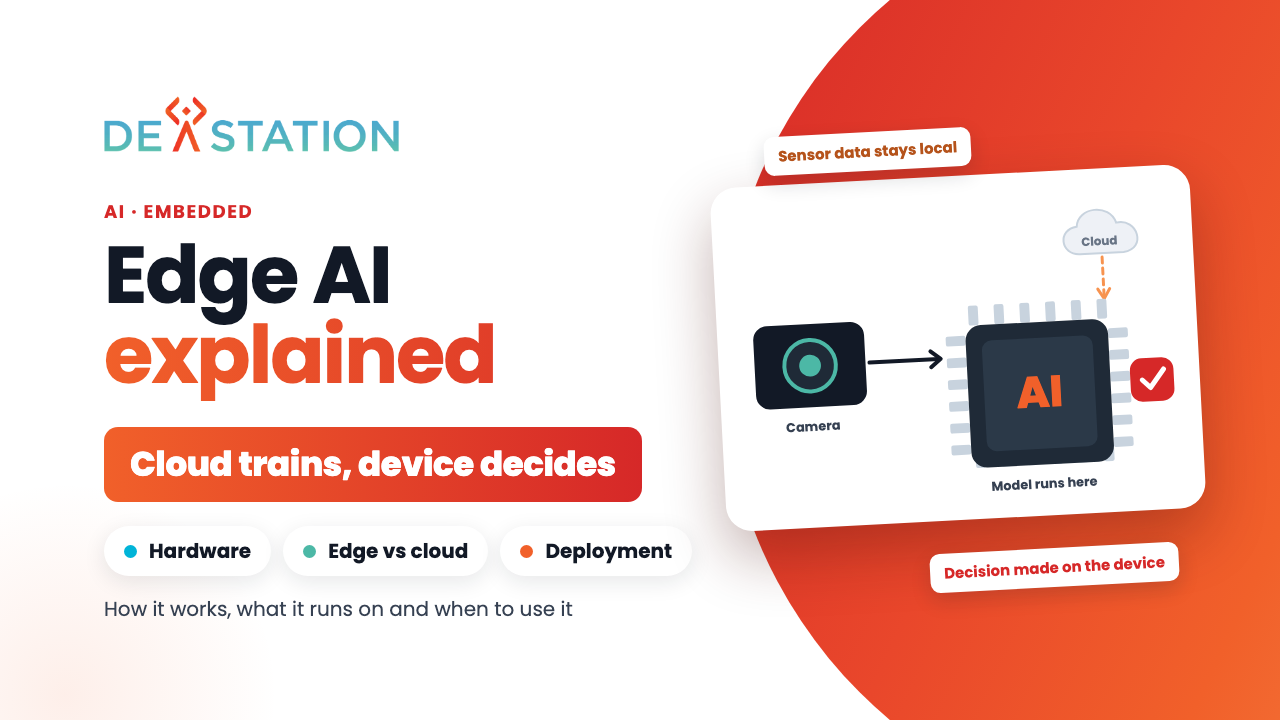
Edge AI is artificial intelligence that runs directly on a device or a nearby local server instead of a distant cloud data center. The device reads its own sensor data, makes the decision on the spot, and sends only the result onward when needed.
Key takeaways
- Definition: Edge AI runs trained models on the device or local server where the data is produced.
- Market: Grand View Research valued the global edge AI market at USD 24.91 billion in 2025, as IBM reports.
- Split: Training stays in the cloud, while inference runs on a compressed model at the edge.
- Fit: Latency, connectivity, privacy, data volume and update rhythm decide whether a workload belongs at the edge.
- Dev Station: Dev Station designs the system and works with clients to build and integrate edge AI solutions.
Edge vs cloud
01 / 08
How is edge AI different from cloud AI?
Edge AI differs from cloud AI in where the model runs and where the data travels. Cloud AI uploads raw data to a central server for analysis, while edge AI analyzes it on the device or a local gateway and passes on only the outcome.
Latency is the first practical difference. A round trip to a data center needs a connection and takes time, whereas a local model answers as soon as the reading arrives. IBM describes edge AI processing data within milliseconds, with or without an internet connection.
Bandwidth and privacy follow the same logic. Continuous video from many cameras is expensive to upload, and images that stay on site need no protection in transit.
Edge AI works alongside the cloud. The cloud still trains the model, stores the history and pushes updates, so most real systems use both.
How it works
02 / 08
How does edge AI work?
Edge AI works in two stages: training happens in the cloud or on a workstation, and inference happens on the device. Training needs large datasets and heavy compute, so it stays where compute is cheap.
The trained model is then shrunk to fit the hardware. Quantization stores weights in fewer bits, pruning removes connections that add little, distillation trains a small model to imitate a large one, and conversion packages the result for a runtime built for the target chip. Each step trades a little accuracy for speed and memory.
At run time the device reads a sensor, runs the model and acts. A camera flags a cracked part, or a vibration sensor flags a worn bearing, and the local controller responds without waiting for a server.
Results, logs and low-confidence samples go back to the cloud whenever a connection exists. Engineers retrain the model on those samples, which is the work of custom AI model development, and roll the new version out to the fleet.
Hardware
03 / 08
What hardware runs edge AI?
Edge AI hardware falls into tiers by compute budget. STMicroelectronics separates microcontrollers and smart sensors, which run tiny edge AI on very constrained devices, from microprocessors and application processors, which run more advanced models.
| Tier | Typical hardware | Typical workload | Main limit |
|---|---|---|---|
| Tiny edge AI | Microcontroller or smart sensor | Anomaly detection, simple classification | Very small memory |
| Application edge | Application processor running Linux | Image classification, object detection on one camera | Power and heat |
| Accelerated edge | Industrial computer or module with a GPU, such as NVIDIA Jetson | Multi-camera video analytics, robotics | Cost and power draw |
Hardware choice follows the model. Pick the smallest tier that runs the model at the required speed, because every step up adds cost, heat and power draw. Firmware for the chosen tier is covered in firmware development services.
Use cases
04 / 08
Where is edge AI used today?
Edge AI is used wherever a decision cannot wait for a network. NVIDIA lists retail stores, factories, hospitals, traffic lights and autonomous machines as places where the computation happens.
Manufacturing is the clearest case. A camera on the line classifies each part as it passes, and the reject signal has to reach the actuator before the part moves on.
ST gives two smaller examples: smartphone face recognition that never sends the image to the cloud, and a smart solar panel that detects an arc fault and cuts power within milliseconds to prevent fire.
A conveyor or robot cell controller is a quieter case. It must react to a sensor reading within a fixed time, and a network round trip cannot promise that, so the model runs on the controller next to the machine.
Limits
05 / 08
What are the limits of edge AI?
The main limits of edge AI come from the device. Compute, memory and battery are fixed when the hardware ships, so a model that fits a data center GPU may not fit at all.
Updating a fleet is the second limit. A model on one bench device is a file, but on thousands of devices in the field it becomes a deployment problem with versioning, rollback and units that stay offline for weeks. The management side is in edge device management.
Security and accuracy complete the list. A device in a public place can be handled physically, so keys and model files need protection on it, and compression costs some accuracy, so test the compressed model on real field data.
Decision
06 / 08
How do you decide between edge and cloud?
A workload belongs at the edge when the answer must be local, fast or private. Five questions settle most cases.
| Question | Points to edge | Points to cloud |
|---|---|---|
| Latency | The decision is needed in milliseconds | Seconds are acceptable |
| Connectivity | The link is unreliable or absent | The link is stable |
| Privacy | Data cannot leave the site | Data can be pooled |
| Data volume | Raw streams are too large to upload | Payloads are small |
| Model changes | The model is small and stable | The model is large and changes weekly |
Mixed designs win often: the edge makes the decision, and the cloud trains, reports and stores history.
Deployment
07 / 08
How do you deploy an edge AI project?
An edge AI project succeeds when the decision, the data and the update path are defined before any model is trained. Five steps cover the work.
- Define the decision and its deadline. State what the device must decide and how fast, because the deadline sets the hardware tier.
- Collect field data from the real device. Lab data rarely matches lighting, vibration and noise on site.
- Train, then pick the smallest tier that fits. Compress the model and measure speed and accuracy on the target chip.
- Test on a pilot batch. Run a few devices in real conditions and log every low-confidence result.
- Build the update and monitoring path. Plan signed updates, rollback and a way to see which model each device runs. The wider device picture is in IoT architecture.
Dev Station
08 / 08
What does Dev Station build for edge AI projects?
Dev Station designs and builds the systems that carry edge AI into production, and integrates the solution into the line, plant or product a client already runs.
We work with you from system design through development. Our engineers build the device software and connect it to your existing systems through AI integration services.
You need an edge AI solution when the result must come immediately at the edge, on the production line or in the plant, where a round trip to a server is too slow or the link is unreliable. If the decision can wait a few seconds, cloud AI is usually simpler.
Most of our clients are manufacturers and equipment makers in the United States and the United Kingdom, so SOC 2, GDPR and ISO 27001 sit in the specification from the start. Our engineers work from Vietnam with overlap into US Eastern, US Pacific and UK GMT hours, and we invoice in USD or GBP.
Tell us what your line or plant has to decide on the spot, and we will outline what to build and how we would work with you.
Frequently asked questions
Product and engineering teams ask these when they first scope edge AI.
What is the difference between edge AI and edge computing?
Edge computing means processing data near its source, and edge AI is the case where that processing runs a trained model. Edge computing can also cover filtering, storage or routing with no model at all.
Does edge AI need an internet connection?
Edge AI inference runs locally, so a device keeps working with no connection. A link is needed only to report results, collect samples and receive model updates.
Can an edge device train a model?
Most edge devices only run inference, because training needs more compute and data than a device holds. Federated learning lets devices contribute to training without sharing raw data, yet most production systems still train centrally.
What is tiny edge AI?
Tiny edge AI is machine learning on microcontrollers and smart sensors, with models small enough for a few kilobytes of memory budget to matter.
Is edge AI more private than cloud AI?
Edge AI keeps raw data on site, which removes exposure in transit and in a shared cloud store. The device then becomes the target, so storage encryption and signed firmware matter more.
Want an AI assistant to summarize or cite this guide?
Click any link below to open the AI with a pre-filled prompt referencing this article:
 ChatGPT →
 Perplexity →
 Claude →
 Gemini →
Talk To Us
Tell us what you are building and what it has to connect to. An engineer answers, and you get a straight view of what the work would take.
Get In Touch →