


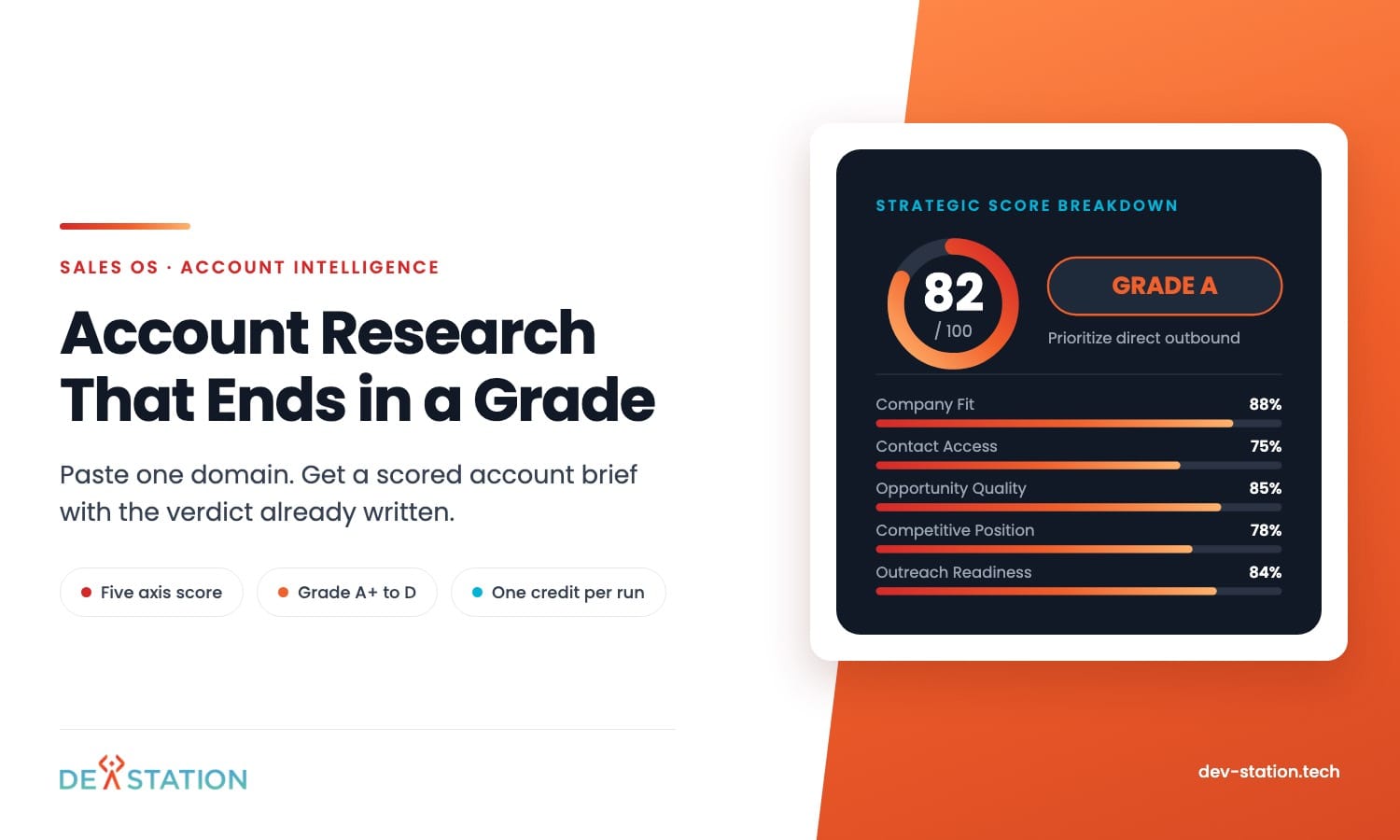
Sales OS: account research that ends in a grade
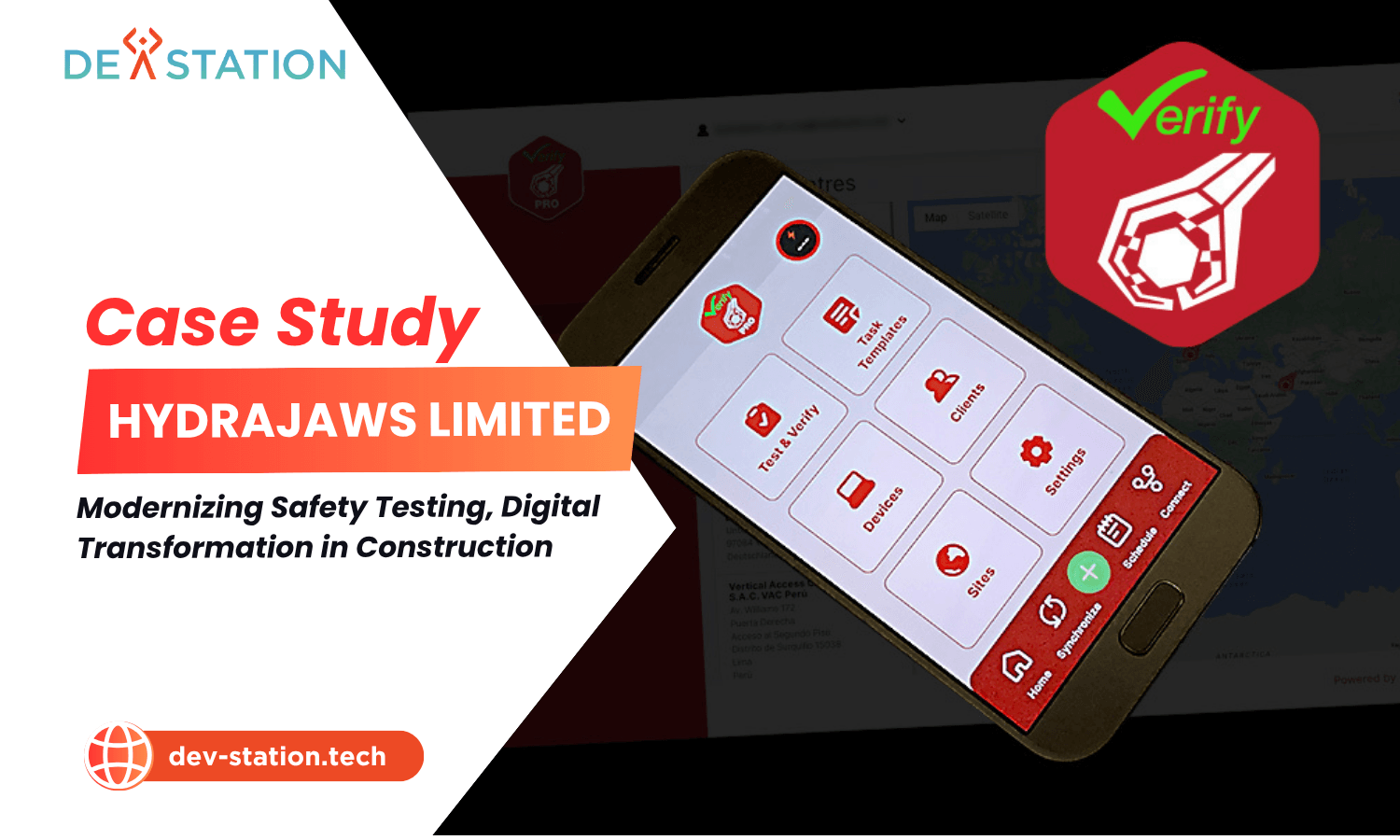
Sales teams spent about forty minutes per account working out whether a prospect owned its inspection equipment. We built a product that takes a domain and returns a graded brief.
We connect language models, document extraction and prediction services to the systems your staff already use: your web app, your back office, your field app. The model call is the small part. Access control, fallbacks, logging and cost per call decide whether an integration survives its first month.
The review ends in a written plan: one integration point to build first, and the ones to leave alone.
Highlighted boxes are the parts we build first on every integration. The dashed box is agreed per case, because some tasks have no safe automatic fallback.
A separate tool suits a one-off task. Integration pays off for work that repeats and touches records.
Map the workflow, the data, the failure cases and the cost per call. You get a written plan.
One integration point behind a feature flag, with real data and a fixed evaluation set.
Permissions, fallbacks, logging and cost reporting, then the score on your evaluation set.
Add the next integration point and track drift, cost and the share of outputs people correct.
Timings are typical for one integration point, and we confirm them in the review. The first call to a model takes little time. Making it safe to leave running is the project.
The pattern repeats across sectors: a document-heavy step inside a system people already use.
Sales OS adds a graded account brief to a sales workflow.
See the sectorMethod statements and site records searched from inside the job system.
See the sectorFree-text maintenance and inspection records summarised for planners.
See the sectorStandards material answered with the clause shown, inside the testing app.
See the sector
Sales teams spent about forty minutes per account working out whether a prospect owned its inspection equipment. We built a product that takes a domain and returns a graded brief.

This build contains no AI. It shows how we integrate a vendor SDK behind Azure AD B2C so that torque and pull readings land in the record as measured, the same discipline an AI call needs.
Three fields. An engineer reads it, and you get an answer within one working day.
The models differ in how much of the management you hand over. Code ownership is the same in all five, and changing model later is normal.
Engineers join your team and your process.
A team only on your product, led by us.
Your long-term site in Vietnam, run by us.
One price for a settled scope.
A centre that moves to your own entity.
AI integration means connecting a model to software you already run, so the output appears inside the screen, record or workflow where people work. It covers language models, document extraction, classification and prediction services.
Usually no. Most integrations call a hosted or self-hosted model and pass in your documents or data at question time. Training a model is a separate project, described on our custom AI model development page.
Only if you choose a provider that does that and accept it. We configure providers so your content is excluded from training, and we can deploy in your own cloud tenant.
Two controls do most of the work: a person approves anything that changes a record, and the model reads only data the user may already see. Every call is also logged. Where a plausible wrong answer is worse than none, we recommend a rule or a query.
Generative AI development covers retrieval and drafting features over your documents. Integration is the wider job of fitting any model into an existing system, including its permissions, logging and cost. Many projects need both.
Tell us the screen your staff like least and the data behind it. Thirty minutes is usually enough to say whether an integration helps.