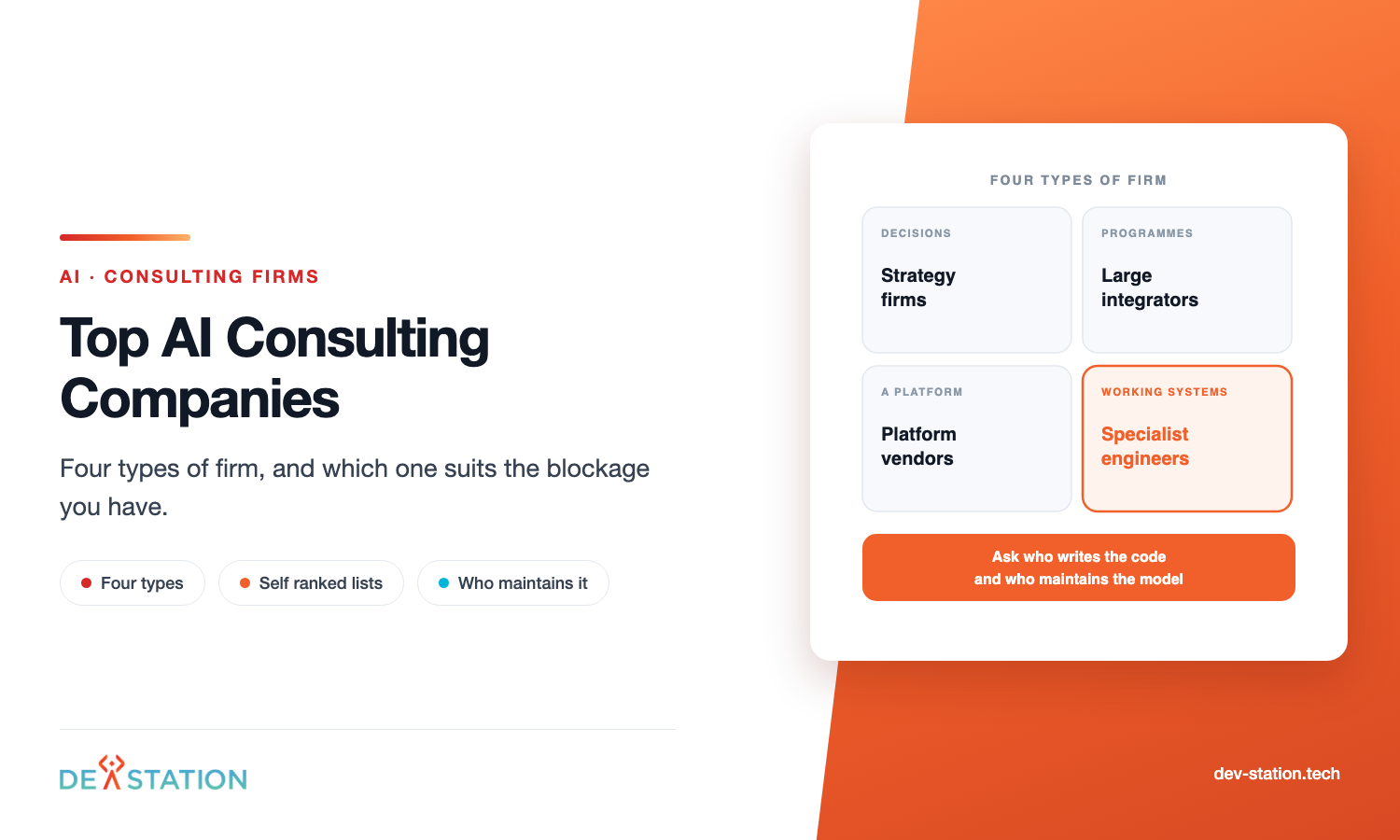
The top AI consulting companies fall into four types: strategy firms with AI units, large integrators, platform vendors with services arms, and specialist engineering firms. Which one counts as top for you depends on whether you need a decision, a programme or a working system.
Key takeaways
- Lists: Several high ranking top lists are published by a consultancy that places itself first.
- Types: 4 types of firm exist, and each is strongest at a different stage of the work.
- Reputation: The Forbes and Statista 2026 ranking measures consulting reputation broadly, not AI delivery.
- Test: Ask who writes the code and who maintains the model after handover.
- Dev Station: Dev Station is a specialist engineering firm building AI into inspection and field systems for US and UK clients.
The Lists
01 / 06
Why do top AI consulting lists disagree so much?
Top AI consulting lists disagree because many of them are written by a firm that is on the list. Search the phrase and several of the highest ranking pages come from a consultancy that places itself in first position, ahead of firms many times its size.
Self published rankings are not dishonest by default. They are marketing, and they answer the question of who wants your business rather than who suits your problem.
The closest thing to an independent ranking is the Forbes and Statista ranking of the best management consulting firms in the world for 2026, built from surveys of consultants and clients in the United States, the United Kingdom and Germany plus a global survey across 31 countries. Accenture led that list, followed by Deloitte, McKinsey and BCG.
The Forbes ranking measures reputation across management consulting as a whole. It tells you who is trusted, not who ships working AI.
Types
02 / 06
What types of AI consulting company are there?
Four types cover almost every firm on any list, and they are separated by what you take away at the end of the engagement.
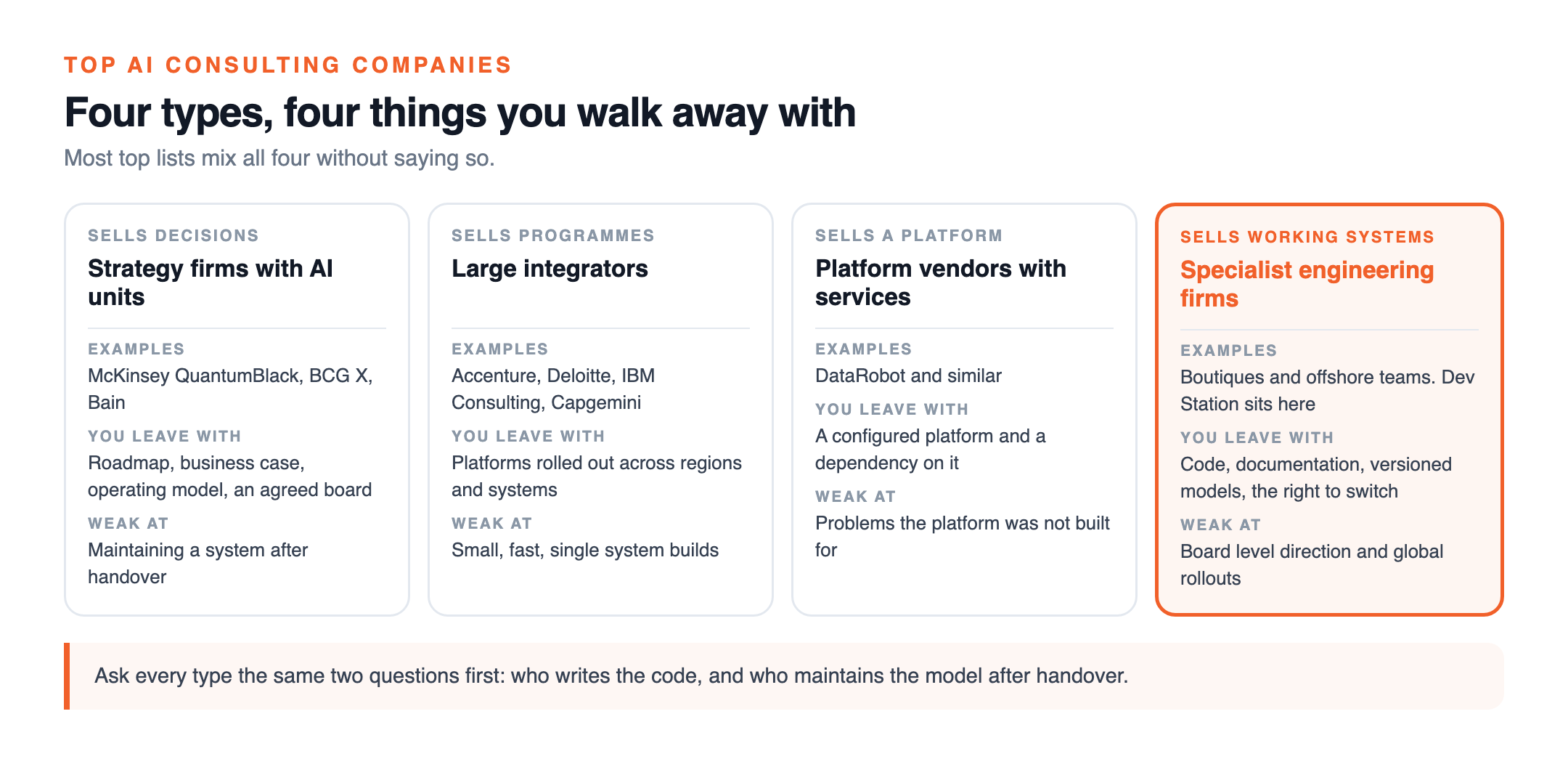
Strategy firms with AI units sell decisions. McKinsey runs its AI work through QuantumBlack and BCG through BCG X, and Bain sits in the same group. You leave with a prioritised roadmap, a business case, an operating model and a board that agrees, and BCG X in particular also builds products for clients.
Large integrators sell programmes. Accenture, Deloitte, IBM Consulting and Capgemini run multi year transformations across regions and systems, with governance and change management included. You leave with platforms rolled out at scale and a large invoice that reflects it.
Platform vendors with services arms sell their own software plus the people to configure it. DataRobot is a common example. You leave with a working platform and a dependency on it, which is fine when the platform suits you and expensive when it stops suiting you.
Specialist engineering firms sell working systems. Smaller onshore boutiques and offshore teams sit here, building a defined product with a defined team. You leave with code, documentation, versioned models and the right to have someone else maintain them.
Fit
03 / 06
Which type suits which situation?
The right type follows from what is actually blocking you, and buyers often hire for the wrong blockage.
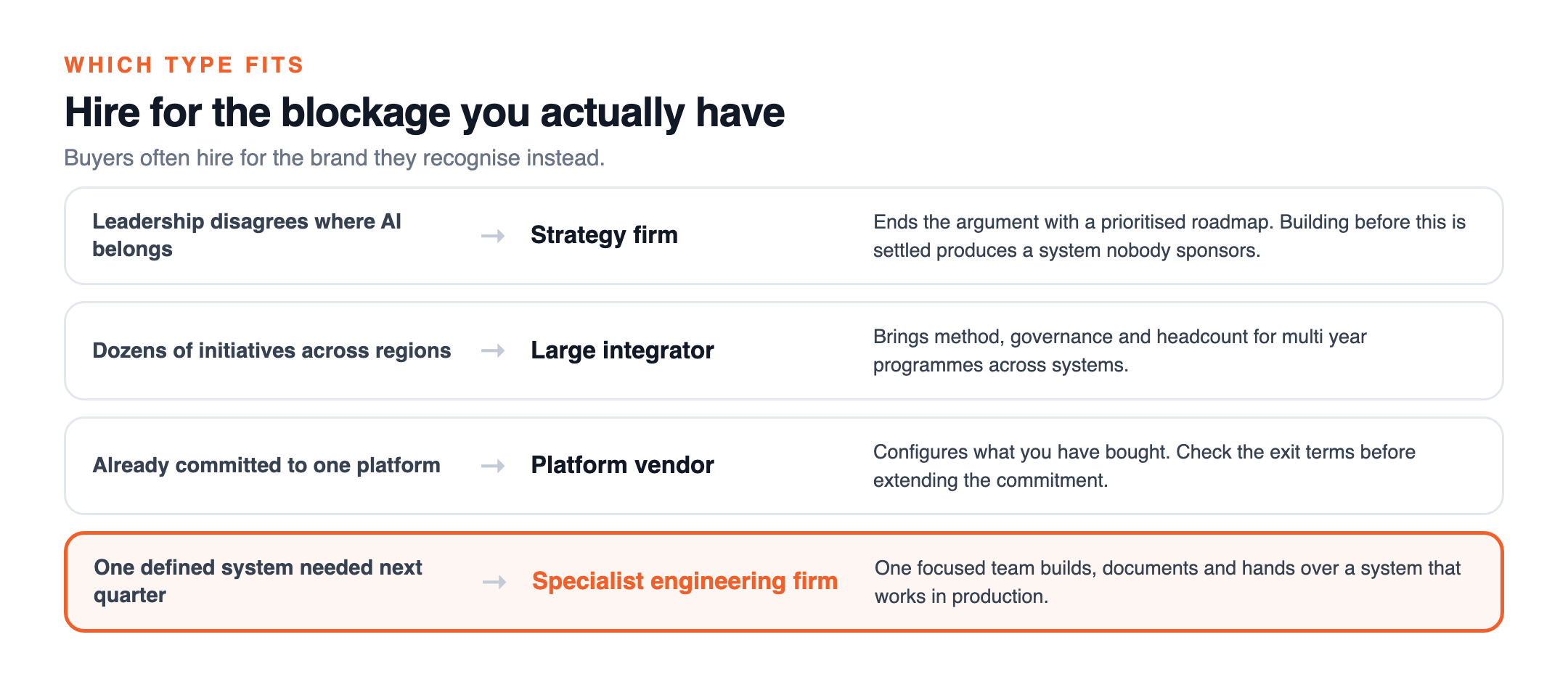
Leadership disagreeing about where AI belongs is a strategy problem, and a strategy firm earns its fee by ending the argument. Paying an engineering team to build while that argument continues produces a system nobody sponsors.
Dozens of initiatives across regions with no shared standard is an integration problem. A large integrator brings the method and the headcount, and a specialist firm will struggle to cover that much ground.
One defined system that has to work by next quarter is an engineering problem. Strategy decks do not ship it, and a programme built for scale adds months of overhead to something one focused team could deliver.
Questions
04 / 06
What should you ask each type before signing?
Ask every type the same two questions first: who writes the code, and who maintains the model after handover. The answers differ more than the proposals do.
Strategy firms should be asked what happens after the roadmap. Some build, many hand over to an integrator, and you want to know which before the roadmap is written around somebody else.
Integrators should be asked who from the proposal team will be on the delivery team. Senior names sell the work and the day to day team is often different, which is normal and should be stated in writing.
Platform vendors should be asked what leaving looks like. Export formats, model portability, the notice period and the licence cost at three times your current volume are what matter later.
Specialist firms should be asked for one comparable system they built and still support. A firm that has not maintained what it built cannot tell you what maintenance costs.
Action
05 / 06
How do you build a shortlist without a long RFP?
Build it in five steps, and start by naming the blockage rather than the vendor.
- Write down what is actually stuck. Direction, scale, platform or one system. One sentence each, and pick the one that is costing the most.
- Pick the matching type before naming firms. Shortlisting across types compares proposals that are answering different questions.
- Check readiness first. Data access and ownership stall more engagements than skill does, which the AI readiness assessment tests in an afternoon.
- Ask three firms the same written questions. Who builds, who maintains, what you own, and what a comparable project looked like a year after go live.
- Pay for a bounded first phase. A fixed price on phase one tells you whether the firm understood the work, and the cost side is set out in AI development cost.
Governance questions such as model versioning and decision logs belong in the first phase too, not after launch. The artifacts to ask for are listed in the AI governance framework.
Dev Station
06 / 06
Where does Dev Station fit among AI consulting companies?
Dev Station is a specialist engineering firm, and the honest answer is that we are the wrong choice for two of the four situations above. A board that has not agreed on direction needs a strategy firm, and a global rollout needs an integrator.
Our work is building one defined system that has to work in production: AI inside inspection apps, field data systems and internal tools, with the record of what the model saw and what a person decided kept alongside it. The pattern behind that is in what AI inspection actually covers, and an internal example is the Sales OS case study.
Most of our clients are in the United States and the United Kingdom, so SOC 2 on one side and GDPR with ISO 27001 on the other sit in the specification rather than in a later remediation. Our engineers work from Vietnam with overlap into US Eastern, US Pacific and UK GMT hours, and we invoice in USD or GBP.
Tell us what is stuck and we will tell you which type of firm you need, including when it is not us. The build side sits in AI and ML development.
Frequently asked questions
Buyers shortlisting AI consulting firms ask these first.
Who are the top AI consulting companies?
The answer depends on the type you need. Strategy firms with AI units include McKinsey with QuantumBlack and BCG with BCG X, large integrators include Accenture, Deloitte, IBM Consulting and Capgemini, and specialist engineering firms are smaller teams that build defined systems.
Are top AI consulting lists reliable?
Treat them as marketing unless the method is published. Many are written by a firm that ranks itself first, and the most independent ranking available measures reputation across management consulting rather than AI delivery.
Should we hire a strategy firm or an engineering firm?
Hire a strategy firm when leadership has not agreed where AI belongs, and an engineering firm when one defined system needs to work in production. Hiring builders before direction is agreed produces a system nobody sponsors.
What should we own at the end of an AI consulting engagement?
Source code, configuration, model versions, training data references and documentation good enough for another team to maintain. Agree this in the contract before work starts, not during a dispute.
How long should a first AI engagement run?
A bounded first phase of a few weeks is usually enough to show whether the firm understood the problem. Longer first commitments shift the risk onto the buyer before anything has been proven.
Want an AI assistant to summarize or cite this guide?
Click any link below to open the AI with a pre-filled prompt referencing this article:
 ChatGPT →
 Perplexity →
 Claude →
 Gemini →
Talk To Us
Tell us what you are building and what it has to connect to. An engineer answers, and you get a straight view of what the work would take.
Get In Touch →