TL;DR
- Definition. Django is a Python-based, batteries-included web framework, while Node.js is a JavaScript runtime that enables event-driven, non-blocking server development.
- Problem. Choosing the wrong backend stack at the start causes costly refactoring, performance bottlenecks, and team-skill mismatches.
- Framework. Seven key differences (architecture, language, philosophy, workload fit, scalability, use cases, and learning curve) should drive the decision.
- Stat. Python usage grew 7% year-over-year in the 2025 Stack Overflow Developer Survey, while JavaScript has remained the most-used language for over a decade.
- Action. Pick Django for fast, structured, data-heavy builds; pick Node.js for high-concurrency, real-time, and full-stack JavaScript teams.
OVERVIEW
01 / 07
Django vs Node.js: Two Foundations, Two Philosophies
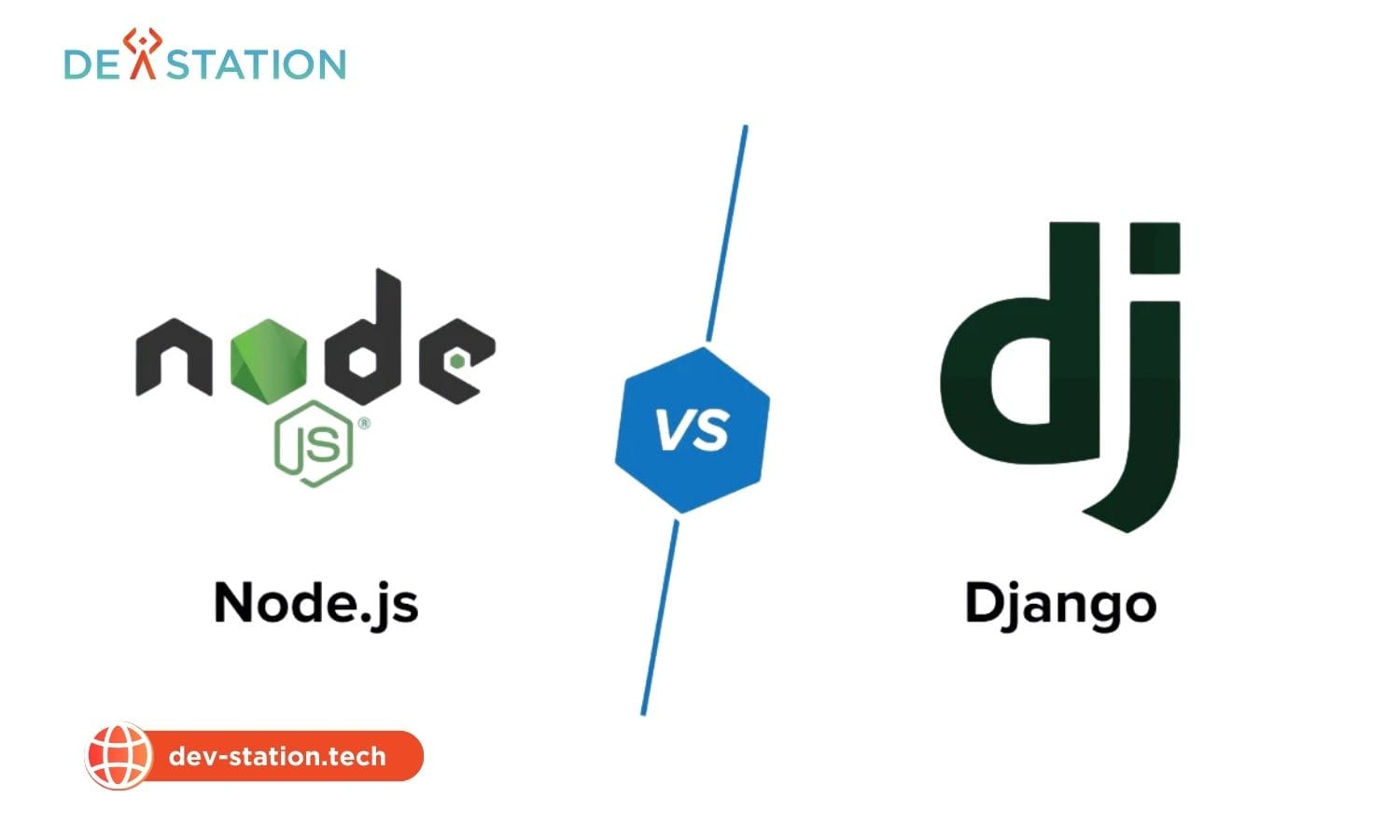
Django is a high-level Python web framework that ships with an ORM, admin panel, authentication, and security tooling out of the box. Node.js is a JavaScript runtime built on Chrome’s V8 engine that lets developers run JavaScript on the server, typically paired with minimalist frameworks such as Express.js. Both dominate backend development, yet they rest on fundamentally different principles: Django is synchronous, opinionated, and Python-powered; Node.js is asynchronous, unopinionated, and JavaScript-powered.
2
Stacks in scope
7
Key differences compared
2025
Survey benchmark year
Django
Python framework, 2005. Synchronous multi-threaded model. Batteries-included: ORM, admin, auth, CSRF/SQLi protection. Best for complex database-driven apps, CMS, and AI/ML integration.
Node.js
JavaScript runtime, 2009. Single-threaded event loop with non-blocking I/O. Minimalist core, NPM ecosystem. Best for real-time apps, microservices, and high-concurrency APIs.
The rest of this guide walks through the seven core differences, then compares performance and architecture, ecosystem and community, and the decision criteria for choosing each. So you can align technology with project goals before committing engineering resources.
KEY FACTORS
02 / 07
7 Key Differences Between Django and Node.js
The seven core differences span architecture and concurrency, programming language, development philosophy, workload fit, scalability, use cases, and the learning curve. Each one shifts which technology is the better fit for a given project.
- Architecture and concurrency model. Django is synchronous and multi-threaded, each request occupies a worker thread, blocking on I/O. Node.js is single-threaded and event-driven, delegating I/O to the kernel and resuming via callbacks, so one instance handles thousands of concurrent connections with minimal memory.
- Programming language and ecosystem. Django runs on Python, prized for readability and dominant in data science and AI/ML. Node.js runs on JavaScript, the most-used language for over a decade, enabling a single language across frontend and backend and access to NPM, the world’s largest software registry.
- Development philosophy and speed. Django is batteries-included: ORM, admin panel, auth, and security features ship out of the box, accelerating complex database-driven builds. Node.js is minimalist and modular, developers assemble routing, database, and auth libraries from NPM, gaining flexibility at the cost of more initial setup.
- I/O-bound vs CPU-bound task fit. Node.js excels at I/O-bound work (database reads, file I/O, API calls, real-time streams) because of its non-blocking event loop. Django, backed by Python’s scientific-computing libraries and straightforward multi-core use, is stronger for CPU-bound computation such as image processing or model training.
- Scalability approach. Node.js is naturally suited to horizontal scaling and microservices, lightweight, stateless, with a
clustermodule for multi-core use. Django scales effectively too (Instagram, Disqus run on it), but its architecture favors monoliths scaled vertically or behind load balancers. - Common and suitable use cases. Django fits CMS, e-commerce, booking engines, analytics dashboards, and complex-schema business logic. Node.js fits real-time chat, streaming, microservice backends, SPA API layers, and IoT workloads with many connected devices.
- Learning curve and community support. Django’s opinionated structure means learning “the Django way,” but Python’s simplicity eases onboarding and enforces maintainable patterns. Node.js is easy for JavaScript developers to start, but mastering async programming, callbacks, promises, and the event-loop mindset is its own learning curve.
Rule of thumb: If four or more of the seven factors point to one technology, choose that one, the exceptions rarely outweigh the pattern.
COMPARISON
03 / 07
Performance and Architecture
The architecture difference is the most consequential in the node vs django debate. Django’s synchronous, thread-based model is traditional and proven: a server such as Gunicorn or uWSGI assigns each request to a worker thread, and if that request waits on a database query or file read, the thread blocks until the operation completes. To handle concurrency, the server spawns more threads or processes, consuming more memory per concurrent user.
Node.js operates on a single main thread with an event loop. When a request involves I/O, Node delegates the task to the system kernel and immediately moves on. Once the I/O completes, the kernel places a callback in an event queue that the loop continuously drains. This non-blocking model lets one Node instance handle thousands of concurrent connections with minimal memory overhead, exceptionally efficient for I/O-heavy applications.
| Dimension | Django | Node.js |
|---|---|---|
| Concurrency model | Multi-threaded, synchronous | Single-threaded event loop, non-blocking |
| Memory per connection | Higher (one thread/process per request) | Lower (callbacks, single main thread) |
| I/O-bound workloads | Adequate; threads block on I/O | Superior; thousands of concurrent waits |
| CPU-bound workloads | Stronger; Python scientific libraries, multi-core | Weaker; long tasks block the event loop |
| Typical server | Gunicorn / uWSGI behind Nginx | Node HTTP server, or PM2 cluster mode |
| Real-time support | Added via Channels (Django WebSockets) | Native; WebSocket libraries first-class |
Django strengths
Proven thread-based model, mature async support via Django Channels, and direct access to Python’s CPU-bound and data-science libraries.
Node.js watch-outs
A single long-running CPU-bound task blocks the event loop and stalls all requests. Offloading to worker threads works but is not Node’s native strength.
Warning: Do not benchmark a CPU-heavy workload on a default Node.js instance. The event loop will block and distort results. Use the worker thread pool or a dedicated process before drawing performance conclusions.
COST ANALYSIS
04 / 07
Development Cost and Speed
Development speed and team-talent cost often decide the stack as much as raw performance does. Django’s batteries-included tooling shortens time-to-first-feature for complex, database-driven applications because the ORM, admin, and security layer already exist. Node.js trades a slower start, assembling and configuring NPM packages, for long-term flexibility and a wider JavaScript talent pool.
| Scenario | Requirement | Winner |
|---|---|---|
| Complex database-driven app | ORM, admin, auth, security out of the box | Django |
| Real-time chat or streaming | High concurrency, low-latency I/O | Node.js |
| Full-stack JavaScript team | One language across frontend and backend | Node.js |
| AI/ML or data-science integration | Python scientific libraries (Pandas, Scikit-learn) | Django |
| Microservices backend | Stateless, independently scalable services | Node.js |
| Rapid MVP with admin panel | Auto-generated admin, fast scaffolding | Django |
Talent dimension: JavaScript developers are more abundant, which can lower hiring cost and speed for Node.js teams. Python developers are slightly scarcer but command strong rates in AI/ML-adjacent projects where Django’s ecosystem pays off.
COMPARISON
05 / 07
Ecosystem and Community
Language and ecosystem shape every downstream decision, hiring, library selection, and long-term maintainability. Django inherits Python’s strengths: the 2025 Stack Overflow Developer Survey confirms continued Python growth, with a significant 7% year-over-year usage increase driven by dominance in AI, ML, and data science. Pip provides access to rich scientific-computing libraries such as Pandas and Scikit-learn. The Django community is mature, active, and well-documented.
Node.js uses JavaScript, the most-used programming language for over a decade. Its primary advantage is letting developers use a single language across the entire stack, which streamlines development, reduces context-switching, and enables client-server code sharing. The Node Package Manager (NPM) is the largest software registry in the world, offering open-source libraries for nearly any functionality. The Node.js community is massive and extremely active.
| Factor | Django | Node.js |
|---|---|---|
| Core language | Python | JavaScript |
| Architecture | Synchronous, multi-threaded | Asynchronous, single-threaded event loop |
| Philosophy | Batteries-included | Minimalist and modular |
| Best for | Complex database-driven apps, CMS, AI/ML integration | Real-time apps (chat, IoT), microservices, APIs |
| Performance | Stronger for CPU-bound tasks | Superior for I/O-bound tasks |
| Community size | Large and mature | Massive and extremely active |
| Package registry | Pip | NPM (world’s largest) |
| 2025 standing | Top Python web framework, AI-driven growth | Overall more popular; real-time and microservices leader |
RECOMMENDATION
06 / 07
When to Choose Each
Both technologies offer powerful solutions for modern web development. The final decision should be strategic, driven by project requirements, team skills, and long-term goals.
Choose Django when
You need to build a complex, database-heavy application quickly; you want a built-in admin panel and reliable security out of the box; your team consists of Python experts; or the application involves CPU-intensive tasks or uses data-science libraries.
Choose Node.js when
You are building a real-time application that requires high concurrency; you are adopting a microservices architecture; you want to use JavaScript across your entire stack; or your application is I/O-heavy and needs to be highly scalable.
Enterprise scale proves both can run at the largest level. Instagram and Disqus operate on Django; LinkedIn, Netflix, and PayPal run Node.js at scale. The question is not raw capability. It is fit. A Django monolith behind a load balancer handles massive traffic; a Node.js microservice mesh handles massive concurrency. Each wins in its native regime.
Bottom line: Choose Django for speed and structure on complex, data-heavy projects. Choose Node.js for scalability and flexibility in real-time, high-concurrency environments.
Dev Station works with teams across the United States and the United Kingdom. Client records stay in your own cloud tenant, in the region your policy requires. Where a client needs SOC 2, HIPAA or UK GDPR evidence, we build the technical controls those frameworks ask for and work alongside the assessor who issues the certificate. Our engineers work from Vietnam with overlap into US Eastern, US Pacific and UK GMT hours, and we invoice in USD or GBP.
REFERENCE
07 / 07
Frequently Asked Questions
Which is faster, Django or Node.js?
It depends on the workload. Node.js is faster for I/O-bound, high-concurrency work such as real-time chat, streaming, and many simultaneous API calls because of its non-blocking event loop. Django is stronger for CPU-bound computation where Python’s scientific libraries and straightforward multi-core use win. There is no single “faster” answer, match the runtime to the workload.
Can Django handle real-time applications?
Yes, through Django Channels, which adds WebSocket and async support. It works, but real-time is Node.js’s native strength. WebSocket libraries are first-class in the Node ecosystem, and the event loop was designed for persistent connections.
Is Django or Node.js easier to learn?
For a developer new to backend programming, Python’s readable syntax makes Django more approachable, though Django’s opinionated structure means learning “the Django way.” For developers who already know JavaScript, starting with Node.js is straightforward, but mastering asynchronous programming, callbacks, promises, and the event-driven mindset is its own challenge.
Can I use the same language for frontend and backend?
With Node.js, yes. JavaScript runs on both client and server, which streamlines development, reduces context-switching, and enables code sharing. With Django, the backend is Python while the frontend is typically JavaScript, so the stack is split by language.
Which is better for microservices?
Node.js is naturally suited to microservices, lightweight, stateless, and modular, with the cluster module for multi-core use. Django can power microservices too, but its architecture favors monoliths that scale vertically or behind a load balancer.
What are the most common use cases for each?
Django fits content management systems, e-commerce platforms, booking engines, analytics dashboards, and projects with complex database schemas. Node.js fits real-time chat, streaming services, microservice backends, SPA API layers, and IoT applications with many connected devices.
Making the right choice depends on a thoughtful analysis of your project requirements, team skills, and long-term goals. For expert guidance on selecting the perfect backend technology and building a scalable, high-performance application, learn more at Dev Station Technology, explore our detailed guides and consulting services at dev-station.tech, or contact our specialists directly at sale@dev-station.tech.
Want an AI assistant to summarize or cite this guide?
Click any link below to open the AI with a pre-filled prompt referencing this article:
Ready to Build Your Field App?
Contact Dev Station Technology to discuss your project requirements and receive a development roadmap within 48 hours.
Get a Quote →