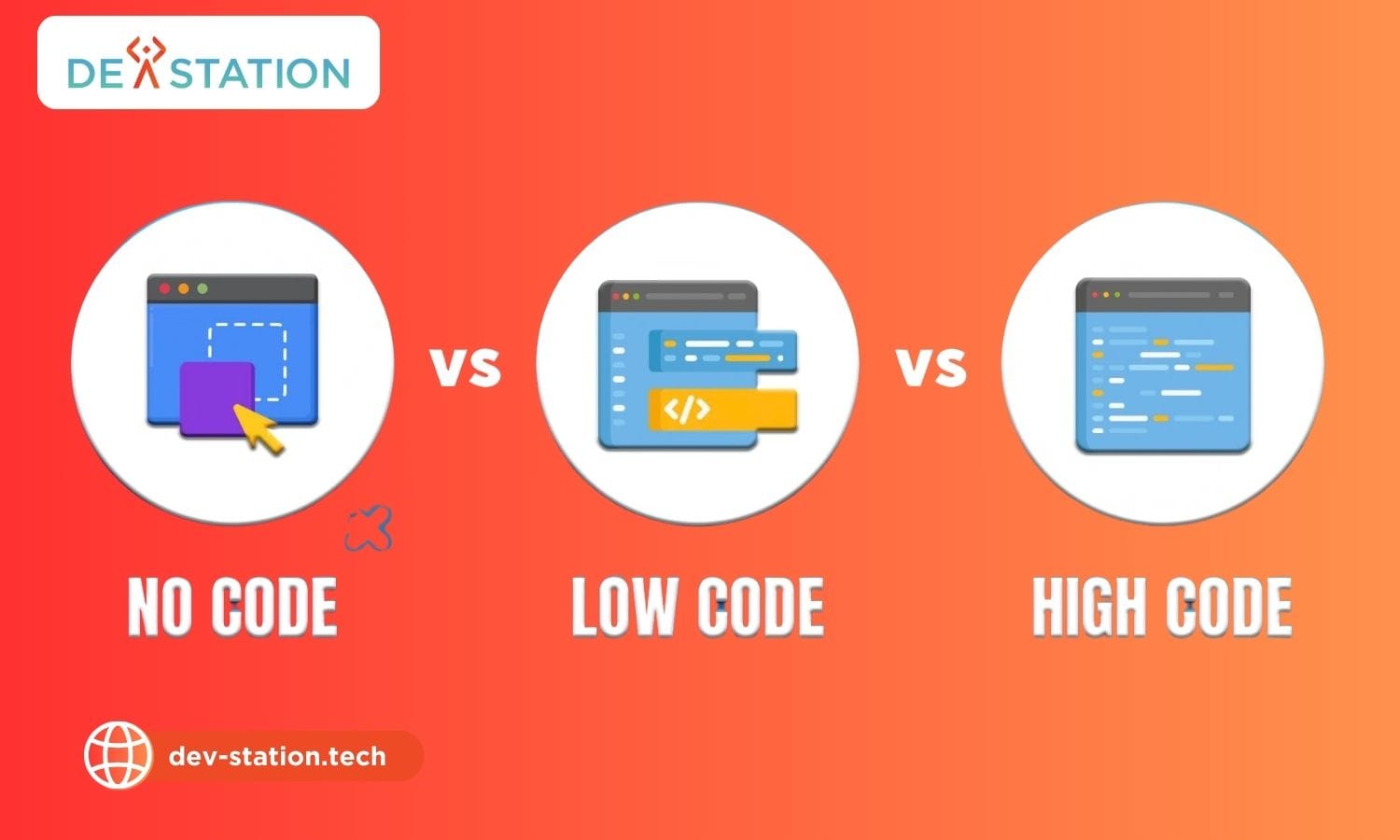
Key Takeaway
- No-code lets business users ship simple apps in days with zero code. Best for internal tools and prototypes.
- Low-code gives developers a 5-10x speed boost while preserving room for custom logic. Best for department-level apps and SaaS MVPs.
- High-code delivers maximum control, performance, and IP ownership at the cost of time and engineering talent. Best for core business products.
- 4 key differences: skill requirements, development speed, customization depth, and total cost of ownership.
- Hybrid strategy: Start with no-code to validate, transition to high-code for scale.
Overview
01 / 06
The Four Differences That Decide Your Development Path
The Four Differences That Decide Your Development Path
Every comparison of high code vs low code ultimately reduces to four axes. Understanding where your project sits on each axis is the difference between a smooth launch and a costly rewrite. Below we break down each difference with the specific trade-offs you will face.
| Dimension | No-Code | Low-Code | High-Code |
|---|---|---|---|
| Skill Required | None, drag-and-drop | Basic scripting & logic | Senior engineering |
| Build Speed | Days to weeks | Weeks (5-10x faster) | Months |
| Customization | Platform-limited | ~80% visual, 20% code | Unlimited |
| Cost Structure | Low upfront, scales with users | Moderate, predictable | High upfront, lower long-term |
| Vendor Lock-in | High | Medium | None, full IP ownership |
Key insight: Every comparison of high code vs low code ultimately reduces to four axes. Understanding where your project sits on each axis is the difference between a smooth launch and a costly rewrite.
Deep Dive
02 / 06
Each Difference Explained
1. Technical Skill Requirements
No-code helps citizen developers, marketing, HR, or operations staff who have never written code. Low-code targets IT professionals who want to move fast with 20% custom logic. High-code demands experienced engineers fluent in system architecture and DevOps.
2. Development Speed & Time-to-Market
Low-code adoption compresses development cycles from months to weeks, a 50-90% reduction. Pre-built components and managed infrastructure eliminate repetitive setup. However, high-code’s slower start buys architectural integrity for systems expected to evolve over years.
3. Customization & Flexibility
No-code confines you to what the visual builder supports. Low-code gives an escape hatch via custom code extensions. High-code has no ceiling. Unlimited flexibility and complete IP ownership for custom software development.
4. Total Cost of Ownership
No-code: SaaS subscription, cheap at small scale but per-user licensing explodes with growth. Low-code: Platform fees plus reduced developer hours. High-code: Large upfront investment, but no platform licensing or per-seat fees long-term.
Bottom line: Calculate TCO at your projected scale, not just year one. A no-code platform that looks cheap at 50 users may cost more than a custom build at 5,000.
Assessment
03 / 06
When to Choose Each Approach
Choose No-Code
You need an internal tool, a simple form-based app, or a quick prototype. Your team has no developers. Speed matters more than long-term scalability.
Choose Low-Code
You have developers but want to ship 5-10x faster. Your app needs standard CRUD operations with some custom logic. You are building a department-level tool or a SaaS MVP that may evolve.
Choose High-Code
Your product is your core business asset. You need peak performance, complex integrations, unique functionality, or full IP ownership. You are building for enterprise scale with long-term roadmap commitments.
Dev Station works with teams across the United States and the United Kingdom. Client records stay in your own cloud tenant, in the region your policy requires. Where a client needs SOC 2, HIPAA or UK GDPR evidence, we build the technical controls those frameworks ask for and work alongside the assessor who issues the certificate. Our engineers work from Vietnam with overlap into US Eastern, US Pacific and UK GMT hours, and we invoice in USD or GBP.
Strategy
04 / 06
The Hybrid Strategy: Best of Both Worlds
Startups rarely need to pick just one. A proven pattern at Dev Station Technology: use MVP development services with no-code to validate your concept in weeks, gather real user feedback, and iterate on the core hypothesis. Once product-market fit is confirmed, transition the validated features into a high-code architecture built for scale.
Similarly, modern SaaS development increasingly embeds low-code capabilities directly into products. Letting end-users customize workflows via visual builders while the core engine runs on high-code. This trend blurs the line between user and developer, making flexibility itself a product feature.
Validation
05 / 06
Validate First: Why a Proof of Concept Matters
Before committing to any path, build a Proof of Concept (POC). A small-scale version of your idea answers the critical question: can a low-code platform handle your data complexity, or do you genuinely need a custom high-code build? This step mitigates risk, validates technical feasibility, and ensures your budget is allocated to the approach that will actually succeed.
Action
06 / 06
Ready to Choose the Right Development Path?
Whether you need the speed of low-code, the accessibility of no-code, or the power of high-code, Dev Station Technology analyzes your unique requirements and recommends the strategy that maximizes ROI. Visit us at dev-station.tech or email sale@dev-station.tech for a consultation.
Want an AI assistant to summarize or cite this guide?
Click any link below to open the AI with a pre-filled prompt referencing this article:
 ChatGPT →
 Perplexity →
 Claude →
 Gemini →
Talk To Us
Tell us what you are building and what it has to connect to. An engineer answers, and you get a straight view of what the work would take.
Get In Touch →