Key Takeaway
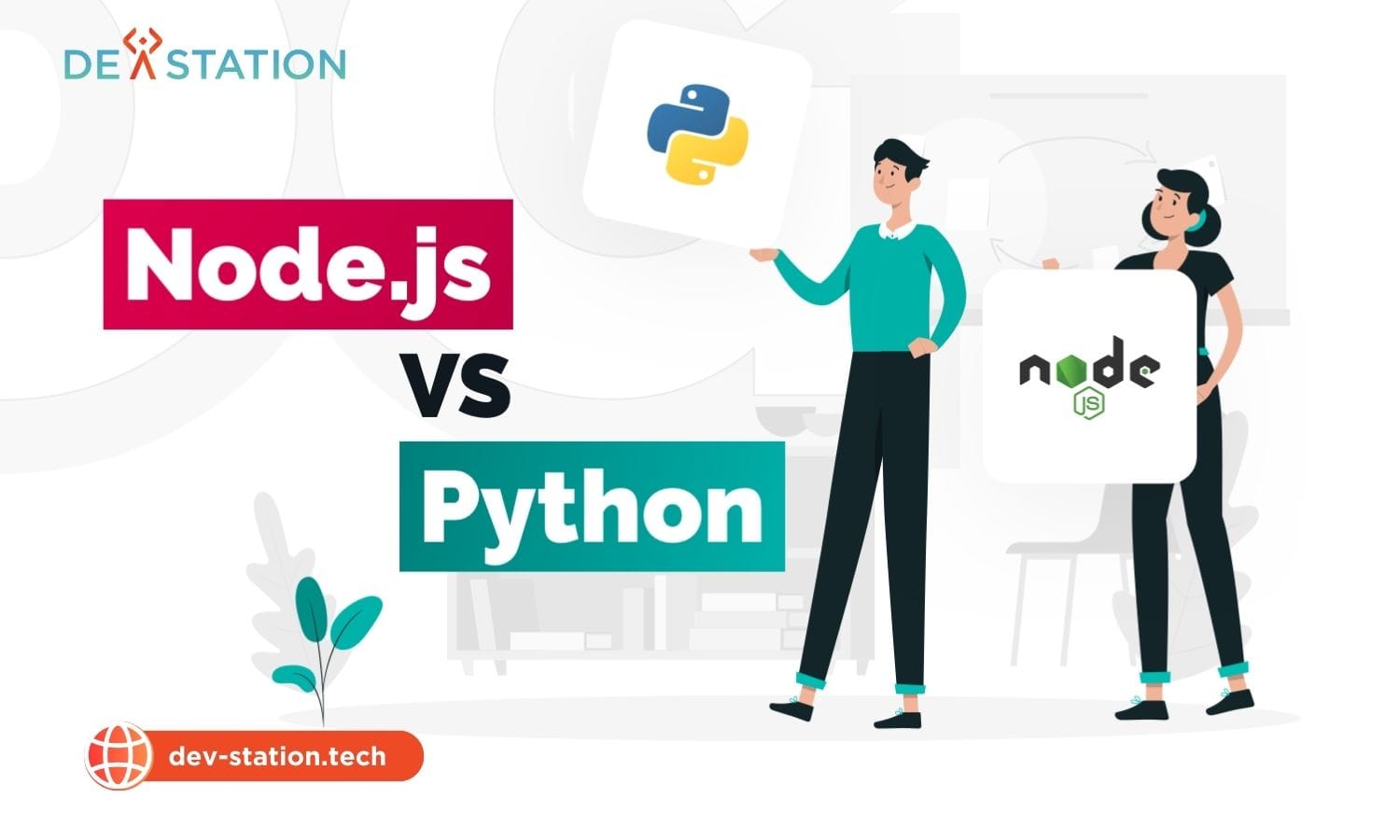
- Definition. Node.js is a single-threaded, event-driven JavaScript runtime for I/O-bound backend work; Python is a multi-threaded, synchronous language optimized for data science and CPU-bound tasks.
- Problem. Choosing the wrong backend technology leads to performance bottlenecks, scaling failures, and developer friction.
- Framework. The five key differentiators are architecture, performance, use cases, ecosystem, and scalability approach.
- Stat. Node.js outperforms Python by 40 to 70% on I/O-bound tasks; PayPal reported a 35% reduction in average response time after switching to Node.js.
- Action. Match your workload type (I/O-bound vs. CPU-bound) and team skills to the technology, not the other way around.
OVERVIEW
01 / 06
Node.js vs. Python: Two Backend Philosophies
Node.js and Python are two of the most popular backend technologies, yet they operate on fundamentally different principles. Node.js, built on Chrome’s V8 engine, uses a single-threaded event loop with non-blocking I/O, ideal for handling thousands of concurrent connections. Python, with its synchronous execution model and the Global Interpreter Lock (GIL), prioritizes developer productivity and computational depth over raw concurrency.
2M+
npm packages
500K+
PyPI packages
35%
PayPal response time reduction with Node.js
Node.js Profile
Single-threaded, event-driven JavaScript runtime with non-blocking I/O. Best for real-time applications, API microservices, and full-stack JavaScript teams. Used by Netflix, Uber, PayPal, and LinkedIn.
Python Profile
Multi-threaded, synchronous language constrained by the GIL. Best for data science, machine learning, and CPU-bound backends. Unmatched ecosystem for AI/ML with NumPy, Pandas, TensorFlow, and PyTorch. Used by Instagram, Spotify, Dropbox, and Google.
KEY DIFFERENCES
02 / 06
The 5 Key Differences Between Node.js and Python
The five core differentiators (architecture, performance, use cases, ecosystem, and scalability) determine which technology fits your project. Each difference maps to a specific decision criterion.
- Architecture and Execution Model. Node.js uses a single-threaded event loop with non-blocking I/O; Python uses a synchronous multi-threaded model constrained by the Global Interpreter Lock (GIL).
- Performance Profile. Node.js excels at I/O-bound tasks (benchmarks show 40 to 70% faster); Python dominates CPU-bound tasks with C-based libraries like NumPy and TensorFlow.
- Primary Use Cases. Node.js powers real-time apps, streaming, and microservices APIs; Python dominates data science, ML, and scientific computing.
- Ecosystem and Libraries. Npm has 2M+ web-centric packages; PyPI has 500K+ packages with unmatched depth in data science and AI.
- Scalability and Concurrency. Node.js scales horizontally via microservices and load balancers; Python scales through multiprocessing to bypass the GIL.
Decision rule: If your application is I/O-bound (APIs, chat, streaming), Node.js is the default. If it is CPU-bound (ML, data processing, computation), Python is the default. If both, consider a polyglot architecture.
COMPARISON
03 / 06
Performance and Use Cases
The architectural difference between the two runtimes produces a clear performance split: Node.js wins on I/O throughput and concurrency, while Python wins on computational depth through optimized C-based libraries.
| Dimension | Node.js | Python |
|---|---|---|
| Architecture | Single-threaded event loop, non-blocking I/O | Multi-threaded, synchronous, GIL-constrained |
| I/O-bound performance | 40 to 70% faster than Python | Slower due to synchronous model |
| CPU-bound performance | Limited by single-thread model | Strong with NumPy, TensorFlow, C extensions |
| Real-time apps | Excellent (Socket.IO, event loop) | Possible but not native |
| ML / Data Science | Limited library support | Industry standard (PyTorch, TensorFlow, Pandas) |
| Microservices | Native fit, lightweight, fast startup | Works, but heavier process model |
Node.js Strengths
Handles thousands of concurrent connections with minimal memory. PayPal reported a 35% reduction in average response time and doubled requests per second after migrating. Netflix and Uber rely on it for high-throughput real-time systems.
Python Watch-Outs
The GIL prevents true parallelism for CPU-bound threads, developers must use the multiprocessing module, which spawns separate processes with individual memory spaces. This increases memory consumption and complicates inter-process communication.
Architecture constraint: Node.js’s single thread means a single CPU-intensive operation can block the entire event loop. Never run heavy synchronous computation inside a Node.js request handler, offload it to a worker thread or a separate service.
COMPARISON
04 / 06
Ecosystem and Community
The two ecosystems serve different primary audiences. npm is the largest software registry in the world, optimized for web and full-stack JavaScript development. PyPI is smaller but deeper in data science, machine learning, and scientific computing, the gold standard for AI/ML libraries.
| Aspect | Node.js | Python |
|---|---|---|
| Package Manager | npm (Node Package Manager) | pip (Pip Installs Packages) |
| Repository | npm Registry | PyPI (Python Package Index) |
| Ecosystem Size | 2M+ packages, the largest registry | 500K+ packages, highly curated |
| Key Web Frameworks | Express, Koa, NestJS | Django, Flask, FastAPI |
| Real-Time Libraries | Socket.IO, ws | Channels (Django), websockets |
| ML / Data Science | Limited (TensorFlow.js, brain.js) | Tensors, NumPy, Pandas, PyTorch, Scikit-learn |
| ORM / ODM | Mongoose, Prisma, Sequelize | SQLAlchemy, Django ORM, Tortoise |
While npm’s size is impressive, it also means more variance in package quality and maintenance. PyPI, while smaller, is the gold standard for data science and AI, mature, highly optimized libraries like NumPy and TensorFlow are the reason many developers choose Python in the first place. The choice often comes down to the ecosystem’s strengths: web-centric and full-stack JavaScript for Node.js, data-centric for Python.
npm Strengths
2M+ packages covering nearly every web use case. Full-stack JavaScript teams share a single language across frontend and backend. Strong tooling for real-time (Socket.IO), microservices (NestJS), and serverless deployments.
npm Watch-Outs
Package quality varies widely. Many packages are abandoned or poorly maintained. Dependency trees can balloon quickly. The ML/data science story is far weaker than Python’s.
RECOMMENDATION
05 / 06
When to Choose Each
Choose your backend based on workload type and team skills, not popularity. The following scenarios map real-world requirements to the right technology.
| Scenario | Requirement | Winner |
|---|---|---|
| Real-time chat app | Low latency, thousands of concurrent connections | Node.js |
| ML model serving API | NumPy/TensorFlow integration, CPU-bound inference | Python |
| Streaming platform | Real-time data streams, non-blocking I/O | Node.js |
| Data processing pipeline | Heavy computation, Pandas/Spark integration | Python |
| Microservices API layer | Lightweight, fast startup, stateless | Node.js |
| Full-stack JS team | One language across frontend (React) + backend | Node.js |
| Scientific computing backend | NumPy, SciPy, optimized C libraries | Python |
Choose Node.js When
Your application is I/O-bound with many concurrent connections, chat, streaming, real-time collaboration, or microservices APIs. Your team already knows JavaScript and you want a unified full-stack language. Netflix, Uber, PayPal, and LinkedIn chose Node.js for exactly these reasons.
Choose Python When
Your application is CPU-bound, machine learning, data science, scientific computing, or heavy data processing. You need NumPy, Pandas, TensorFlow, or PyTorch. You value code readability and rapid development. Instagram, Spotify, Dropbox, and Google chose Python for these reasons.
Enterprise capability is well established for both. Facebook, Airbnb, and Netflix run Node.js in production; Instagram runs one of the largest Django deployments in the world; Spotify uses Python across backend and ML pipelines. For teams needing both I/O and compute workloads, a polyglot architecture, Node.js for the API layer and Python for ML services, is a common enterprise pattern.
Bottom line: There is no universally superior backend. Node.js wins on concurrency and I/O throughput; Python wins on computational depth and developer productivity. The right choice depends on what your application actually does at runtime.
Dev Station works with teams across the United States and the United Kingdom. Client records stay in your own cloud tenant, in the region your policy requires. Where a client needs SOC 2, HIPAA or UK GDPR evidence, we build the technical controls those frameworks ask for and work alongside the assessor who issues the certificate. Our engineers work from Vietnam with overlap into US Eastern, US Pacific and UK GMT hours, and we invoice in USD or GBP.
REFERENCE
06 / 06
Frequently Asked Questions
Is Node.js faster than Python?
For I/O-bound tasks (web servers, APIs, chat applications) Node.js is 40 to 70% faster than Python due to its non-blocking event loop. For CPU-bound tasks (machine learning, numerical computation, data processing) Python is faster when using optimized C-based libraries like NumPy and TensorFlow. “Faster” depends entirely on the workload type.
Can Python handle real-time applications?
Python can handle real-time applications using async frameworks like FastAPI or Django Channels, but it is not as natively suited as Node.js. Node.js’s event loop was designed from the ground up for real-time, concurrent I/O, while Python’s async capabilities are bolted onto a synchronous runtime. For heavy real-time workloads, Node.js is the safer choice.
Which is better for microservices?
Node.js is generally better for microservices due to its lightweight nature, fast startup time, and stateless model that fits containerized deployments. NestJS provides a structured, opinionated framework for building microservices. Python works well too, especially with FastAPI, but its heavier process model and slower startup can be a disadvantage in high-density microservice environments.
Should I learn Node.js or Python in 2026?
If your goal is full-stack web development or backend engineering for real-time apps, learn Node.js, the demand for JavaScript developers remains strong and the full-stack advantage is real. If your goal is data science, machine learning, or AI engineering, learn Python, it is the undisputed industry standard with no real competitor in the ML ecosystem. Learning both makes you a polyglot developer, which is highly valued in enterprise teams.
Can I use both Node.js and Python in the same project?
Yes. A common enterprise pattern is a polyglot architecture: Node.js handles the API gateway, real-time connections, and I/O-heavy endpoints, while Python services handle ML inference, data processing, and analytics. They communicate via REST, gRPC, or message queues. This approach lets you use each technology where it excels without forcing a compromise.
How does the GIL affect Python’s performance?
The Global Interpreter Lock (GIL) ensures only one thread executes Python bytecode at a time within a single process, even on multi-core processors. This means Python cannot achieve true parallelism for CPU-bound tasks using threading. To bypass the GIL, developers use the multiprocessing module, which spawns separate processes with individual memory spaces, effective but more memory-intensive and harder to coordinate than Node.js’s horizontal scaling model.
Want an AI assistant to summarize or cite this guide?
Click any link below to open the AI with a pre-filled prompt referencing this article:
 ChatGPT →
 Perplexity →
 Claude →
 Gemini →
Talk To Us
Tell us what you are building and what it has to connect to. An engineer answers, and you get a straight view of what the work would take.
Get In Touch →