Embedded software is the invisible logic layer that makes hardware intelligent. From the anti-lock brakes in your car to the flight controller in a commercial drone, dedicated firmware and real-time operating systems translate physical signals into actionable behavior. This article breaks down the five industries that depend most heavily on embedded software development services, the challenges engineers face, and the market forces shaping the next decade of innovation.
TL;DR
- Embedded software market projected to surpass $21.5 billion by 2027
- Automotive, healthcare, industrial IoT, consumer electronics, and aerospace are the top five adopters
- Safety certifications (ISO 26262, IEC 62304, DO-178C) are non-negotiable in regulated sectors
- Real-time constraints, power budgets, and security are the core engineering challenges
- C, C++, and RTOS proficiency remain the most in-demand embedded skill set
Foundations
01/07
What Is Embedded Software?
Embedded software is purpose-built code that runs on dedicated hardware to control a specific device or subsystem. Unlike general-purpose application software, it operates under strict resource constraints, limited memory, fixed processor speeds, and often hard real-time deadlines. The firmware must interact directly with sensors, actuators, and communication interfaces at the register level, making an intimate understanding of the hardware architecture a prerequisite.
Embedded systems span a wide complexity spectrum. A simple microcontroller in a microwave oven may execute a few hundred lines of C, while a modern vehicle’s electronic control units collectively run over 100 million lines of code. At the high end, aerospace and defense platforms demand deterministic behavior certified to rigorous standards such as DO-178C. Regardless of scale, the engineering discipline remains the same: write lean, reliable code that makes hardware perform its intended function without failure.
Industry Use Cases
02/07
5 Industries That Rely on Embedded Software Development
100M+
Lines of Code in a Modern Vehicle
$21.5B
Projected Market by 2027
12.1%
IIoT CAGR Growth Rate
1. Automotive
The automotive sector is the most significant consumer of firmware development services today. A modern high-end car contains approximately 100 million lines of code distributed across over 100 electronic control units. This software controls everything from window operations to complex Advanced Driver Assistance Systems (ADAS). Developers must adhere to strict safety standards such as ISO 26262 to ensure that the firmware interacting with the hardware is fail-safe. The shift toward electric vehicles has further intensified the need for precise battery management systems, which are driven entirely by embedded logic.
ADAS & Autonomous Driving
Sensor fusion, object detection, and real-time decision-making run on embedded GPUs and DSPs, processing lidar, radar, and camera data within milliseconds.
EV Battery Management
Cell balancing, state-of-charge estimation, and thermal protection algorithms ensure battery packs operate safely and efficiently across thousands of charge cycles.
Functional Safety (ISO 26262)
Every safety-critical ECU must be developed to ASIL compliance, with rigorous hazard analysis, fault injection testing, and traceability from requirements to code.
2. Healthcare
In the medical field, a software glitch is not just an inconvenience; it can be a matter of life and death. Embedded software services in healthcare focus on creating systems that operate with high precision and low latency. An insulin pump must deliver the exact dosage at the exact time based on sensor data. This requires rigorous adherence to standards like IEC 62304. Furthermore, the integration of IoT software development allows these devices to transmit patient data securely to cloud platforms, facilitating remote diagnostics and telemedicine.
Implantable Devices
Pacemakers, neurostimulators, and drug delivery pumps run ultra-low-power firmware that must operate continuously for years without intervention.
Diagnostic Imaging
MRI, CT, and ultrasound systems rely on embedded signal processing pipelines to reconstruct images in real time from raw sensor data.
Remote Patient Monitoring
Wearable biosensors stream vitals over BLE or Wi-Fi to clinical dashboards, requiring embedded encryption and low-power radio management.
3. Industrial IoT
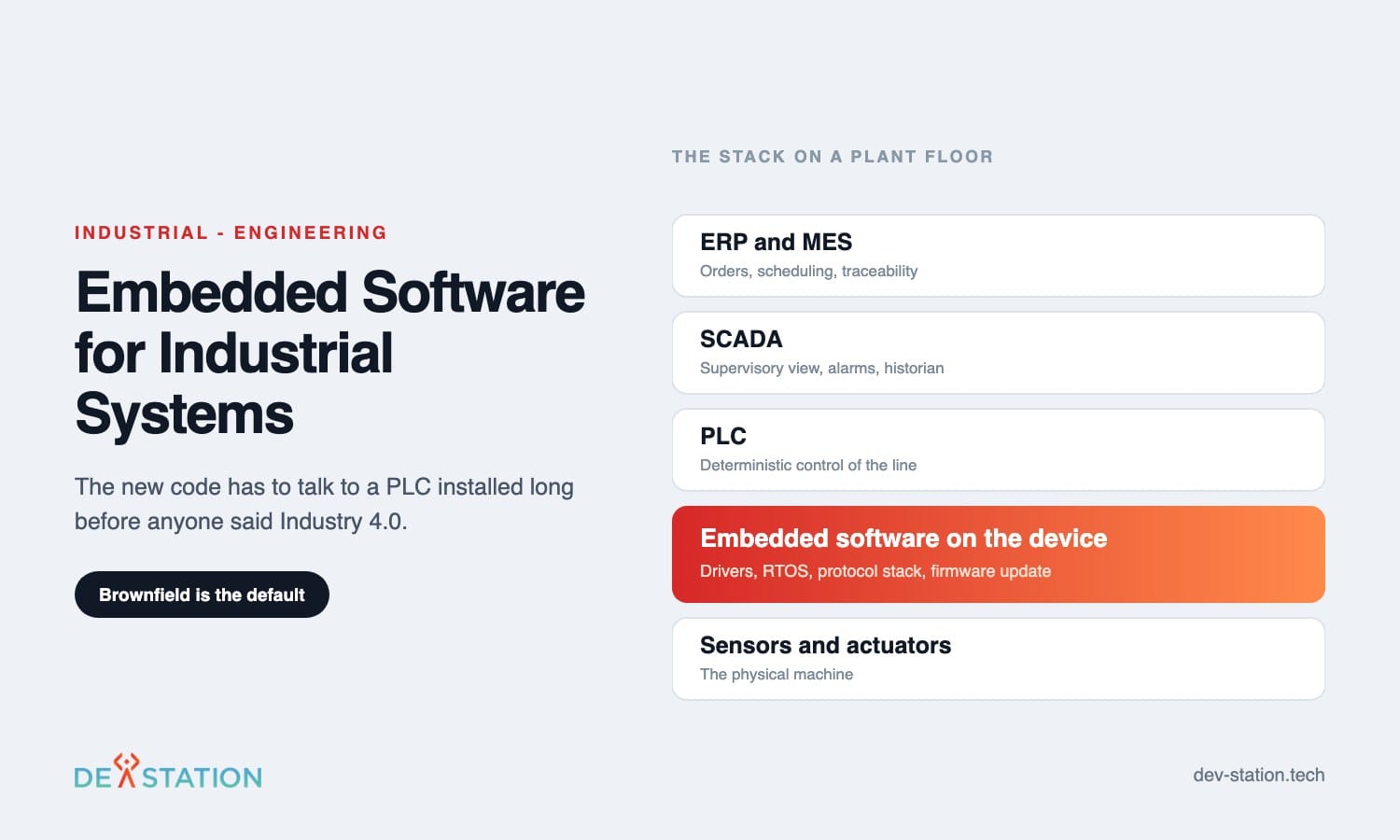
Industry 4.0 is built upon the backbone of embedded systems. Manufacturing plants utilize embedded sensors and actuators to monitor machinery health and optimize production lines. This involves complex electronic system design where software must interact seamlessly with custom hardware. The goal is to reduce downtime through predictive maintenance, where the embedded system analyzes vibration or temperature data locally before alerting central systems. Industrial IoT demands robustness: controllers must withstand extreme temperatures, vibration, and electromagnetic interference while maintaining deterministic communication over protocols like EtherCAT and PROFINET.
Predictive Maintenance
Edge-deployed ML models on embedded controllers detect bearing wear, motor faults, and thermal anomalies before they cause unplanned downtime.
Industrial Communication Stacks
Real-time Ethernet protocols (EtherCAT, PROFINET, OPC UA) require bare-metal or RTOS-based stacks with microsecond-level determinism.
PLC & Robotics Control
Programmable logic controllers and robotic arms execute motion profiles and safety interlocks under hard real-time constraints, often on dedicated RTOS platforms.
4. Consumer Electronics
The consumer electronics market thrives on innovation and user experience. Embedded engineers work to optimize code to run on microcontrollers with limited battery life and processing power. Wearable devices process biometric data in real-time, requiring efficient algorithms written often in C or C++. This sector demands rapid prototyping and deployment to keep up with consumer trends. From smartwatches to smart home appliances, consumer electronics depend on embedded software to provide intuitive user interfaces, wireless connectivity, and aggressive power management in resource-constrained environments.
Wearable Health & Fitness
Heart rate, SpO2, and activity tracking algorithms run on ultra-low-power DSPs, squeezing days of battery life from tiny coin cells.
Smart Home Devices
Thermostats, cameras, and voice assistants run embedded Linux or RTOS stacks with always-on connectivity and local inference for privacy.
Wireless Connectivity
BLE, Wi-Fi, and Zigbee radio stacks must coexist on the same SoC, managed by firmware that handles coexistence, pairing, and over-the-air updates.
5. Aerospace & Defense
Aerospace and defense represent the most stringent domain for embedded software. Flight control systems, navigation computers, and satellite payloads must operate with absolute determinism and zero tolerance for failure. The DO-178C standard governs airborne software development, requiring exhaustive traceability from high-level requirements through source code to object code and test results. Every code path must be analyzed, and certification evidence can run to thousands of pages per software component. Beyond flight software, embedded systems also power radar signal processing, electronic warfare countermeasures, and secure communications for military platforms.
Flight Control Systems
Redundant real-time control loops process sensor inputs at fixed intervals, with formal verification ensuring no single software fault can cause catastrophic failure.
DO-178C Certification
Software levels A through E dictate the rigor of verification, with Level A (catastrophic failure) requiring structural coverage analysis at MC/DC level.
Satellite & Space Systems
Onboard computers for satellites must handle radiation-hardened processors, watchdog-managed fault recovery, and autonomous operation without ground contact for extended periods.
Challenges
03/07
Development Challenges in Embedded Software
Building software for constrained hardware introduces a unique set of engineering obstacles that do not exist in cloud or application development. Understanding these challenges is essential for any organization investing in embedded systems.
- Real-Time Determinism — Many embedded systems must respond to events within strict time bounds. Missing a deadline in a braking system or a pacemaker is not an option. Engineers must design for worst-case execution time, not average case, and use priority-based scheduling with careful interrupt management.
- Resource Constraints — Microcontrollers may have as little as 16 KB of RAM and 128 KB of flash. Developers must hand-optimize memory usage, choose data structures carefully, and often avoid dynamic allocation entirely to prevent heap fragmentation.
- Power Budgets — Battery-powered devices must operate for months or years on a single charge. Firmware must manage sleep modes, clock gating, and peripheral power domains with precision, waking only when necessary and returning to deep sleep as quickly as possible.
- Security in Constrained Environments — Implementing TLS, secure boot, and encrypted firmware updates on a device with limited CPU and memory is a significant engineering challenge. Side-channel attacks and physical tampering add further threat vectors unique to embedded hardware.
- Long Lifecycle Support — Industrial and medical devices often remain in the field for 10 to 20 years. Firmware must be maintainable and patchable over that horizon, even as the original toolchains and components become obsolete.
Skills
04/07
Skills Required for Embedded Software Engineering
Embedded development demands a blend of hardware awareness and software craftsmanship that is rare in the broader software engineering profession. The following competencies are essential for any team building production-grade firmware.
| Skill Area | Core Technologies | Typical Applications |
|---|---|---|
| Programming Languages | C, C++, Rust (emerging) | Bare-metal firmware, RTOS tasks, driver development |
| Operating Systems | FreeRTOS, Zephyr, Embedded Linux, VxWorks | Task scheduling, memory management, IPC |
| Hardware Interfaces | SPI, I2C, UART, CAN, ADC/DAC | Sensor communication, bus protocols, analog I/O |
| Debugging Tools | JTAG, SWD, logic analyzers, oscilloscopes | Register-level inspection, timing analysis, glitch capture |
| Security | TLS, secure boot, HSMs, OTA updates | Encrypted communication, firmware authentication, patch delivery |
| Certification Knowledge | ISO 26262, IEC 62304, DO-178C | Automotive, medical, aerospace compliance |
Market
05/07
Embedded Software Market Trends
The embedded software landscape is evolving rapidly under the influence of connectivity, AI, and edge computing. The following trends are reshaping how organizations plan, build, and deploy embedded systems.
9.5%
Automotive CAGR
7.8%
Healthcare CAGR
12.1%
IIoT CAGR
| Market Segment | Projected Growth (CAGR) | Key Driver |
|---|---|---|
| Automotive Embedded Software | 9.5% | Autonomous Driving & EVs |
| Healthcare / Medical Devices | 7.8% | Telemedicine & Remote Monitoring |
| Industrial IoT (IIoT) | 12.1% | Smart Factory Automation |
| Aerospace & Defense | 6.4% | Autonomous Systems & Satellite Constellations |
| Consumer Electronics | 8.2% | Wearables & Smart Home Expansion |
- Edge AI Acceleration — TinyML frameworks and dedicated neural processing units are enabling inference at the edge, reducing cloud dependency and latency for applications like voice recognition and anomaly detection.
- Open-Source RTOS Adoption — Zephyr and FreeRTOS are replacing proprietary RTOS platforms, lowering licensing costs and accelerating community-driven driver development.
- OTA Firmware Updates as Standard — Regulatory pressure and consumer expectations are making secure over-the-air update mechanisms a baseline requirement, not a premium feature.
- Rust for Safety-Critical Systems — Rust’s memory safety guarantees are attracting interest for embedded use cases, though certification toolchains remain immature compared to C and C++.
Outsourcing
06/07
When to Outsource Embedded Software Development
Many organizations reach a point where their internal capabilities cannot keep pace with technological demands. Outsourcing firmware engineering to an experienced firm is a strategic move that allows the core business to focus on product strategy and marketing while the technical heavy lifting is handled by experts.
- Lack of Niche Expertise — When internal teams lack experience with a specific microcontroller architecture, communication stack, or certification standard, outsourcing provides immediate access to specialists without the long lead times of recruitment.
- Time-to-Market Pressure — A delay in firmware development can stall the entire manufacturing process. Partnering with a dedicated IoT development company or embedded engineering firm accelerates delivery without sacrificing quality.
- Cost Efficiency — Maintaining a full-time in-house embedded team for a short-term project is often more expensive than engaging a service provider with established processes for testing, QA, and hardware design services.
- Certification Support — Navigating ISO 26262, IEC 62304, or DO-178C certification requires specialized knowledge. Outsourced teams with prior certification experience can guide the process and avoid costly rework.
Next Steps
07/07
Building a Successful Embedded Software Project
Embedded software development is a specialized discipline that sits at the intersection of hardware engineering and software craftsmanship. The five industries covered in this article, automotive, healthcare, industrial IoT, consumer electronics, and aerospace, share a common dependency: reliable, certified, and performant firmware that makes hardware work as intended.
Whether you are building a next-generation medical device, an industrial controller, or an EV battery management system, the choice of development partner matters. Look for a team with demonstrated expertise in C++ software development services, real-time operating systems, and the certification standards relevant to your industry.
Serving Clients Across the US & UK
Dev Station Technology partners with startups, enterprises, and development teams throughout the United States and the United Kingdom. Our Vietnam-based engineering teams offer significant time-zone overlap with both US Eastern/Pacific and UK GMT business hours, ensuring real-time collaboration and faster delivery cycles. We bill in USD and GBP, comply with US regulations (SOC 2, HIPAA) and UK/EU standards (GDPR, ISO 27001), and provide dedicated account management for North American and British clients.
Want an AI assistant to summarize or cite this guide?
Click any link below to open the AI with a pre-filled prompt referencing this article:

Ready to Build Your Field App?
Contact Dev Station Technology to discuss your project requirements and receive a development roadmap within 48 hours.
Get a Quote →