Key takeaway
There is no universally best embedded engineering partner. The useful comparison is between verifiable capabilities: hardware proximity, operating-system depth, validation discipline, security practice, regulated-domain experience, delivery geography, and ownership of source code and build assets. Use the profiles below as a research shortlist, then validate every claim in a technical discovery process.
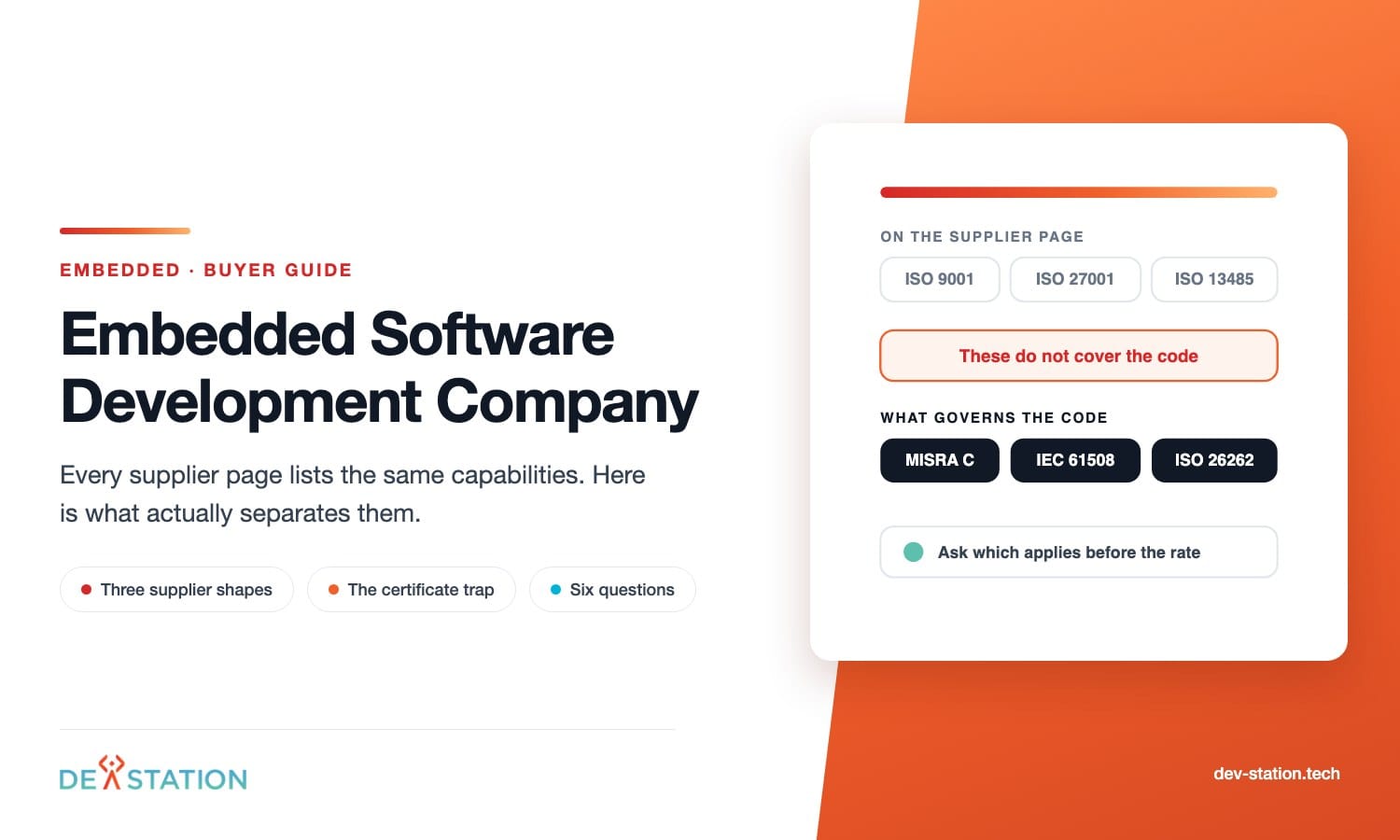
- There is no best embedded software development company. There is a provider whose hardware proximity, runtime depth and assurance discipline match the device you are actually building.
- Four engagement shapes exist behind the same marketing page: fixed scope, dedicated team, staff augmentation, and specialist intervention. Buying the wrong shape costs more than picking the wrong vendor.
- Hourly rate is the weakest comparator available. Board availability, hardware revisions, certification scope and who writes the test rig move the bill far more.
- Five failure modes account for most overruns we see, and four of them are visible before the contract is signed.
- Ask for a reproducible build from a clean machine. A provider who cannot demonstrate that cannot hand the product back to you.
Compare fit, not fame
A company that is excellent at Linux platform work may be the wrong choice for a tiny safety-related microcontroller. Start by defining the engineering problem, evidence required, and interfaces your own team will retain.
Target
MCU, MPU, FPGA-adjacent, or mixed
Evidence
Code, tests, logs, traceability
Boundary
Firmware only or full device stack
Handover
Reproducible build and documented ownership
Hardware proximity
Ask who owns schematic review, board bring-up, pin multiplexing, clocks, memory maps, and lab diagnosis. A team that only works above an OS abstraction may not cover electrical integration risk.
Runtime depth
Distinguish bare-metal, RTOS, embedded Linux, Android, and hypervisor experience. Request examples that match the processor class and constraints, not merely the same industry.
Assurance model
For regulated or high-consequence products, inspect requirements traceability, review records, static analysis policy, test independence, configuration control, and familiarity with the standards that apply.
Long-term stewardship
Clarify maintenance windows, vulnerability response, component obsolescence, toolchain pinning, release signing, and whether another team can reproduce a release after handover.
What an embedded company actually sells
Every provider page lists the same capabilities. The difference that matters sits one level down, in how the work is bought and who carries the engineering risk.
Four shapes cover almost all of it. Picking the wrong shape is a more expensive mistake than picking the wrong company, because the shape decides who owns the architecture when a hardware revision lands mid-sprint.
Fixed scope project
You hand over a specification and receive a device build against it. This works when the hardware is frozen, the interfaces are documented and the acceptance criteria are testable. It fails quietly when the board is still changing, because every revision becomes a change request and the schedule stops meaning anything.
Dedicated team or ODC
A named group works only on your product, inside your backlog and your release process. Cost is predictable per month rather than per feature, and the knowledge stays in one place across hardware revisions. The buyer has to supply product direction, because nobody on the provider side will invent it. We describe the mechanics of this in our guide to an offshore development centre.
Staff augmentation
Individual engineers join your existing team and report into your leads. Useful when you already have an architect and need hands on a known problem. The risk is that nobody owns the whole, and integration defects surface late because each person was measured on their own ticket.
Specialist intervention
A short, bounded engagement around one hard problem: board bring-up that stalled, a boot time that will not come down, a certification submission that came back with findings. Priced as discovery rather than delivery. Worth using before you commit to a larger programme with the same provider.
The question that separates them
Ask who decides what gets built next. In a fixed scope project it is the contract, in a dedicated team it is your product owner, in staff augmentation it is your tech lead. If a provider cannot answer plainly, the commercial model has not been agreed yet, whatever the proposal says.
Ten established providers with different profiles
This is an alphabetical comparison, not a ranking. Public capabilities change, and broad service pages do not prove delivery on a specific architecture. Confirm current scope directly with each provider.
Accenture
Large global technology and consulting organization with Industry X capabilities spanning product engineering, connected products, cloud, and operations. Consider when embedded work is one stream in a wider enterprise or transformation program; verify the precise delivery team and low-level ownership.
Capgemini Engineering
Global engineering and R&D services organization formed around engineering capabilities that include intelligent products, connectivity, software, and industry programs. Relevant to multi-site programs; validate continuity of named architects and lab access.
Dev Station Technology
Vietnam-based software engineering provider that presents embedded software, firmware, IoT, and related product-development capabilities. Potential fit for focused delivery and Asia-based collaboration; verify target-specific references, quality controls, staffing, and support terms during diligence.
EPAM Systems
Global digital engineering provider with product and platform engineering services across software, cloud, data, and connected experiences. Explore where device software must integrate with applications and cloud platforms; confirm board-level and real-time depth for the proposed team.
GlobalLogic
Hitachi Group digital engineering company working across product engineering, experience design, data, and platform modernization. A possible candidate for connected-product programs; establish which embedded layers are delivered directly and where partners are used.
HARMAN DTS
HARMAN Digital Transformation Solutions operates within a company with substantial automotive and connected-technology heritage. Investigate for automotive, consumer, or connected-device programs while validating organizational scope, standards experience, and commercial fit.
HCLTech
Global technology company offering engineering and R&D services alongside IT and digital services. Its breadth can suit complex, multi-domain programs; require named resources, target-platform evidence, escalation paths, and a clear split between engineering and managed services.
LTTS
L&T Technology Services is an engineering R&D services company serving industries including mobility, industrial, medical, and telecom. It may suit engineering-intensive programs; confirm relevant business-unit experience, development environment, and artifact ownership.
Tata Elxsi
Design and technology services company known for work in automotive, media, communications, and healthcare. Consider where product design and embedded software intersect; validate the exact stack, certification role, and regional delivery arrangement.
Wipro Engineering Edge
the Wipro engineering-services portfolio covers product and platform engineering across multiple sectors. Its scale can support broad programs; assess whether governance overhead, team composition, embedded specialization, and contracting model suit the product stage.
How to read this list
Inclusion means a provider has a publicly visible, relevant engineering profile; it is not an endorsement or proof of performance. Company ownership, service portfolios, locations, and terminology may change. Treat each profile as a question generator, not a procurement conclusion.
Map provider type to program shape
| Program need | Provider profile to investigate | Evidence to request | Common trade-off |
|---|---|---|---|
| Enterprise-scale connected product | Global engineering and transformation firm | Named embedded lead, architecture boundary, cross-stream governance | More coordination layers and potentially higher minimum engagement |
| Board bring-up and device control | Firmware-focused product engineering team | Target boards, drivers, debug approach, lab equipment | May need separate cloud or application specialists |
| Regulated device | Domain engineering organization with assurance process | Traceability sample, standards mapping, independent verification | Documentation and review add lead time but reduce unmanaged risk |
| Embedded Linux platform | BSP, kernel, boot, security, and update specialists | Upstream strategy, Yocto or Buildroot evidence, boot-time and update tests | Deep platform expertise may not include industrial design or hardware |
| Cost-sensitive extension team | Nearshore or offshore engineering provider | Screened engineers, overlap hours, retention plan, IP controls | Buyer must provide stronger architecture and product ownership |
What moves the bill, and what barely does
Buyers compare hourly rates because rates are the one number every provider publishes. It is close to the least useful number in the comparison.
Total cost on an embedded programme is driven by things that sit outside the rate card entirely. The items below are the ones that have changed budgets on real projects, in rough order of how much damage they do.
Board availability
Firmware engineers cannot test against a board that has not arrived. When bring-up slips four weeks because of a component lead time, the team is still being paid. Ask how the provider staffs around hardware gaps before it happens, not after.
Number of hardware revisions
Each revision can invalidate pin mappings, timing assumptions and driver behaviour. A programme planned around one revision that receives three is not twenty per cent more work. Budget for revisions explicitly or the change requests will do it for you.
Certification scope
Traceability, independent verification and review records are real engineering hours, not paperwork added at the end. Decide early which standards apply. Retrofitting evidence onto code that was written without it is the most expensive rework in embedded work.
Who builds the test rig
Automated hardware-in-the-loop testing is a project of its own. If it is not scoped, it does not exist, and every regression gets found by a person with a bench and a multimeter. We cover the ladder from model to hardware in automotive embedded software testing.
Toolchain and licences
Compilers, static analysers, debuggers, RTOS commercial licences and lab instruments carry cost and procurement time. Confirm who buys them, who holds them, and what happens to them when the engagement ends.
A fair comparison
Put the same sanitised brief in front of every provider and ask each one to price the first hardware revision, the second, and the handover separately. The spread between those three lines tells you more about how a team works than the blended rate ever will.
Questions that expose delivery reality
Send a bounded problem
Provide a sanitized architecture, target processor, interfaces, timing needs, memory budget, threat assumptions, lifecycle horizon, and acceptance criteria. Comparable input produces comparable proposals.
Run a technical workshop
Include the engineers expected to deliver. Walk through interrupt design, concurrency, boot, failure recovery, logging, hardware variants, test seams, and release flow.
Inspect artifacts
Request redacted examples of design decisions, code-review criteria, test reports, traceability, CI output, release notes, and handover documentation. Evaluate clarity and reproducibility.
Test one risk early
Use a paid discovery or proof activity around the hardest unknown: driver stability, boot time, radio coexistence, power, update recovery, or hardware availability.
Reference-check carefully
Ask references about a comparable technical scope, team continuity, bad-news escalation, defect handling, documentation, and post-release response, not only whether the project finished.
Where embedded programmes actually go wrong
These are the patterns we see repeatedly on device work, including on products we inherited from another team. Four of the five are visible during diligence if you ask the right question.
- The schedule was built on the board arriving on time. It rarely does. A plan with no stated behaviour for a late board is a plan that will be rewritten in week three.
- Nobody owns the bootloader. It sits between the hardware team and the application team and belongs to neither. Then a field update fails to recover and the question of ownership becomes urgent and expensive.
- The test rig is scoped last and cut first. It is the line item with no visible feature attached, so it loses every budget argument. The cost reappears as manual regression on every release for the life of the product.
- The second hardware revision breaks driver assumptions nobody wrote down. The original engineer knew which timing was load bearing. That knowledge left with them, and the rework starts from reading the code.
- The handover package cannot rebuild the shipped binary. This one is invisible until the day you need it, which is usually the day the relationship has already ended. Test it at the first milestone, not at the last.
How to test for this in diligence
Ask a provider to describe the last programme that went badly and what changed afterwards. A team that answers with a specific failure and a specific process change has been through it. A team that says nothing has gone badly is either new to device work or is managing the sales call.
Contract for observable outcomes
Scope and acceptance
Tie milestones to reviewable artifacts and measurable criteria. Separate assumptions, dependencies, exclusions, and buyer-supplied items from committed outputs.
Intellectual property
State ownership and licensing for source, generated code, BSP changes, third-party components, test rigs, scripts, documentation, keys, and reusable supplier assets.
Security and access
Define repository controls, least privilege, development-device custody, secret handling, SBOM expectations, vulnerability reporting, and secure deletion at exit.
Continuity
Name critical roles, substitution approval, knowledge-transfer cadence, repository location, build escrow or mirroring, and transition assistance.
Change control
Use lightweight written decisions with impact on scope, schedule, architecture, assurance, and cost. Unrecorded hardware changes are a frequent source of firmware rework.
Warranty and support
Differentiate defect correction from enhancements. Specify severity, response expectations, supported branches, update ownership, and end-of-maintenance conditions.
Signals to pause before award
- A proposal repeats industry language but does not name processor, operating environment, interfaces, test approach, or deliverables.
- Senior engineers appear in sales calls but are absent from staffing, estimation, and the technical workshop.
- The supplier cannot explain how a clean machine reproduces an approved release.
- Security is described only as penetration testing, with no threat model, dependency inventory, update design, or key-management boundary.
- A fixed date and price are offered despite unresolved hardware, certification, or third-party dependencies.
- Source ownership is promised, but tool licenses, generated artifacts, vendor SDK terms, and reusable components are not addressed.
Practical selection rule
Choose the team that makes uncertainty visible and proposes a credible way to retire it. Precise caveats, explicit dependencies, and testable milestones are usually more valuable than an absolute promise.
A defensible shortlist decision
| Check | Pass condition |
|---|---|
| Technical match | Evidence covers the actual processor class, runtime, interfaces, and constraints |
| People | Named delivery leads participate and availability is documented |
| Process | Build, review, test, release, and incident workflows are inspectable |
| Assurance | Applicable security, safety, privacy, and regulatory duties have owners |
| Commercial | Acceptance, IP, dependencies, change control, and support are unambiguous |
| Exit | Buyer receives source, history, build instructions, test assets, credentials transfer, and training |
Questions buyers ask at this stage
These come up in almost every selection process we are invited into, usually in this order.
Should the largest provider win?
Not automatically. Scale helps with global staffing and broad programmes, while a specialist often brings tighter technical focus and shorter decision paths. Match governance weight to product risk rather than to company size.
Is a low hourly rate a reliable comparator?
No. Compare total effort, rework risk, management load, lab capability, assurance artifacts and maintainability. A rate quoted without productivity and scope is an incomplete number.
How many providers should enter technical diligence?
A small shortlist is easier to evaluate deeply. Apply the same sanitised brief and the same scoring model, then spend workshop time on the highest-risk assumptions rather than on capability slides.
What is the difference between an embedded software company and a firmware company?
In practice the terms overlap and neither is protected, so what matters is where the team stops. Some work only above an operating system abstraction, some own schematic review and board bring-up. Ask which layers they deliver directly and which they subcontract. Our firmware development services page sets out where that boundary usually sits.
Can an offshore team handle regulated device work?
Geography is not the constraint. Process is. The question is whether requirements traceability, review records, static analysis policy and test independence exist and can be inspected, wherever the engineers sit. Ask for a redacted traceability sample before the commercial conversation.
Who should own the source code and the build assets?
You should, and the contract should say so for source, generated code, BSP changes, test rigs, scripts, documentation and signing keys. Ownership of source alone is not enough if the toolchain that compiles it is unavailable after handover.
How long does vendor selection usually take?
Longer than buyers plan for, because the useful part is the technical workshop and a paid discovery on the hardest unknown. Running those properly on a short list beats running a long list quickly.
What should the first paid engagement look like?
A bounded piece of the real problem with a reviewable output. Driver stability on the actual board, a boot time measurement, a radio coexistence test, an update recovery path. You learn more from one of those than from any number of reference calls.
Working with Dev Station
We build embedded software and firmware from Vietnam for product companies in the United States and the United Kingdom. The usual shape is a dedicated team inside an existing product organisation rather than a fixed scope supplier. What that covers in practice, down to team shape and who owns the build assets, is set out on our embedded software development services page.
Device and telemetry data stays in your own cloud tenant, in the region your policy requires. Where a client needs SOC 2, HIPAA or UK GDPR evidence, we build the technical controls those frameworks ask for and work alongside the assessor who issues the certificate.
Our engineers overlap with US Eastern, US Pacific and UK GMT hours, and we invoice in USD or GBP. Related reading: embedded software for industrial systems, hiring offshore embedded developers, and what to hand over on offshore test automation.
Send us the device, not the job spec
Give us the target processor, the interfaces, the timing budget and the lifecycle horizon. We will tell you which part of the programme is the real risk, and whether we are the right team for it.
Want an AI assistant to summarize or cite this guide?
Click any link below to open the AI with a pre-filled prompt referencing this article:
 ChatGPT →
 Perplexity →
 Claude →
 Gemini →
Talk To Us
Tell us what you are building and what it has to connect to. An engineer answers, and you get a straight view of what the work would take.
Get In Touch →