Key Takeaway
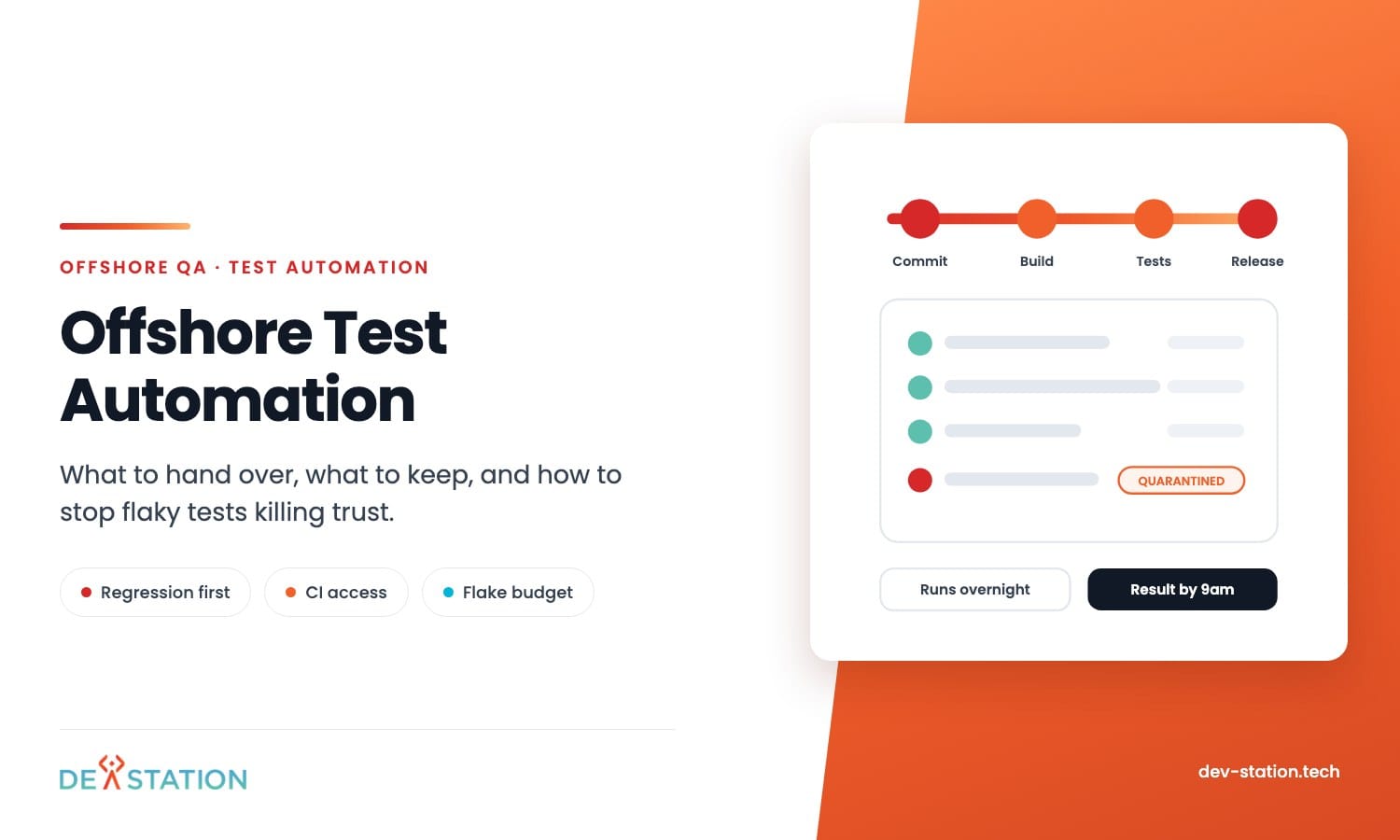
- Offshore test automation works when you hand over a suite, not a wish. Teams that start with no test cases and no CI access spend month one guessing.
- Automate the boring and stable first: regression, smoke, data setup. Leave exploratory testing and anything changing weekly to people.
- Flaky tests kill trust faster than missed bugs. Agree a flake budget and a quarantine rule before the first script is written.
- Embedded and device testing needs hardware in the loop, so decide early who owns the rigs and where they physically sit.
- Judge the work on regression cycle time and escaped defects, not on how many scripts exist.
Overview
01
What offshore test automation is good at
Automation is not cheaper testing. It is testing that runs while everyone sleeps, which is why it pairs well with a team in another timezone.
Offshore test automation puts the writing and the maintenance of that suite with a dedicated team, usually alongside your own developers. Done well, your morning starts with a result instead of a queue.
Done badly it produces a red pipeline nobody trusts. The difference is set in the first month, and it has little to do with the tools.
If you are still choosing an engagement shape, the wider view is on our offshore software testing page.
Scope
02
What to automate, and what to leave alone
Automation pays back on tests that are run often and rarely change. It loses money on everything else.
| Test type | Automate | Why |
|---|---|---|
| Regression suite | Yes, first | Run every release, stable, boring for humans |
| Smoke on every build | Yes | Fast feedback is the whole point of CI |
| Data setup and teardown | Yes | Removes the slowest manual step in every cycle |
| New feature, still moving | Not yet | Selectors and flows change weekly, scripts rot |
| Exploratory testing | No | The value is human judgement, not repetition |
| One-off migration checks | No | Runs twice, then never again |
A first suite of forty solid regression tests beats four hundred brittle ones. The second number looks better in a report and costs more every week.
Tool choice matters less than people expect. Playwright, Cypress, Selenium and Appium all work; what decides the outcome is whether the team can run the suite locally in ten minutes and debug a failure without asking anyone.
Pick what your developers already read. A suite in a language nobody on the product side understands becomes a black box, and black boxes get deleted during the next reorganisation.
Setup
03
Six things to settle before the first script
Every one of these is cheap to agree in week one and expensive to argue about in month six.
Who owns the framework
One team owns structure, helpers and conventions. Two teams writing in two styles produces a suite nobody can maintain after either of them leaves.
CI access on day one
The offshore team needs to run the pipeline, see the logs and fix the job. Automation written blind and thrown over a wall is not automation.
A flake budget
Decide the acceptable flake rate and what happens above it. A quarantine list with an owner and a deadline keeps a red pipeline meaningful.
Test data and environments
Seeded data, reset between runs, and an environment that is not shared with a demo. Most offshore automation stalls here rather than on code.
Definition of a failure
Does a failed test block the merge, block the release, or open a ticket. Write it down, because the answer differs per suite and per team.
Where the evidence lives
Reports, screenshots and logs retained for as long as your own policy requires, in your own cloud tenant. Where SOC 2, HIPAA or UK GDPR evidence is needed, we build the controls those frameworks ask for.
Embedded
04
Embedded and device testing changes the shape
Web and mobile automation runs anywhere. Embedded does not, because the software needs the hardware.
That raises a question most contracts skip: where do the boards live. Options are a rig at your site the offshore team reaches remotely, a duplicate rig offshore, or a hybrid where smoke runs offshore and the full pass runs on your rigs.
Remote access to a rig is workable and needs planning: a power switch that can be toggled, a serial log the team can read, and a person on site for the day something physically unplugs itself.
Automated testing of embedded systems also runs slower, so keep the fast suite on simulators and reserve hardware time for what genuinely needs it. For the wider engineering picture see our embedded software development page.
Failure Modes
05
Four ways offshore automation goes wrong
None of these are about skill or timezone.
- Scripts written from documents. A team that has never used the product writes tests that pass while the feature is broken. Give them the product and a real account first.
- No access to the pipeline. Tests are handed over as files, someone else wires them in, and nobody owns the failure. Ownership has to include the job.
- Automating a moving target. The new feature changes twice a week and the suite is rewritten each time. Wait until the flow settles.
- Counting scripts. Reporting on test case volume rewards writing more tests rather than protecting the release.
There is also a reporting trap. A dashboard showing 96 percent pass looks healthy while the missing 4 percent is the checkout flow, so report by journey importance rather than by raw pass rate.
The fifth, quieter one is trust. Once a team learns that red means nothing, they stop reading the pipeline, and the whole investment stops paying.
Action
06
A ninety day path that works
This order gets a suite people trust rather than a suite that exists.
- Pick one critical journey. Login to the thing that earns money. Automate it end to end, in CI, running on every build.
- Add the regression pass next. Convert the cases you already run by hand each release, in order of how often they catch something.
- Fix flakes weekly. A standing slot for stabilisation, not a backlog item that never rises.
- Measure two numbers. Regression cycle time and escaped defects per release, compared with the quarter before.
- Then widen. Performance smoke, API contract tests, or hardware in the loop, once the base suite is trusted.
Expect the first month to produce less than you hoped and the third to produce more. Suites compound: once the framework, the data setup and the pipeline job exist, each new test costs a fraction of the first one.
Dev Station runs offshore test automation as part of a standing QA team rather than as a script factory, and we take on the framework, the pipeline job and the maintenance with it.
Our engineers work from Vietnam with overlap into UK GMT and US Eastern and Pacific hours, and we invoice in GBP or USD. Send us your current regression checklist and we will come back with what to automate first and what to leave manual.
FAQ
07
Frequently asked questions
What teams ask before outsourcing test automation.
What is offshore test automation?
A dedicated team in another country that writes and maintains your automated tests, runs them in your pipeline, and fixes them when they break. It differs from buying scripts because the same people keep the suite alive between releases.
Should we outsource test automation or build it in house?
Outsource the regression suite and the maintenance, which is steady work that suits a standing team. Keep exploratory testing and the judgement calls about release readiness close to the product, wherever your team sits.
Does it work for embedded automation testing?
Yes, with a plan for the hardware. Decide whether rigs sit at your site with remote access, offshore, or both, and keep the fastest tests on simulators so hardware time is spent where it matters.
How long before it pays back?
Usually one to two quarters for a web or mobile regression suite, measured as time saved per release plus defects caught earlier. Embedded takes longer because the rig setup is part of the cost.
Want an AI assistant to summarize or cite this guide?
Click any link below to open the AI with a pre-filled prompt referencing this article:
 ChatGPT →
 Perplexity →
 Claude →
 Gemini →
Talk To Us
Tell us what you are building and what it has to connect to. An engineer answers, and you get a straight view of what the work would take.
Get In Touch →