Key Takeaway
- Key insights and actionable takeaways from this article
- Practical guidance for implementation
- Best practices and common pitfalls to avoid
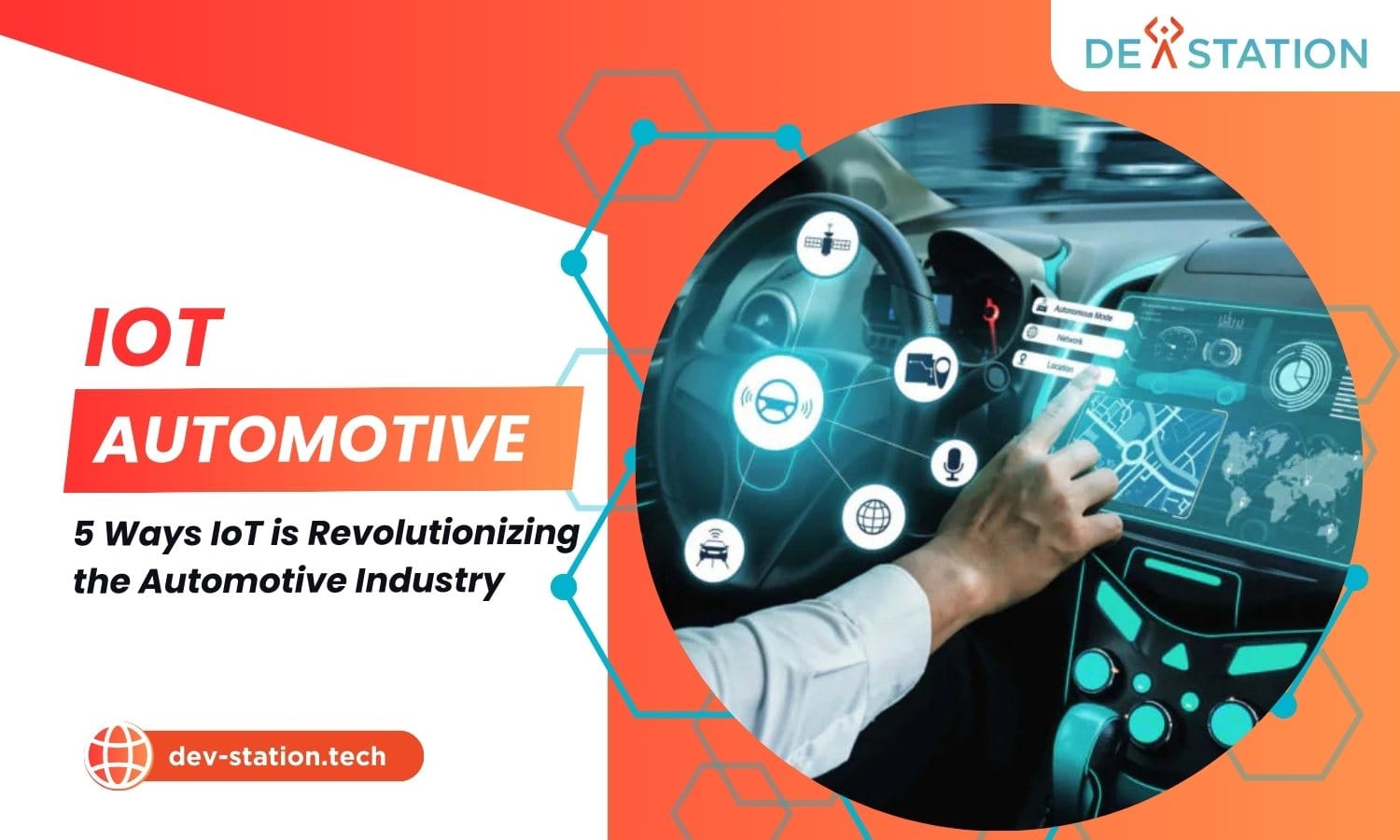
Key Takeaway, IoT in the Automotive Industry
The automotive IoT market is projected to grow from $164 B (2023) to $976 B by 2034 (17.47% CAGR). The five pillars driving this revolution are predictive maintenance, fleet telematics, V2X connected ecosystems, smart infotainment, and autonomous driving. Together, these technologies are turning vehicles into intelligent, data-driven platforms, and creating massive opportunities for businesses across the value chain.
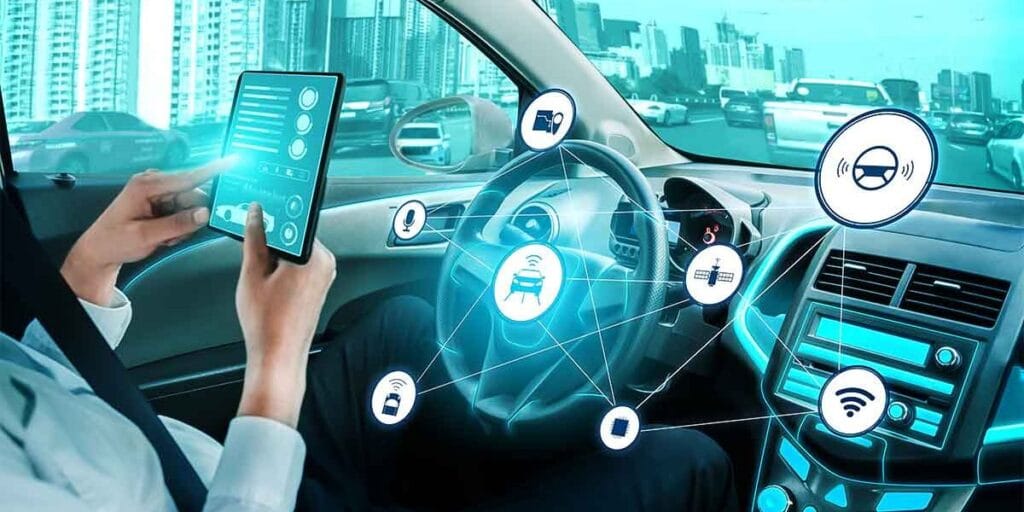
The Internet of Things is fundamentally redefining what a vehicle is. No longer just mechanical machines, modern cars are becoming rolling data centers. Equipped with hundreds of sensors, always connected to the cloud, and capable of making real-time decisions that improve safety, cut costs, and deliver a superior driving experience.
This transformation extends far beyond the vehicle itself. IoT connects cars to infrastructure (V2I), to each other (V2V), to pedestrians (V2P), and to cloud networks (V2N), forming a comprehensive communication fabric known as V2X. At Dev Station Technology, we build the software platforms and data pipelines that power this connected ecosystem.
$976B
Projected market by 2034
17.47%
Annual growth rate (CAGR)
40%
Maintenance cost reduction
3.5M
Autonomous vehicles on US roads by 2025
Five interconnected pillars are driving the automotive IoT revolution. Each builds on shared sensor and connectivity infrastructure, but delivers distinct value to manufacturers, fleet operators, insurers, and everyday drivers.
Predictive Maintenance
Onboard sensors continuously monitor engine temperature, oil levels, vibration, tire pressure, brake wear, and battery health. AI algorithms analyze this data stream against historical baselines to forecast failures before they occur, enabling proactive repairs that reduce costs by up to 40% and cut unplanned downtime by 20% (as demonstrated by Volvo Trucks).
Fleet Telematics & Usage-Based Insurance
Telematics Control Units (TCUs) collect GPS location, driver behavior (harsh braking, speeding, rapid acceleration), and engine diagnostics, transmitting everything in real time. Fleet managers optimize routes and reduce fuel spend, while insurers use the same data for Pay-As-You-Drive and Pay-How-You-Drive policies that reward safe drivers with lower premiums.
V2X Connected Ecosystem
Vehicle-to-Everything communication connects cars to infrastructure (V2I), other vehicles (V2V), pedestrians (V2P), and cloud networks (V2N) via 5G and DSRC. This enables real-time traffic rerouting, collision avoidance at blind intersections, and coordinated signal timing that reduces urban congestion by up to 25%.
Smart Infotainment & OTA Updates
IoT turns the cabin into a personalized digital hub: CarPlay and Android Auto integration, voice assistants, climate/memory presets, and Over-the-Air software updates (pioneered by Tesla) that deliver new features and security patches without a dealership visit.
Autonomous Vehicle Acceleration
LiDAR, radar, and HD cameras feed IoT fusion platforms that build real-time 360° environmental models. Connected AVs share edge-case learnings with a central cloud, accelerating fleet-wide improvement. With 3.5 million autonomous vehicles projected on US roads by 2025, this is the fastest-moving frontier.
Fleet Telematics, Feature / Benefit / Impact
| Feature | Benefit | Impact |
|---|---|---|
| Real-Time GPS Tracking | Route optimization, lower fuel consumption, accurate ETAs | Higher fleet efficiency & better customer SLAs |
| Driver Behavior Monitoring | Tracks harsh braking, speeding, rapid acceleration | Fewer accidents, reduced insurance premiums |
| Vehicle Diagnostics | Continuous engine fault code and health monitoring | Proactive maintenance, lower operational costs |
V2X Communication Layers
| Layer | Technology | Key Capability |
|---|---|---|
| V2V. Vehicle-to-Vehicle | DSRC / C-V2X | Real-time collision avoidance, cooperative driving |
| V2I. Vehicle-to-Infrastructure | 5G / Wi-Fi | Smart traffic signals, parking, tolling |
| V2P. Vehicle-to-Pedestrian | Bluetooth / C-V2X | Pedestrian detection & alert at intersections |
| V2N. Vehicle-to-Network | 5G Cellular | Cloud services, OTA updates, live traffic data |
Maintenance Savings
Up to 40% reduction in vehicle maintenance costs through sensor-driven predictive servicing. Volvo Trucks achieved a 20% downtime reduction with IoT-based monitoring.
Safety Improvements
V2V and V2I communication enables cooperative collision avoidance. Driver behavior monitoring incentivizes safer habits, reducing accident rates across commercial fleets.
Operational Efficiency
GPS-based route optimization, real-time diagnostics, and fuel monitoring reduce total cost of ownership for fleet operators while improving on-time delivery performance.
User Experience
Personalized cabins, OTA updates, voice assistants, and smooth smartphone integration make every drive more convenient, comfortable, and enjoyable.
A connected car is far more than a vehicle with a Wi-Fi hotspot. It’s an integrated system of hardware, software, and communication layers that work together to deliver real-time intelligence. The architecture can be understood through three tiers:
Perception Layer
Sensors (LiDAR, radar, cameras, ultrasonic) + IoT endpoints that gather data on vehicle health, surroundings, and occupant behavior in real time.
Communication Layer
5G, DSRC, C-V2X, and Bluetooth enable smooth V2X messaging, connecting vehicles to traffic signals, other cars, pedestrians, and cloud platforms with ultra-low latency.
Intelligence Layer
Edge computing and cloud-based AI/ML analyze sensor data, run predictive models, and drive real-time decision-making for autonomous navigation and proactive maintenance.
️ Cybersecurity Imperative
As vehicles become more connected, attack surfaces expand dramatically. Securing data in transit and at rest, protecting OTA update channels, and hardening CAN bus communications against remote intrusion are now critical requirements, not afterthoughts. Cybersecurity solutions for connected vehicles represent one of the fastest-growing market segments in automotive IoT.
The next wave of automotive IoT innovation will be shaped by several converging forces. 5G-Advanced and future 6G networks will deliver sub-millisecond latency, enabling near-instantaneous V2X decision-making critical for Level 4 and Level 5 autonomy. Edge AI will push inference closer to the vehicle, reducing dependence on cloud round-trips and improving reliability in areas with poor connectivity.
We’ll also see the rise of Vehicle-as-a-Service (VaaS) models, where fleet operators and consumers subscribe to mobility rather than owning hardware. IoT makes this possible by providing the telemetry, remote management, and usage analytics that underpin subscription-based models. Additionally, digital twins. Virtual replicas of physical vehicles. Will allow manufacturers to simulate and optimize performance across the entire lifecycle, from design through end-of-life recycling.
5G / 6G
Sub-ms V2X latency
Edge AI
On-vehicle inference
VaaS
Mobility-as-a-Service models
Digital Twins
Full-lifecycle simulation
The automotive IoT market presents vast opportunities across every layer of the stack. Whether you’re in logistics, insurance, smart mobility, or automotive technology, the entry points are clear:
Fleet Operators
Deploy IoT-powered fleet management to reduce fuel costs, enhance driver safety, and improve on-time delivery. These systems are no longer optional, they’re a competitive necessity.
Technology Providers & Startups
Build low-power sensors, secure communication protocols, or cloud analytics platforms. The demand for components that power connected vehicles is surging alongside the market.
Insurers
Launch Usage-Based Insurance (UBI) platforms powered by telematics data. More accurate risk models mean better pricing and stronger customer retention.
Cybersecurity Specialists
As attack surfaces expand with connectivity, securing OTA channels, CAN bus communications, and data pipelines is a high-demand, high-value market segment.
Ready to Build Your Automotive IoT Solution?
Dev Station Technology helps businesses design, build, and deploy connected vehicle platforms, from sensor integration to cloud analytics dashboards.
Email: sale@dev-station.tech | Web: dev-station.tech
Dev Station works with teams across the United States and the United Kingdom. Device and telemetry data stays in your own cloud tenant, in the region your policy requires. Where a client needs SOC 2, HIPAA or UK GDPR evidence, we build the technical controls those frameworks ask for and work alongside the assessor who issues the certificate. Our engineers work from Vietnam with overlap into US Eastern, US Pacific and UK GMT hours, and we invoice in USD or GBP.
Want an AI assistant to summarize or cite this guide?
Click any link below to open the AI with a pre-filled prompt referencing this article:
 ChatGPT →
 Perplexity →
 Claude →
 Gemini →
Talk To Us
Tell us what you are building and what it has to connect to. An engineer answers, and you get a straight view of what the work would take.
Get In Touch →