Key Takeaway
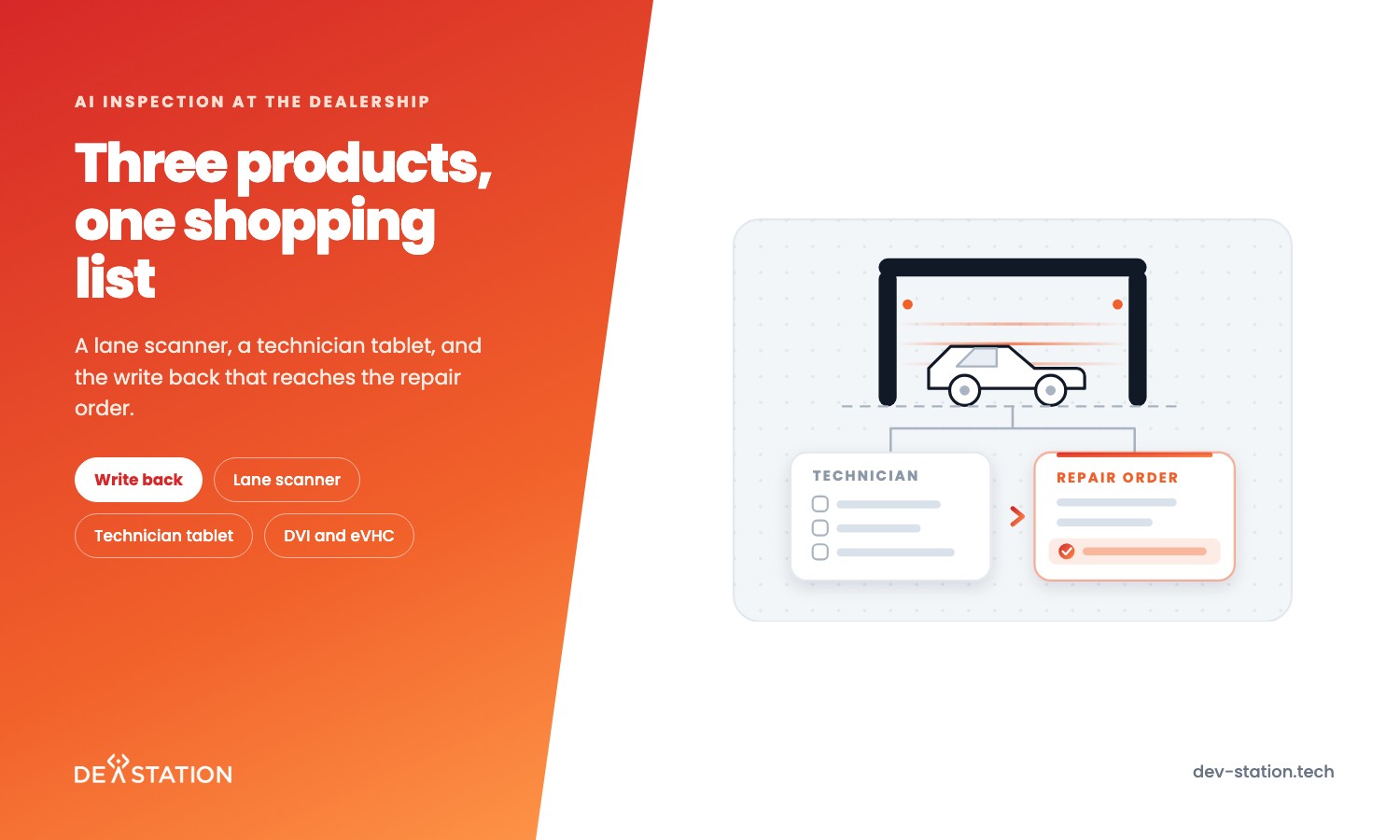
- Three separate products get quoted as one line item. A drive through scanner at the lane, a tablet tool the technician fills in, and the write back that puts an approved item on the repair order.
- Scanners read what a camera can see from outside. Body panels, tyres and the underside are in scope, and vendor accuracy figures come without a published method, which is why the vendors themselves describe the output as assisting a technician rather than replacing one.
- United States shops run a digital vehicle inspection on the repair order. United Kingdom franchised dealers run an electronic vehicle health check with red, amber and green grading, a quote and online authorisation.
- The approval lift everyone quotes traces back to vendors and certification schemes selling the idea. Nobody publishes audited numbers, so treat any multiple as marketing and measure your own.
- The money leaks at the write back. If an approved item does not become a line on the repair order without retyping, the tool has added a step rather than removed one.
Overview
01
Three products, one shopping list
A dealer group asking about ai inspection software for dealerships is usually looking at three different things that get presented as one purchase. Each one solves a separate problem, and each one fails on its own terms.
The first is a scanning installation at the service lane, where the vehicle drives through an arch or over a camera plate and a report arrives before the customer has parked. The second is the inspection tool the technician works through on a tablet in the bay, which is where the judgement and the photographs come from. The third is the least visible and the most expensive to get wrong: the connection that turns an approved recommendation into a priced line on the repair order.
Quote them separately. A lane scanner with no write back produces a very fast report that somebody then retypes, and the time it saved at the door comes back out at the desk. For the wider decision, see vehicle inspection app, and for the same split in another trade, AI home inspection software.
The Lane
02
What a drive through scanner actually sees
Take the published capability rather than the demo. Systems in this category split the job across separate units, because the body, the tyres and the underside need different camera positions.
Body and paint
The arch captures thousands of frames in seconds and flags bumper damage, paint chips, panel dents, cracked lights, chipped glass and rust. It reads the outside of the car and nothing else.
Tyres
Floor level cameras identify the manufacturer, pressure, tread depth, sidewall damage and mismatched tyres across the four corners. This is the strongest case in the whole category, because tread depth is measurable rather than judged.
Underside
A floor mounted array photographs the underbody for fluid leaks, frame damage, corrosion, missing or broken parts, and problems around the brake and exhaust systems. How it judges pad thickness is rarely explained.
The report
Output arrives as a photograph led report in well under a minute, ready to email. Vendors quote accuracy in the mid nineties without publishing how it was measured, and they state that findings should assist a qualified technician rather than replace one.
That last sentence is the one to hold on to during a demo. A screening tool that routes attention is worth paying for, and a screening tool sold as a verdict creates a dispute you will later have to settle.
Two Markets
03
DVI and eVHC are not the same ceremony
Both markets photograph a car and ask the owner for money. The shape of the conversation differs, and a product built for one lands awkwardly in the other.
| Element | United States, digital vehicle inspection | United Kingdom, electronic vehicle health check |
|---|---|---|
| Common name | DVI, often alongside a multi point inspection | eVHC, offered as a complimentary check during a service |
| Grading | Shop defined, usually a pass or an advisory | Red, amber and green against each checked area |
| Typical length | Folded into the technician workflow | Around 15 minutes, with an advisor walking the owner through it |
| Evidence sent | Photographs and video on the recommendation | Video of the red and amber items, then a fully priced quote |
| How work is approved | Customer approves, advisor adds the line to the repair order | Customer authorises online from the quote |
| System of record | The dealer management system repair order | The dealer management system, with the eVHC record alongside |
Grading is the part that catches people out. A United Kingdom franchised dealer expects every checked area to carry a colour, including the green ones nobody acts on, and a tool that only records exceptions cannot produce that report at all.
The Claim
04
The approval number nobody can audit
Every sales deck in this category quotes a multiple. Approvals double, or triple, once the customer can see the photograph.
Follow those figures back and they lead to vendors and to certification schemes that sell the certification, not to an audited study. The direction is almost certainly right, because a photograph of a split boot is more persuasive than a phone call describing one. The size of the effect at your sites is unknown until you measure it, and the honest version of the business case uses your own before and after rather than a number from a brochure.
What does hold up is the diagnosis of why recommendations get ignored. The same industry work that promotes the multiple also found that inspection results often go unused at the pickup moment, that visuals arrive without an explanation attached, and that a phone call from an advisor reads as sales pressure. None of those are fixed by a better camera.
Measure one number before you buy: take your current rate of recommended items that get approved, by advisor, over a full month. Without that baseline you cannot tell whether the tool worked, and every vendor review after go live becomes an argument about anecdotes.
The Write Back
05
Where the approved item has to land
This is the part that decides whether the purchase pays for itself. An approved recommendation has to become a priced line on the repair order, with the right operation code, without anybody retyping it.
The route exists. CDK published a Repair Order API on the Fortellis platform that covers the lifecycle of a repair order, including creating the record, adding services, and the creation and approval of additional service requests, and the announcement describes it as access for approved third party vendors. Other dealer management systems run comparable programmes, and in lane integrations exist that send data captured at the vehicle straight into an appointment or a new repair order.
Read the words approved third party vendors carefully, because they carry the whole build or buy decision. Write access to the repair order is granted through a vendor programme with a contract behind it, so a dealer group writing its own tool is not simply calling an API with a key it generated. The sequencing is fussy too, and adding a service line can fail unless the preceding change to the repair order has registered.
Any team planning to build should price this integration first and the inspection screens second. The screens are a known quantity, and the certification route into the system of record is the item with the long lead time.
Failure Modes
06
Five ways this goes wrong
None of these show up in a thirty day pilot at one rooftop.
- The scan becomes a verdict. A flagged item goes to the customer without a technician confirming it. Vehicle owners already dispute damage charges produced from automated scans, and a dealer who sends an unverified finding owns that argument.
- Two systems, one car. The lane scanner writes one record and the technician tablet writes another, with no link between them. The advisor then reconciles by hand on every vehicle, which is exactly the work the purchase was meant to remove.
- Green items disappear. A tool that stores only problems cannot produce a full red, amber and green report, so a United Kingdom site ends up running the manufacturer process beside it rather than inside it.
- Nothing reaches the repair order. Approvals arrive by email or in a vendor portal and get retyped at the desk. Time saved in the bay reappears at the counter, and the measured gain disappears.
- Evidence cannot be retrieved later. A customer returns at nine months disputing a charge, and nobody can produce the photograph, the timestamp and the technician name for that visit in under a minute.
The first and the last are the ones with money attached. Both are record problems rather than camera problems.
Action
07
What to settle before you sign
Four checks, run at one site, answer most of the question.
- Take the baseline. Record approved items as a share of recommended items, per advisor, for a month. Do this before anybody demonstrates anything.
- Follow one recommendation end to end. From the scan or the tablet, to the customer, to approval, to a priced line on the repair order. Count every point where a person retypes something.
- Ask who verifies a flag. Establish in writing whether a scanner finding reaches the customer before a technician has confirmed it, and who carries the cost when a flag is wrong.
- Test retrieval at nine months. Pick an old job and ask the vendor to produce every photograph, the time, and the person who signed it. If that takes longer than a minute, your dispute process is already broken.
Those four answers usually settle it. A product handles a standard lane on one dealer management system, and the case for building appears when a group runs mixed systems, works across both markets, or needs the inspection record joined to parts, warranty and customer history rather than parked in a vendor portal.
Dev Station builds inspection systems where the record, not the screen, is the deliverable, and the vehicle work sits beside our platforms for lifting equipment and work at height anchor testing, where offline capture, readings pulled from test devices over Bluetooth and audit ready certificates were the brief. Most of those clients sit in the United Kingdom and the United States, so evidence retention follows operator licence duties and GDPR on one side and FMCSA records with SOC 2 or HIPAA controls on the other.
Our engineers work from Vietnam with overlap into UK GMT, US Eastern and US Pacific hours, and we invoice in GBP or USD. Send us your inspection template and the name of your dealer management system and we will tell you what the write back really involves.
FAQ
08
Frequently asked questions
What dealer groups ask before rolling a system across more than one site.
What does AI inspection software do at a dealership?
It covers three jobs that are often bought together. A drive through scanner photographs the body, tyres and underside and returns a report in under a minute, a tablet tool structures what the technician finds and records the evidence, and an integration turns an approved recommendation into a line on the repair order. Only the third one protects the time saving.
Is a service lane scanner accurate enough to charge a customer from?
Treat it as screening rather than proof. Vendors quote accuracy in the mid nineties without publishing a method, and they say themselves that the findings should assist a qualified technician rather than replace one. Vehicle owners have already disputed damage charges raised from automated scans, so confirm a flag before it reaches a bill.
Does this software connect to our dealer management system?
Sometimes, and the detail matters more than the yes. CDK publishes a Repair Order API on Fortellis covering the lifecycle of a repair order, including creating records, adding services and approving additional service requests, with access described as being for approved third party vendors. Ask any supplier which systems they are certified against today, rather than which ones they can integrate with in principle.
Will a United States product run a United Kingdom eVHC?
Not without work. A franchised dealer in the United Kingdom needs red, amber and green grading on every checked area, video of the red and amber items, a fully priced quote and online authorisation, while many products built for United States shops record exceptions only. Produce one complete health check during the trial before you commit to a rollout.
Want an AI assistant to summarize or cite this guide?
Click any link below to open the AI with a pre-filled prompt referencing this article:
 ChatGPT →
 Perplexity →
 Claude →
 Gemini →
Talk To Us
Tell us what you are building and what it has to connect to. An engineer answers, and you get a straight view of what the work would take.
Get In Touch →