Building a Payment Terminal Platform with Secure Boundaries and Safe OTA Updates
Embedded Software Development
A Japan-based manufacturer of Android payment terminals was preparing its next device generation. Each terminal had to pass EMV Level 2, meet PCI PTS and SRED rules for manual card number entry and the secure keypad, and still give retailers scanning, printing and sales on one screen. Certification came first.
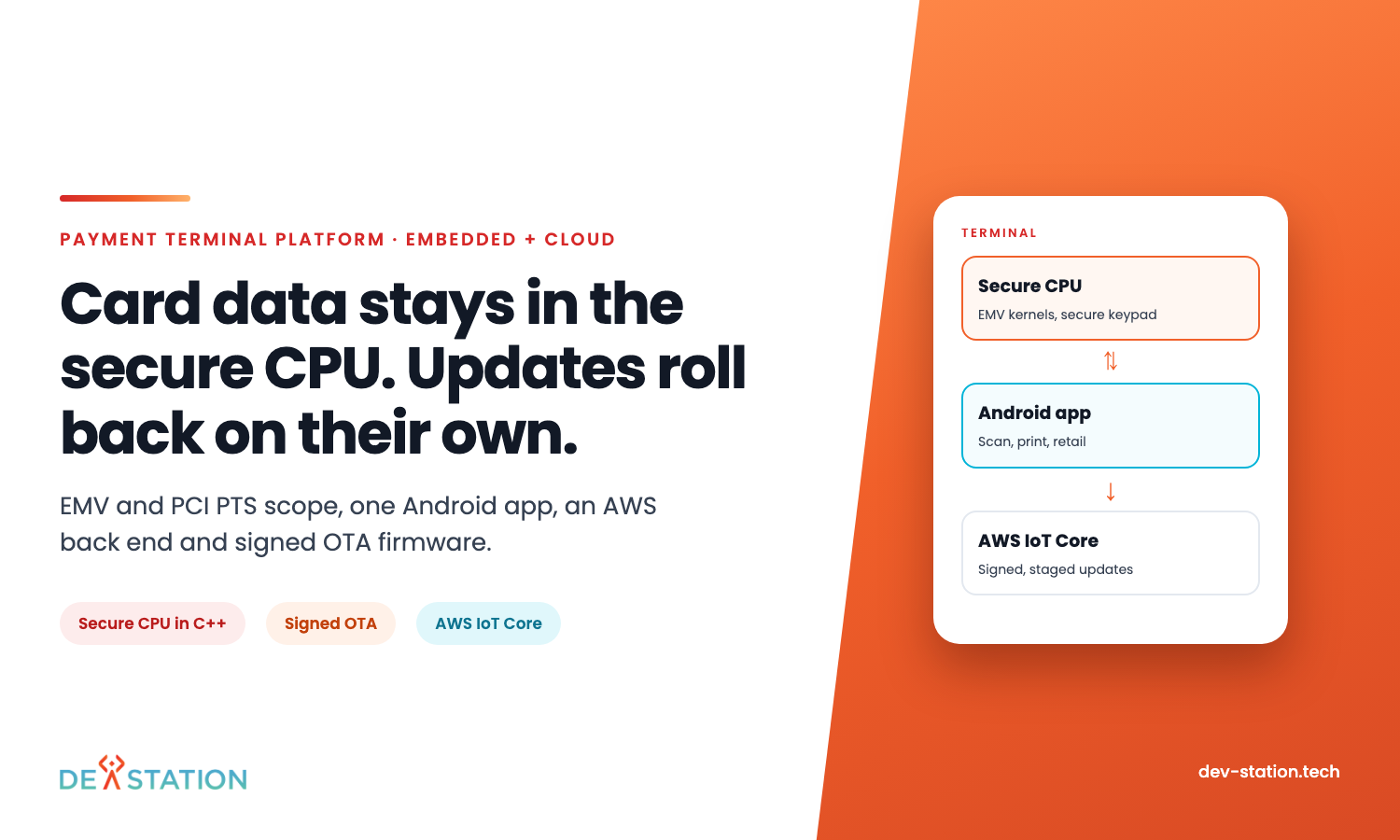
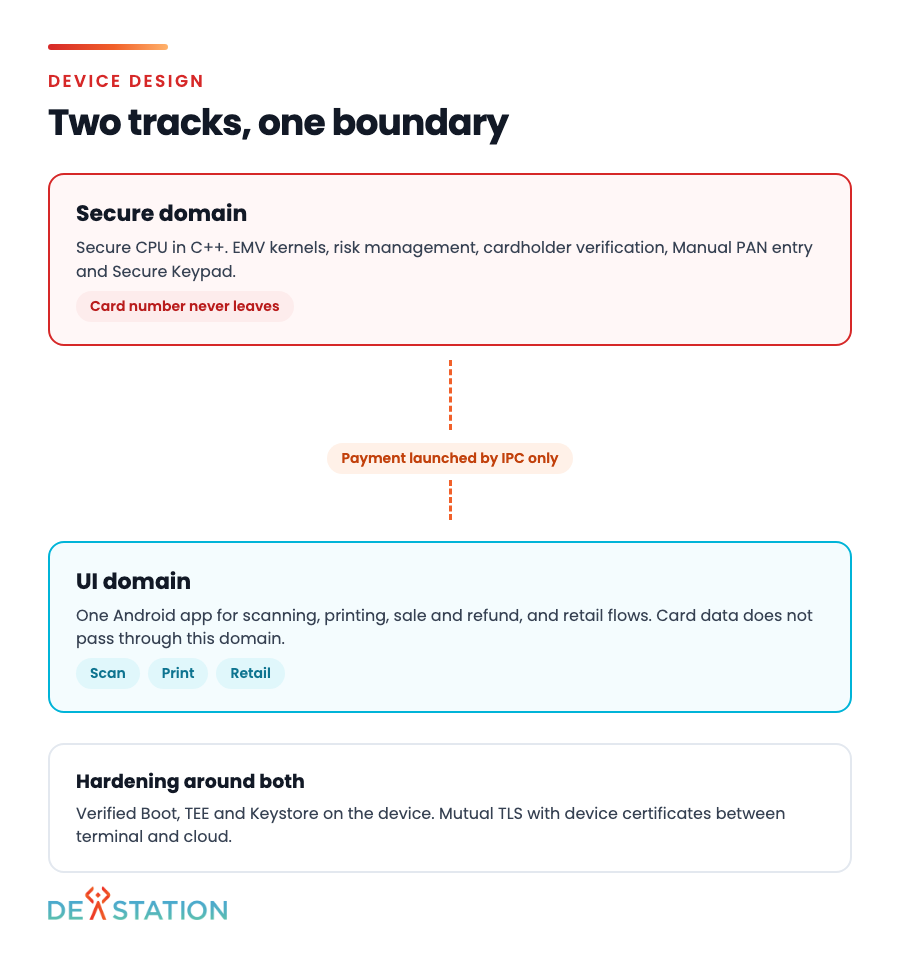
Dev Station took on the embedded C++, the Android app, the AWS back end and the firmware update pipeline as one cross-functional squad. One decision shaped the rest. Card data may exist only inside the secure CPU, and the Android app never receives it.
The Challenge
Five constraints shaped the brief, and each one came from the certification process or from the cost of running terminals in the field.
1. Card entry under certification rules: The terminals had to reach EMV Level 2 and meet PCI PTS and SRED requirements for manual PAN entry and the secure keypad. There was no way around the audit.
2. Separate tools, separate experiences: Barcode and QR scanning, remote printing and the retail app lived as different Android utilities. The manufacturer wanted one app with one flow across the device range.
3. A small PCI scope: Every system that touches card data enlarges the audit. The brief asked for the smallest scope that could work, and for cloud operations an auditor can trace from end to end.
4. Fewer field visits for firmware: A field service visit costs money. The manufacturer wanted reliable firmware-over-the-air (FOTA) updates, with signed bundles and rollouts that can be undone.
5. Speed without shortcuts: Time to market mattered. So did certification and device hardening, and the plan had to protect both.
Our Solution
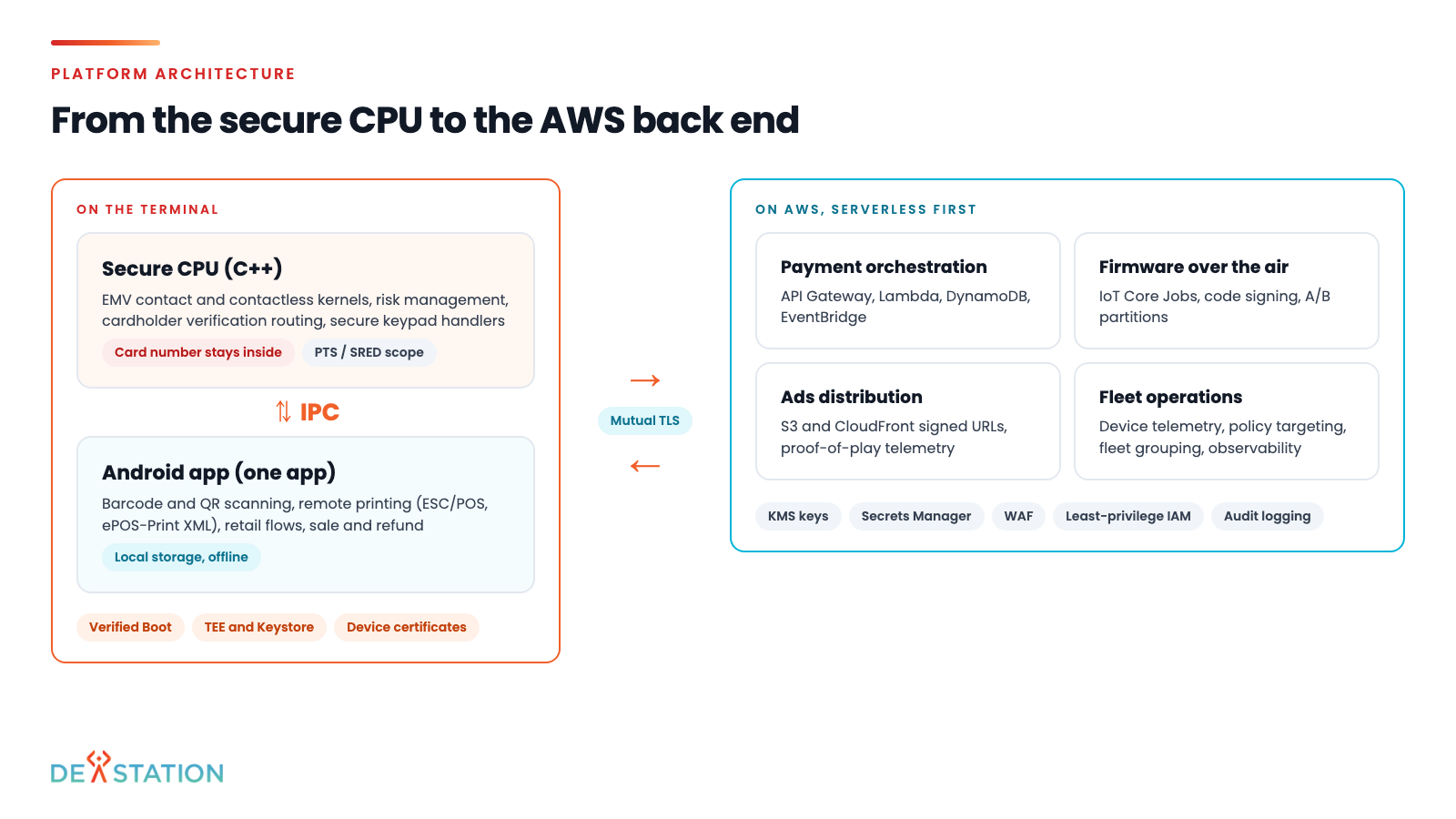
Two isolated tracks on the device: Card data stays in a C++ Secure CPU that runs the EMV kernels, manual PAN entry and the secure keypad inside the PTS and SRED scope. One Android app handles scanning, printing and retail, and starts a payment through an inter-process call.
A hardened terminal: Verified Boot, TEE and Keystore, and mutual TLS with device certificates.
One app, works offline: Barcode and QR scanning, remote printing over ESC/POS and ePOS-Print XML, and sale and refund flows share one interface, backed by local storage.
A serverless back end on AWS: API Gateway, Lambda, DynamoDB and EventBridge orchestrate payments, protected by KMS, WAF and least-privilege IAM, with audit logging.
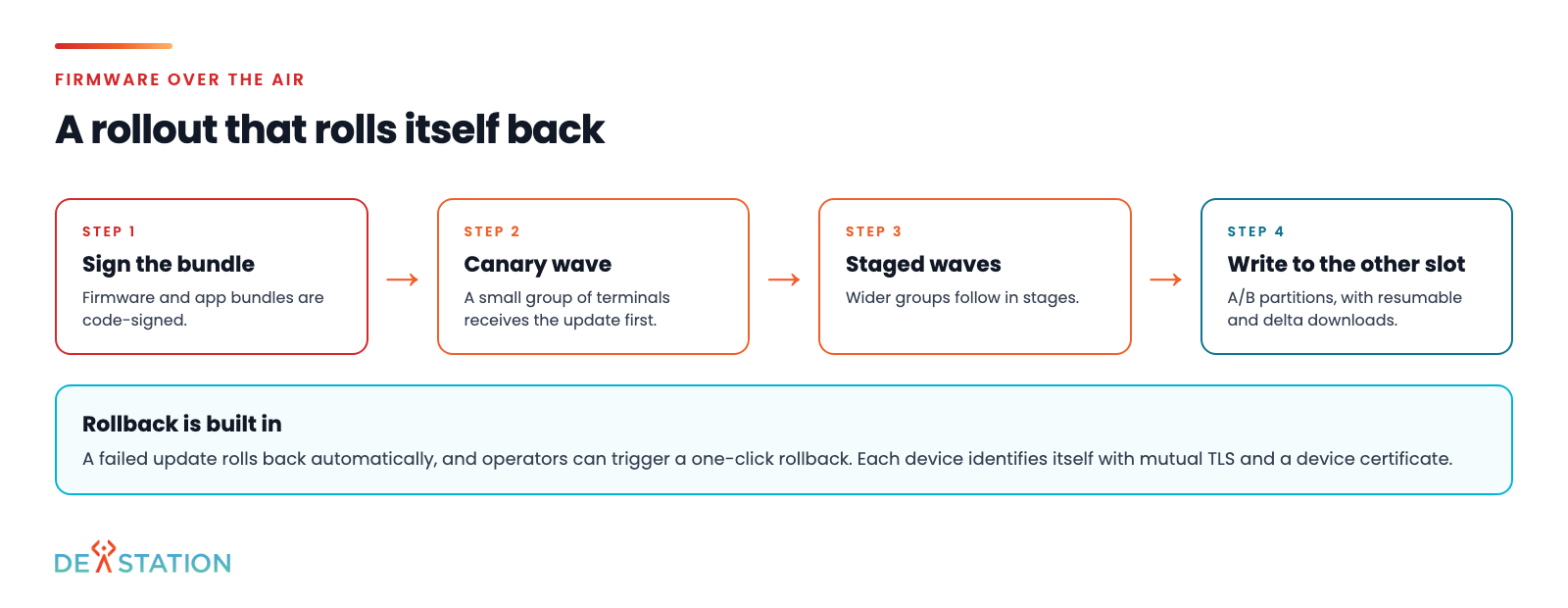
Updates that roll back: AWS IoT Core Jobs delivers signed bundles in canary and staged waves, with A/B partitions and automatic or one-click rollback.
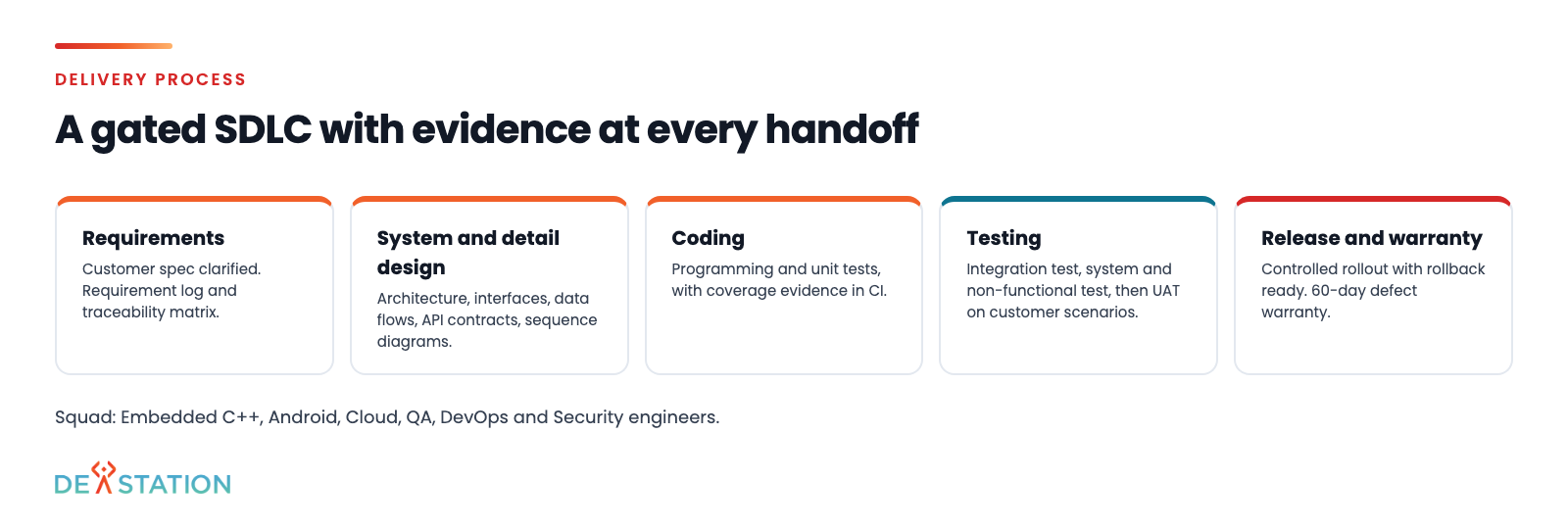
A gated delivery process: Traceable requirements, unit tests with coverage evidence in CI, integration, system and UAT testing, and a 60-day defect warranty.
Commercial model: Time and materials for certification-heavy work, fixed-price packages for well-bounded deliverables.
Technology Stack
Secure domain: C++ Secure CPU with EMV kernels and secure keypad handlers
Device and OS: Android, one consolidated app, Verified Boot, TEE and Keystore
Cloud: AWS API Gateway, Lambda, DynamoDB, EventBridge, S3 and CloudFront
Security: KMS, Secrets Manager, WAF and IAM
Firmware over the air: AWS IoT Core Jobs, code signing and A/B partitioning
Observability: CloudWatch and device fleet observability dashboards
Delivery: CI/CD pipelines, automated unit tests and integration tests
Key Outcomes & Impact
One experience across device models: A consolidated UX reduced duplicated code and release overhead.
Certification and UI kept apart: Strict separation of the secure domain from the UI domain accelerated certification and made deployments safer.
Lower running cost: Serverless services and FOTA cut idle cost and field service visits.
A tighter PCI boundary: Auditable IAM, logging and device-side data minimization keep the scope small.
Built by Dev Station: Embedded, IoT and device-connected software, with the mobile and cloud layers around it, for product companies and enterprises in Japan, the US, the UK and Singapore
OurCase Study
Nothing speaks louder than results. Explore how Dev Station Technology has helped other enterprises transform their ideas into digital products with outstanding user experiences and clear business impact.