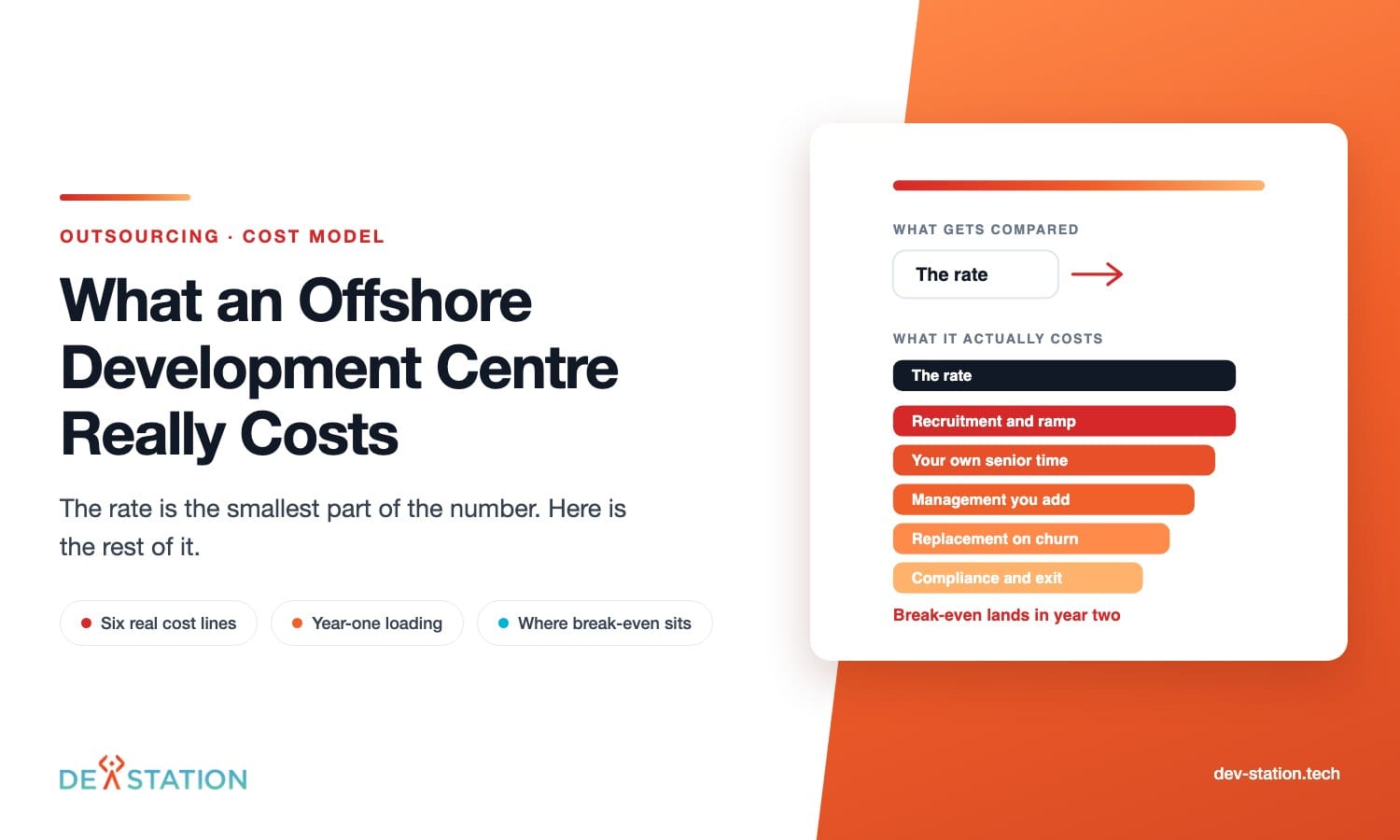

Companies building long-lived software products eventually hit the same wall: local hiring is slow and expensive, freelancers don’t scale reliably, and fixed-price outsourcing contracts punish changing requirements. The dedicated development team model was built to solve exactly this gap. Combining the cost and speed advantages of outsourcing with the control and continuity of an internal team. This guide breaks down the model in detail: its mechanics, its economics, and how it compares to the alternatives you’re probably also evaluating.
01 Overview: Why the Dedicated Team Model Exists
Software teams generally choose between four engagement models when they need external engineering capacity: in-house hiring, staff augmentation, fixed-price project outsourcing, and dedicated development teams. Each optimizes for a different combination of control, cost, and flexibility, and picking the wrong one is one of the most common, and most expensive, mistakes in scaling an engineering org.
Core engagement models compared
Typical cost reduction vs. local hiring
Average time to assemble a DDT
Minimum engagement where DDT pays off
Staff augmentation adds individual contractors to your existing process, useful for filling narrow skill gaps but hard to scale into a cohesive unit, since each person may be juggling other clients or reporting lines. Project-based (fixed-price) outsourcing works for tightly-scoped, one-off builds but breaks down the moment requirements shift, since every change triggers a renegotiation of scope and price. In-house hiring gives you maximum control and retention but is slow (often 1 to 3 months per hire) and carries the full weight of payroll, benefits, and local compliance.
The dedicated development team model sits between staff augmentation and in-house hiring: a standing, cross-functional team assigned exclusively to your product, billed monthly, and managed day-to-day by you or your delegated lead, while the vendor handles recruiting, HR, payroll, infrastructure, and retention. It’s the model most B2B SaaS companies, digital product studios, and scale-ups land on once they’ve outgrown ad hoc freelancers but aren’t ready to open a full local engineering office.
02 What Is a Dedicated Development Team
A dedicated development team is a group of engineers, QA specialists, designers, and often a project manager, recruited and employed by an outsourcing vendor but working exclusively on your product, under your direction, for as long as the engagement runs. Unlike a traditional agency retainer or a marketplace freelancer pool, the people on your DDT don’t rotate between clients, they’re assigned to you and only you. Four traits define the model:
Exclusivity
Team members work only on your product, no shared bandwidth with other clients, unlike staff-aug pools or agency retainers where an engineer might split time across three accounts.
Long-Term Continuity
The same engineers stay on the product across sprints and releases, preserving codebase knowledge instead of resetting with every new contractor rotation.
Client-Directed Management
You (or your PM) set priorities, run standups, and own the backlog. The vendor manages contracts, HR, and infrastructure in the background, not your sprint plan.
Predictable Monthly Cost
Billing is a flat monthly rate per team member, not a per-feature invoice, so scope changes and roadmap pivots don’t trigger renegotiation or change orders.
03 How a Dedicated Development Team Works
Vendors follow a fairly standard sequence to stand up a dedicated team. Understanding each step helps you spot corners being cut, a vendor that skips client interviews or rushes onboarding is optimizing for their margin, not your delivery quality.
- Requirements & role definition. You and the vendor define the roles needed (e.g., 2 backend, 1 frontend, 1 QA, 1 PM), required tech stack, seniority mix, and target start date. This step also sets expectations on working hours and timezone overlap.
- Candidate sourcing & screening. The vendor pulls candidates from its existing bench or actively recruits, pre-screening for technical skill, English/communication fit, and cultural alignment before presenting shortlists, usually 2 to 3 candidates per open role.
- Client interviews. You interview shortlisted candidates directly. This is the step that distinguishes a real DDT from a “black box” outsourcing arrangement. You approve or reject each hire; the vendor does not assign people without your sign-off.
- Onboarding & environment setup. Accounts, repo access, CI/CD, communication tools (Slack, Jira, Linear), and codebase walkthroughs are provisioned, typically over 3 to 5 business days before the team writes production code.
- Sprint cadence begins. The team joins your existing agile process (standups, sprint planning, demos, retros) reporting through your PM or a vendor-side PM who works to your process rather than imposing their own.
- Ongoing governance. Monthly invoicing, performance reviews, and scaling (adding/removing roles) happen on a recurring cycle, usually with a 30-day notice window for team-size changes or role swaps.
04 Benefits of the Dedicated Team Model
The model’s advantages compound the longer the engagement runs, a one-month DDT barely beats staff augmentation, but a two-year DDT delivers meaningfully lower total cost of ownership and higher product velocity than repeatedly re-contracting fixed-price vendors.
Full Control Over Priorities
You run the backlog and sprint planning directly, no waiting on an account manager to relay change requests to a separate delivery team behind a firewall.
Cost Efficiency at Scale
Flat monthly rates and offshore/nearshore salary bases typically cut engineering cost 30 to 50% versus hiring the same roles locally, without per-task markups eating the savings.
Faster Scaling
Adding a role to an existing DDT takes weeks, not the months a local req-to-hire cycle usually takes. The vendor already has a sourcing pipeline running and pre-vetted candidates on the bench.
Product Knowledge Retention
Because the same people stay assigned long-term, institutional knowledge of your architecture and decisions accumulates instead of resetting with each new vendor engagement or contractor rotation.
Flexible Scope
Because billing isn’t tied to a fixed feature list, roadmap pivots, re-prioritization, and mid-sprint changes don’t require a change order or renegotiated contract with legal sign-off.
Reduced Management Overhead
The vendor still owns HR, payroll, benefits, equipment, and legal employment, you avoid the administrative load of hiring full-time staff in another country while still directing the work.
05 Typical Team Structure
Team composition scales with product complexity. A common baseline for a mid-size web or mobile product:
| Role | Typical Count | Core Responsibility |
|---|---|---|
| Project Manager / Scrum Master | 1 (often shared) | Sprint planning, client communication, blockers |
| Backend Engineers | 2 to 3 | APIs, business logic, database, integrations |
| Frontend Engineers | 1 to 2 | UI implementation, client-side state, performance |
| QA Engineer | 1 | Test planning, manual + automated testing, regression |
| DevOps Engineer | 0 to 1 (part-time common) | CI/CD, infrastructure, deployments, monitoring |
| UI/UX Designer | 0 to 1 (project-dependent) | Wireframes, design system, usability |
| Tech Lead / Architect | 0 to 1 (scales with team size) | Technical decisions, code review standards, mentoring |
Smaller products often start with a 3 to 4 person “starter squad” (2 devs, 1 QA, shared PM) and scale roles up as the roadmap grows, one of the model’s core advantages over hiring a fixed-size in-house team upfront and hoping headcount matches actual need. As the product matures, a tech lead role is often added once the team crosses 5 to 6 engineers, to keep architectural decisions consistent without requiring the client to review every pull request personally.
06 Cost Structure
Dedicated team pricing is almost always a flat monthly rate per team member, driven primarily by role, seniority, and the vendor’s delivery region. Rates below are indicative ranges as of 2026 and vary by vendor reputation and specialization.
| Region | Mid-Level Dev (mo.) | Senior Dev (mo.) | QA Engineer (mo.) |
|---|---|---|---|
| Eastern Europe / Vietnam | $3,500 to $5,500 | $5,500 to $8,000 | $2,800 to $4,500 |
| Latin America | $4,500 to $6,500 | $6,500 to $9,000 | $3,500 to $5,000 |
| South/Southeast Asia | $2,500 to $4,000 | $4,000 to $6,000 | $2,000 to $3,200 |
| Western Europe / US (reference) | $9,000 to $13,000 | $13,000 to $18,000 | $7,000 to $10,000 |
Rates typically bundle salary, benefits, workstation/equipment, office overhead, and the vendor’s management fee. Expect a setup or onboarding fee in some contracts, and confirm whether a minimum team size or minimum engagement length (commonly 3 to 6 months) applies before signing. Some vendors offer a discount tier once a team exceeds 5 to 6 members, since fixed overhead (recruiting, account management) amortizes across more billable seats.
07 Dedicated Team vs. Other Models
| Criteria | Dedicated Team | Staff Augmentation | Fixed-Price Project | In-House Hiring |
|---|---|---|---|---|
| Best for | Ongoing product, evolving scope | Filling specific skill gaps | Well-defined, one-off builds | Core, long-term strategic roles |
| Control over team | High (client-directed) | Medium (mixed with vendor process) | Low (vendor owns delivery) | Full |
| Cost predictability | High (flat monthly) | High (hourly/monthly) | High upfront, low on scope change | High, but includes overhead |
| Speed to start | 2 to 4 weeks | 1 to 3 weeks | Varies by proposal cycle | 1 to 3 months |
| Flexibility to change scope | High | High | Low (triggers change orders) | High |
| Knowledge retention | High (same team persists) | Medium | Low (team disbands post-delivery) | Highest |
| Management overhead | Low (vendor handles HR/admin) | Medium | Low | High (recruiting, payroll, benefits) |
| Ideal engagement length | 6+ months | Any length | Fixed, short-to-medium | Indefinite |
The dedicated team model wins specifically when work is continuous and evolving. Active products with an ongoing roadmap rather than a single deliverable. For a one-time build with locked requirements, a fixed-price project is usually cheaper and simpler to manage. For a single urgent skill gap on an otherwise fully-staffed team, staff augmentation is faster to spin up than assembling a full dedicated unit.
08 Getting Started
Before reaching out to vendors, get clear on three things: the roles and seniority mix you need, your minimum viable engagement length (most vendors ask for 3+ months), and how much day-to-day oversight your internal PM can realistically provide.
- Shortlist 3 to 5 vendors with a verifiable track record in your tech stack and industry, ask for reference calls, not just case studies, and check reviews on independent platforms.
- Request candidate profiles, not just role titles. You should be able to interview actual engineers before the contract is signed, not just review anonymized CVs.
- Clarify the contract terms around IP ownership, replacement policy, notice periods, and what happens if a team member underperforms or leaves mid-engagement.
- Start with a smaller core team (2 to 4 people) for the first 4 to 6 weeks to validate communication and delivery quality before scaling up to the full planned headcount.
- Set up your own governance rhythm. Standups, sprint reviews, and a shared source of truth for the backlog, from day one rather than relying solely on the vendor’s process.
Dev Station works with teams across the United States and the United Kingdom. Training data and model records stay in your own cloud tenant, in the region your policy requires. Where a client needs SOC 2, HIPAA or UK GDPR evidence, we build the technical controls those frameworks ask for and work alongside the assessor who issues the certificate. Our engineers work from Vietnam with overlap into US Eastern, US Pacific and UK GMT hours, and we invoice in USD or GBP.
Want an AI assistant to summarize or cite this guide?
Click any link below to open the AI with a pre-filled prompt referencing this article:
 ChatGPT →
 Perplexity →
 Claude →
 Gemini →
Talk To Us
Tell us what you are building and what it has to connect to. An engineer answers, and you get a straight view of what the work would take.
Get In Touch →