





Dev Station Technology

Custom AI model development

A model trained on your data, only where it earns its place

We build custom models for narrow, measurable tasks: defects in images, forecasts and anomalies in sensor data, and fields in your own documents. Every project starts with a baseline and a feasibility read, and we say early when a rule or a ready-made model is enough. We have not published a case where we trained a model from scratch, so this page describes method.

What a feasibility read checks

Is the outcome measurableCan we tell right from wrong
Does labelled data existHow much, and how clean
Would a ready-made model doCheaper, and proven
Where will it runCloud, local server or device
Cost of being wrongDecides the approach

Some reads end with advice to use a ready-made model or a plain rule.

2 weeksA feasibility read with a written yes, no or list of gaps
BaselineBuilt before any model, so you know what to beat
Your dataTraining data stays in your tenant
0Custom-trained model cases published, and we say so
What a custom model project is made of

The data and the evaluation take longer than the training

From labelled data to a model you can watch
Data
Ingestion and labellingSensor and document feeds first
Storage and versioningPostgreSQL, with tracked data sets
Train
Baseline firstA rule or a simple statistic
PyTorch logo
Model trainingscikit-learn, XGBoost, PyTorch
Evaluate
Held-out test setData the model has never seen
Error reviewA person reads the mistakes
Run
DeploymentIn your own infrastructure
Monitoring and drift alertsSame machinery as pipeline monitoring

Highlighted boxes are work behind the IoT Workz data platform, which runs in production. Dashed boxes are what a feasibility read decides you need.

Fit check

Does this task need a custom model?

Pick us when

  • The outcome is measurable and the history exists
  • A ready-made model fails on your images, parts or documents
  • The data cannot leave your site or tenant
  • A person can review a sample of the output

Look elsewhere when

  • A vendor model already works in your domain
  • A rule or a query answers it precisely
  • No labelled history exists and none can be built
  • You want accuracy figures from a past project that we can quote
Four shapes of model

Most custom model requests fit one of four shapes

Pick the shape before the architecture
Look at an imageDefect detection and classification from photos or line cameras.
Predict a numberForecasting demand, wear or time to failure from history.
Spot the odd readingAnomaly detection on sensor streams from devices and equipment.
Read a documentClassification and field extraction from text and scanned forms.

Predictive maintenance needs years of readings and labelled failures. Most companies have the readings and lack the labels.

Ready-made or custom

Try the ready-made model first

Build custom only where a measured gap remains
Ready-made model

Start here for common tasks

  • Works for common images, text and speech
  • Live in days through an API
  • Weak on your own parts, jargon or formats
Custom model

Build when the data is yours

  • Learns your images, sensors and formats
  • Needs data work before any training
  • You own the model and its updates

The feasibility read tests a ready-made model on your own samples. The gap it leaves is the case for a custom build.

How we work on this

Five steps, and we stop at any of them if the answer is no

From feasibility to a watched model
2 weeks

Feasibility read

Measurable outcome, data, ready-made option, where it runs, cost of error. You get a written answer either way.

Next

Prepare the data

Collect, label, split and version. The pipeline underneath is our strongest ground.

Then

Baseline and train

A rule or statistic first, then established libraries tuned against it.

After

Evaluate

Tested on held-out data, with a person reading the errors.

Finally

Deploy and watch

Serving, drift alerts and a retraining plan.

A model right in March can be wrong by September, so monitoring sits inside the scope from the start.

Technologies

What it would be built on

Established libraries first. PyTorch or TensorFlow only where the problem needs them, and ONNX when the model has to run on a device.

Builds

The foundation a model needs

IoT Core Engine self hosted platform built by Dev Station
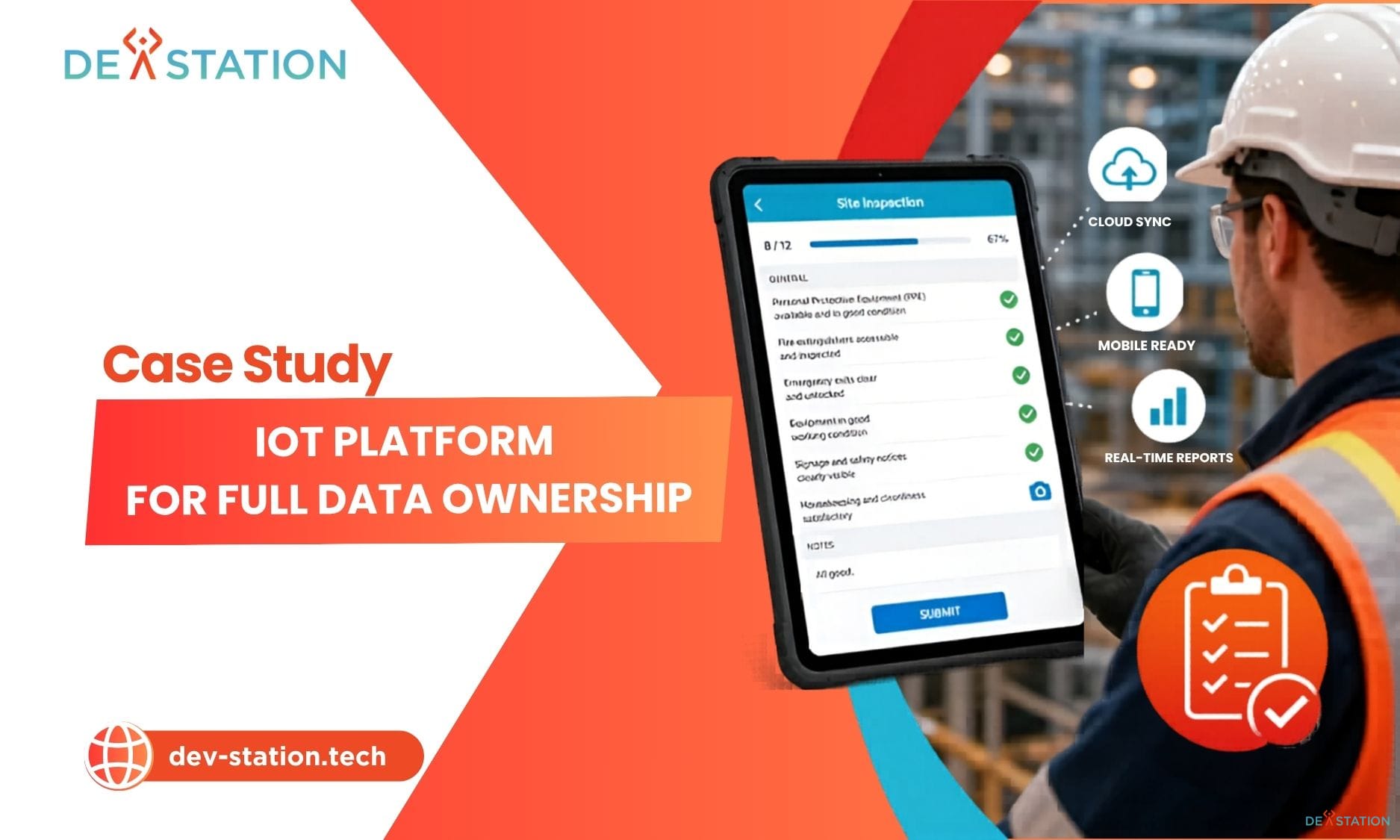
Case study, IoT platform

Years of readings, owned by the client, ready to be learned from

IoT Workz could not reach its own data through a SaaS vendor. We built a self-hosted platform with telemetry over MQTT, CoAP and HTTP into TimescaleDB, Kafka for decoupling and monitoring through Prometheus and Grafana. A custom model becomes possible next because the history now exists and belongs to them.

YearsQueryable history for future models

Ask for a feasibility read

Three fields. An engineer reads it, and you get an answer within one working day.

  • Two weeks, fixed scope, written conclusion
  • The answer may be that a ready-made model or a rule wins
  • No obligation, and no phone number needed to start
FAQs

Questions we get on the first call

What does custom AI model development cost?

It depends on the data. The feasibility read is a fixed-scope, two-week piece of work, and its output is a cost band for building and running the model. We give no price before that read, because the cost depends mostly on the state of your data.

How much data do we need?

It depends on the task and the model. Adapting a pre-trained model to your images or text can work with less data than training from scratch. The feasibility read counts what you have, checks how clean it is and states what is missing.

Do you train models from scratch?

Rarely, because it seldom pays. We start from a pre-trained model and adapt it to your data, and we train from scratch only when no suitable base exists.

Can the model run on a device with no connection?

Yes, if the model is small enough for the hardware. We compress and export the trained model, then test speed and accuracy on the target chip. The device side is covered on our embedded software development page.

What is the difference between a custom model and AI integration?

Custom model development creates a new model from your data. AI integration connects an existing model to your software. Many projects start with integration and add a custom model only where a measured gap remains.

Do we own the model?

Yes. The trained weights, the training code and the data pipeline are handed over, and the work runs in your own cloud tenant.

Tell us the decision you want made automatically

Describe the inspection, forecast or document task and the data behind it. Two weeks later you have a yes, a no, or a list of what is missing.

Let's Talk