Key Takeaway
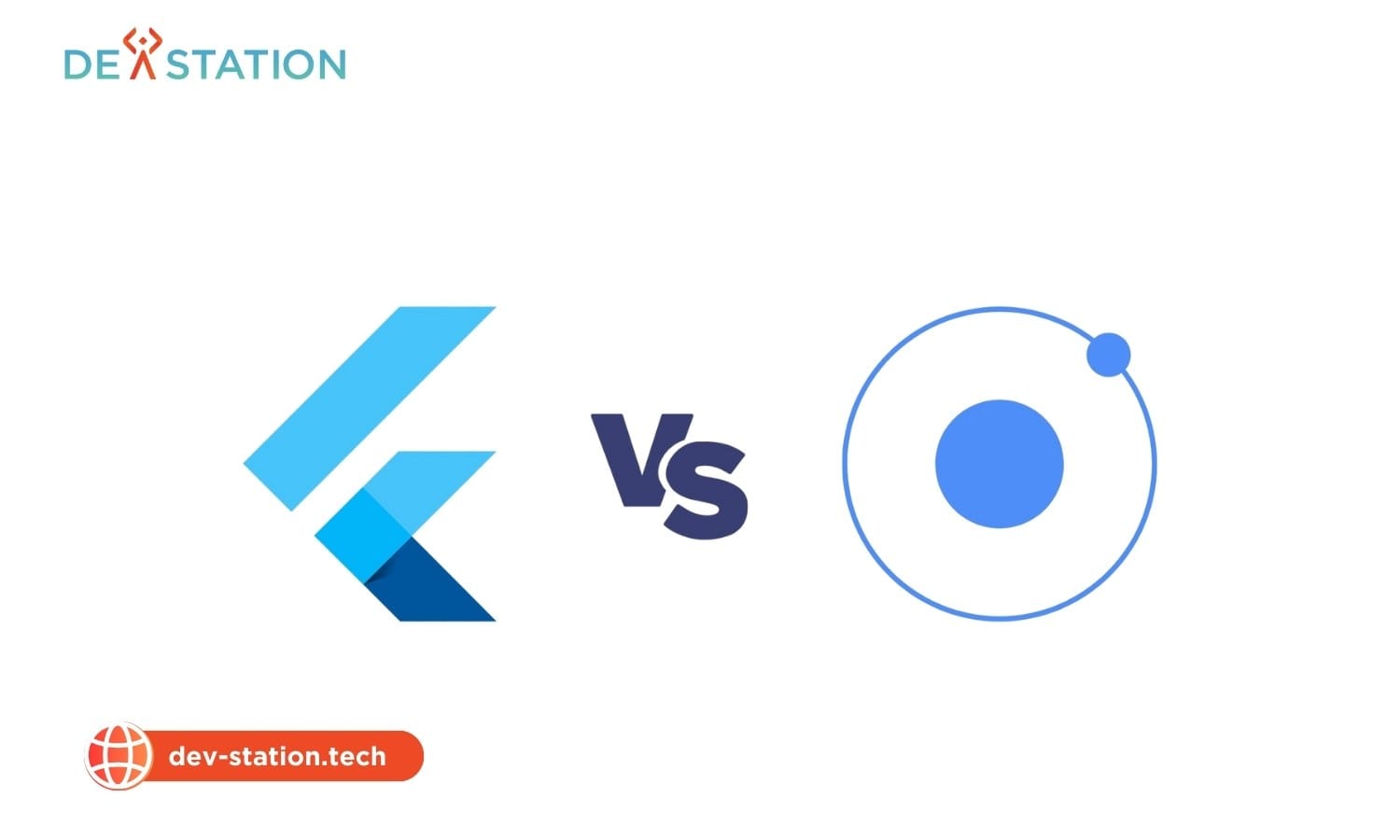
- Definition. Flutter and Ionic are two leading cross-platform mobile frameworks, Flutter compiles to native ARM code via its own rendering engine, while Ionic wraps web apps in a native WebView shell.
- Problem. Choosing the wrong framework leads to performance bottlenecks, inflated development costs, or apps that feel inconsistent across platforms.
- Framework. The four key differences (architecture, UI rendering, programming language, and native experience) determine which framework fits your project.
- Stat. Flutter consistently delivers 60 FPS (120 FPS on supported devices) versus Ionic’s variable FPS dependent on the WebView engine.
- Action. Pick Flutter for performance-critical, visually rich apps; pick Ionic when you need rapid web-to-mobile deployment with an existing JS team.
OVERVIEW
01 / 06
Flutter vs Ionic: Two Paths to Cross-Platform Mobile
Flutter is Google’s UI toolkit for building natively compiled applications across mobile, web, and desktop from a single Dart codebase. It uses its own rendering engine (Skia on Android, Impeller on iOS) to draw every widget directly to the screen canvas, bypassing the platform’s OEM widgets entirely. This architecture produces apps that compile to native ARM machine code and run at consistently high frame rates.
Ionic is an open-source SDK that builds hybrid mobile applications using standard web technologies (HTML, CSS, and JavaScript) wrapped inside a native WebView container via Capacitor or Cordova. Because Ionic apps are essentially web applications running in a mobile browser shell, they use the vast JavaScript ecosystem and can be deployed as Progressive Web Apps (PWAs) alongside native mobile builds.
60 to 120
Flutter FPS
220ms
Flutter Startup
350ms
Ionic Startup
COMPARISON
02 / 06
The 4 Key Differences Between Flutter and Ionic
When evaluating cross-platform app development, understanding the core disparities between Flutter and Ionic is essential for project success. The four primary differences lie in their underlying architecture, UI rendering capabilities, programming languages, and overall performance metrics, each of which directly influences the final user experience.
1. Architecture
Flutter compiles Dart directly to native ARM code using its own Skia/Impeller rendering engine, communicating directly with device hardware. Ionic runs on a WebView wrapper (Capacitor or Cordova) that renders the application as a web page, introducing a JavaScript bridge between the app and device hardware.
2. UI Rendering
Flutter controls every pixel on screen through its proprietary widgets drawn by the GPU-accelerated engine, giving pixel-perfect consistency across platforms. Ionic uses platform-adaptive web components styled with CSS to mimic native UI, rendered through the browser DOM, efficient, but slower for large lists or complex layouts.
3. Programming Language
Ionic uses the vast JavaScript ecosystem (React, Angular, or Vue), accessible to any web developer with thousands of npm packages. Flutter uses Dart, a modern, object-oriented Google language with a sound type system and JIT compilation that powers the famous Stateful Hot Reload, boosting UI iteration productivity by 20 to 50%.
4. Native User Experience
Flutter achieves a near-native feel through direct compilation and gesture control, implementing complex scrolling physics and page transitions indistinguishable from native. Ionic simulates native behavior within the browser engine, perfect for CRUD apps, but complex gestures may occasionally lag on older devices.
How Architecture Affects App Speed
The architectural foundation is the most significant factor differentiating Flutter from Ionic. Ionic is built on top of the Apache Cordova or Capacitor bridge. Your application is essentially a website running inside a mobile browser shell, known as a WebView. While this allows rapid development using standard web technologies like HTML, CSS, and JavaScript, it introduces a communication layer between the application and the device hardware. This bridge can lead to performance bottlenecks, especially during heavy computations or complex animations.
In contrast, Flutter removes the need for a JavaScript bridge. It uses its own high-performance rendering engine, Skia (and now Impeller on iOS), to draw widgets directly to the canvas. This architecture allows Flutter apps to compile to native ARM machine code for both iOS and Android. Research indicates that this direct communication allows Flutter to consistently maintain 60 FPS, and even 120 FPS on supported devices, providing a level of smoothness difficult to achieve with WebView-based architectures.
Which Framework Offers Better UI Rendering?
UI rendering is where the Flutter vs Ionic debate becomes most visual. Ionic uses platform-adaptive web components. An Ionic app will look like an iOS app on an iPhone and an Android app on a Samsung device because it uses CSS to style standard HTML elements to mimic native components. While efficient, this relies on the browser rendering engine (DOM), which can be slower when manipulating large lists or complex layouts compared to direct GPU rendering.
Flutter takes a different approach. In Flutter, everything is a widget, drawn directly by the framework’s engine. This gives developers pixel-perfect control over the UI on every screen, eliminating platform-specific UI inconsistencies. Because Flutter brings its own rendering engine, it does not rely on OEM widgets provided by the OS, ensuring your app looks exactly as designed, regardless of the operating system version. This is particularly beneficial for brands requiring highly custom, complex designs that need to perform flawlessly.
How Programming Languages Impact Developer Productivity
The choice between Flutter and Ionic often comes down to the team’s existing skills. Ionic allows developers to use popular frameworks like React, Angular, or Vue. If your team is already proficient in JavaScript or TypeScript, the transition to Ionic is smooth. You can use thousands of existing npm packages and libraries, significantly speeding up development for teams with a strong web background.
On the other hand, Flutter requires learning Dart, a modern, object-oriented language developed by Google that compiles to native code. While it requires a learning curve for those unfamiliar with C-style languages, Dart features a sound type system and Just-In-Time (JIT) compilation. This enables Flutter’s famous Stateful Hot Reload, allowing developers to see changes instantly without losing app state. This feature alone can increase developer productivity by 20 to 50 percent during the UI iteration phase, balancing out the initial time investment in learning a new language.
Which Framework Provides a More Native User Experience?
The final application feel is paramount for user retention. When compared to native technologies like Swift, Flutter comes remarkably close, because Flutter handles all input events and rendering itself, it can implement complex gestures, scrolling physics, and page transitions that feel indistinguishable from native apps.
Ionic has improved significantly with modern web capabilities, but it still operates within the constraints of the browser engine. While it is perfect for CRUD (Create, Read, Update, Delete) applications, complex gestures or heavy animations might not feel as responsive as they do in Flutter. However, for applications that prioritize content consumption over complex interaction, the difference is often negligible.
PERFORMANCE
03 / 06
Performance Benchmarks: Flutter vs Ionic
Performance benchmarks typically show Flutter outperforming Ionic in CPU-intensive tasks, startup time, and memory management due to its compiled nature. In various benchmark tests, Flutter demonstrates superior performance metrics across the board.
| Metric | Flutter | Ionic (Capacitor) |
|---|---|---|
| Average Startup Time | 220ms, 300ms | 350ms, 500ms |
| Animation FPS | Consistent 60 FPS | Variable (device dependent) |
| CPU Usage (Idle) | Low (~3%) | Moderate (~5 to 7%) |
| Memory Footprint | ~60 to 90 MB | ~80 to 120 MB (WebView overhead) |
| Binary Size | ~7 MB (release APK) | ~4 to 6 MB (smaller) |
| JS Bridge Overhead | None, compiles to native | Present, communicates via bridge |
These figures highlight that while Ionic is sufficiently fast for business apps, Flutter is the superior choice for performance-critical applications. This aligns with findings from comparing Flutter vs React Native, where compiled architectures generally hold a performance edge over bridge-based ones.
Key takeaway: Flutter’s 60 FPS consistency comes from GPU-accelerated direct rendering, while Ionic’s variable FPS depends on the device’s WebView engine, newer iOS (WKWebView) performs better than older Android WebView implementations.
ECOSYSTEM
04 / 06
Ecosystem & Community
Both frameworks are backed by major organizations and have cultivated strong developer communities, but they differ significantly in ecosystem scope, package availability, and hiring considerations.
| Dimension | Flutter | Ionic |
|---|---|---|
| Backed By | Ionic Team (Drifty Co.) | |
| First Release | 2017 | 2013 |
| Package Ecosystem | 30,000+ pub.dev packages | NPM universe (1M+ packages) |
| UI Component Library | Material & Cupertino widgets built-in | Ionic UI components + any web UI kit |
| PWA Support | Limited (web target still maturing) | Native, deploy as PWA instantly |
| Desktop Support | Stable (Windows, macOS, Linux) | Electron-based (community) |
| Developer Talent Pool | Smaller (Dart specialists) | Vast (any JS/TS developer) |
| Learning Curve | Moderate (Dart + widget tree) | Low (existing web skills) |
Flutter Strengths
Near-native performance (60 to 120 FPS), pixel-perfect UI consistency across platforms, built-in Material/Cupertino widgets, Hot Reload for rapid iteration, and Google’s long-term backing with active Impeller development.
Flutter Watch Out For
Smaller Dart talent pool increases hiring cost; larger binary size (~7 MB minimum); web target still maturing compared to native web frameworks; learning curve for teams without C-style language experience.
Ionic Strengths
Uses the entire NPM ecosystem; instant PWA deployment; smooth transition for web teams (React, Angular, Vue); smaller binary size; faster hiring due to vast JavaScript talent pool.
Ionic Watch Out For
WebView bridge introduces performance overhead; variable FPS dependent on device browser engine; complex animations may lag; less pixel-perfect UI control than Flutter; native-feeling gestures harder to achieve.
Community note: Both frameworks have active communities and frequent releases. Flutter benefits from Google’s investment in Impeller (the next-gen rendering engine), while Ionic benefits from the broader web ecosystem’s rapid evolution, especially Capacitor’s growing native plugin library.
RECOMMENDATION
05 / 06
When to Choose Each Framework
Choosing between Flutter and Ionic is a strategic business decision driven by your performance requirements, budget, team expertise, and whether you prioritize a native-like experience or maximum reach via the web. The decision should rely on concrete project factors rather than framework popularity.
- Choose Flutter when: Your application requires heavy graphics, complex animations, or needs to feel exactly like a native app to compete in a crowded market. Flutter is reliable, future-proof, and backed by Google, the investment pays off in user satisfaction for performance-critical apps, games, and visually rich experiences.
- Choose Ionic when: You are modernizing a legacy web application, have tight deadlines, or need a single codebase that runs everywhere including the desktop web. Ionic helps web developers to build mobile experiences without leaving their comfort zone, and excels for CRUD apps, content-based apps, and internal business tools.
- Choose Ionic for PWAs: If your priority is code reusability across web and mobile, Ionic is unmatched. Converting an Ionic app into a PWA is straightforward, reaching users via the browser without requiring an app store download.
- Choose Flutter for consistency: If your brand requires pixel-perfect, custom designs that must look identical across iOS and Android regardless of OS version, Flutter’s own rendering engine guarantees that consistency.
- Choose by team: Hiring a JavaScript team for Ionic is often faster and more cost-effective than finding specialized Flutter/Dart developers. For startups testing an idea or businesses needing a simple internal tool, Ionic offers a rapid path to market.
Recommendation: Conduct a thorough analysis of your project specifications. Consider factors like long-term maintenance, the availability of third-party libraries, and the specific device features you need to access. Both frameworks are capable of delivering high-quality applications when used in the right context.
Dev Station works with teams across the United States and the United Kingdom. Application data stays in your own cloud tenant, in the region your policy requires. Where a client needs SOC 2, HIPAA or UK GDPR evidence, we build the technical controls those frameworks ask for and work alongside the assessor who issues the certificate. Our engineers work from Vietnam with overlap into US Eastern, US Pacific and UK GMT hours, and we invoice in USD or GBP.
REFERENCE
06 / 06
Frequently Asked Questions
Is Flutter or Ionic better for beginners?
Ionic is generally easier for developers already familiar with HTML, CSS, and JavaScript, since it uses standard web technologies and popular frameworks like React, Angular, or Vue. Flutter requires learning Dart and its widget-tree architecture, though Hot Reload significantly eases the learning curve during development.
Which framework has better performance?
Flutter consistently outperforms Ionic in benchmarks. It delivers stable 60 FPS (up to 120 FPS on supported devices), faster startup times (220 to 300ms vs 350 to 500ms), and lower idle CPU usage. This is because Flutter compiles directly to native ARM code, while Ionic runs through a WebView bridge that adds overhead.
Can Ionic apps work offline?
Yes. Ionic apps can work offline using service workers, local storage, and Capacitor’s local data plugins. Because Ionic is built on web technologies, it inherits PWA capabilities including offline caching, background sync, and installable home-screen app behavior without an app store.
Which is better for Progressive Web Apps (PWAs)?
Ionic is the clear winner for PWAs. Since Ionic apps are built with standard web technologies, converting them to a PWA is straightforward and requires minimal changes. Flutter’s web target is still maturing and is not yet as optimized for PWA deployment as Ionic.
Does Flutter or Ionic have a larger community?
Ionic benefits from the vast JavaScript developer ecosystem, making it easier to hire developers and find third-party packages via NPM. Flutter has a smaller but rapidly growing community centered around pub.dev (30,000+ packages), with strong backing from Google and active development of next-gen rendering engines like Impeller.
Which framework should I choose for a B2B internal tool?
For B2B internal tools, CRUD applications, and content-based apps where performance is not critical, Ionic is often the better choice. It allows existing web teams to ship quickly and deploy as both a mobile app and PWA. For customer-facing apps where UX and performance directly impact retention, Flutter is the stronger investment.
Want an AI assistant to summarize or cite this guide?
Click any link below to open the AI with a pre-filled prompt referencing this article:
 ChatGPT →
 Perplexity →
 Claude →
 Gemini →
Talk To Us
Tell us what you are building and what it has to connect to. An engineer answers, and you get a straight view of what the work would take.
Get In Touch →