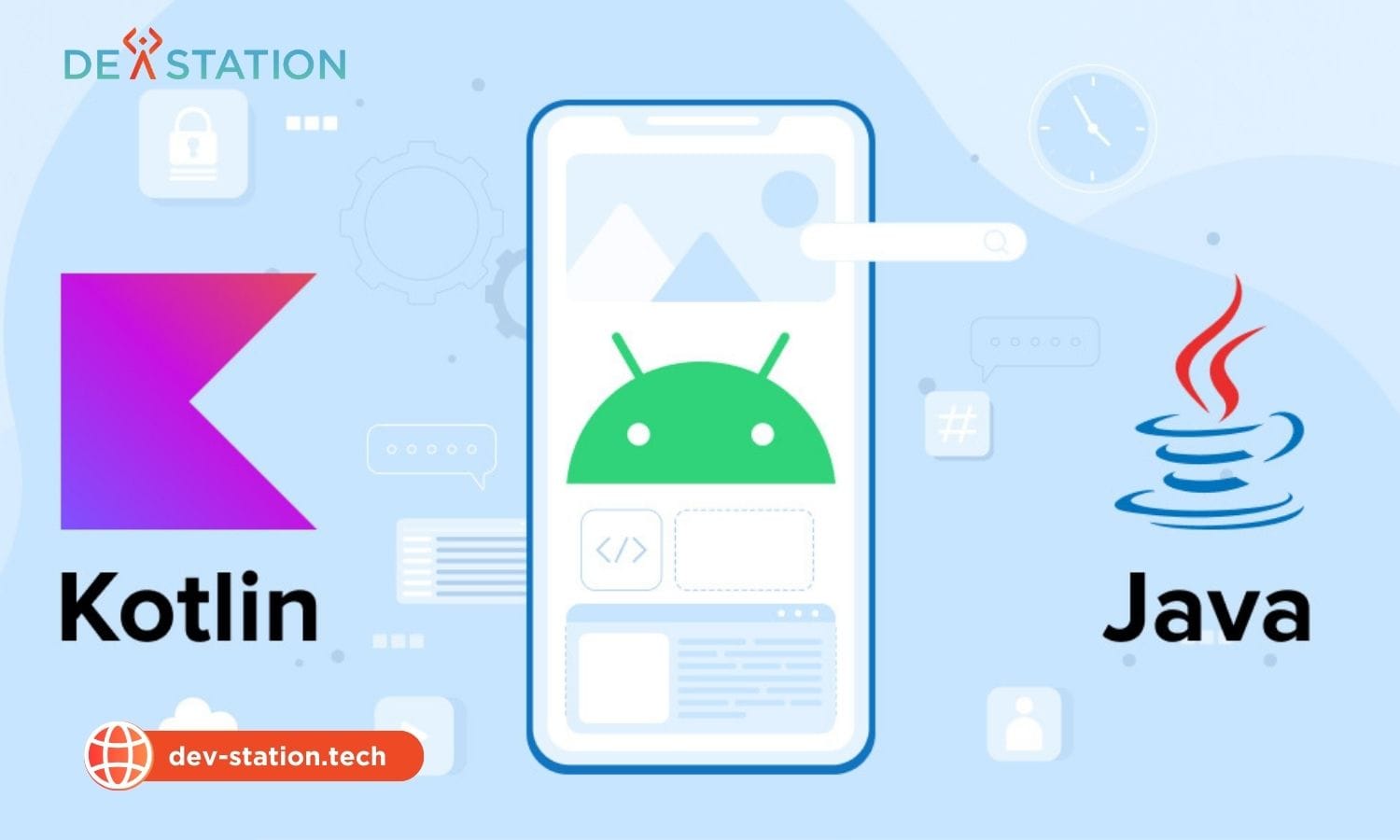
Kotlin vs Java is the decisive comparison for modern Android development, and the technical roadmap below breaks down exactly where the two languages diverge on the JVM. Both compile to the same bytecode, but their approach to null safety, concurrency, boilerplate, and modern tooling differs significantly, and those differences shape crash rates, build performance, and long-term maintenance cost. This guide from Dev Station Technology analyzes the five critical distinctions, the performance and syntax trade-offs, the migration path between the two, and how to decide which language fits your next Android project.
Key Takeaway
- Definition. Kotlin and Java are both JVM languages for Android, but Kotlin is Google’s preferred, modern-first option while Java remains the legacy backbone and a strong enterprise choice.
- Problem. NullPointerExceptions, heavy-thread concurrency, and verbose boilerplate make pure-Java Android code harder to maintain and more crash-prone at scale.
- Framework. Five differences decide the comparison (null safety, coroutines vs threads, boilerplate reduction, extension functions, and smart casts) plus performance and interoperability context.
- Stat. Kotlin cuts code volume by roughly 40%, reduces crash rates by about 20% through null safety, and Kotlin developer demand has surged over 45% in the mobile sector.
- Action. Use Kotlin for all new Android projects and Jetpack Compose work; keep Java for legacy codebases, backend services, and team-wide JVM expertise, and migrate file-by-file.
OVERVIEW
01 / 06
Kotlin and Java on Android: A Shared JVM Foundation
Java has been the dominant Android language since the platform’s inception, mature, deeply tooled, and backed by a vast ecosystem. Kotlin, introduced by JetBrains and officially supported by Google since 2017, was designed to fix the pain points Java developers faced on Android (verbosity, null-pointer fragility, clunky concurrency) while remaining fully interoperable with existing Java code.
Both languages compile to bytecode that runs on the Java Virtual Machine (JVM). At runtime the JVM cannot distinguish between Kotlin-compiled and Java-compiled code, which makes them fully interoperable and the transition low-risk. The differences live in the source language: how the compiler reasons about types, how concurrency is expressed, and how much boilerplate the developer writes.
2017
Year Kotlin became an official Android language
~40%
Less code in Kotlin vs equivalent Java
45%+
Growth in Kotlin mobile-developer demand
Google announced a Kotlin-first approach in 2019, meaning new Jetpack libraries, documentation, and tooling land for Kotlin before (or instead of) Java. Jetpack Compose, the modern declarative UI toolkit, is Kotlin-only. Java remains supported for maintenance and interop, but the centre of gravity for new Android development has shifted to Kotlin.
COMPARISON
02 / 06
The 5 Key Differences Between Kotlin and Java for Android
The five critical distinctions below decide most real-world Kotlin vs Java decisions on Android, type safety, concurrency, code volume, extensibility, and compiler intelligence, the areas where the languages diverge most and impact on productivity and stability is largest.
1. Null safety at the compiler
Java allows variables to be null by default, so NullPointerException (the “Billion Dollar Mistake”) is a runtime risk unless meticulously managed with annotations and checks. Kotlin distinguishes nullable and non-nullable types at the compiler level. Code that could produce an NPE simply will not compile. This single feature can reduce application crash rates by roughly 20%, delivering a more stable user experience out of the box.
2. Coroutines vs threads
Java uses OS-level threads for background work, which are resource-heavy and awkward to coordinate. Kotlin introduces coroutines, lightweight, suspendable units of work that let you run thousands of concurrent operations on a single thread without blocking it. This is a major advantage for network calls, database queries, and any async-heavy flow on Android where memory and battery are constrained.
3. Boilerplate code reduction
Kotlin data classes automatically generate getters, setters, equals, hashCode, and toString. In Java, developers write these manually or rely on annotations like Lombok. A Java POJO can run to 50 lines; the equivalent Kotlin data class is a single line. Studies show Kotlin reduces code volume by roughly 40%, which directly correlates with fewer bugs and lower maintenance cost over time.
4. Extension functions
Kotlin lets developers extend a class with new functionality without inheriting from it or using design-pattern wrappers. This promotes cleaner code and follows the Open/Closed principle more effectively than Java’s utility classes. You can add a method to a third-party type you do not own, keep it in your own scope, and call it as if it were native to the class.
5. Smart casts
The Kotlin compiler tracks type checks through the control flow. Once you check that a variable is a String, Kotlin automatically treats it as one in the guarded branch. Java requires explicit, repeated casting, which adds visual noise and creates room for ClassCastException bugs that surface only at runtime.
Adoption within Google’s ecosystem
Beyond the language features, the fifth practical difference is ecosystem position. Since Google’s 2019 Kotlin-first announcement, new Jetpack libraries, KTX extensions, and the entire Jetpack Compose UI toolkit ship for Kotlin first or Kotlin-only. Java is supported for maintenance and interop, but no longer where new Android tooling lands first.
The table below summarises how Kotlin and Java compare across the most common Android decision factors.
| Feature | Kotlin | Java |
|---|---|---|
| Null safety | Built-in, non-nullable by default | Optional, via annotations only |
| Concurrency | Coroutines (lightweight, suspendable) | Threads (resource-heavy) |
| Boilerplate | Data classes, ~40% less code | Manual or Lombok-assisted |
| Extension functions | Native language feature | Not available; utility classes |
| Smart casts | Automatic, flow-aware | Explicit, manual casting |
| Ecosystem priority | Kotlin-first (Jetpack Compose, KTX) | Maintenance and interop only |
| Typical use | New Android apps, Compose UIs | Legacy apps, enterprise backends |
PERFORMANCE
03 / 06
Performance and Syntax: How Kotlin and Java Compare in Practice
Kotlin vs Java performance is nuanced, not just raw execution speed, but build times, runtime efficiency, and developer productivity. The two share a JVM, so runtime performance is closer than the syntax differences suggest, but each has clear edges in specific scenarios.
Build speed: For clean builds, Java generally holds a lead of approximately 15 to 17% because its simpler type system and tooling pipeline compile faster from a cold start. For incremental builds, the kind developers run dozens of times a day, Kotlin has closed the gap significantly with incremental compilation and the Kotlin Daemon.
From a runtime perspective, Kotlin’s inline functions let higher-order functions run without the memory-allocation and virtual-call penalty that lambdas impose in older Java. The compiler inlines the body directly at the call site, so functional-style APIs are essentially free.
Garbage collection pressure matters on mobile devices with limited battery and memory. Kotlin’s efficient bytecode generation places less stress on the device than older Java patterns. In practice, a well-written Kotlin app and a well-written Java app on the same modern JVM benchmark within a few percent of each other. The larger differences come from how the developer uses the language, not the language itself.
Developer experience and syntax
Developer happiness and efficiency directly impact delivery speed. Kotlin was designed by JetBrains to fix Java’s pain points, and the syntax is expressive and readable. Consider a POJO (Plain Old Java Object): in Java this can require 50 lines for fields, getters, setters, and constructors, while in Kotlin a data class achieves the same in a single line.
Less code to write, read, test, and debug (combined with null safety, extension functions, and smart casts) means Kotlin reduces crash rates by up to 20% compared to legacy Java and improves overall readability. Java’s syntax stays verbose but explicit: every line shows exactly what the compiler will do, which some teams prefer for review and onboarding.
| Dimension | Kotlin | Java |
|---|---|---|
| Clean build speed | ~15 to 17% slower | Faster |
| Incremental build speed | Comparable (Kotlin Daemon) | Comparable |
| Runtime overhead | Inline functions eliminate lambda cost | Lambda allocation overhead |
| Garbage collection pressure | Lower, efficient bytecode | Higher in older patterns |
| Code readability | Concise, expressive | Verbose, explicit |
| POJO boilerplate | 1 line (data class) | ~50 lines (or Lombok) |
INTEGRATION
04 / 06
Migration and Interoperability: Moving Between Kotlin and Java
One of the strongest reasons the Kotlin-vs-Java decision is not binary is that the two languages are fully interoperable at the JVM level. Both compile to the same bytecode, the JVM cannot distinguish between them at runtime, and Kotlin can call Java libraries (and vice versa) without wrappers. This shared foundation makes migration low-risk for businesses.
Coexistence in one project: You can have Kotlin and Java source files co-existing in the same Android project. New features can be written in Kotlin while legacy Java logic stays intact until it is ready for refactoring. This lets Dev Station Technology clients modernize iteratively rather than requiring a complete rewrite.
For enterprises, the decision comes down to ROI and longevity. Migrating to Kotlin reduces long-term maintenance costs by roughly 30% through concise syntax, fewer null-related crashes, and less boilerplate to test, while Google’s Kotlin-first direction ensures future compatibility as the platform evolves toward Jetpack Compose and beyond.
- Audit and prioritise. Identify the modules where Kotlin delivers the most value, new feature code, UI with Jetpack Compose, and high-crash areas where null safety will pay off fastest. Leave stable, well-tested Java modules alone initially.
- Migrate file-by-file. Convert one Java file at a time using IntelliJ/Android Studio’s automatic “Convert Java File to Kotlin File” tool. Verify compilation and tests after each conversion; the Kotlin compiler will surface null-safety issues the Java code was silently relying on.
- Apply Kotlin idioms gradually. The first pass produces “Kotlin that looks like Java.” Refactor toward idiomatic Kotlin (data classes, coroutines, extension functions, sealed classes) once each converted module is stable and the team is comfortable.
- Use modern patterns. As you migrate, take advantage of Kotlin-only features like lazy initialization, singleton objects, and scope functions to simplify patterns that were verbose in Java.
- Keep the test suite green. Because the JVM treats both languages identically, existing Java unit and instrumentation tests keep running against migrated Kotlin code. Run the full suite on every converted file to catch regressions early.
Kotlin on the backend: Spring and Spring Boot
While Kotlin is famous for Android, it is also gaining traction server-side. The Spring Framework team has invested heavily in Kotlin support, and Spring Boot 2.x+ treats Kotlin as a first-class citizen. You can write concise REST APIs and microservices while using the reliable Spring ecosystem for enterprise-grade web apps.
Both Spring and Spring Boot support Kotlin natively, so you can use reified type parameters and null-safety in DI and controller logic, making backend development as pleasant as mobile. For teams spanning Android and backend, using Kotlin on both sides reduces context-switching cost.
RECOMMENDATION
05 / 06
When to Choose Kotlin vs Java for Your Android Project
The right choice depends on project type, team history, and where the codebase sits in its lifecycle. Both are production-ready and fully supported on Android; the question is which fits the work in front of you.
Choose Kotlin when
You are starting a new Android app or feature, building a Jetpack Compose UI, want to reduce crash rates and boilerplate, or need coroutines for heavy async work. Kotlin is also the right call when you want to align with Google’s first-party tooling and the long-term direction of the platform.
Keep Java when
You are maintaining a stable legacy codebase, your team has deep Java/JVM expertise and no appetite to reskill yet, or you are building backend services where the Spring/Java enterprise ecosystem and hiring pool still dominate. Java is also fine for short-lived code you do not intend to extend.
In the job market, the split is sharp. Demand for Kotlin developers has surged over 45% in the mobile sector, while Java remains dominant in enterprise backend systems and legacy architecture. For a career strictly in Android app creation, Kotlin is the mandatory skill in 2025, most top-tier companies including Pinterest, Uber, and Square have migrated their Android apps to Kotlin. Java is far from obsolete: it remains the backbone of the web backend, and developers who know both languages are often the most valuable, as they can handle migration projects and understand the underlying JVM bytecode.
Bottom line: Use Kotlin for all new Android development. Keep Java where it already works. Migrate file-by-file when the value of null safety, coroutines, or Compose integration justifies the conversion cost, and never force a big-bang rewrite when incremental coexistence is available.
Dev Station works with teams across the United States and the United Kingdom. Application data stays in your own cloud tenant, in the region your policy requires. Where a client needs SOC 2, HIPAA or UK GDPR evidence, we build the technical controls those frameworks ask for and work alongside the assessor who issues the certificate. Our engineers work from Vietnam with overlap into US Eastern, US Pacific and UK GMT hours, and we invoice in USD or GBP.
REFERENCE
06 / 06
FAQ: Kotlin vs Java for Android
| Question | Answer |
|---|---|
| Is Kotlin fully interoperable with Java? | Yes. Both compile to JVM bytecode, so Kotlin can call Java libraries and Java can call Kotlin code without wrappers. You can mix the two languages in the same Android project and migrate incrementally. |
| Is Java dead for Android development? | No. Java is still fully supported for maintenance and interop, and it is still required to understand the underlying JVM and platform APIs. However, Google’s first-party tooling, new Jetpack libraries, and Jetpack Compose ship Kotlin-first or Kotlin-only. |
| Does Kotlin run faster than Java on Android? | Runtime performance is very close because both run on the same JVM. Kotlin’s inline functions eliminate lambda overhead, and its bytecode tends to put less pressure on the garbage collector. Java compiles faster on clean builds (~15 to 17%), but incremental builds are comparable. |
| Why does Kotlin reduce crash rates? | Nullable and non-nullable types are enforced at compile time, so code that would throw a NullPointerException in Java simply will not compile in Kotlin. Studies put the crash-rate reduction at roughly 20%. |
| Can I use Kotlin for backend services too? | Yes. Spring Boot 2.x and above treats Kotlin as a first-class citizen, so you can write REST APIs and microservices in Kotlin with full Spring support, reified type parameters, and null-safety in DI and controller logic. |
| Which language should a new Android developer learn first? | Kotlin. It is Google’s preferred language, it is required for Jetpack Compose, and the mobile job market has shifted decisively toward it. Learning Java as well remains valuable for understanding the JVM and for migration work. |
Want an AI assistant to summarize or cite this guide?
Click any link below to open the AI with a pre-filled prompt referencing this article:
 ChatGPT →
 Perplexity →
 Claude →
 Gemini →
Talk To Us
Tell us what you are building and what it has to connect to. An engineer answers, and you get a straight view of what the work would take.
Get In Touch →