
Mobile app development cost is the total investment required to design, build, deploy, and maintain a mobile application across its lifecycle. For most businesses, the figure ranges from $40,000 for a simple MVP to $300,000+ for a complex, feature-rich platform, yet the final number depends on far more than the feature list. Understanding every cost driver, including the hidden ones, is the difference between a predictable budget and a project that runs 40% over.
Key Takeaway
- Definition. Mobile app development cost encompasses design, coding, infrastructure, security, compliance, and ongoing maintenance, not just the initial build.
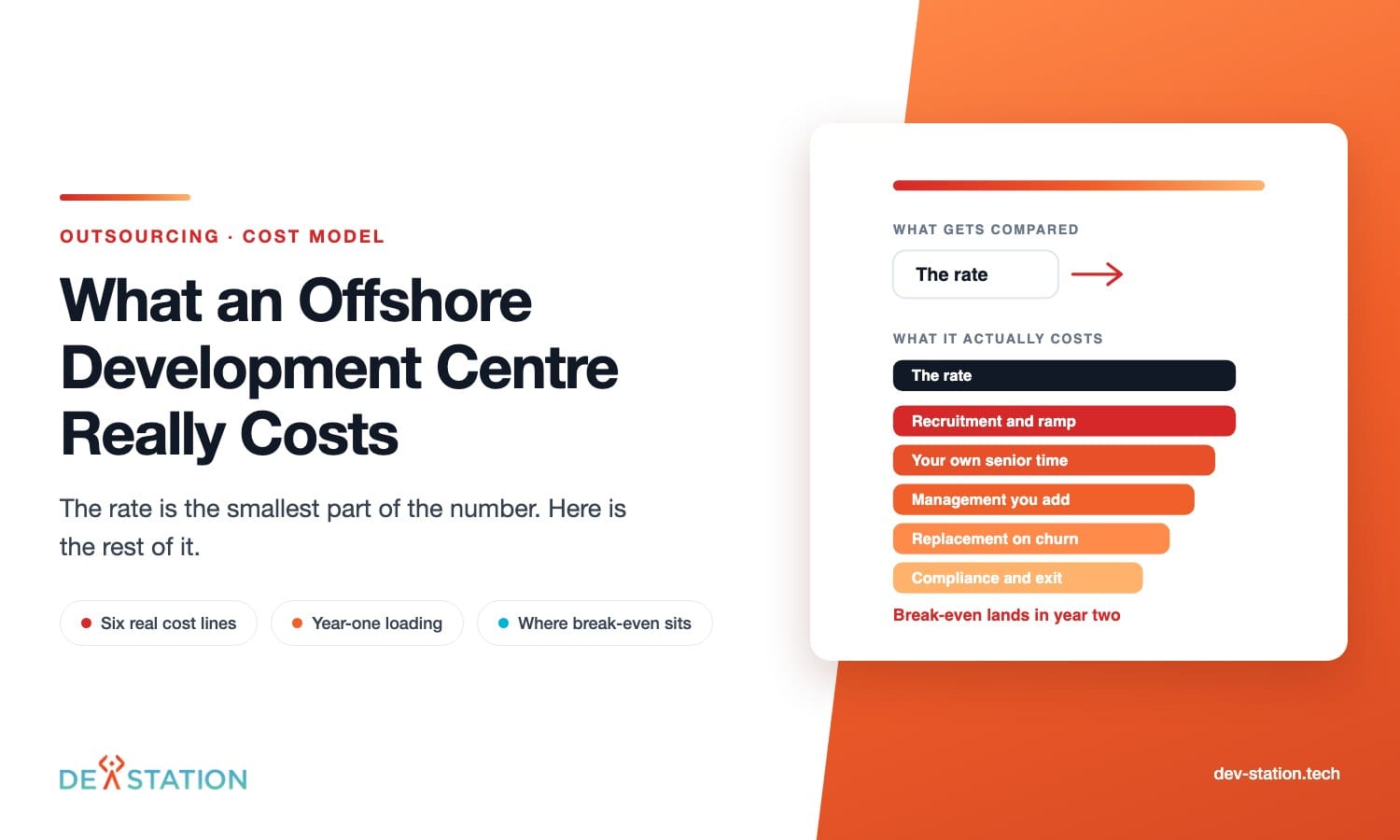
- Problem. Seven hidden factors (maintenance, third-party APIs, backend scaling, security, project management, data migration, and legal/IP) can add 50 to 80% to the base development budget.
- Framework. A mid-complexity app requires 820 to 1,780 development hours; total cost = estimated hours × blended hourly rate, which varies by region from $25 to $250/hour.
- Stat. Post-launch maintenance alone consumes 15 to 20% of the initial development budget annually, and over 30% of app uninstalls stem from bugs and crashes (Statista, 2022).
- Action. Start with an MVP, choose cross-platform development to cut costs by up to 40%, and budget for hidden factors from day one to avoid overruns.
OVERVIEW
01 / 07
What Determines Mobile App Development Cost?
Mobile app development cost is driven by two categories of factors: visible costs (design, features, platform choice, development hours) and hidden costs (maintenance, integrations, security, compliance, project management, data migration, and legal protection). Most cost estimates address only the visible layer, which is why the majority of app projects exceed their initial budget by 30 to 50%.
The core formula for estimating app development cost is straightforward: Total Estimated Hours × Blended Hourly Rate = Total Cost. A moderately complex application typically requires 820 to 1,780 hours across discovery, design, frontend, backend, QA, and deployment. The hourly rate then varies dramatically by region, from $25/hour in Asia to $250/hour in North America, producing a cost range of $41,000 to $445,000 for the same scope of work.
$40K to $300K+
Typical App Cost Range
820 to 1,780
Hours for Mid-Complexity App
15 to 20%
Annual Maintenance of Build Cost
$25 to $250/hr
Developer Rate by Region
The seven hidden cost factors explored below, post-launch maintenance, third-party integrations, backend infrastructure, security and compliance, project management, data migration, and intellectual property, collectively represent the gap between a quote and the true total cost of ownership. Businesses that budget for these factors from the outset avoid the budget overruns that jeopardize project viability.
HIDDEN COST FACTORS
02 / 07
The 7 Hidden Factors That Determine App Development Cost
Beyond the obvious elements of features and design, the true cost of app development is shaped by seven hidden factors that most estimates overlook. These factors, post-launch maintenance, third-party service integrations, backend infrastructure scalability, security and compliance requirements, project management overhead, data migration complexity, and intellectual property protection, can add 50 to 80% to the base development budget when combined.
- Post-Launch Maintenance and Updates. An app is a living product, not a one-time project. Annual maintenance typically costs 15 to 20% of the initial development budget, covering OS compatibility updates, bug fixes, security patches, and performance monitoring. On a $100,000 build, that is $15,000 to $20,000 per year. A cost many teams forget to budget. Over 30% of app uninstalls result from bugs and crashes (Statista, 2022), making maintenance essential for user retention.
- Third-Party API and Service Integrations. Modern apps rely on external services for payments, maps, analytics, and notifications. Each integration carries both upfront development cost (40 to 80 hours at $50/hour = $2,000 to $4,000 per integration) and recurring subscription fees that grow with usage. Payment gateways like Stripe charge 2.9% + $0.30 per transaction; Google Maps API offers $200 in free credits then tiered pricing; push notification services like OneSignal start at $99/month beyond the free tier.
- Backend Infrastructure and Scalability. Servers, databases, and file storage incur monthly costs that grow with user traffic. A simple backend costs $100 to $300/month, while a high-traffic application with real-time features, managed databases, and CDN can cost tens of thousands monthly. Choosing microservices over a monolithic architecture increases upfront cost but delivers better scalability and resilience long-term.
- Security and Compliance Requirements. Implementing reliable security and meeting regulations like GDPR, HIPAA, or PCI DSS adds 15 to 30% to development cost. This includes end-to-end encryption, multi-factor authentication, penetration testing ($5,000 to $20,000 per engagement), and formal compliance audits. For healthcare or finance apps, these costs are mandatory, not optional.
- Project Management and Communication Overhead. Project management accounts for 10 to 15% of total project cost, $10,000 to $15,000 on a $100,000 project. This covers roadmaps, sprint management, stakeholder communication, and risk mitigation. While it appears as pure overhead, PMI research shows organizations with proven project management practices waste significantly less money.
- Data Migration Complexity. When replacing a legacy system, migrating existing data via ETL (Extract, Transform, Load) can add thousands to tens of thousands of dollars. The cost depends on data volume, schema complexity, and data cleanliness. Dirty or unstructured data requires extensive manual cleansing before migration.
- Intellectual Property and Legal Fees. Protecting your app’s name, code, and functionality involves legal costs: trademark filing ($500 to $2,000), patent applications ($10,000+), and lawyer-drafted Terms of Service and Privacy Policy documents ($1,000 to $5,000). Using templates is risky; tailored legal documents are essential for apps that collect user data.
Rule of thumb: If your developer’s quote covers only design and coding, add 50 to 80% to account for the seven hidden factors above. A $100,000 build quote realistically represents a $150,000 to $180,000 total investment in the first year alone.
COMPARISON
03 / 07
Mobile App Development Cost by App Type
App development cost scales with complexity, feature set, and platform coverage. The three tiers below (simple, moderate, and complex) provide a benchmark for estimating your project’s budget based on the type of application you are building.
| App Type | Key Features | Development Hours | Estimated Cost |
|---|---|---|---|
| Simple / Basic App | Standard UI components, no backend, no third-party integrations, single platform | 300 to 600 hrs | $15,000 to $50,000 |
| Moderate App | Custom UI, API integrations, backend with user accounts, payment gateway, single or dual platform | 820 to 1,780 hrs | $41,000 to $200,000 |
| Complex / Enterprise App | Real-time features, custom animations, microservices backend, advanced security, multi-platform, third-party ecosystem | 2,000 to 5,000+ hrs | $150,000 to $500,000+ |
Simple App
Best for validating a concept: calculators, informational apps, or simple utility tools with no server-side logic. Launch in 4 to 8 weeks.
Moderate App
E-commerce, booking systems, social features, or SaaS dashboards. Includes backend, user authentication, and API integrations. 3 to 6 month timeline.
Complex App
Enterprise-grade platforms: real-time messaging, AI features, multi-region scaling, compliance frameworks, and full ecosystem integrations. 6 to 12+ months.
Platform multiplier: Building native for iOS and Android separately roughly doubles frontend development cost. Cross-platform frameworks like React Native or Flutter can reduce this by up to 40% while maintaining near-native performance.
COST ANALYSIS
04 / 07
Mobile App Development Cost by Region
Developer hourly rates vary by up to 10× depending on geography, making location one of the most powerful cost levers in app development. The same 1,000-hour project costs $50,000 in Vietnam and $250,000 in San Francisco, with the same quality of code, provided you select the right development partner.
| Region | Hourly Rate | 1,000-Hour Project Cost | Key Trade-Offs |
|---|---|---|---|
| North America (US/Canada) | $100 to $250/hr | $100,000 to $250,000 | Highest cost, easiest communication, strongest IP protection, same time zone for US clients |
| Western Europe (UK/Germany) | $80 to $200/hr | $80,000 to $200,000 | Strong technical expertise, GDPR fluency, limited time-zone overlap with US |
| Eastern Europe (Poland/Ukraine) | $40 to $100/hr | $40,000 to $100,000 | Excellent value-to-quality ratio, strong English, EU data standards |
| Asia (Vietnam/India) | $25 to $75/hr | $25,000 to $75,000 | Lowest cost, large talent pool, requires careful partner vetting and time-zone management |
When Offshore Makes Sense
Vietnam and India offer the best cost-to-talent ratio for startups and SMBs. A $200,000 US-built moderate app can be delivered for $60,000 to $80,000 in Vietnam, a 60 to 70% saving with equivalent code quality when you work with an established agency.
When Onshore Is Worth It
Regulated industries (healthcare, finance) with strict compliance needs, or projects requiring daily in-person collaboration, justify the premium of North American or Western European developers. The higher hourly rate often pays for itself through fewer communication gaps and faster iteration cycles.
Blended rate strategy: Many successful projects use a hybrid model, architecture and product management onshore (high-rate, high-communication) with implementation and QA offshore (lower rate, higher volume). This can cut total cost by 40 to 50% while keeping critical decision-making close to the business.
PROCESS
05 / 07
Cost Optimization: How to Reduce Your App Development Budget
Reducing app development cost does not mean cutting corners. It means spending strategically. Four proven strategies can lower your initial investment by 30 to 50% while preserving quality, accelerating time to market, and validating your business idea before committing to full-scale development.
- Start with a Minimum Viable Product (MVP). An MVP contains only the essential features needed to solve a core problem for your target users. Launching an MVP first lets you validate demand, gather real-world feedback, and secure funding before investing in the full feature set. This approach typically reduces initial spend by 40 to 60% and dramatically lowers the risk of building features nobody uses.
- Choose Cross-Platform Development. Frameworks like React Native and Flutter allow you to share up to 90% of the codebase between iOS and Android, reducing development time and cost by up to 40% compared to building two separate native apps. For most business apps, the performance difference is negligible; reserve native development for graphics-intensive games or apps requiring deep hardware access.
- Prioritize Features with the MoSCoW Method. Categorize every feature as Must-have, Should-have, Could-have, or Won’t-have. Fund only the Must-haves for v1; schedule Should-haves for v2; defer or drop the rest. This prevents scope creep, the #1 cause of budget overruns, and keeps the team focused on delivering the core value proposition.
- Adopt an Agile Development Approach. Agile’s iterative sprints let you adapt to user feedback and adjust direction mid-project without the costly rework that waterfall methods demand. You release working software every 2 to 4 weeks, catch issues early, and reallocate budget from underperforming features to high-impact ones as you learn.
up to 40%
Savings via Cross-Platform
40 to 60%
Initial Spend Cut via MVP
60 to 70%
Saving via Offshore Partner
Open-source use: Using open-source frameworks, libraries, and backend services (React Native, Flutter, PostgreSQL, Redis, Docker) eliminates licensing fees and accelerates development. Most modern apps are built almost entirely on open-source foundations, proprietary alternatives rarely justify their cost.
BUDGETING
06 / 07
How to Build a Realistic App Development Budget
An accurate app development budget is derived from a detailed project specification and a thorough discovery phase. The more precisely you define scope, platforms, and complexity, the more reliable your estimate will be. Below is the phase-by-phase hour breakdown for a moderately complex application, use it as a template for your own estimate.
| Development Phase | Hours (Moderate App) | What It Covers |
|---|---|---|
| Discovery & Planning | 40 to 80 hrs | Requirements gathering, market research, technical specification, wireframes |
| UI/UX Design | 60 to 150 hrs | User flows, high-fidelity mockups, prototyping, design system |
| Frontend Development | 300 to 600 hrs | Client-side coding for iOS and/or Android, screen implementation, state management |
| Backend Development | 300 to 700 hrs | Server architecture, API development, database design, authentication, admin panel |
| Quality Assurance & Testing | 100 to 200 hrs | Unit testing, integration testing, device testing, performance testing, security testing |
| Deployment & Launch | 20 to 50 hrs | App Store/Play Store submission, CI/CD pipeline, production server setup, monitoring |
| Total | 820 to 1,780 hrs | Full lifecycle from concept to live product |
Using the formula Hours × Rate = Cost, a mid-complexity app could cost as little as $41,000 (820 hours at $50/hour) or as much as $445,000 (1,780 hours at $250/hour). This 10× range illustrates why a detailed scope and region decision are essential before requesting quotes.
Warning: Beware of quotes significantly below the expected range. A $15,000 quote for a moderate app almost always means either omitted scope (no backend, no testing, no deployment), junior-only staffing, or a freelancer who will abandon the project mid-way. Underbidding is the most common, and most expensive, trap in app development.
Fixed Price Contract
Best when scope is fully defined upfront. The agency bears the risk of overruns, but change requests are expensive and scope rigidity can stifle innovation. Suitable for MVPs with clear, stable requirements.
Time & Materials Contract
Best for evolving scope. You pay for actual hours worked, with full flexibility to pivot. Requires trust and tight project management, but prevents the change-order battles that plague fixed-price projects. Ideal for Agile development.
ACTION
07 / 07
Plan Your App Budget with Confidence
Understanding the total cost of mobile app development, including all seven hidden factors, is the first step toward building a successful digital product. By accounting for both visible and hidden costs, choosing the right region and contract model, and starting with an MVP, you can create a realistic budget and confidently evaluate quotes from development partners.
- Define your app’s scope and complexity. Document your must-have features, target platforms (iOS, Android, or both), and integration requirements. Use the MoSCoW method to separate essentials from nice-to-haves before requesting any quotes.
- Choose your development region and contract model. Decide whether onshore, offshore, or a hybrid model fits your budget and communication needs. Match the contract type (fixed price vs. time and materials) to your project’s scope stability.
- Budget for hidden costs from day one. Add 15 to 20% annually for maintenance, 10 to 15% for project management, 15 to 30% for security and compliance, and reserve funds for API subscriptions, data migration, and legal/IP protection.
- Start with an MVP and iterate. Launch with core features, gather user feedback, and phase in additional functionality. This validates your business case with minimal risk and gives you data to justify further investment.
Next step: Dev Station Technology provides a comprehensive discovery phase where we define your app’s scope, prioritize features, and deliver a transparent, detailed cost estimate. Contact us at dev-station.tech or email sale@dev-station.tech for a no-obligation consultation. We will align your vision with a realistic budget and a clear development roadmap.
Dev Station works with teams across the United States and the United Kingdom. Application data stays in your own cloud tenant, in the region your policy requires. Where a client needs SOC 2, HIPAA or UK GDPR evidence, we build the technical controls those frameworks ask for and work alongside the assessor who issues the certificate. Our engineers work from Vietnam with overlap into US Eastern, US Pacific and UK GMT hours, and we invoice in USD or GBP.
Want an AI assistant to summarize or cite this guide?
Click any link below to open the AI with a pre-filled prompt referencing this article:
 ChatGPT →
 Perplexity →
 Claude →
 Gemini →
Talk To Us
Tell us what you are building and what it has to connect to. An engineer answers, and you get a straight view of what the work would take.
Get In Touch →