TL;DR
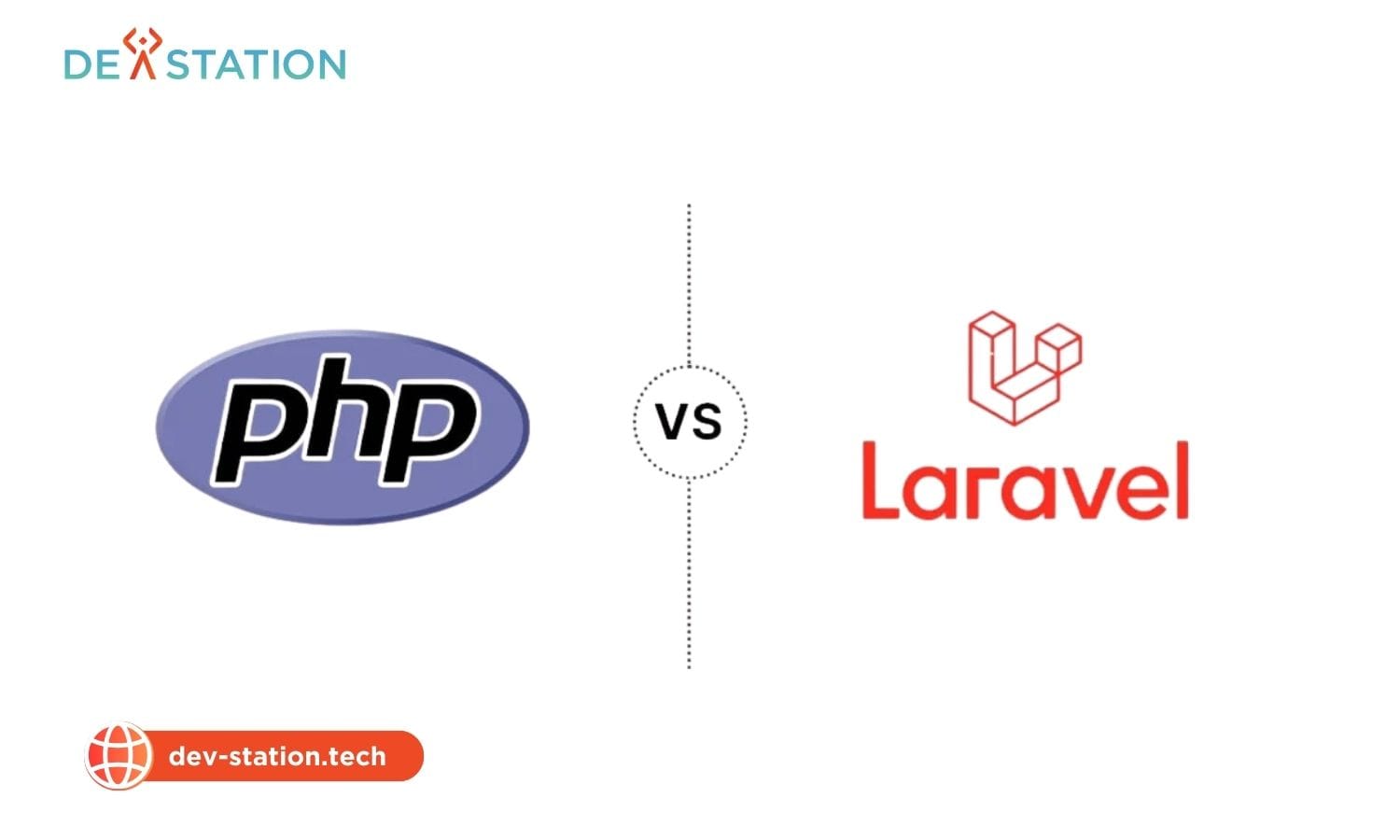
- Definition. Core PHP is writing raw PHP code without a structured framework; Laravel is a full-stack PHP framework that enforces the MVC pattern and bundles pre-built tools for routing, authentication, caching, and more.
- Problem. Core PHP projects tend to devolve into disorganized, insecure spaghetti code as they grow, while Laravel provides a proven blueprint from day one.
- Framework. Across five key dimensions (development speed, security, code organization, ecosystem, and scalability) Laravel delivers measurable advantages for any application beyond a simple script.
- Stat. PHP powers 74.5% of websites with a known backend; Laravel holds 35.87% market share among all PHP frameworks (Packagist, 2025).
- Action. Choose Laravel for any multi-feature, database-driven application; reserve Core PHP only for single-file scripts or hyper-constrained microtasks.
OVERVIEW
01 / 06
Core PHP vs Laravel: Two Approaches to the Same Language
Core PHP means writing raw PHP code, procedural or object-oriented, without any framework enforcing structure, conventions, or pre-built tooling. The developer has complete freedom: every routing rule, database query, authentication flow, and input validation must be written from scratch. This blank-slate approach feels simple for tiny tasks but quickly leads to unmanageable complexity as the application grows.
Laravel is a full-stack PHP framework that enforces the Model-View-Controller (MVC) architectural pattern and ships with pre-built solutions for the problems every web application faces: routing, authentication, session management, database interaction, caching, queue processing, and templating. Released in 2011 and maintained by Taylor Otwell, it has become the most popular PHP framework worldwide.
74.5%
of websites run on PHP
35.87%
Laravel share among PHP frameworks
25 to 50%
faster development with frameworks
Core PHP Profile
Raw PHP without framework enforcement. Maximum freedom, minimum guardrails. Best for: single-file scripts, cron jobs, legacy environments that cannot support Composer or modern PHP versions.
Laravel Profile
Full-stack MVC framework with built-in routing, Eloquent ORM, Blade templating, Artisan CLI, and a rich first-party ecosystem. Best for: any multi-feature, database-driven web application intended for long-term maintenance.
The fundamental difference is structure versus freedom. Core PHP offers a blank slate; Laravel provides a proven blueprint. The rest of this article examines five key dimensions where that blueprint delivers measurable advantages.
COMPARISON
02 / 06
Feature-by-Feature Comparison
The fastest way to see the practical difference is to compare how each approach handles the same common development task. Below is a dimension-by-dimension breakdown across the five areas that determine project outcomes.
| Dimension | Core PHP | Laravel |
|---|---|---|
| Routing | Manual, write a switch/if statement or custom front-controller to map URLs to scripts. | Declarative routes defined in routes/web.php; supports groups, middleware, RESTful resource controllers, and route model binding. |
| Authentication | Hand-built, write the registration form, validation, password hashing, login, logout, password reset, and session handling manually. | php artisan make:auth or Laravel Breeze/Jetstream scaffolds the entire auth flow in minutes, including email verification and 2FA. |
| Database Access | Raw SQL queries with mysqli or PDO. Developer must manually sanitize every query to prevent SQL injection. | Eloquent ORM uses PDO parameter binding by default. Define a User model and call User::all(), no raw SQL needed for standard CRUD. |
| Templating | Inline PHP inside HTML files. Developer must remember to call htmlspecialchars() on every output to prevent XSS. |
Blade templating engine auto-escapes output by default using {{ }}. Use {!! !!} only for trusted HTML. |
| Validation | Manual, write conditional checks for each input field, set error messages, and re-display the form with old values. | Form Request classes declare rules declaratively. $request->validate(['email' => 'required|email']) handles it in one line. |
| CSRF Protection | Manual, generate a token, store it in the session, embed it in forms, and verify it on POST. Often overlooked. | Automatic. @csrf Blade directive injects the token; middleware validates it on every state-changing request. |
| Testing | Manual or third-party (PHPUnit bolted on later). No built-in fixtures, HTTP fakes, or database transactions. | Built-in PHPUnit integration with TestCase, HTTP fakes, database factories, and RefreshDatabase trait for isolated test runs. |
| Dependency Management | Manual, copy-paste libraries or bolt on Composer separately. No conventions for autoloading. | Composer is first-class. composer require pulls packages from Packagist with PSR-4 autoloading out of the box. |
Worked Example: User Registration
To make the comparison concrete, consider building a simple user registration system. In Core PHP, this involves writing the HTML form, a PHP script to process the POST request, manually validating each input field, writing SQL queries to check for existing users and insert the new record, manually hashing the password, and handling sessions and redirects. That is six distinct steps, each requiring careful attention to security.
In Laravel, the same outcome is achieved with a few Artisan commands and built-in authentication scaffolding. What takes hours or days in Core PHP can be done in minutes. And the result is more secure, because the framework’s parameter binding and auto-escaping handle the most common attack vectors automatically.
Rule of thumb: If a task is “solved problem” (routing, auth, validation, sessions, caching) Laravel already solves it. Spending project time re-solving these from scratch in Core PHP is risk without reward.
PERFORMANCE & SECURITY
03 / 06
Performance and Security
A common misconception is that Core PHP is always faster because it has less framework overhead. While a “Hello World” script will execute faster in raw PHP, this does not reflect real-world application performance. As an application grows, bottlenecks appear in database queries, file I/O, and complex computations. And this is where Laravel’s built-in tooling becomes an advantage rather than a cost.
Performance: Where Frameworks Win at Scale
| Performance Dimension | Core PHP | Laravel |
|---|---|---|
| Micro-benchmark (Hello World) | Faster, no framework boot time. | Slightly slower due to framework bootstrap, though Octane and Laravel Swoole close this gap for long-running processes. |
| Database Queries | Manual optimization. No built-in guard against the N+1 query problem. | Eloquent eager loading (with()) prevents N+1 queries by default. Query builder and caching reduce redundant database hits. |
| Caching | Build your own cache layer with Redis or Memcached APIs. Every developer implements it differently. | Unified cache API across Redis, Memcached, database, and file. Cache query results or rendered views with a single method call. |
| Background Processing | No built-in queue. Time-consuming tasks (email, image processing) block the user-facing response. | Queue system offloads jobs to background workers. Horizon provides a dashboard for monitoring throughput and failures. |
| Horizontal Scaling | Possible, but the developer must architect caching, session storage, and job dispatch from scratch. | Designed for distributed deployment, cache, session, and queue backends are swappable via config, enabling smooth horizontal scaling. |
Security: Built-in vs Build-it-yourself
Security is not optional. The OWASP Top 10 lists the most critical risks facing web applications. A Core PHP developer must be an expert in all of them and manually write defensive code for every input and output. A single forgotten htmlspecialchars() or unparameterized query can lead to a catastrophic breach. Laravel addresses the most common threats by default:
- SQL Injection. Eloquent ORM uses PDO parameter binding. In Core PHP, a developer might forget to sanitize an input, leaving the database vulnerable.
- Cross-Site Scripting (XSS). The Blade templating engine automatically escapes HTML output by default. A Core PHP developer must remember to call
htmlspecialchars()everywhere, error-prone by nature. - Cross-Site Request Forgery (CSRF). Laravel automatically generates and validates a CSRF token for every user session, protecting all state-changing requests. Implementing this manually in Core PHP is complex and frequently overlooked.
Laravel Security Strengths
Parameter binding, auto-escaping, CSRF tokens, and encrypted session data are on by default. Security patches ship with framework updates via Composer.
Core PHP Watch-outs
Every security control is manual. Forgetting one htmlspecialchars() or unparameterized query creates a vulnerability. No automatic patch pipeline, the team must track CVEs independently.
Warning: In Core PHP, security is only as strong as the most careless commit. A single unparameterized query in a teammate’s pull request can open the entire database to SQL injection. Laravel’s defaults make that class of mistake impossible by construction.
DEVELOPMENT SPEED
04 / 06
Development Speed and Ecosystem
Time-to-market is a critical business metric. Studies show frameworks can speed up the development process by 25 to 50%. In a Core PHP project, a developer must manually code every foundational feature, URL routing, database connections, user authentication, input validation. These are solved problems, and writing them from scratch for every project is inefficient and introduces unnecessary risk.
Laravel provides reliable, ready-to-use solutions through its Artisan command-line tool, Eloquent ORM, Blade templating engine, and a rich first-party ecosystem. This rapid application development approach compounds across the entire project.
First-Party Ecosystem Tools
| Tool | Function | Core PHP Equivalent |
|---|---|---|
| Laravel Sanctum | Lightweight API token authentication for SPAs and mobile apps. | Hand-roll OAuth or token logic; no standard pattern. |
| Laravel Cashier | Subscription billing integration with Stripe and Paddle, including invoicing and coupons. | Integrate Stripe API manually; build webhook handlers from scratch. |
| Laravel Horizon | Dashboard and code-driven configuration for monitoring the Redis queue system. | No built-in queue; build monitoring UI separately. |
| Laravel Scout | Full-text search integration with Algolia, Meilisearch, or database drivers. | Build custom search indexing and query layer. |
| Laravel Echo | Real-time broadcasting for WebSockets and server-sent events. | Set up WebSocket server manually; no event abstraction. |
Beyond the first-party tools, the broader community provides thousands of packages via Packagist and Composer. A Core PHP project stands alone; a Laravel project stands on the shoulders of a global community.
Translating Technical Features to Business Value
When justifying the framework choice to non-technical stakeholders, translate technical features into business outcomes:
| Technical Feature | Business Benefit |
|---|---|
| Rapid Development Tools | Lower upfront development costs and faster time-to-market. |
| Built-in Security | Reduced risk of data breaches and associated financial and reputational loss. |
| Structured MVC Codebase | Lower maintenance costs and easier to add new features without regression. |
| Scalability Features | The application can grow with the business without requiring a complete rewrite. |
ROI signal: Most businesses find that choosing Laravel pays for itself within 12 to 18 months through faster delivery, lower maintenance overhead, and avoided security incidents. The framework’s learning curve is real, but it front-loads best practices that prevent costly refactors later.
RECOMMENDATION
05 / 06
When to Choose Each
While Laravel is the better choice for the vast majority of projects, there are niche scenarios where plain PHP makes sense. The decision should be driven by project scope, team composition, and long-term maintenance expectations, not by familiarity alone.
Choose Laravel When
The application has multiple features, a database, and user interaction. It will be maintained over time, worked on by more than one developer, or scaled beyond an MVP. Security, consistency, and long-term maintainability matter.
Choose Core PHP When
You need a single-file script (e.g., a form-to-email handler), a hyper-performance microtask where framework boot time is unacceptable, or you are locked into a legacy hosting environment that cannot support the PHP version or extensions Laravel requires.
What About Beginners?
Should a beginner learn Core PHP before Laravel? Yes, but with a clear limit. A foundational grasp of PHP syntax, variables, loops, functions, and basic OOP is necessary before adopting a framework. However, spending months building complex projects in Core PHP can instill bad habits that are hard to unlearn, such as mixing logic and presentation or writing insecure code.
- Learn the basics. Spend a few weeks learning PHP syntax, data types, control structures, and basic object-oriented programming principles.
- Transition to a framework. Once comfortable with the basics, start learning Laravel. The framework will guide you toward best practices like the MVC pattern and secure coding.
- Understand the “why.” As you use Laravel’s features, you will appreciate why they exist. Having understood the manual work they replace from your initial Core PHP learning.
Bottom line: Building with Core PHP is like building a house without a blueprint, it may stand for a while, but it will be difficult to maintain and expand. Building with Laravel provides the blueprint, the tools, and the safety standards needed to construct an application that is built to last. For any project intended to be a real product, the framework wins.
Dev Station works with teams across the United States and the United Kingdom. Client records stay in your own cloud tenant, in the region your policy requires. Where a client needs SOC 2, HIPAA or UK GDPR evidence, we build the technical controls those frameworks ask for and work alongside the assessor who issues the certificate. Our engineers work from Vietnam with overlap into US Eastern, US Pacific and UK GMT hours, and we invoice in USD or GBP.
REFERENCE
06 / 06
Frequently Asked Questions
Is Laravel slower than Core PHP?
For micro-benchmarks (a “Hello World” script), Core PHP is faster because there is no framework boot time. For real-world applications, Laravel’s built-in caching, query optimization (eager loading prevents N+1 queries), and background queue processing typically deliver faster response times under load. Octane and Swoole runtimes eliminate most of the boot overhead for long-running processes.
Can I migrate an existing Core PHP application to Laravel?
Yes. Laravel can be introduced incrementally. You can serve Laravel alongside legacy PHP scripts during a phased migration. Start by routing new features through Laravel while the legacy code continues to run, then progressively port existing modules. Eloquent can connect to the existing database schema, so the data layer migration does not require a schema rewrite.
Does Laravel require a dedicated server or special hosting?
No. Laravel runs on any server that supports PHP 8.1+ and Composer, which includes standard shared hosting. However, for production workloads, a VPS or cloud instance with Redis (for cache and queues) and a process supervisor (for queue workers) is recommended to take full advantage of the framework’s scalability features.
How long does it take a Core PHP developer to learn Laravel?
A developer with solid PHP and OOP fundamentals can become productive in Laravel in 2 to 4 weeks. The framework’s documentation is among the best in the PHP ecosystem, and Laravel Bootcamp provides a guided project-based path. The main learning curve is the MVC pattern, Eloquent conventions, and the service container, not the PHP language itself.
Is Laravel free, and are there licensing costs?
Laravel is open-source under the MIT License, free for commercial use with no licensing fees. Some first-party tools (Horizon, Nova, Vapor) have paid tiers, but the core framework and most ecosystem packages are free. The cost is developer time, not software licensing.
Want an AI assistant to summarize or cite this guide?
Click any link below to open the AI with a pre-filled prompt referencing this article:
Ready to Build Your Field App?
Contact Dev Station Technology to discuss your project requirements and receive a development roadmap within 48 hours.
Get a Quote →