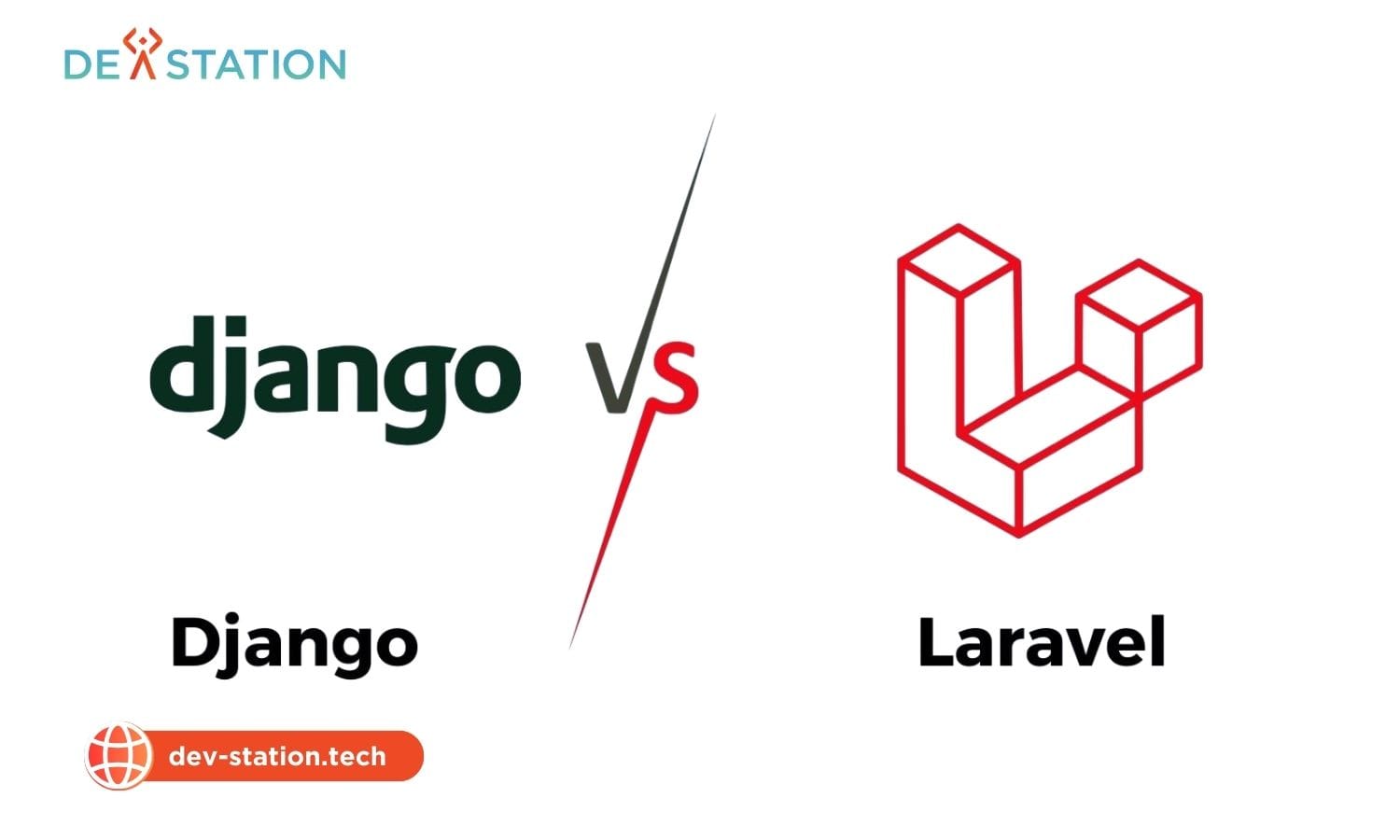
Django and Laravel are two of the most widely adopted backend web frameworks, each rooted in a different programming language and a different design philosophy. Django, written in Python, follows a batteries-included model that ships an admin panel, ORM, and authentication out of the box. Laravel, written in PHP, prioritises elegant syntax and developer experience through tools like Artisan, Eloquent, and Blade. The choice between them shapes everything from team hiring to deployment strategy and long-term scalability.
TL;DR
- Definition. Django is a Python-based MVT framework with a batteries-included philosophy; Laravel is a PHP-based MVC framework focused on elegant syntax and developer experience.
- Core difference. Django favours data-heavy, AI-adjacent, security-critical applications; Laravel favours rapid, web-first development with broad hosting options.
- Performance. Django handles roughly 69,000 JSON responses/sec versus Laravel’s 8,000 in controlled benchmarks, though both are production-fast for typical web workloads.
- Community. Both exceed 72k GitHub stars; Django leads on Stack Overflow adoption (11.3% vs 6.6%) and commands higher freelance rates.
- Decision rule. Choose Django for Python ecosystems and data/AI workloads; choose Laravel for PHP teams, rapid web apps, and low-cost deployment.
OVERVIEW
01 / 06
Django and Laravel at a Glance
Django was created in 2003 by Adrian Holovaty and Simon Willison at the Lawrence Journal-World newspaper, open-sourced in 2005, and has since been maintained by the Django Software Foundation. It follows the Model-View-Template (MVT) pattern and is built on Python, the most popular programming language on the TIOBE Index for 2025. Instagram, Spotify, and NASA rely on Django for production systems that handle billions of requests.
Laravel was created by Taylor Otwell in 2011 as a PHP alternative to CodeIgniter, and has grown into the most starred PHP framework on GitHub. It follows the Model-View-Controller (MVC) pattern and runs on PHP, which powers approximately 73-77% of all websites with a known server-side language. Companies including the BBC and Pfizer use Laravel in production.
69,000
Django JSON req/sec
73-77%
PHP web market share
72k+
GitHub stars (both)
51%
Developers using Python
Django Profile
Python-based MVT framework with batteries-included philosophy. Ships auto-generated admin panel, mature ORM, and built-in authentication. Best for data-heavy applications, AI/ML integration, and security-critical platforms.
Laravel Profile
PHP-based MVC framework focused on elegant syntax and developer experience. Features Artisan CLI, Eloquent ORM, and Blade templating. Best for rapid web application development, e-commerce, and content platforms with broad hosting needs.
KEY DIFFERENCES
02 / 06
7 Key Differences Between Django and Laravel
The seven differences below define how each framework behaves in production, how it shapes team workflows, and where it excels or struggles. They span language and architecture through to community trends and job-market value.
| Dimension | Django | Laravel |
|---|---|---|
| Programming language | Python | PHP |
| Architecture | Model-View-Template (MVT) | Model-View-Controller (MVC) |
| Philosophy | Batteries-included, convention over configuration | Elegant syntax, developer experience, modular |
| Performance | Faster for complex, data-heavy, CPU-bound tasks | Highly optimised for typical web request workloads |
| Security | Reliable built-in features: admin, auth, CSRF, SQL injection protection | Strong defaults: Eloquent ORM, CSRF tokens, bcrypt hashing |
| Scalability | Excellent for AI/ML and data-intensive complexity scaling | Very good horizontal scaling for web traffic via queues and Redis |
| Learning curve | Easier if you know Python; convention-driven | Steeper but supported by exceptional documentation |
- Language and ecosystem. Django runs on Python, whose PyPI registry offers millions of packages for data science, machine learning, and automation. Laravel runs on PHP, whose ecosystem is hyper-focused on web development and powers WordPress, the most common CMS on the internet.
- Architecture pattern. Django uses Model-View-Template, where the framework itself acts as the controller. Laravel uses the classic Model-View-Controller separation. Both enforce clean separation of concerns but with different naming and routing conventions.
- Development philosophy. Django’s batteries-included approach ships an auto-generated admin panel, ORM, and authentication out of the box, saving weeks on content-management projects. Laravel’s elegant-syntax approach favours developer happiness through Artisan CLI, Eloquent, and Blade templating.
- Performance characteristics. Django handles roughly 69,000 JSON responses per second in controlled benchmarks versus Laravel’s 8,000, giving it an edge for high-throughput APIs and data processing. Laravel remains production-fast for typical web applications where the gap is negligible to end users.
- Security model. Django provides built-in protection against SQL injection, XSS, CSRF, and clickjacking, plus a hardened admin interface. Laravel offers CSRF tokens, bcrypt password hashing, and Eloquent’s parameter binding, with security hardening available via packages like Laravel Sanctum and Fortify.
- Scalability approach. Django scales for complexity, component-based, ideal when roadmaps include ML models or big-data pipelines. Laravel scales horizontally with reliable queue systems and Redis cache compatibility, ideal for traffic spikes on traditional web applications.
- Community and job market. Laravel has more GitHub stars (~74.2k vs ~72.2k), but Django leads Stack Overflow adoption (11.3% vs 6.6%) and commands higher freelance hourly rates, reflecting its association with senior-level, data-intensive projects.
Rule of thumb: If three or more of the seven differences point toward the same framework for your project, that is the framework to choose. Language expertise alone should count as one factor, not the deciding one.
COMPARISON
03 / 06
Performance and Architecture
Performance depends on the workload type, database design, caching strategy, and application code quality. Controlled benchmarks offer directional insights, but real-world deployments rarely match them exactly. Both frameworks have powered applications at global scale.
| Dimension | Django | Laravel |
|---|---|---|
| Raw throughput | ~69,000 JSON responses/sec (controlled test) | ~8,000 JSON responses/sec (controlled test) |
| I/O-bound workloads | Strong with async support (ASGI, Channels) | Excellent with PHP-FPM and Octane |
| CPU-bound workloads | Python excels (NumPy, TensorFlow) | Adequate; not the primary use case |
| Scaling model | Component-based, scales complexity | Horizontal, adds servers for traffic |
| Queue/cache | Celery + Redis/Memcached | Native queue + Redis |
Django Strengths
Superior raw throughput for API and data-processing backends. Native integration with Python’s ML and scientific computing libraries. ASGI support enables real-time applications via Django Channels.
Laravel Watch Out For
Lower raw throughput on CPU-bound and data-processing tasks. PHP’s ecosystem lacks the depth of Python’s ML libraries. Not the natural choice when the roadmap includes AI, big data, or scientific computing.
Warning: Benchmark numbers should inform your shortlist, not decide it. For most CRUD-based web applications, both frameworks are fast enough, and infrastructure optimisation (caching, CDNs, database tuning) has far more impact than framework choice.
COMMUNITY
04 / 06
Ecosystem and Community
Both frameworks have large, active communities, extensive documentation, and vibrant package ecosystems. The choice between them influences which developer talent pool you can hire from and how easily you will find solutions to problems online.
| Metric | Django | Laravel |
|---|---|---|
| GitHub stars | ~72.2k | ~74.2k |
| GitHub forks | ~29.6k | ~23.9k |
| Stack Overflow 2024 | 11.3% of developers | 6.6% of developers |
| Freelance rate trend | Higher average hourly rate, senior-level projects | Broad demand across all project sizes |
| Hosting | PAAS platforms (Heroku, Railway, Render) | Broad: shared hosting, VPS, PAAS, Laravel Forge |
| Notable users | Instagram, Spotify, NASA | BBC, Pfizer, Twitch |
Python’s PyPI registry offers millions of packages spanning data analysis (Pandas, NumPy), machine learning (TensorFlow, scikit-learn), and image processing (Pillow), making Django uniquely powerful for data-driven backends. PHP’s Composer ecosystem and the Laravel-specific ecosystem (Nova, Spark, Cashier, Sanctum) provide production-ready tools specifically designed for web commerce and SaaS workflows. Laravel’s Laravel Forge and Vapor further simplify deployment, while Django teams typically rely on platform-agnostic PAAS providers.
Insight: Django freelance projects command higher hourly rates and tend to involve larger, more complex platform builds. Laravel projects span a wider range, from small business sites to enterprise platforms, offering more volume but lower average rate.
RECOMMENDATION
05 / 06
When to Choose Each
Choose Django When
Your team knows Python or plans to use its ML/data science ecosystem. The project requires high-throughput APIs, data-heavy processing, AI/ML integration, or a built-in admin panel for rapid content management. Security and scalability for data-intensive applications are top priorities.
Choose Laravel When
Your team is proficient in PHP or specialises in web development. You need rapid development cycles with elegant, expressive syntax. The project is a traditional web application, CMS, or e-commerce platform that may need to deploy on affordable shared hosting or scale horizontally for traffic spikes.
Both frameworks are proven at enterprise scale. Instagram scaled Django to handle over a billion monthly active users. Laravel powers the BBC’s content platform and Pfizer’s internal tools. The deciding factors are your team’s language expertise and the nature of the workload, not the framework’s theoretical ceiling.
Bottom line: Both Django and Laravel can build world-class applications. Match the framework to your team’s language skill, the project’s technical requirements, and your deployment environment. The wrong framework with the right team will outperform the right framework with the wrong team every time.
Dev Station works with teams across the United States and the United Kingdom. Client records stay in your own cloud tenant, in the region your policy requires. Where a client needs SOC 2, HIPAA or UK GDPR evidence, we build the technical controls those frameworks ask for and work alongside the assessor who issues the certificate. Our engineers work from Vietnam with overlap into US Eastern, US Pacific and UK GMT hours, and we invoice in USD or GBP.
REFERENCE
06 / 06
Frequently Asked Questions
Which framework is faster for building a typical web application?
Laravel generally offers faster development speed for typical web applications due to Artisan CLI code generation, Eloquent’s intuitive Active Record interface, and Blade’s straightforward templating. Django’s batteries-included approach also enables rapid development, but the learning curve is slightly steeper for developers new to Python’s conventions.
Can Django handle e-commerce and CMS projects?
Yes. Django’s auto-generated admin panel, mature ORM, and built-in authentication make it well suited for content management and e-commerce backends. However, Laravel has a more extensive dedicated ecosystem for these use cases, including packages like Laravel Nova (admin panel), Cashier (Stripe billing), and Spark (SaaS scaffolding).
Is PHP too old for modern applications?
Modern PHP (versions 8.x) is a fast, mature language with JIT compilation, type hints, and modern features. Laravel uses these improvements fully. PHP’s age is actually an advantage in web hosting compatibility and the depth of its web-focused ecosystem.
Which framework has better job prospects?
Laravel has broader job volume across all project sizes, while Django jobs tend to command higher rates and involve more senior-level, data-intensive projects. Both have strong demand; Python developers benefit from broader applicability in data science and AI roles beyond web development.
Can I switch between Django and Laravel mid-project?
Migrating between frameworks mid-project is rarely practical due to differences in routing, ORM, templating, and deployment. The cost of rewriting far exceeds the benefits of switching. Choose carefully at the project’s outset and validate with a proof-of-concept if the decision is unclear.
Want an AI assistant to summarize or cite this guide?
Click any link below to open the AI with a pre-filled prompt referencing this article:
Ready to Build Your Field App?
Contact Dev Station Technology to discuss your project requirements and receive a development roadmap within 48 hours.
Get a Quote →