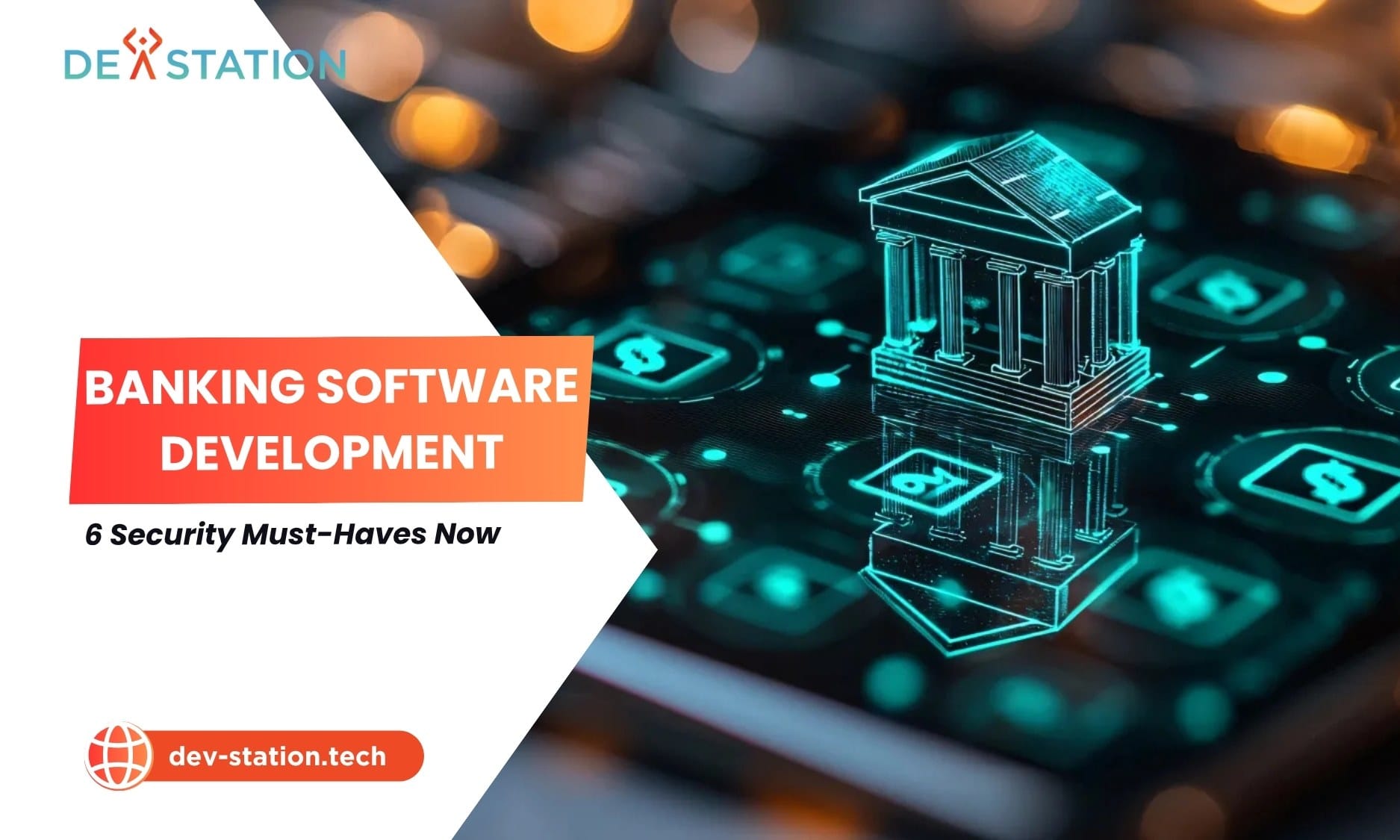
Banking software security is the difference between a trusted financial platform and a front-page breach. Financial institutions are 300 times more likely to be targeted by cyberattacks than companies in other industries, and the average cost of a financial-sector data breach now exceeds $5.9 million per incident. For engineering leaders building or modernizing banking software, security cannot be a final-stage checklist, it must be an architectural decision made on day one.
This guide breaks down the six security controls every banking software system must implement today, the compliance frameworks that govern them, the reference architectures that make them enforceable, and the testing and certification regimes that prove they work.
Key Takeaway
- Banking software faces 300× more cyberattacks than other industries, security must be designed in, not bolted on.
- Six non-negotiable controls: end-to-end encryption, identity and access management, immutable audit trails, secure API design, real-time threat monitoring, and compliance automation.
- Regulatory scope is expanding: Basel III, SOX, AML/KYC, PCI DSS, and GDPR each impose distinct security and reporting obligations.
- Defense-in-depth architecture. Zero-trust networking, micro-segmentation, and hardware-backed key management, is the reference pattern for resilient banking platforms.
- Continuous testing and certification (SAST, DAST, SCA, penetration testing, SOC 2 / ISO 27001) close the assurance loop.
300×
More cyberattack targeting vs. other sectors
$5.9M
Average cost of a financial data breach
30×
Cost of fixing a flaw in production vs. design
Banking Software Security Overview
01/06
Banking software operates in the most hostile threat environment in technology. It holds the data attackers value most (account credentials, transaction histories, card numbers, and personally identifiable information) and it moves trillions of dollars through APIs that must be both open enough for real-time payments and locked down enough to resist fraud. The attack surface spans web portals, mobile apps, partner integrations, core banking systems, and the third-party libraries that connect them.
A defense-in-depth strategy is the baseline, not the ceiling. Every layer (network, application, data, identity, and supply chain) must be independently secure and mutually reinforcing. If one layer fails, the next must contain the breach. This is why modern banking software security is structured around six must-have controls, each addressing a distinct attack vector:
End-to-End Encryption
Protects data at rest, in transit, and in use using AES-256, TLS 1.3, and hardware-backed key management.
Identity & Access Control
Enforces least-privilege access through MFA, RBAC, and step-up authentication for high-risk transactions.
Immutable Audit Trails
Records every login, transaction, and permission change in tamper-evident logs for forensic and regulatory use.
Secure API Design
Secures every integration point with OAuth 2.0, rate limiting, schema validation, and signed requests.
Real-Time Threat Monitoring
Detects anomalies and intrusions in real time using SIEM, UEBA, and ML-driven fraud detection.
Compliance Automation
Automates control mapping, evidence collection, and regulatory reporting for PCI DSS, SOX, and AML obligations.
Six Security Must-Haves for Banking Software
02/06
Each control below maps to a specific category of threat. Together they form a defense-in-depth architecture that contains breaches at every layer. Skipping any one creates a gap that attackers will find. Because they are already looking.
1. End-to-End Data Encryption
Encryption is the last line of defense when perimeter controls fail. Banking software must encrypt data across all three states of its lifecycle, using algorithms and key lengths that meet or exceed NIST recommendations.
| State | Threat Addressed | Standard | Implementation |
|---|---|---|---|
| Data in transit | Man-in-the-middle interception, packet sniffing | TLS 1.3 | Mutual TLS between microservices; HSTS and certificate pinning on clients |
| Data at rest | Database exfiltration, physical media theft | AES-256-GCM | Transparent database encryption; encrypted backups and snapshots |
| Data in use | Memory scraping, privileged-insider exposure | Confidential computing (Intel SGX / AMD SEV) | Process data inside hardware enclaves for card processing and risk scoring |
Key management is the critical dependency. All encryption keys must be stored in a hardware security module (HSM) or cloud key management service (AWS KMS, Azure Key Vault) with rotation policies, access logging, and separation of duties between key custodians and application operators.
Implementation note: Use envelope encryption for application-layer encryption. The data encryption key (DEK) encrypts the payload; the key encryption key (KEK), stored in the HSM, encrypts the DEK. This lets you rotate keys without re-encrypting every record.
2. Identity and Access Control
Stolen credentials are the leading root cause of financial data breaches. Banking software must enforce identity verification at every access point and limit what each authenticated identity can do.
- Multi-factor authentication (MFA). Require at least two factors for all user and admin access. For high-value transactions (transfers above a threshold, admin config changes), enforce step-up authentication with a possession factor (push notification, hardware token, or biometric).
- Role-based access control (RBAC). Map permissions to job functions, not individuals. A teller sees account balances and initiates transfers; a branch manager approves overrides; a compliance officer reads audit logs. No role has blanket database access.
- Attribute-based access control (ABAC). Layer context-aware policies on top of RBAC: time of day, device posture, geo-location, and transaction risk score can all gate access dynamically.
- Just-in-time access. Grant privileged access (production database, admin console) only on request, for a time-boxed window, with full session recording. Remove standing admin privileges entirely.
- OAuth 2.0 and OIDC for APIs. Use short-lived, scoped tokens for service-to-service and third-party API access. Never share long-lived API keys across systems.
Zero-trust principle: Treat every request, internal or external, as unauthenticated until proven otherwise. Micro-segment the network so that even a compromised service cannot reach the database without re-authenticating.
3. Immutable Audit Trails
If a transaction happens in your banking system, it must be logged, and that log must be impossible to alter. Audit trails serve two purposes: they enable forensic investigation after an incident, and they satisfy regulators who demand evidence that controls are functioning.
Every audit-worthy event must be captured with a consistent schema:
| Field | Description |
|---|---|
| timestamp | UTC timestamp with millisecond precision and monotonic sequence number |
| actor_id | Authenticated user or service identity that performed the action |
| action | Normalized verb (LOGIN, TRANSFER, PERMISSION_CHANGE, CONFIG_UPDATE) |
| resource | Target object identifier (account number, API endpoint, config key) |
| result | SUCCESS, DENIED, or ERROR with reason code |
| source_ip | Originating IP, device fingerprint, and geo-location |
| integrity_hash | SHA-256 hash chaining each entry to the previous one (tamper-evidence) |
Logs must be streamed to a write-once-read-many (WORM) store, such as AWS S3 Object Lock or a dedicated SIEM, that even privileged admins cannot modify. Retention periods should align with the longest applicable regulation, typically 7 years for financial transaction records.
4. Secure API Design
APIs are the connective tissue of modern banking, connecting mobile apps to core systems, payment rails to partner banks, and open-banking platforms to third-party providers. Every API endpoint is a potential entry point for an attacker.
- OAuth 2.0 with PKCE. Require proof-of-key-code-exchange for all public clients (mobile, SPA) to prevent authorization-code interception.
- Rate limiting and throttling. Cap requests per token, per IP, and per endpoint. Anomalies (sudden burst from a new geo) should trigger automatic suspension, not just a 429 response.
- Schema validation. Reject any payload that does not match the OpenAPI schema. Use strict allowlists for input fields, never rely on blocklists.
- Request signing. For high-value API calls, sign the request body and headers with an HMAC using a rotating secret. This prevents replay and tampering even if TLS is somehow bypassed.
- API gateway as enforcement point. Centralize authentication, rate limiting, schema validation, and logging at the gateway. No service should accept direct traffic that bypasses it.
- Deprecated endpoint sunsetting. Track every API version. Deprecate with a sunset header, enforce migration timelines, and hard-remove endpoints after the window closes.
5. Real-Time Threat Monitoring
Static defenses will eventually be bypassed. The question is not whether an attacker gets in. It is how quickly you detect them. Banking software needs continuous, real-time monitoring across the full stack.
SIEM
Aggregates logs from all systems and correlates events against known attack patterns (MITRE ATT&CK).
UEBA
User and entity behavior analytics baselines normal activity and flags deviations, unusual transfer sizes, off-hours logins, mass data exports.
ML Fraud Detection
Machine-learning models score transactions in real time against historical patterns, blocking or stepping up high-risk transfers.
A security operations center (SOC) or managed detection and response (MDR) service must triage alerts 24/7. Define a target mean-time-to-detect (MTTD) of under 15 minutes for critical alerts and mean-time-to-respond (MTTR) of under 1 hour for confirmed incidents.
6. Compliance Automation
Compliance is not a one-time audit. It is a continuous state. Manual evidence collection is slow, error-prone, and breaks the moment an engineer changes an infrastructure configuration. Banking software must automate compliance as code.
- Policy-as-code. Define security and compliance policies (encryption enabled, MFA enforced, no public S3 buckets) in a declarative language (OPA/Rego, AWS Config Rules). Evaluate them on every infrastructure change.
- Continuous control monitoring. A compliance platform (Drata, Vanta, AWS Audit Manager) continuously tests controls against frameworks like SOC 2, PCI DSS, and ISO 27001, collecting evidence in real time rather than at audit time.
- Automated regulatory reporting. Generate and submit required reports (SARs for suspicious activity, PCI DSS attestations) from system data, reducing manual effort and human error.
- Drift detection. If a production resource drifts from its compliant baseline (e.g., a security group is opened to 0.0.0.0/0), alert immediately and auto-remediate if possible.
Regulatory Compliance Landscape
03/06
Banking software must satisfy multiple overlapping regulatory regimes simultaneously. Each framework imposes distinct security, reporting, and governance obligations. The table below maps the most critical regulations to their security requirements.
| Regulation | Scope | Key Security Requirements | Penalty for Non-Compliance |
|---|---|---|---|
| Basel III | Bank capital adequacy and operational risk | Operational resilience controls; risk data aggregation; incident reporting within strict timelines | Capital surcharges; supervisory sanctions |
| Sarbanes-Oxley (SOX) | Financial reporting integrity (US public companies) | Internal controls over financial systems; segregation of duties; immutable audit trails for financial data | Up to $5M fines and 20 years imprisonment for executives |
| AML / KYC | Anti-money laundering and customer due diligence | Identity verification, transaction monitoring, suspicious activity reporting (SARs), sanctions screening | Fines up to $1B+ per violation; loss of banking license |
| PCI DSS v4.0 | Cardholder data storage, processing, transmission | Encryption, network segmentation, vulnerability scanning, access logging, quarterly ASV scans | $5,000 to $100,000 per month; card brand fines |
| GDPR / CCPA | Personal data privacy (EU / California) | Data minimization, consent management, right to erasure, breach notification within 72 hours | Up to 4% of global annual revenue |
| NYDFS 23 NYCRR 500 | Cybersecurity for NY-regulated financial entities | CISO appointment, penetration testing, incident notification within 72 hours, third-party risk management | Up to $250,000 per violation |
Key insight: Compliance automation is not about passing audits. It is about making compliance a byproduct of your engineering process. When controls are coded into your CI/CD pipeline and infrastructure, evidence is generated continuously and audits become a verification exercise rather than a fire drill.
Secure Banking Software Architecture
04/06
A defense-in-depth architecture layers security controls so that no single failure compromises the system. The reference architecture below is the pattern used by resilient banking platforms today.
Reference Architecture Layers
- Edge and WAF layer. DDoS protection, bot mitigation, and a Web Application Firewall filtering OWASP Top 10 attacks (SQL injection, XSS, request smuggling) before traffic reaches any application server.
- API gateway layer. Centralized authentication (OAuth 2.0 / OIDC), rate limiting, request validation, and logging. No service accepts traffic that bypasses the gateway.
- Zero-trust network layer. Micro-segmentation with mutual TLS between every service. East-west traffic is authenticated and encrypted, not just north-south.
- Application layer. Microservices with isolated trust boundaries. Each service has its own identity, least-privilege IAM role, and scoped database credentials. No shared secrets.
- Data layer. Encrypted databases and object stores with field-level encryption for PII and PCI data. Database credentials are short-lived and auto-rotated via a secrets manager (HashiCorp Vault, AWS Secrets Manager).
- Key management layer. All encryption keys are generated, stored, and rotated in an HSM or cloud KMS. Application code never handles raw keys, only ciphertext and encrypted DEKs.
- Observability and security layer. All logs, metrics, and traces flow to a SIEM and monitoring stack. Security events trigger automated playbooks (isolate host, revoke token, page on-call).
Core Banking Modernization Pattern
Legacy core banking systems, often mainframe-based and decades old, are stable but hard to secure against modern threats. A big-bang replacement is unacceptably risky. The strangler-fig pattern allows secure, incremental modernization:
- API abstraction layer. Build a secure API gateway in front of the legacy core. All security controls (authentication, encryption, rate limiting, logging) are enforced at this layer, giving the legacy system a modern security front door.
- Phased module replacement. Build new functionality (mobile banking, loan origination, payments) as secure microservices that interact with the legacy core only through the API layer. Each new module is independently deployable and securable.
- Gradual decommissioning. As more capability moves to modern services, the legacy core’s footprint shrinks. Eventually it can be retired without disruption.
Testing and Certification
05/06
Security controls that are never tested are assumptions, not assurances. Banking software requires a multi-layered testing regime that runs continuously throughout the development lifecycle, plus periodic external validation through penetration testing and certification.
Continuous Security Testing
| Testing Type | What It Finds | When It Runs |
|---|---|---|
| SAST (Static Analysis) | Code-level vulnerabilities: SQL injection, hardcoded secrets, insecure crypto usage | On every pull request and in CI pipeline |
| DAST (Dynamic Analysis) | Runtime vulnerabilities: XSS, authentication bypass, misconfigured headers | Against every staging deployment, nightly |
| SCA (Software Composition Analysis) | Known CVEs in third-party and open-source dependencies | On every build and continuously against production |
| IAST (Interactive Analysis) | Vulnerabilities confirmed at runtime during automated test execution | During integration and end-to-end test runs |
| Secret scanning | Committed API keys, tokens, and private keys in source code | Pre-commit hook and in CI on every push |
| Container image scanning | OS-level CVEs and misconfigurations in Docker images | Before image push to registry; admission control at deploy |
Penetration Testing
Automated testing finds known vulnerability patterns. Penetration testing finds the unknown, logic flaws, chained exploits, and business-logic abuses that automated tools cannot model. Banking software should undergo:
- Annual third-party penetration test. Conducted by an independent qualified security firm. Scope: external-facing APIs, mobile apps, web portals, and internal network from a compromised-host perspective.
- Quarterly internal red-team exercise. Simulated adversary exercises against production-equivalent staging environments, testing detection and response, not just prevention.
- Bug bounty program. Continuous external testing through a managed bug bounty platform (HackerOne, Bugcrowd) that rewards researchers for finding and responsibly disclosing vulnerabilities.
Security Certifications
SOC 2 Type II
Demonstrates continuous operational effectiveness of security controls over a 12-month audit period. Required for B2B banking partnerships.
ISO 27001
International standard for information security management systems (ISMS). Demonstrates a systematic, risk-based approach to security governance.
PCI DSS v4.0
Mandatory for any system that stores, processes, or transmits cardholder data. Requires quarterly ASV scans and annual on-site assessment by a QSA.
Action Plan: Implementing the Six Must-Haves
06/06
Security is built incrementally, but priorities matter. The following roadmap sequences the six controls by risk reduction, each phase closes the largest open gap first.
- Phase 1 (Weeks 1 to 4): Close the encryption gap. Inventory all data stores and transit paths. Enable AES-256 at rest and TLS 1.3 everywhere. Migrate keys to an HSM or KMS with rotation enabled. This is the highest-impact, lowest-effort control.
- Phase 2 (Weeks 3 to 8): Lock down identity and access. Enforce MFA on all admin and user access. Audit all service accounts and remove standing privileges. Implement just-in-time access for production. Deploy RBAC with least-privilege roles.
- Phase 3 (Weeks 6 to 10): Build immutable audit trails. Define the audit event schema. Instrument every critical path (auth, transactions, config changes). Stream logs to a WORM store with hash-chained integrity.
- Phase 4 (Weeks 8 to 14): Secure the API layer. Deploy an API gateway with OAuth 2.0, rate limiting, and schema validation. Sign high-value requests. Sunset deprecated endpoints.
- Phase 5 (Weeks 12 to 18): Deploy real-time monitoring. Stand up a SIEM with log correlation. Configure UEBA for behavioral baselines. Integrate ML fraud scoring into the transaction pipeline. Define SOC alerting and escalation runbooks.
- Phase 6 (Weeks 16 to 24): Automate compliance. Encode policies as code. Deploy continuous control monitoring. Integrate evidence collection into CI/CD. Run the first automated compliance audit against SOC 2 or PCI DSS.
Critical reminder: Security is a continuous process, not a project with an end date. After the initial rollout, every code change, new dependency, and infrastructure update must pass through the same controls. The CI/CD pipeline is the enforcement point. If a change does not pass security gates, it does not ship.
Dev Station works with teams across the United States and the United Kingdom. Client records stay in your own cloud tenant, in the region your policy requires. Where a client needs SOC 2, HIPAA or UK GDPR evidence, we build the technical controls those frameworks ask for and work alongside the assessor who issues the certificate. Our engineers work from Vietnam with overlap into US Eastern, US Pacific and UK GMT hours, and we invoice in USD or GBP.
Banking software security is the foundation of digital trust. The six must-haves (encryption, access control, audit trails, secure APIs, threat monitoring, and compliance automation) are not optional layers. They are the minimum viable security posture for any system that handles financial data. Implement them as architecture, not as add-ons, and your platform will be built to withstand the threats that are already targeting it.
Want an AI assistant to summarize or cite this guide?
Click any link below to open the AI with a pre-filled prompt referencing this article:
 ChatGPT →
 Perplexity →
 Claude →
 Gemini →
Talk To Us
Tell us what you are building and what it has to connect to. An engineer answers, and you get a straight view of what the work would take.
Get In Touch →