Key Takeaway
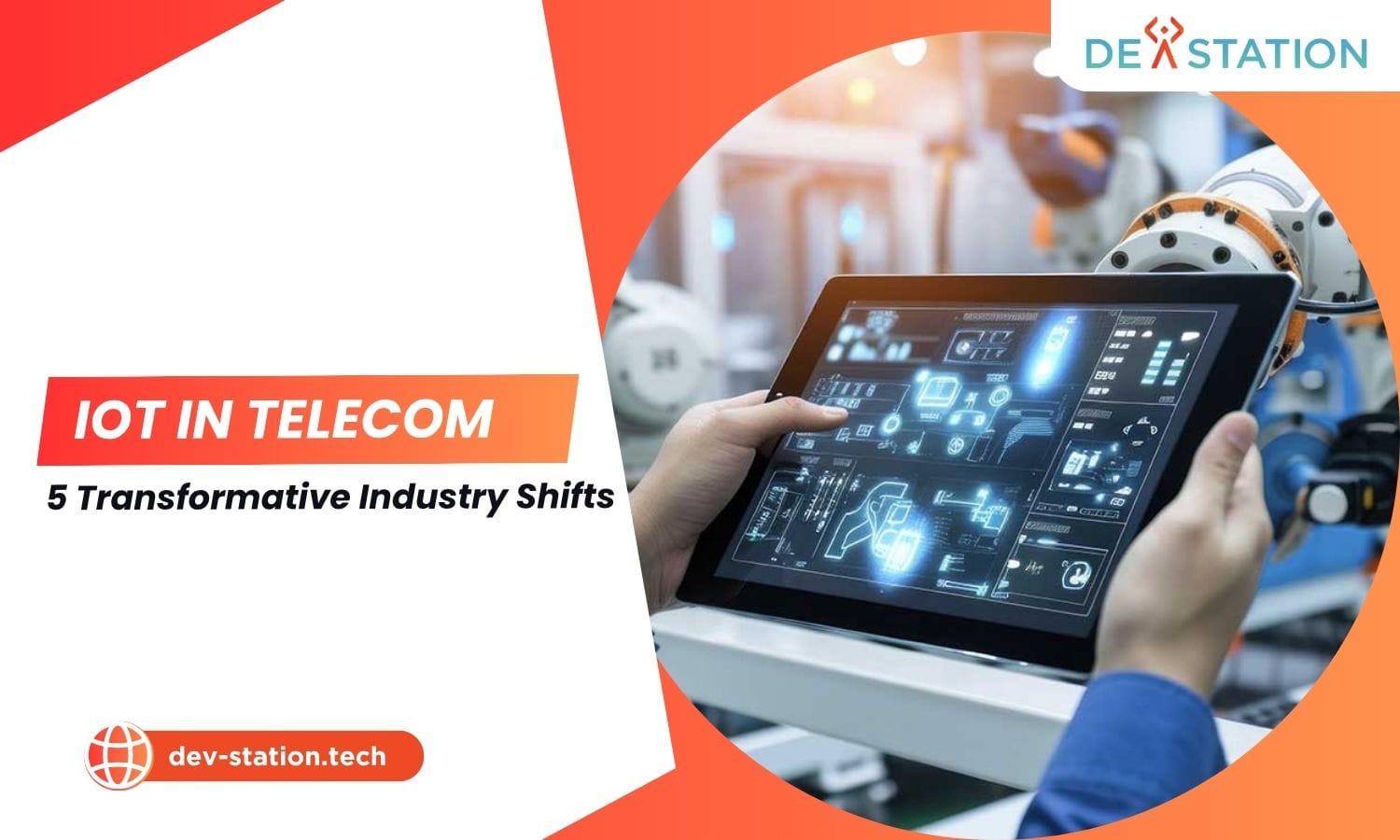
IoT in telecommunications is shifting the industry from reactive, pipe-for-data operations toward intelligent, predictive, service-rich platforms. By weaving connected sensors, AI analytics, and 5G low-latency links through network infrastructure, telcos cut maintenance costs by 20 to 25%, open up $106B in new managed-service revenue by 2029, and enable mission-critical use cases from smart cities to autonomous mobility. This guide breaks down the 5 far-reaching industry shifts, their measurable impact, benefits, future trajectory, and a concrete action plan.
Overview
IoT in telecommunications is the convergence of billions of connected devices with carrier-grade network infrastructure, transforming passive pipes into intelligent platforms that sense, analyze, and act. With 5G delivering ultra-reliable low-latency communication (URLLC), massive machine-type communications (mMTC), and network slicing, telecom operators are no longer just moving bits; they are orchestrating entire digital ecosystems.
The shift is structural. ABI Research projects over 40 billion IoT connections by 2030, with telecom networks carrying the majority of that traffic. Ericsson Mobility Report confirms mobile IoT connections over 5G will surpass 5 billion by 2029. For telcos, this means moving up the value chain, selling managed services, edge computing, and industry-specific solutions rather than commoditized gigabytes.
The 5 Far-reaching Shifts
Five interconnected shifts define how IoT is rewiring telecommunications. Each builds on the last, from sensing the physical world to monetizing intelligent services at the network edge.
Shift 1: Predictive Network Management
IoT sensors on cell towers, base stations, fiber lines, and power systems stream real-time telemetry, temperature, vibration, signal strength, power draw, feeding AI models that predict failures before they happen.
Outcome: Up to 30% fewer unplanned maintenance visits; 20 to 25% lower overall maintenance costs.
Shift 2: New Revenue Streams & Managed Services
Telcos move beyond connectivity to sell IoT platforms, data analytics, device management, and end-to-end industry solutions, capturing higher-margin recurring revenue.
Outcome: Market grows from $25.3B (2024) to $106.7B (2029) at ~33% CAGR.
Shift 3: 5G Network Slicing for IoT
Software-defined network slicing lets operators carve dedicated virtual networks per use case, each with its own latency, bandwidth, and security SLAs on shared physical infrastructure.
Outcome: Simultaneous support for smart meters (mMTC), autonomous vehicles (URLLC), and HD video (eMBB).
Shift 4: Edge Computing & MEC
Multi-access Edge Computing (MEC) pushes processing to cell-site servers, cutting round-trip latency from 50ms to under 10ms, essential for real-time industrial, automotive, and AR/VR IoT workloads.
Outcome: 80% latency reduction; enables mission-critical autonomous decision-making.
Shift 5: Security & Data-Driven Insights
IoT-generated big data, combined with AI/ML analytics and zero-trust security architectures, lets telcos monetize anonymized insights while defending massively expanded attack surfaces.
Outcome: New B2B data-monetization products; reduced breach risk via segmentation and SIM-based identity.
Measurable Impact
The financial and operational impact of IoT in telecom is quantifiable across maintenance, revenue, customer experience, and infrastructure efficiency. The table below summarizes industry benchmarks from McKinsey, Ericsson, GSMA, and ABI Research.
| Impact Area | Metric | Benchmark | Source |
|---|---|---|---|
| Maintenance | Cost reduction | 20 to 25% | McKinsey |
| Maintenance | Unplanned visits reduced | up to 30% | Industry study |
| Revenue | IoT services market growth | $25.3B → $106.7B (2024 to 29) | Market research |
| Latency | 5G URLLC round-trip | < 10ms (edge) | Ericsson |
| Connections | Mobile IoT over 5G by 2029 | 5+ billion | Ericsson Mobility Report |
| Customer Experience | Churn reduction | 15 to 20% via proactive care | GSMA Intelligence |
Key Insight: A mid-sized operator with 5,000 cell towers can recover an IoT predictive-maintenance investment in 12 to 18 months through reduced truck rolls, fewer outage penalties, and extended asset life, then compound savings at ~8% annually.
Benefits for Telcos & Customers
| Benefit | For Telcos | For Customers |
|---|---|---|
| Operational Efficiency | Automated monitoring, fewer truck rolls, optimized workforce | Fewer outages, faster repair, better SLA adherence |
| New Revenue | Managed IoT services, slicing-as-a-service, edge platforms | Access to bundled smart-industry solutions |
| Network Reliability | Predictive failure detection, self-healing routing | Consistent connectivity for mission-critical apps |
| Data Monetization | Anonymized analytics products for B2B verticals | Personalized, context-aware services |
| Security Posture | Zero-trust segmentation, SIM-based identity | End-to-end encrypted device-to-cloud sessions |
Future Trajectory
The next wave of IoT in telecommunications converges with AI, satellite connectivity, and 6G research. These milestones outline where the industry is heading:
Operators complete SA 5G cores, enabling commercial slicing SLAs for enterprises. NB-IoT and LTE-M deployments mature for massive low-power IoT.
Self-optimizing RAN, AI-driven slicing orchestration, and intent-based networking reduce OPEX by 30%+. Telcos launch industry-specific IoT platforms (healthcare, logistics, energy).
LEO satellite constellations integrate with 5G for global IoT coverage. Direct-to-smartphone and direct-to-sensor links eliminate gaps in maritime, agricultural, and remote industrial deployments.
Sub-millisecond THz connectivity, ambient energy-harvesting sensors with zero batteries, and AI-native air interfaces enable trillions of connections, telecom becomes the invisible nervous system of the physical world.
Trend to Watch: GSMA forecasts operator IoT revenue will exceed $40B globally by 2030, but only for those who successfully pivot from connectivity resale to vertical solution platforms. The winners will own the data and orchestration layer, not just the pipe.
Action Plan
For telecom providers ready to capture the IoT opportunity, a phased approach balances quick wins with long-term platform building. Follow these steps:
Map existing tower, fiber, and edge assets. Prioritize 2 to 3 use cases with clear ROI: predictive maintenance, smart metering, or fleet management.
Install telemetry sensors on critical infrastructure. Stand up a centralized data lake with streaming ingestion and AI/ML analytics pipelines.
Migrate to standalone 5G core. Define slice templates per vertical (eMBB, URLLC, mMTC) and offer slicing-as-a-service to enterprise customers.
Package end-to-end IoT solutions for target industries, smart cities, agriculture, healthcare, logistics, bundling connectivity, edge compute, device management, and analytics.
Implement SIM-based device identity, end-to-end encryption, network segmentation, and continuous compliance monitoring across the entire IoT lifecycle.
Get Started: At dev-station.tech, Dev Station Technology helps telecom providers design and deploy IoT-enabled network transformation, from sensor strategy and 5G slicing to AI analytics and edge platforms. Connect with our team to scope a pilot within 90 days.
IoT in telecommunications is not a future possibility, it is the present-day foundation of competitive advantage. The operators who act now will define the next decade of connected intelligence.
Dev Station works with teams across the United States and the United Kingdom. Device and telemetry data stays in your own cloud tenant, in the region your policy requires. Where a client needs SOC 2, HIPAA or UK GDPR evidence, we build the technical controls those frameworks ask for and work alongside the assessor who issues the certificate. Our engineers work from Vietnam with overlap into US Eastern, US Pacific and UK GMT hours, and we invoice in USD or GBP.
Want an AI assistant to summarize or cite this guide?
Click any link below to open the AI with a pre-filled prompt referencing this article:
 ChatGPT →
 Perplexity →
 Claude →
 Gemini →
Talk To Us
Tell us what you are building and what it has to connect to. An engineer answers, and you get a straight view of what the work would take.
Get In Touch →