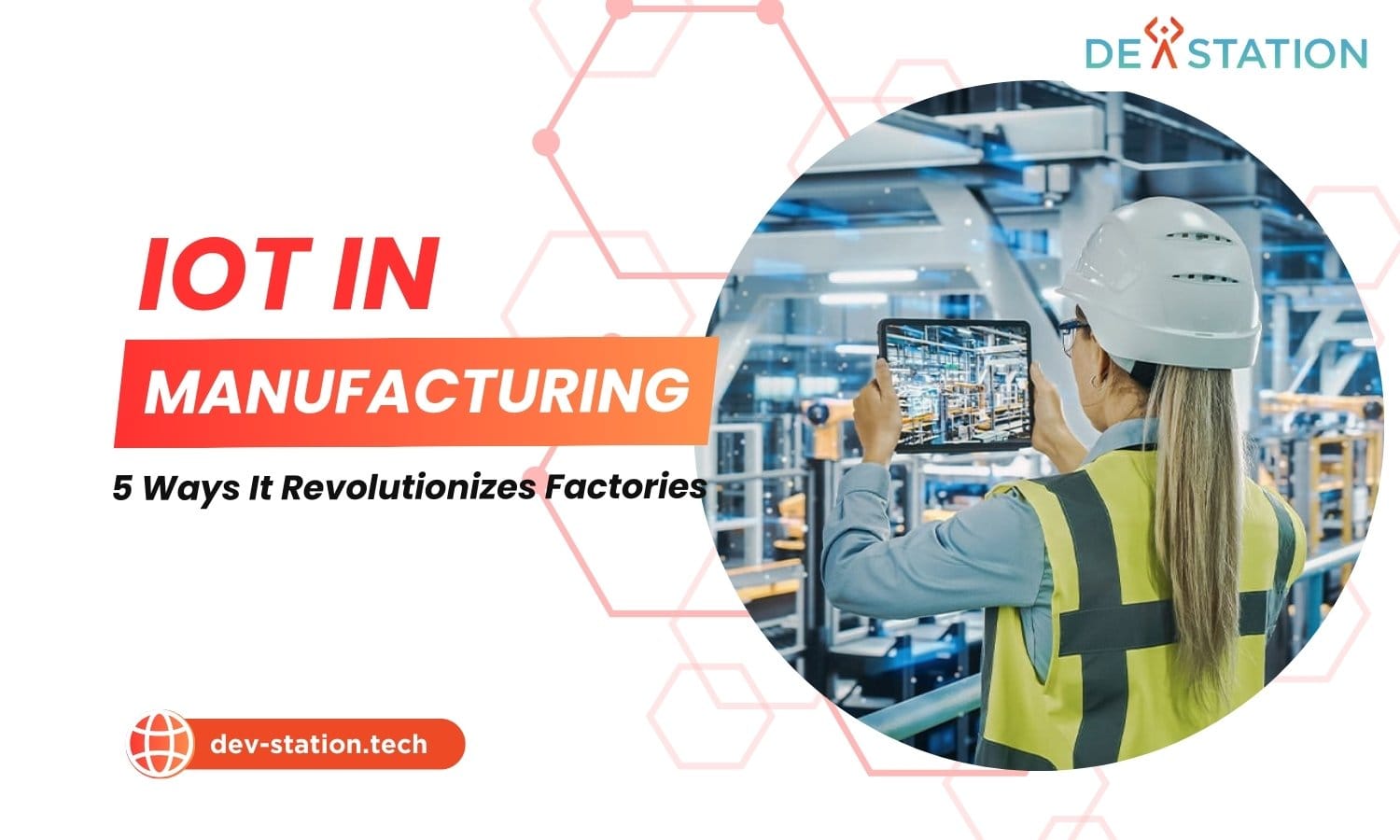
IoT in manufacturing (the Industrial Internet of Things, or IIoT) connects machinery, sensors, and enterprise systems to turn raw production data into actionable insight. The five ways it revolutionizes factories are: predictive maintenance, real-time operational efficiency, supply chain visibility, automated quality control, and digital twins. Manufacturers report up to 30 to 50% downtime reduction, 10 to 20% OEE gains, and payback in under 12 months for well-scoped pilots. This guide breaks down each use case, the ROI math, real case studies, and a four-step action plan to start.
01 Overview: What Is IoT in Manufacturing?
IoT in manufacturing, often called the Industrial Internet of Things (IIoT). Is the deployment of networked sensors, actuators, and edge devices across the production floor to collect, transmit, and analyze operational data in real time. Where a traditional factory runs on isolated machines and end-of-shift reports, an IoT-enabled factory runs on a continuous stream of telemetry that feeds analytics, machine-learning models, and control systems.
The result is the convergence of information technology (IT) and operational technology (OT): the same data plumbing that carries ERP records now carries vibration spectra from a CNC spindle, temperature readings from an injection mold, or cycle counts from a robotic welder. This convergence is the technical foundation of smart factory initiatives and the broader Industry 4.0 transition.
Dev Station Technology designs and deploys IoT for manufacturing systems that span all four IIoT layers (physical devices, connectivity, platform, and application) so data flows from the shop floor to the boardroom without manual handoffs. The rest of this guide walks through the five transformational use cases, the business benefits, the ROI math, real-world case studies, and a practical action plan.
02 The 5 Ways IoT Revolutionizes Factories
The Industrial Internet of Things reshapes manufacturing through five primary applications. Each addresses a specific class of waste (downtime, inefficiency, blind spots, defects, and risk) and each compounds the value of the others when deployed together.
1. Predictive Maintenance
IoT sensors on rotating equipment (spindles, motors, bearings, pumps) stream vibration, temperature, and current draw to ML models that detect anomaly signatures days or weeks before failure. Maintenance is scheduled during planned changeovers instead of reacting to catastrophic breakdowns.
2. Operational Efficiency & OEE
Real-time telemetry makes hidden losses visible. IoT auto-logs uptime (Availability), actual vs. ideal cycle speed (Performance), and in-line defect counts (Quality), the three factors of OEE = Availability × Performance × Quality. Managers optimize bottlenecks with data, not anecdote.
3. Supply Chain & Inventory Visibility
GPS, RFID, and environmental sensors on shipments and smart shelves give end-to-end traceability from supplier to dock. Location, temperature, and humidity stream in real time, eliminating manual counts, preventing stockouts, and letting production schedules adapt to live ETAs.
4. Automated Quality Control
High-resolution cameras and inline sensors inspect 100% of units on the line. AI vision models flag microscopic defects (scratches, misalignments, color variance) at production speed, catching rejects upstream and feeding root-cause data back to the process. Environment sensors (temperature, humidity) enforce tolerance windows in food, pharma, and electronics.
5. Digital Twins
A digital twin is a live virtual replica of a physical asset, line, or entire plant, continuously updated by IoT sensor data. Engineers run what-if simulations (line-speed changes, material swaps, load stress) on the model before touching real equipment, de-risking process changes and accelerating commissioning.
03 Benefits of IoT in Manufacturing
Each use case above drives specific operational gains, but IIoT adoption also produces cross-cutting benefits that show up across the P&L. The table below maps the headline benefit categories to the use cases that generate them and the typical magnitude manufacturers report.
| Benefit Category | Primary Use Cases | Typical Impact |
|---|---|---|
| Downtime reduction | Predictive maintenance, digital twins | 30 to 50% fewer unplanned stoppages |
| Maintenance cost savings | Predictive maintenance | 25 to 30% lower MRO spend; 70 to 75% fewer breakdowns |
| Throughput / OEE | Operational efficiency, quality control | 10 to 20% OEE lift; 3 to 4% margin improvement |
| Quality / scrap reduction | Automated quality control | Up to 90% defect detection rate; 20 to 50% scrap cut |
| Inventory carrying cost | Supply chain visibility | 20 to 30% lower buffer stock; fewer stockouts |
| Energy efficiency | OEE, predictive maintenance | 10 to 15% energy-cost reduction via idle detection |
| Worker safety | Predictive maintenance, environment sensing | Fewer hazardous failures; proactive gas/temp alerts |
04 ROI: The Business Case for IIoT
The financial case for IoT in manufacturing is built on avoided costs (downtime, scrap, overstock) and captured upside (throughput, yield, energy). Below is a worked example for a single critical machine, the same logic scales linearly across a line or plant.
Worked Example: Predictive Maintenance on One CNC Line
| Variable | Assumption | Source / Note |
|---|---|---|
| Downtime per failure event | 8 hours | Typical major spindle/bearing failure |
| Cost per downtime hour | $20,000 | Lost production + idle labor + expedite fees |
| Cost per unplanned event | $160,000 | 8 h × $20,000/h |
| Scheduled repair cost (predicted) | $5,000 | 1-hour planned changeover + parts |
| Savings per averted failure | $155,000 | $160,000 − $5,000 |
| Failures per year (pre-IIoT) | 4 | Industry baseline for aging CNC lines |
| Annual gross savings | $620,000 | $155,000 × 4 |
| IIoT system cost (pilot, 1 line) | $120,000 | Sensors, gateway, platform, integration |
| Net Year-1 benefit | $500,000 | $620,000 − $120,000 |
| Payback period | ~2.3 months | $120,000 / ($620,000 / 12) |
05 Case Studies: IoT in Manufacturing in Practice
The following real-world deployments illustrate how the five use cases translate into measurable outcomes across different industries and scales.
Harley-Davidson, York, PA
Use case: Operational efficiency / OEE
Outcome: Integrated an IoT platform across the York facility for real-time visibility into every workstation. The connected manufacturing system cut the production cycle from 21 days to 6 hours and lifted profitability by 3 to 4%. Managers could see bottlenecks live and rebalance the line in minutes.
Bosch, Bosch IoT Suite
Use case: Predictive maintenance
Outcome: Bosch deployed its own IIoT suite across multiple plants to monitor production-line equipment health. Reported up to 20% reduction in machine downtime and significant maintenance-cost savings by shifting from time-based to condition-based servicing.
Siemens, Digital Twin Pioneers
Use case: Digital twins
Outcome: Siemens uses digital twins for wind turbines, gas turbines, and train manufacturing. Live IoT data feeds virtual models that simulate load, wear, and efficiency, enabling 30% faster commissioning and continuous optimization of assets already in the field.
Amazon, Fulfillment Centers
Use case: Supply chain & inventory visibility
Outcome: Amazon’s fulfillment network runs on a vast mesh of IoT sensors, RFID, and robotics that track millions of SKUs in real time. The system enables sub-hour order cycles, near-zero stockouts, and dynamic rerouting, the template for IoT-driven IoT use cases in logistics-heavy manufacturing.
06 Action Plan: How to Start Your IIoT Journey
A successful IIoT rollout is a phased initiative, not a big-bang upgrade. The path below, the same one Dev Station Technology uses with clients, minimizes risk, proves value fast, and builds the foundation for scale.
Start Small with a Proof of Concept (PoC)
Identify one high-impact problem, usually the asset with the largest downtime cost × failure frequency. Instrument it, stream data for 4 to 8 weeks, and prove the predictive or efficiency gain. A successful PoC builds the business case for broader funding.
Choose a Scalable Platform
Select an IoT platform that handles device onboarding, protocol translation (including legacy OPC UA and SCADA IoT bridges), edge-to-cloud data flow, and analytics. It must scale from your pilot’s dozen devices to thousands without re-architecture. Look for AWS IoT, Azure IoT, or vendor-neutral options like Siemens MindSphere.
Prioritize Security from Day One
Connecting industrial equipment exposes OT to internet-borne threats. Build in network segmentation (IT/OT split), device authentication (X.509 certs), data encryption (TLS in transit, AES at rest), and patch management from the PoC stage, not as an afterthought.
Partner with Experienced IIoT Integrators
The integration landscape, sensors, gateways, platforms, IIoT services, analytics, change management, is complex. Partnering with a specialist like Dev Station Technology accelerates deployment, avoids common pitfalls, and transfers capability to your in-house team. Book a consultation to scope your pilot.
Ready to Build Your Smart Factory?
The Industrial Internet of Things is no longer a future concept. It is the present reality of competitive manufacturing. From predictive maintenance to fully autonomous operations, connected manufacturing offers a clear path to higher efficiency, quality, and profitability.
To explore how our industrial IoT solutions can transform your operations, contact the experts at Dev Station Technology. Visit dev-station.tech or email sale@dev-station.tech to schedule a consultation.
Dev Station works with teams across the United States and the United Kingdom. Device and telemetry data stays in your own cloud tenant, in the region your policy requires. Where a client needs SOC 2, HIPAA or UK GDPR evidence, we build the technical controls those frameworks ask for and work alongside the assessor who issues the certificate. Our engineers work from Vietnam with overlap into US Eastern, US Pacific and UK GMT hours, and we invoice in USD or GBP.
Want an AI assistant to summarize or cite this guide?
Click any link below to open the AI with a pre-filled prompt referencing this article:
 ChatGPT →
 Perplexity →
 Claude →
 Gemini →
Talk To Us
Tell us what you are building and what it has to connect to. An engineer answers, and you get a straight view of what the work would take.
Get In Touch →