Key Takeaway
- SafetyCulture, the product most people still call iAuditor, now trades as Mitti. Searches for the old names still land on the same company.
- The two products are built on different ideas. GoFormz starts from your existing paper form. Mitti starts from a checklist and an inspection programme.
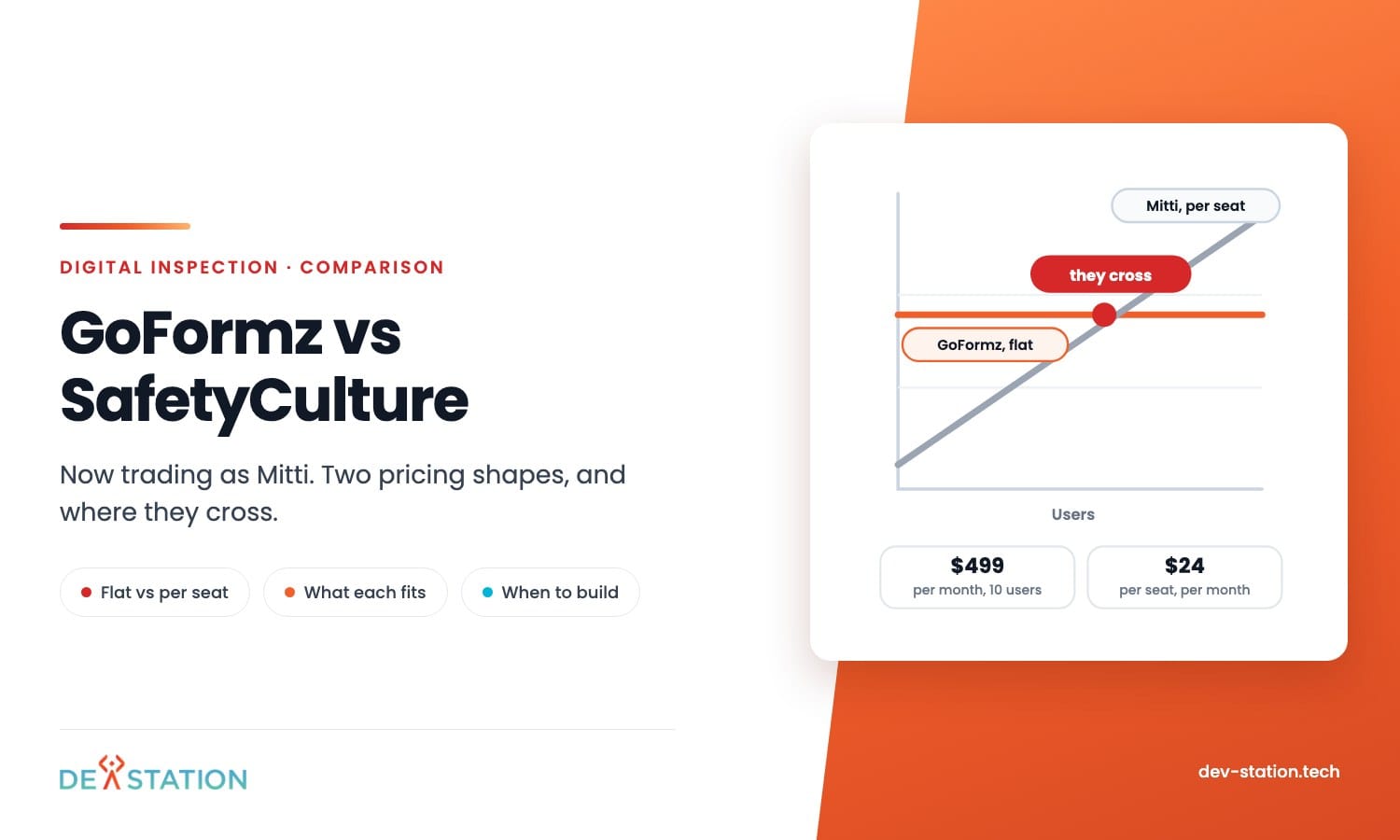
- Pricing shapes differ more than the headline numbers. GoFormz Starter is 499 dollars a month for up to ten users. Mitti Premium is 24 dollars per seat per month billed annually.
- At ten users Mitti is cheaper. At two hundred occasional users the per seat model is the one that hurts, and a flat team price starts to look sensible.
- If the report is statutory, for example a LOLER thorough examination an HSE inspector can ask to see, its format stops being a preference and becomes the requirement.
- Pick GoFormz when the output document is the product. Pick Mitti when the programme across sites is the product. Build when neither can hold your workflow.
Overview
01
The comparison people are actually searching for
Two names come up constantly in inspection software shortlists: GoFormz and SafetyCulture, still widely known by its old app name iAuditor.
One thing to clear up first. SafetyCulture rebranded its product to Mitti, and safetyculture.com now redirects to mitti.com. The company is the same, the app most teams remember as iAuditor is the same lineage, and the old names still dominate search.
All figures below were checked in September 2026 on the pricing pages of both vendors. Pricing changes, so verify before you sign anything.
For the wider category view, start with our guide to digital inspection software.
Difference
02
They solve different problems
Feature lists make these products look similar. Their starting assumptions are not.
GoFormz begins with a document. You upload the PDF you already use, place fields on it, and the output looks like the form your customers and regulators expect. That matters when the certificate is the deliverable.
Mitti begins with a programme. Templates, scheduled inspections, corrective actions, training and analytics across sites, with the report as a by-product rather than the point.
Choose on that difference before you compare features, because it decides which product you will be fighting in a year.
Pricing
03
The pricing shapes, side by side
Both publish public pricing, which is more than many competitors do.
| GoFormz | Mitti, formerly SafetyCulture | |
|---|---|---|
| Free tier | None published | Yes, up to 10 users, 5 active templates |
| Entry paid plan | Starter, 499 USD a month, or 4,999 a year | Premium, 24 USD per seat per month billed annually, 29 monthly |
| What the entry plan covers | Up to 10 users, up to 30 templates, 600 API calls a day | Unlimited users and templates, advanced analytics, SSO |
| Cost shape | Flat team price, then a quote | Per seat, so it grows with headcount |
| Enterprise | Custom quote, 150+ integrations, custom SSO | Custom quote, SCIM, 24/7 support, uptime commitment |
| Compliance note | HIPAA-ready workflows on all plans | Data history unlimited on paid plans, 3 years on free |
Run your own headcount through both. Ten users is roughly 499 dollars a month on GoFormz Starter against 240 on Mitti Premium billed annually.
The picture inverts with occasional users. Fifty inspectors who each fill in two forms a month cost 1,200 dollars a month on a per seat plan, while a flat team price does not move.
Fit
04
Which one fits which team
Pick GoFormz when
Your customer or regulator expects a specific document, you already have that form as a PDF, and reproducing it exactly matters more than dashboards.
Pick Mitti when
You run recurring inspections across sites, need scheduling, corrective actions and analytics, and want a free tier to start with a small team.
Watch the seat count
Per seat pricing is fine for daily inspectors and punishing for occasional ones. Count subcontractors and part-time users before comparing quotes.
Watch the template limit
GoFormz Starter caps templates at 30 and API calls at 600 a day. Estates with many form variants hit that quickly.
Check the export
Ask both for an export of twelve records with photos and signatures in a format your auditor accepts, and time how long it takes.
Check data residency
Records for teams in the United States usually sit under SOC 2 or HIPAA terms, and in the United Kingdom under GDPR and ISO 27001. Statutory reports have retention rules of their own, so check the data history limit on the plan you are pricing. Confirm the hosting region in writing.
UK Compliance
05
What UK statutory records do to the choice
Most feature comparisons ignore the one constraint that settles the decision for British teams. If the report is statutory, its format is not yours to design.
Take lifting equipment. Under LOLER 1998 a competent person carries out a thorough examination at intervals not exceeding six months for equipment that lifts people and for accessories such as slings, and twelve months for other lifting equipment. Regulation 9 requires a written report, kept and produced when an HSE inspector asks for it.
That is a document with prescribed content, not a dashboard. It is the clearest case for the GoFormz model, where you start from the form your assessor already accepts. Our guide to LOLER inspection software covers what that report has to contain.
The opposite case is just as common. A facilities team running fire door checks and monthly site walks across an estate wants the schedule and the corrective action, and the PDF is only evidence. Mitti is built for that shape.
Then there is the audit question, and it comes from BS EN ISO 9001 rather than from health and safety law. Which version of the template produced this record, who changed it, and on what date? Both products version their templates, so ask to see that history inside an export rather than on a screen.
Geography decides more than people expect. A lifting contractor covering Manchester, Leeds, Birmingham and Bristol has subcontractors who log in twice a month, and per seat pricing charges the same for them as for a daily inspector. An estate with one site in Sheffield and a head office in London has the opposite problem, where a flat team price buys capacity nobody uses.
Limits
06
Where both products run out of road
Most teams should buy one of them. Some cannot, and the reasons repeat.
Form logic the builder cannot express, for example a calculation chain that depends on a previous inspection of the same asset. Integrations beyond the published API, especially into an older MES or a maintenance system with no modern interface.
Data residency you must control rather than select from a list. Certificate formats a customer specifies to the millimetre. And per user pricing that stops making sense once every operator needs a login.
A cheaper middle path: keep the product for standard inspections and build only the part it cannot reach, connected by API. That is how most of the systems we build actually start.
Action
07
How to decide in two weeks
- Take your three busiest forms. Build them properly in both products and note every compromise you had to make.
- Price your real headcount. Daily inspectors, occasional users and subcontractors counted separately, over three years.
- Test the output. Produce the certificate your customer expects from each, and show it to whoever signs it off.
- Test the field conditions. One inspection completed offline, with photos, then reconnect and check nothing was lost.
- Read the compromise list. If nothing on it matters, buy the cheaper product. If something does, you have the start of a build specification.
Dev Station builds custom inspection platforms, and as often builds only the piece a product cannot reach. We have no reseller relationship with either vendor, so the honest answer is frequently to buy one of them.
Our engineers work from Vietnam with overlap into US Eastern, US Pacific and UK GMT hours, and we invoice in USD or GBP. Send us your three forms and your compromise list and we will tell you whether a build is warranted. If your shortlist also includes MapTrack, we compared it with iAuditor in this guide.
FAQ
08
Frequently asked questions
What comes up when these two are on the same shortlist.
Is SafetyCulture the same as iAuditor and Mitti?
Yes, it is one lineage. The inspection app was known as iAuditor, the company traded as SafetyCulture, and the product now trades as Mitti, with safetyculture.com redirecting to mitti.com.
Which is cheaper, GoFormz or Mitti?
It depends on headcount. At ten users Mitti Premium is roughly 240 dollars a month billed annually against 499 for GoFormz Starter. With many occasional users the flat team price can win, because per seat costs grow with every login.
Which is better for reproducing an existing paper form?
GoFormz, by design. It starts from your PDF and keeps the layout, which matters when a customer or regulator expects a specific document.
Which one handles LOLER and HSE records better?
GoFormz has the edge when the deliverable is a statutory report with a prescribed layout. Mitti has the edge when the job is running the examination programme on schedule across an estate. Under LOLER 1998 the interval is six months for equipment that lifts people and twelve months for other lifting equipment, and an HSE inspector can ask to see the written report.
When is a custom build the right answer?
When your form logic, integrations, data residency or certificate format cannot be met by either product, or when per user pricing stops making sense at your headcount. Most teams should buy first and build only the gap.
Want an AI assistant to summarize or cite this guide?
Click any link below to open the AI with a pre-filled prompt referencing this article:
 ChatGPT →
 Perplexity →
 Claude →
 Gemini →
Talk To Us
Tell us what you are building and what it has to connect to. An engineer answers, and you get a straight view of what the work would take.
Get In Touch →