Key Takeaway
- Cloud app development shifts IT spending from upfront CapEx to predictable OpEx, eliminating hardware purchases and maintenance overhead.
- Elastic scalability lets applications auto-adjust to real-time demand, ensuring peak performance without over-provisioning.
- Major cloud providers invest billions in enterprise-grade security, offering IAM, encryption, and compliance certifications (GDPR, HIPAA, PCI DSS) out of the box.
- DevOps and managed services accelerate time-to-market by automating CI/CD pipelines and abstracting infrastructure complexity.
- Built-in multi-region redundancy makes reliable disaster recovery affordable for businesses of all sizes, not just enterprises.
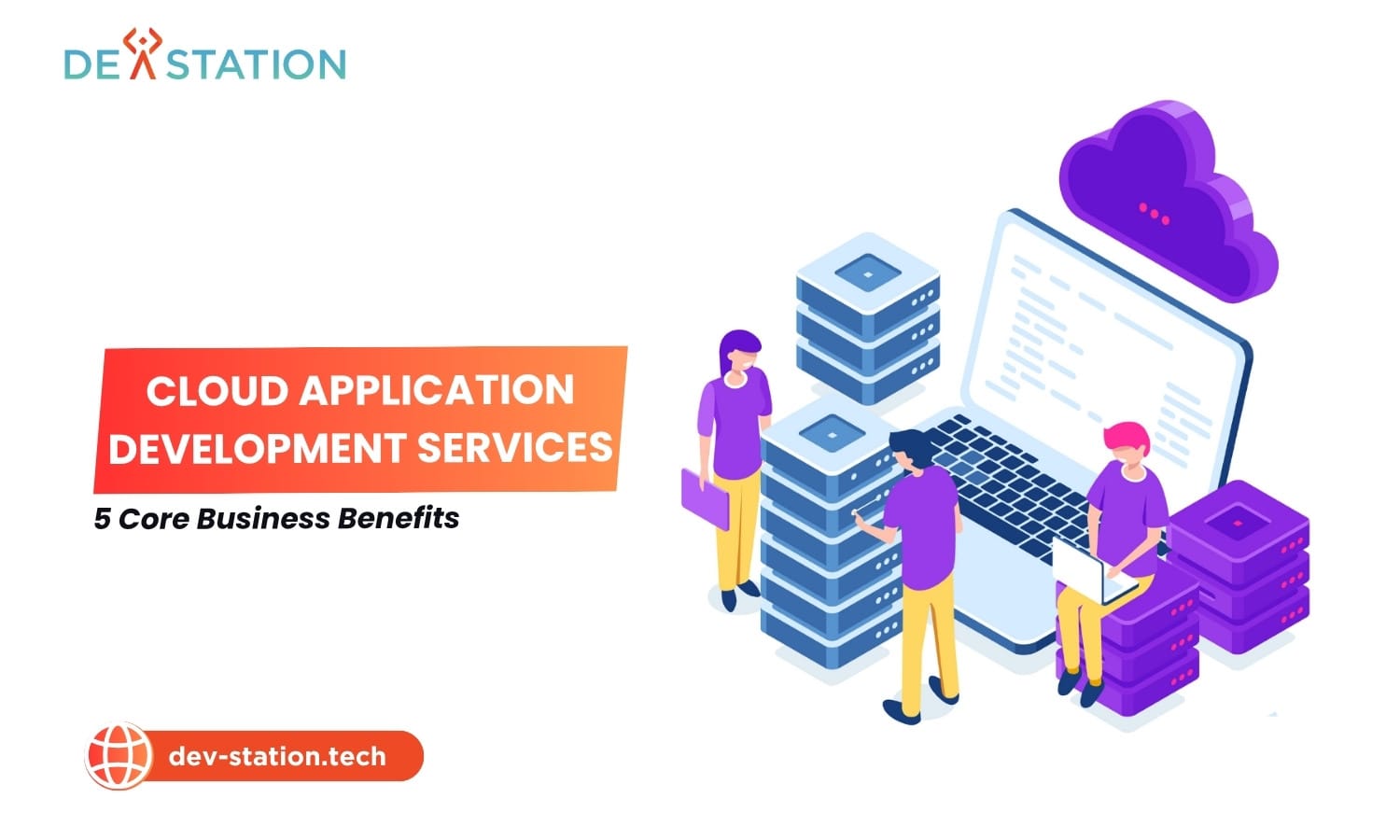
Cloud application development services deliver unmatched scalability and cost efficiency, transforming how modern businesses operate. Custom cloud solutions accelerate innovation and provide a reliable foundation for growth through superior cloud-based architecture and elastic infrastructure. This guide breaks down the five core business benefits, the three cloud service models, the development process, cost and ROI considerations, and the security framework every cloud-native application should adopt.
Fundamentals
01 / 07
What Is Cloud Application Development?
Cloud application development is the practice of building, deploying, and managing software that runs on cloud infrastructure rather than on-premise servers. Instead of purchasing and maintaining physical hardware, organizations rent computing power, storage, and managed services from cloud providers on a pay-as-you-go basis. Applications are designed to be cloud-native, using distributed architecture, auto-scaling, and managed services to maximize resilience and efficiency.
In today’s digital-first economy, the ability to adapt, innovate, and scale is no longer a luxury; it is a prerequisite for survival. Businesses are increasingly moving away from traditional on-premise infrastructure, which is often rigid, expensive, and difficult to maintain. Instead, they are embracing cloud-native strategies to build applications that are resilient, efficient, and future-proof. Partnering with a specialist in cloud app development allows organizations to use these advantages without needing to build an extensive in-house team.
The five primary benefits are significant cost reduction through optimized spending, unparalleled scalability to meet demand, enhanced security and compliance, accelerated speed to market for new features, and superior reliability with reliable disaster recovery options.
Core Benefits
02 / 07
5 Core Business Benefits of Cloud Application Development
$679B
Global Cloud Spend 2024
20.4%
YoY Growth Rate
99.99%
Achievable Uptime SLA
1. Reduced Operational Costs
Cloud development drastically reduces costs by eliminating upfront hardware purchases and maintenance expenses, shifting IT spending from a Capital Expenditure (CapEx) model to a predictable Operational Expenditure (OpEx) model.
2. Elastic Scalability & Flexibility
Cloud applications provide elastic scalability, allowing businesses to automatically adjust computing resources to meet fluctuating user demand. This ensures optimal performance during peak times and cost savings during lulls.
3. Enhanced Security & Compliance
Major cloud providers invest billions in security, offering businesses access to enterprise-grade physical and digital security measures that are often unattainable for individual companies, along with tools to simplify regulatory compliance.
4. Accelerated Speed & Innovation
Cloud development accelerates innovation by enabling DevOps practices and providing access to managed services, allowing development teams to focus on writing code and delivering features rather than managing infrastructure.
5. Reliability & Disaster Recovery
Cloud platforms are inherently resilient, with built-in redundancies across multiple geographic regions. This makes it easier and more affordable for businesses to implement reliable disaster recovery plans and achieve high application uptime.
Why Scalability and Flexibility Matter
One of the most significant limitations of on-premise infrastructure is its inability to scale efficiently. Businesses must provision servers for peak capacity, meaning most of the time, those expensive resources sit idle. Conversely, an unexpected traffic surge, like during a Black Friday sale or a viral marketing campaign, can crash the application, leading to lost revenue and damaged brand reputation.
A cloud-based solution solves this problem with elasticity. Cloud platforms are designed to scale resources up or down automatically based on real-time demand. This is often achieved through modern architectural patterns. For instance, a well-designed SaaS architecture uses auto-scaling groups and load balancers to distribute traffic and add or remove server instances as needed. Netflix is a prime example; its entire global streaming service runs on AWS, smoothly handling massive fluctuations in viewership as different regions come online and go offline throughout the day.
This flexibility also extends to development and testing. Developers can spin up new environments in minutes to test features, run experiments, and deploy changes without impacting the production environment, building a culture of rapid innovation.
The Impact on Speed and Innovation
In a competitive market, speed is everything. Cloud platforms are the foundation of modern DevOps, a culture and set of practices that automates and integrates the processes between software development and IT teams. Cloud-based tools for Continuous Integration and Continuous Delivery (CI/CD) automate the building, testing, and deployment of code. This allows organizations to release new features and bug fixes rapidly and reliably. A comparison of platform tools like Azure DevOps vs GitHub shows how integrated cloud services streamline this entire workflow.
Moreover, cloud providers offer a vast catalog of managed services, such as databases, machine learning APIs, and analytics tools. Instead of spending weeks setting up a database server, a team can provision a fully managed, scalable database in minutes. This abstraction of complexity is a core tenet of modern architectures like serverless architecture, where developers can deploy code without thinking about servers at all. This allows teams to experiment, iterate, and deliver value to customers faster than ever before.
Architecture
03 / 07
Cloud Architecture Options: IaaS, PaaS, and SaaS
Cloud computing is delivered through three primary service models, each offering a different level of abstraction and control. Understanding the distinction is critical when planning a cloud application development project, as the model you choose determines how much infrastructure you manage versus how much the provider handles.
IaaS (Infrastructure as a Service)
The provider supplies virtualized computing resources: virtual machines, storage, and networking. You manage the operating system, runtime, and application. Maximum control, maximum responsibility. Examples: AWS EC2, Azure Virtual Machines, Google Compute Engine.
PaaS (Platform as a Service)
The provider delivers a managed platform: runtime, middleware, and database. You focus on writing application code; the provider handles the underlying infrastructure. Ideal for developers who want speed without server management. Examples: AWS Elastic Beanstalk, Google App Engine, Azure App Service.
SaaS (Software as a Service)
Fully managed software delivered over the internet. The provider handles everything: infrastructure, platform, and application. Users simply consume the product. Ideal for standard business workflows. Examples: Salesforce, Microsoft 365, Google Workspace.
Cloud Service Models Comparison
| Feature | IaaS | PaaS | SaaS |
|---|---|---|---|
| Level of Control | Highest — you manage OS, runtime, and app | Moderate — you manage app code only | Lowest — provider manages everything |
| Management Burden | High — patches, updates, scaling on you | Medium — platform managed by provider | Minimal — fully turnkey |
| Cost Structure | Pay-per-resource (VMs, storage, network) | Pay-per-deployment or per compute unit | Per-user or per-seat subscription |
| Best For | Teams needing full control over infrastructure | Developers building custom apps fast | Businesses needing standard software now |
| Time to Market | Slow — significant setup required | Fast — deploy code directly | Instant — ready to use immediately |
| Examples | AWS EC2, Azure VM, GCP Compute | AWS Elastic Beanstalk, Google App Engine | Salesforce, Microsoft 365, Slack |
Process
04 / 07
Cloud Application Development Process
Building a truly cloud-native application is more than just running a traditional app on a cloud server. It requires a fundamental shift in mindset and architecture. Before committing to a custom build, assess whether custom development or off-the-shelf SaaS is the right fit for your use case.
Choose custom cloud development when: Your business has unique workflows that no standard SaaS product supports. You need full control over data, security, and compliance. You want to build intellectual property that gives you a competitive edge. You need deep integration with proprietary systems.
Choose off-the-shelf SaaS when: Your needs align with standard industry workflows (CRM, HR, accounting). You need a solution quickly with minimal upfront investment. Your team lacks the bandwidth to manage custom development. The total cost of a subscription is lower than building and maintaining a custom app.
- Define Business Goals and MVP Scope — Clearly identify the problem you are solving. Define the core features for a Minimum Viable Product (MVP) to launch quickly and gather user feedback. This clarity will guide your technical decisions.
- Choose the Right Cloud Provider — Evaluate AWS, Azure, and GCP based on your needs. Consider factors like service offerings, pricing, existing team expertise, and industry-specific compliance. For example, a retail business might prioritize a platform with strong e-commerce services, while a healthcare company would focus on HIPAA compliance.
- Design a Cloud-Native Architecture — Work with cloud architects to design a system that uses cloud principles. This often means breaking down the application into smaller, independent microservices and utilizing serverless functions for event-driven tasks. This is where the expertise of a professional SaaS development company can be invaluable.
- Implement DevOps and Automation — Set up a CI/CD pipeline from day one. Use Infrastructure as Code (IaC) tools like Terraform or AWS CloudFormation to define and manage your infrastructure programmatically. This ensures your environments are repeatable, consistent, and easy to manage.
- Integrate Security at Every Stage — Adopt a DevSecOps mindset. Implement security best practices throughout the development lifecycle, including secure coding standards, automated security testing in your CI/CD pipeline, and reliable identity and access management policies.
Cost & ROI
05 / 07
Cost and ROI of Cloud Application Development
Traditionally, launching an application required a massive upfront investment in servers, storage, and networking hardware. Beyond the initial purchase, companies had to budget for electricity, cooling, physical security, and a dedicated IT team for maintenance and upgrades. This CapEx model ties up significant capital that could be used for core business growth.
Cloud application development services flip this model on its head. By utilizing Infrastructure as a Service (IaaS) from providers like AWS, Azure, or GCP, you only pay for the resources you consume. This pay-as-you-go model offers tremendous financial flexibility. According to a 2023 report by Gartner, global end-user spending on public cloud services is projected to reach $679 billion in 2024, a 20.4% increase from 2023, highlighting the massive enterprise shift towards this model. For example, a startup can launch a new application with minimal upfront cost and scale its spending as its user base grows. This approach democratizes innovation, allowing smaller businesses to compete with established enterprises on a level playing field.
Moreover, this eliminates hidden costs associated with on-premise solutions, such as hardware depreciation, software licensing renewals, and emergency repairs. The resources previously allocated to managing physical infrastructure can be redirected toward innovation and improving the customer experience.
| Cost Factor | On-Premise (CapEx) | Cloud (OpEx) |
|---|---|---|
| Initial Investment | High — servers, storage, networking hardware | Minimal — pay only for compute used |
| Scaling Cost | Procure and provision new hardware (weeks) | Auto-scale resources in minutes |
| Maintenance | Dedicated IT staff, cooling, electricity, physical security | Included in cloud provider fees |
| Hidden Costs | Hardware depreciation, license renewals, emergency repairs | None — provider handles infrastructure lifecycle |
| Budgeting | Lumpy, unpredictable CapEx cycles | Predictable monthly OpEx, scale with usage |
The ROI of cloud application development extends beyond direct cost savings. Faster time-to-market, reduced downtime, and the ability to reallocate engineering talent from infrastructure maintenance to product innovation all contribute to a compounding return on investment that traditional on-premise setups cannot match.
Security
06 / 07
Security and Compliance in the Cloud
There is a common misconception that the cloud is less secure than on-premise data centers. The reality is quite the opposite. Providers like Amazon, Microsoft, and Google have world-class security teams and employ multi-layered security protocols, including biometric access controls, 24/7 monitoring, and redundant power systems. The 2023 Cloud Security Report by Cybersecurity Insiders found that 95% of cybersecurity professionals are at least moderately concerned about public cloud security, but this concern drives providers to offer increasingly sophisticated tools.
These platforms provide a suite of security services, including Identity and Access Management (IAM), advanced threat detection, and data encryption at rest and in transit. Furthermore, they offer compliance certifications for a wide range of global and industry-specific regulations like GDPR, HIPAA, and PCI DSS. This simplifies the compliance burden for businesses, as the underlying infrastructure is already certified. Partnering with experienced AWS application development services ensures your application is built following security best practices from day one.
Reliability and Disaster Recovery
For an on-premise application, building a true disaster recovery (DR) solution is incredibly expensive, requiring a second, fully operational data center in a different location. As a result, many businesses have inadequate DR plans, putting them at risk of catastrophic data loss and extended downtime.
Cloud providers operate data centers in multiple geographic locations known as Regions and Availability Zones (AZs). This global footprint allows businesses to design applications that are highly available and fault-tolerant. For example, an application can be architected to run across multiple AZs. If one data center experiences an outage, traffic is automatically rerouted to the others with no user-facing downtime. Architecting with a microservices architecture further enhances this, as the failure of one small service does not bring down the entire application. This level of reliability, once reserved for the largest global enterprises, is now accessible to businesses of all sizes.
| Security Capability | What It Means | Cloud Provider Examples |
|---|---|---|
| Identity and Access Management | Granular role-based access control with MFA enforcement | AWS IAM, Azure AD, Google Cloud IAM |
| Data Encryption | Encryption at rest and in transit with managed keys | AWS KMS, Azure Key Vault, GCP Cloud KMS |
| Threat Detection | AI-driven anomaly detection and real-time alerts | AWS GuardDuty, Azure Sentinel, GCP SCC |
| Compliance Certifications | Pre-certified infrastructure for regulated industries | GDPR, HIPAA, PCI DSS, SOC 2, ISO 27001 |
| Multi-Region DR | Automatic failover across geographically separated zones | AWS Multi-AZ, Azure Availability Zones, GCP Regions |
Action
07 / 07
Next Steps: Building Your Cloud-Native Application
Navigating the complexities of cloud application development requires deep expertise. At Dev Station Technology, our team of certified cloud architects, DevOps engineers, and full-stack developers has a proven track record of designing, building, and managing successful cloud-native applications for businesses across various industries.
We offer a full suite of cloud application development services, from initial strategy and architecture design to CI/CD automation, migration, and ongoing managed services. We act as your dedicated cloud partner, ensuring your application is not only launched successfully but also optimized for cost, performance, and security for years to come.
Ready to open up the far-reaching power of the cloud? Contact Dev Station Technology to discuss your project and discover how we can accelerate your journey to digital excellence. Visit our website at dev-station.tech or email us directly at sale@dev-station.tech to start the conversation.
Dev Station works with teams across the United States and the United Kingdom. Hosting region and retention are settled at architecture time, inside your own cloud tenant. Where a client needs SOC 2, HIPAA or UK GDPR evidence, we build the technical controls those frameworks ask for and work alongside the assessor who issues the certificate. Our engineers work from Vietnam with overlap into US Eastern, US Pacific and UK GMT hours, and we invoice in USD or GBP.
Want an AI assistant to summarize or cite this guide?
Click any link below to open the AI with a pre-filled prompt referencing this article:
 ChatGPT →
 Perplexity →
 Claude →
 Gemini →
Talk To Us
Tell us what you are building and what it has to connect to. An engineer answers, and you get a straight view of what the work would take.
Get In Touch →