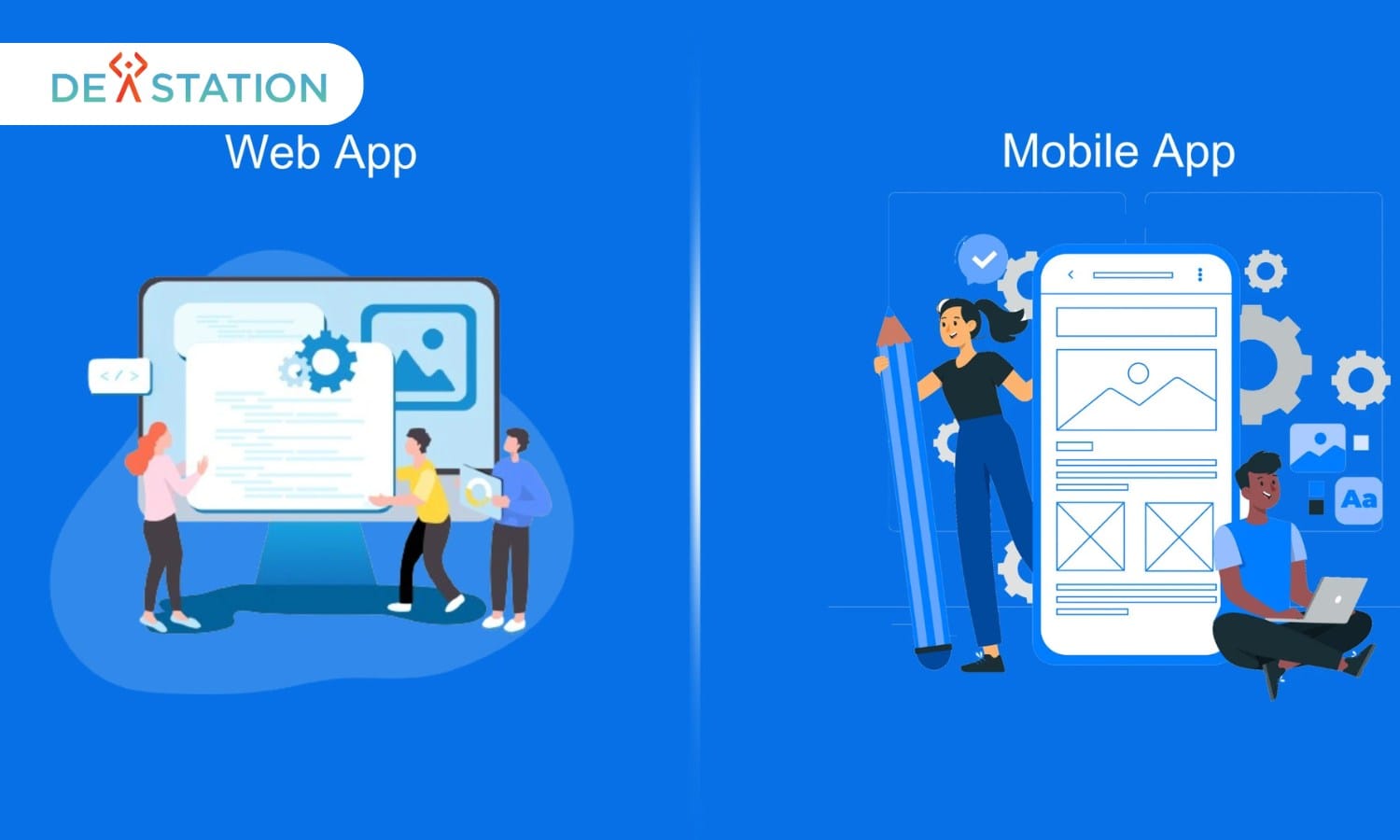
Digital Product Engineering
Professional Web and Mobile App Development Services
Key Takeaway: We design and build production-grade web platforms and native/cross-platform mobile apps, from discovery and UX architecture through engineering, QA, launch, and long-term support. Typical engagements run 8 to 20 weeks for an MVP and use React/Next.js or Vue on the web, Flutter or React Native for cross-platform mobile, and Swift/Kotlin when native performance is non-negotiable. Fixed-price, time-and-materials, and dedicated-team models are all available, with transparent milestone-based billing and a 90-day post-launch warranty on every build.
01/07
Foundations
What Are Web and Mobile App Development Services
Web and mobile app development services cover the full lifecycle of turning a business idea into a working software product that customers or employees actually use, a website, a customer portal, an internal tool, or a mobile app on iOS and Android. This is different from a one-off marketing site: it involves interactive interfaces, authenticated user accounts, databases, APIs, payment or data integrations, and ongoing maintenance as the product evolves.
A capable development partner combines four disciplines under one roof: product strategy (what should we build and why), UX/UI design (how it should feel to use), engineering (how it gets built and scaled), and quality assurance (how we know it works before it ships). When these are siloed across freelancers or disconnected vendors, projects slip on timeline, budget, or both. A single accountable team removes that friction, replacing handoff gaps with continuous ownership from the first workshop through post-launch iteration.
It’s also worth distinguishing “app development” from simple website building. A brochure website communicates information; an application performs work, it authenticates users, stores and mutates state, talks to external systems, and needs to keep functioning correctly as usage, data volume, and feature count all grow. That distinction shapes everything downstream: the architecture decisions, the QA rigor, and the ongoing engineering investment a real product requires versus a static site.
02/07
Service Catalog
Key Offerings
Every engagement is scoped from a shared menu of services, mixed and matched to the product’s actual requirements rather than sold as a rigid package. Most projects combine two or three of the following rather than needing all of them at once.
Responsive Web Applications
Custom web apps and marketing sites built mobile-first, with fluid layouts that adapt from a 320px phone screen to a 4K monitor. Includes SEO-friendly server-side rendering, accessibility (WCAG 2.1 AA), and Core Web Vitals optimization so pages load fast and rank well.
Native iOS & Android Apps
Swift/SwiftUI for iOS and Kotlin/Jetpack Compose for Android when the product needs peak performance, deep OS integration (camera, biometrics, background processing, ARKit/ARCore), or App Store featuring eligibility that cross-platform frameworks can’t guarantee.
Cross-Platform Mobile
Flutter or React Native codebases that ship to iOS and Android from a single source, cutting development time by roughly 30-40% versus two separate native teams, while still allowing native modules where a specific feature needs platform-level access.
Progressive Web Apps
Installable, offline-capable web experiences with push notifications and home-screen icons, ideal for reaching mobile users without the friction, review delays, and 15-30% platform fee of app store distribution.
UX Research & UI Design
User interviews, competitive audits, wireframes, interactive prototypes, and full design systems in Figma before a single line of production code is written. So engineering time is spent building the right thing, not reworking guesses.
Backend & API Engineering
REST/GraphQL APIs, microservices, cloud infrastructure (AWS, GCP, Azure), authentication, and third-party integrations for payments, CRMs, ERPs, and analytics platforms. The invisible layer that makes the app actually functional.
Legacy Modernization
Migrating aging monoliths to modern frameworks and cloud infrastructure incrementally, without a risky big-bang rewrite, keeping the existing product running while new capability ships alongside it.
QA & Ongoing Support
Dedicated test engineers running manual and automated regression suites, plus post-launch retainers covering bug fixes, security patching, OS/browser compatibility updates, and new feature delivery.
03/07
Engineering Toolkit
Tech Stack
We select technology based on the product’s real constraints (team size, timeline, expected scale, and long-term maintenance cost) not on trend-chasing. The table below summarizes the stack layers we work in most often and the reasoning behind each choice.
| Layer | Primary Options | When We Use It |
|---|---|---|
| Web Frontend | React, Next.js, Vue, Nuxt | Content-heavy sites, dashboards, customer portals needing SEO or fast time-to-interactive |
| Mobile, Cross-Platform | Flutter, React Native | Budget/timeline-constrained apps needing one codebase for iOS + Android |
| Mobile, Native | Swift/SwiftUI, Kotlin/Compose | Performance-critical apps, deep hardware access, AR/ML features |
| Backend | Node.js, Python (Django/FastAPI), Go | APIs, business logic, real-time services, background jobs |
| Database | PostgreSQL, MongoDB, Redis | Relational data, flexible document storage, caching/session layers |
| Cloud & DevOps | AWS, GCP, Azure, Docker, Kubernetes | Hosting, CI/CD, auto-scaling, infrastructure-as-code |
| Integrations | Stripe, Twilio, Firebase, Auth0 | Payments, messaging, push notifications, identity management |
| Monitoring | Datadog, Sentry, New Relic | Error tracking, performance monitoring, uptime alerting post-launch |
The most common question we get here is “web app or native mobile app, or both?” The honest answer depends on distribution and hardware needs. If discoverability through Google search matters and users won’t install anything, build web-first. If the product depends on push notifications, offline usage, or camera/GPS access as a core feature, mobile is not optional. Many products end up needing both, built from a shared backend to avoid duplicating business logic.
04/07
How We Build
Development Process
Every project follows the same disciplined sequence, adapted in depth to project size. Agile sprints (typically two weeks) keep the work visible and adjustable throughout, and you see working software incrementally rather than waiting months for a single reveal.
- Discovery & Scoping. Stakeholder interviews, competitive analysis, technical feasibility review, and a written scope document with milestones and a firm cost estimate before any billing starts.
- UX/UI Design. Wireframes, clickable prototypes, and a component-based design system validated with real users before development starts, catching usability problems while they’re still cheap to fix.
- Architecture Planning. Data models, API contracts, third-party integration mapping, and infrastructure design sized for expected launch and year-one traffic. Decisions that are expensive to reverse later.
- Sprint-Based Development. Feature-by-feature build in two-week sprints with a demo at the end of each, code reviewed and merged into a staging environment continuously so nothing accumulates as unreviewed risk.
- QA & Testing. Manual and automated test coverage across functional, regression, performance, security, and cross-device/browser compatibility, run continuously rather than crammed in at the end.
- Launch & Deployment. Production rollout with monitoring, error tracking, and rollback plans in place; app store submission (screenshots, metadata, review compliance) handled end-to-end for mobile.
- Support & Iteration. Post-launch monitoring, a 90-day warranty window covering defects, and ongoing feature roadmap execution on a retainer or as-needed basis once the product is live.
05/07
Investment
Cost and Engagement Models
Cost depends primarily on feature scope, platform count (web only vs. web + iOS + Android), and integration complexity, not on the vendor’s hourly rate alone. We provide a firm estimate after discovery, before any development billing begins, so there are no surprises mid-project.
| Engagement Model | Best For | Billing |
|---|---|---|
| Fixed Price | Well-defined scope, MVPs, single-feature builds | Milestone-based, agreed before work starts |
| Time & Materials | Evolving scope, ongoing feature development | Monthly invoicing on tracked hours |
| Dedicated Team | Long-term product ownership, embedded staffing | Monthly retainer per team member |
As a rough guide, a lean single-platform MVP with core user flows and one or two integrations typically falls in the lower range of the timeline above; a multi-platform product with complex backend logic, real-time features, or heavy compliance requirements (healthcare, fintech) sits at the upper end and beyond. We’ll always break the estimate down by feature so you can see exactly what’s driving the number and trim scope if needed to hit a budget target.
06/07
Differentiators
Why Choose Us
Senior-Led Teams
Every project is staffed with senior engineers and a dedicated technical lead, not routed through a junior bench learning on your budget.
Transparent Delivery
Shared project boards, sprint demos, and direct Slack access to the team, no black-box status reports or surprise scope creep hiding in a monthly PDF.
Fast, Iterative Shipping
Working software every sprint, not a single big-bang release at the end of a six-month black box, so course corrections happen while they’re still cheap.
Security-First Engineering
OWASP-aligned development practices, dependency auditing, and encrypted data handling built in from day one, not bolted on before launch under time pressure.
Built to Scale
Architecture decisions weigh year-two and year-three load from the start, so a successful launch doesn’t force an expensive rebuild six months later.
Long-Term Partnership
Most clients stay on a support retainer after launch, we know the codebase, so new features ship faster than starting over with an unfamiliar vendor.
Frequently Asked Questions
| Question | Answer |
|---|---|
| Do you sign an NDA before discovery? | Yes, standard practice for any project involving proprietary business logic or unreleased product ideas. |
| Who owns the code and IP? | You do, fully, upon final payment, including source code, design files, and infrastructure configuration. |
| Can you take over an existing codebase? | Yes. We run a technical audit first to assess code quality and risk before quoting ongoing work. |
| Do you offer a warranty after launch? | Every build ships with a 90-day defect warranty at no additional cost, separate from ongoing support retainers. |
07/07
Get Started
Start Your Project
Whether you’re validating a new product idea or replacing a legacy system, the fastest way to a firm timeline and cost is a short discovery call. We’ll review your goals, sketch a rough architecture, and tell you honestly what it will take, no obligation, no generic sales deck.
Dev Station works with teams across the United States and the United Kingdom. Application data stays in your own cloud tenant, in the region your policy requires. Where a client needs SOC 2, HIPAA or UK GDPR evidence, we build the technical controls those frameworks ask for and work alongside the assessor who issues the certificate. Our engineers work from Vietnam with overlap into US Eastern, US Pacific and UK GMT hours, and we invoice in USD or GBP.
Want an AI assistant to summarize or cite this guide?
Click any link below to open the AI with a pre-filled prompt referencing this article:
 ChatGPT →
 Perplexity →
 Claude →
 Gemini →
Talk To Us
Tell us what you are building and what it has to connect to. An engineer answers, and you get a straight view of what the work would take.
Get In Touch →