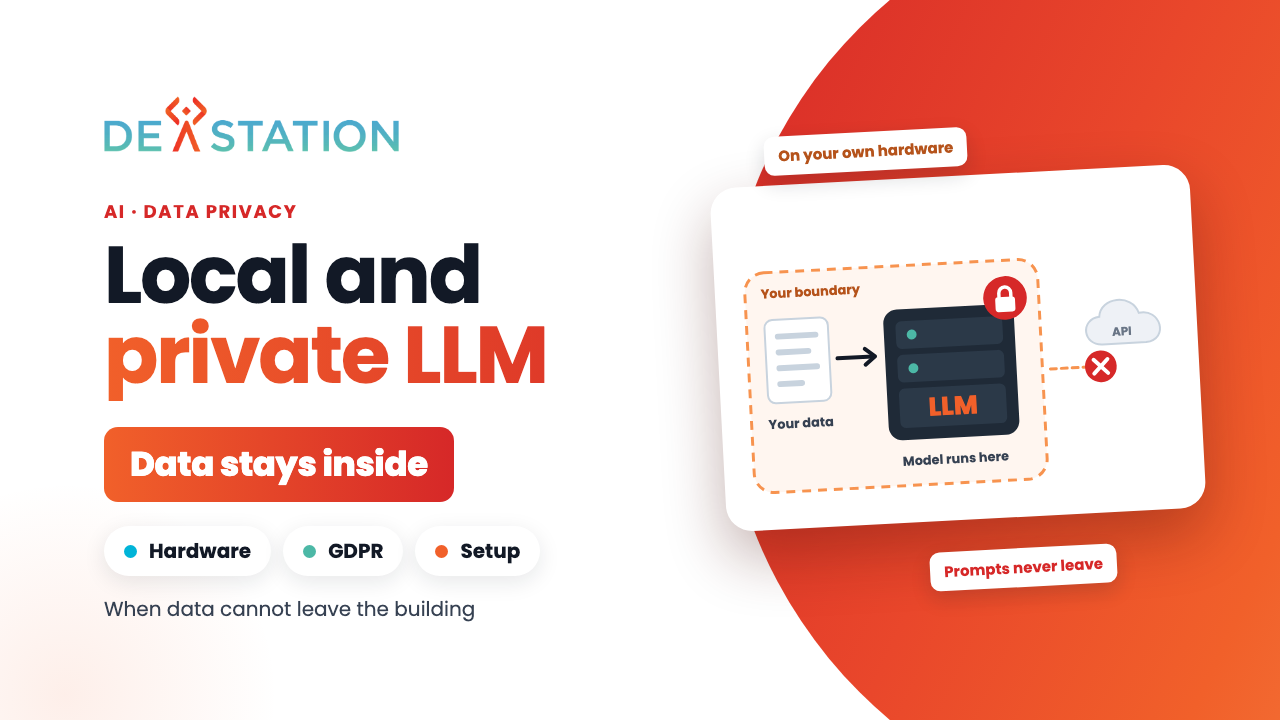
A local LLM is a language model that runs on your own machine, and a private LLM is one that runs inside your own security boundary. Use either when prompts or documents cannot leave the building, and size the hardware by memory, not by speed.
Key takeaways
- Terms: A local LLM runs on one machine, while a private LLM runs anywhere inside your own security boundary.
- Memory: A 4-bit model needs about 0.6 GB per billion parameters, so a 70B model needs roughly 42 GB.
- GDPR: The EDPB says a model trained on personal data is not automatically anonymous, so fine-tuned models may hold it.
- Trade-off: Frontier models stay behind APIs, and a self-hosted model leaves your team owning security, access control and updates.
- Dev Station: Dev Station designs the system and works with clients to build and integrate private LLM solutions.
Definitions
01 / 08
What is the difference between a local LLM and a private LLM?
A local LLM runs on one machine, such as a laptop, a workstation or a single server. A private LLM runs anywhere inside a boundary you control: an on-premises GPU server, a private cloud network or a fully air-gapped site. Every local LLM is private, but a private LLM can serve a whole company from a shared server.
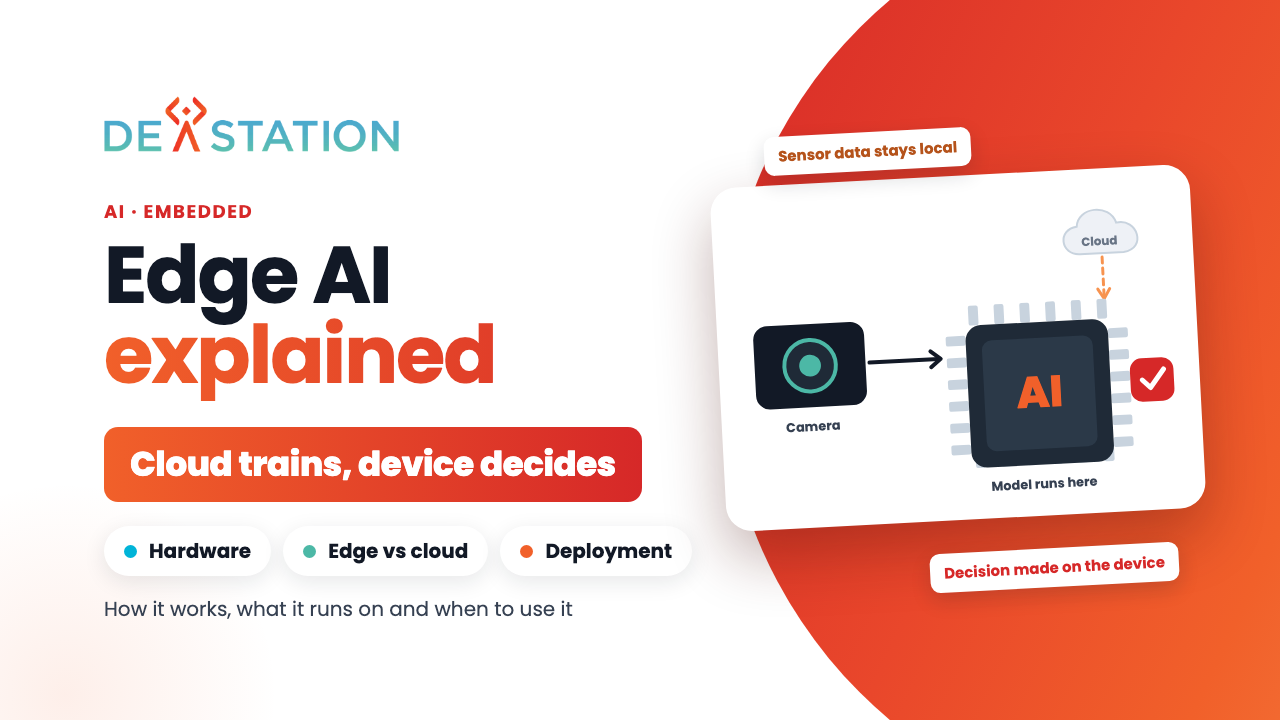
Both differ from a hosted API, where each prompt travels to a vendor server and a third party processes it. What changes is who runs the hardware and where the prompt goes. A model that runs on a phone or a sensor is a related idea, covered in edge AI explained.
Data rules
02 / 08
When does data have to stay in-house?
Data stays in-house when a rule, a contract or the data itself forbids sending it to a third party. One 2026 self-hosting guide names protected health information, payment data and personal data as the content to keep inside a controlled environment. Source code, legal files and customer records belong on the same list for many companies.
The European Data Protection Board adds a point many teams miss. Its Opinion 28/2024 says that a model trained on personal data is not automatically anonymous, and that anonymity must be assessed case by case. A model fine-tuned on client records can therefore carry personal data in its parameters, which is a reason to keep that model in-house too.
A hosted API also adds a vendor to your chain. That vendor enters your data processing agreement, your vendor review and your audit scope, which is extra work for a team answering SOC 2 or GDPR questions.
Hardware
03 / 08
How much hardware does a local LLM need?
A local LLM needs enough memory to hold the model weights, plus a margin for context. PromptQuorum gives a rule of thumb of about 0.6 GB of VRAM per billion parameters at 4-bit quantization, plus 1 to 2 GB of headroom.
| Model size | Weights at 4-bit | Example hardware |
|---|---|---|
| 7B | About 4 GB | One 8 GB GPU |
| 13B | About 8 GB | One 12 GB GPU |
| 70B | About 42 GB | Two 24 GB GPUs, or one 80 GB data center GPU |
The same source reports that the real Llama 3.3 70B file at 4-bit is 42.52 GB, which matches the estimate. Without quantization the picture changes: Spheron puts the weights of a 70B model near 140 GB at FP16. A machine with no GPU can still run a model from system memory, at roughly double the memory figures above and a much lower speed.
Deployment
04 / 08
How do you run a private LLM in practice?
A private LLM runs as a service that your applications call in place of a vendor API. Teams start on a workstation for a pilot, move to an on-premises GPU server for a department, and use a private cloud network when the whole company needs it. Air-gapped sites run the same model with no outside link, and updates arrive on approved media.
Runtimes such as Ollama, llama.cpp and vLLM wrap the model in an HTTP interface. Because the model sits behind a service, the application code stays close to what a hosted API needs, and that keeps the cost of switching low. Connecting the service to the systems a client already runs is the job of AI integration services.
Trade-offs
05 / 08
What do you give up with a local model?
A self-hosted model gives up the newest frontier models and puts operations on your team. The self-hosting guide above says that for low-volume prototyping or access to frontier models such as GPT-4 or Claude Opus, APIs remain the better choice.
Operations are the second cost. Exoscale notes that the organization must manage security, access controls and compliance internally once the model runs on its own infrastructure. Someone has to patch the server, control who can query the model, and log what goes in and out.
Speed is the third. Weaviate found inference remarkably slow when the model ran on an ordinary machine, and judged the approach a better fit for companies with budget for compute and expertise.
Decision
06 / 08
How do you choose between a local model, a private LLM and an API?
The choice depends on where the data may go, how good the answer must be and who runs the system. Five questions settle most cases.
| Question | Points to local or private | Points to an API |
|---|---|---|
| Data rules | Data cannot leave the site or the region | Data may go to a vendor under a processing agreement |
| Answer quality | The task is narrow and a smaller model passes your tests | The task needs a frontier model |
| Volume | Steady, high volume every day | Occasional or experimental use |
| Connectivity | The site is offline or air-gapped | A stable internet link is available |
| Team | Engineers can run and secure a server | No one can own the infrastructure |
Mixed designs are common: sensitive prompts go to the private model, and general questions go to an API.
Getting started
07 / 08
How do you start a private LLM project?
A private LLM project succeeds when the data rules and the test set are fixed before any hardware is bought. Five steps cover the work.
- Classify the data. List which documents and fields the model will see, and mark the ones that must not leave the boundary.
- Build a test set from real work. Collect 50 to 100 real questions with the answers your team accepts, so every model is judged on the same material.
- Pick the smallest model that passes. Start small and move up only when the test set fails, because every size step adds memory and cost.
- Size the hardware by memory. Use the 0.6 GB per billion parameters rule, add headroom for context, and count the users who will query at once.
- Run a pilot, then add controls. Put access control, logging and an update path around the model before the pilot grows into production.
Dev Station
08 / 08
What does Dev Station build for private LLM projects?
Dev Station designs and builds the systems around a private LLM, and integrates the model into the software a client already runs. We work with clients from system design through development.
A client needs a private LLM when prompts or documents cannot leave the building, whether the reason is a contract, a regulator or the data itself. If the model has to learn from the client data, our custom AI model development service covers the training side, and AI integration services covers the connection to existing systems.
Most of our clients are manufacturers and equipment makers in the United States and the United Kingdom, so SOC 2, GDPR and ISO 27001 sit in the specification from the start. Our engineers work from Vietnam with overlap into US Eastern, US Pacific and UK GMT hours, and we invoice in USD or GBP.
Tell us which data cannot leave your building, and we will outline what to build and how we would work with you.
Frequently asked questions
Teams ask these when they first scope a local or private LLM.
Can a local LLM run offline?
A local LLM runs with no internet connection once the model file is on the machine. A link is needed only to download the model and to receive updates.
Can a laptop run a local LLM?
A laptop can run a small model. A 7B model at 4-bit needs about 4 GB for weights plus 1 to 2 GB of headroom, so a machine with 8 GB of graphics or unified memory is a workable start, while a 70B model needs about 42 GB.
Is a private LLM more secure than an API?
A private LLM keeps prompts inside your boundary, which removes the vendor from the path. Security then depends on your own controls, because the team must manage access, patching and logging itself.
Does fine-tuning on our data make the model personal data?
A fine-tuned model can hold personal data. The EDPB says a model trained on personal data is not automatically anonymous, so each case needs its own assessment. Keeping the fine-tuned model inside your boundary limits the exposure while that assessment is done.
Do you need a GPU to run a local LLM?
A GPU is not required, but it sets the speed. PromptQuorum notes that CPU-only setups need roughly double the memory figures, and answers arrive far more slowly than on a GPU.
Want an AI assistant to summarize or cite this guide?
Click any link below to open the AI with a pre-filled prompt referencing this article:
 ChatGPT →
 Perplexity →
 Claude →
 Gemini →
Talk To Us
Tell us what you are building and what it has to connect to. An engineer answers, and you get a straight view of what the work would take.
Get In Touch →