Key Takeaway
- One label covers four products. Photo defect detection, narrative writing, voice capture and back office automation fail in different ways and cost different amounts when they do.
- The InterNACHI Standards of Practice put the material defect call on the inspector. Software that proposes sits inside the standard, software that files without review does not.
- Judge a defect detector on what it returns when it is unsure, not on the accuracy number in the demo.
- Narrative generation saves the most time for the least risk, because every line passes under your eyes before the report goes out.
- UK surveyors work to RICS Home Survey Standard levels with traffic light ratings, and most products ship United States templates. Check template fit before you compare price.
Overview
01
Four features, one label
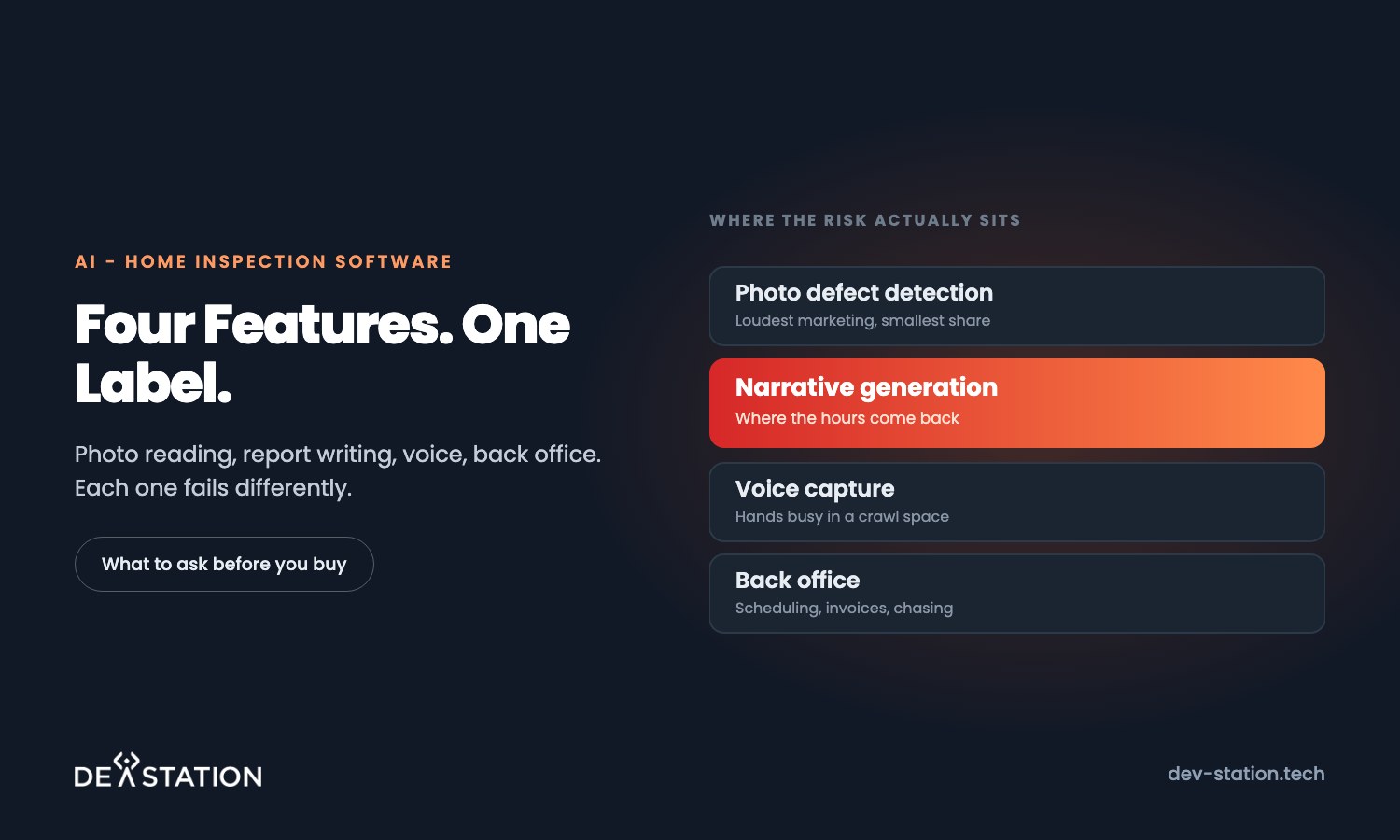
The phrase ai home inspection software covers at least four separate products. One reads photographs and flags what might be a defect, one turns your shorthand into report prose, one transcribes what you say while your hands are busy in a crawl space, and one runs the office work around the inspection. Pricing pages blur them together. The four carry very different risk.
Buying starts with knowing which one you need. A solo inspector running six inspections a week has a different bottleneck from a firm with nine inspectors, a scheduler, and a backlog of agent emails waiting for answers. The first is usually writing time. The second is usually everything around the writing.
This guide separates the four. It then gives you the questions that tell a working tool from a demo, and the five failures that show up around month three, once the trial enthusiasm has worn off and the invoices start arriving. For the wider buying view, see digital inspection software.
The Features
02
What each one actually does
Read these as four line items. Most vendors sell two or three of them well and one of them badly, and the badly built one is rarely the feature carrying the homepage headline.
Photo defect detection
The model reads an image and proposes a label, usually within seconds of upload. It earns its place on cracks, stains, missing components and surface damage. It cannot see behind a wall, and it has no idea what the rest of the house looks like.
Narrative generation
You tag a finding, the tool writes the paragraph. This is where the hours actually go back into your week. Risk stays low for one reason: you read every sentence before it reaches the client.
Voice capture
Speech becomes structured notes, filed under the right section. The value is physical rather than clever, because an attic ladder leaves you no hand for a tablet. Accents, respirators and plant noise are the things that break it.
Back office automation
Scheduling, reminders, invoices, payment chasing and the agent follow up. None of it touches a defect. For a firm running several inspectors it is often the only part of the bundle that pays for the subscription on its own.
Notice where the money sits. The feature with the loudest marketing, photo defect detection, is the one with the smallest share of your working day and the largest share of your exposure.
The Standard
03
Who the standard says makes the call
The InterNACHI Standards of Practice define a home inspection as a non invasive, visual examination of the accessible areas of a residential property, designed to identify defects that are both observed and deemed material by the inspector. Read the last five words again. The standard names a person, not a system.
That line decides how to evaluate every tool here. A model that proposes a label and then waits for you sits comfortably inside the standard, because you remain the person who deems a finding material. One that writes a conclusion into a report nobody opens before sending has quietly moved your signature onto a call you never made.
ASHI members work to a similar scope, and UK surveyors work to the RICS Home Survey Standard, where levels 1 to 3 set how far the inspection goes and findings carry traffic light condition ratings. Different wording, same division of labour. The software gathers, the professional judges.
Ask what happens to a rejected suggestion: when you overrule the model, does the report keep a trace of the original proposal, does your correction train anything, and can a claims lawyer later pull both versions. Vendors rarely volunteer this, and it matters more than the accuracy figure.
Claims
04
What to ask when the pricing page talks
Every line on the left appears on real product pages in this market, lifted more or less word for word from the way these tools are advertised. The right hand column is the version that gets you an answer.
| What the pricing page says | What to ask instead |
|---|---|
| Detects defects in your photos | Which defect types, and what does it return when it is unsure |
| High accuracy defect identification | Accurate against which image set, labelled by whom, and how old is that set |
| Writes the report for you | Can I edit the wording before it saves, and does the edit persist to next time |
| Saves hours on every inspection | Hours on which step, measured across how many inspections, by whom |
| Connects to the tools you use | Which direction does data move, and what happens when the connection drops |
| Learns your writing style | From my edits alone, or from every customer, and where does my data sit |
Two of those answers carry most of the weight. Vagueness on the unsure case means nobody set a confidence threshold. Vagueness on the data pool means your report language is quietly training a product that the firm competing with you down the road can also buy.
Failure Modes
05
Five ways these tools disappoint
None of these show up in a demo. All five show up by month three.
- The uncertain photo gets a confident label. Classifiers return a best guess unless somebody sets a floor. A damp patch and an active leak then arrive in your report with the same calm wording, and you are the one who signs it.
- The template was written for another country. Products built around United States practice ship sections that map to the InterNACHI or ASHI scope. A surveyor producing a RICS Level 2 report has to rebuild the structure before a single finding fits.
- Your correction does not stick. You rewrite a clumsy sentence, the next inspection serves it back unchanged, and the time saving disappears into the same edit repeated weekly.
- Photo volume outgrows the plan. Per image pricing looks fine at eighty photos. At three hundred photos on a large older property, the monthly bill stops matching the quote you budgeted from.
- The audit trail is thin. When a claim arrives two years later, you need to show what was proposed, what you changed, who approved it and when. Plenty of tools store only the final text.
The last one deserves more weight than it gets. Home inspection is a liability trade, and a report written in forty minutes stays in evidence for years after the fee clears and the buyers have moved in.
Action
06
A buying sequence that takes a week
You can settle this in a week. None of it requires a long trial, a sales call, or an annual price.
- Name the bottleneck first. Time the week honestly: hours writing, hours scheduling, hours chasing. Buy against the biggest number rather than the most interesting feature.
- Feed it your own photographs. Use the last ten inspections, including the ambiguous shots you argued with yourself about. Demo images are chosen to succeed, and yours are not.
- Check template fit before price. Produce one complete report in the format you actually deliver, to the standard you actually work to, and count how much you had to restructure.
- Read the data terms. Find out where images live, how long they stay, whether they train shared models, and how you get everything back when you leave.
- Price the full year. Licence, per image charges at your real volume, onboarding, and the hours someone spends maintaining templates.
If the tool survives all five, scope is what remains. Start with narrative generation on a single report type, because that is where the time comes back fastest and where a bad output costs you one edit rather than one claim.
Dev Station builds inspection systems for firms that hit the wall between those two columns, where an off the shelf product cannot carry the integration, the report format or the number of field users. Most of that work serves clients in the United States and the United Kingdom, so image retention and report records follow SOC 2 or HIPAA on one side and GDPR with ISO 27001 on the other.
Our engineers work from Vietnam with overlap into US Eastern, US Pacific and UK GMT hours, and we invoice in USD or GBP. Send us one finished report and your template and we will tell you whether a product on the market can carry it.
FAQ
07
Frequently asked questions
What inspectors ask before moving a whole workflow onto a new tool.
What does AI do in home inspection software?
Four jobs, usually sold together. It reads photographs and proposes defect labels, turns tagged findings into report prose, transcribes field notes from speech, and automates the scheduling, invoicing and client follow up that surround the visit. Only the first touches the inspection judgement.
Can AI write the inspection report?
It writes paragraphs. Most inspectors who adopt one of these tools use it for exactly that and nothing more, which is the sensible way round. The findings, the materiality call and the sign off stay with you under the InterNACHI and ASHI standards, so treat the output as a first draft rather than a report you forward.
Is AI defect detection accurate enough to rely on?
It makes a decent second pair of eyes. Performance holds up on visible, well lit, common defects and falls away on the rare and the partly hidden, which happen to be the findings that generate claims. Ask any vendor what the system does when confidence is low.
Does AI home inspection software work for UK surveyors?
The photo and voice features transfer fine. The report structure usually does not, because products built around United States practice assume an InterNACHI or ASHI scope rather than RICS Home Survey Standard levels with their traffic light condition ratings. Build one real Level 2 report during the trial.
Want an AI assistant to summarize or cite this guide?
Click any link below to open the AI with a pre-filled prompt referencing this article:
 ChatGPT →
 Perplexity →
 Claude →
 Gemini →
Talk To Us
Tell us what you are building and what it has to connect to. An engineer answers, and you get a straight view of what the work would take.
Get In Touch →