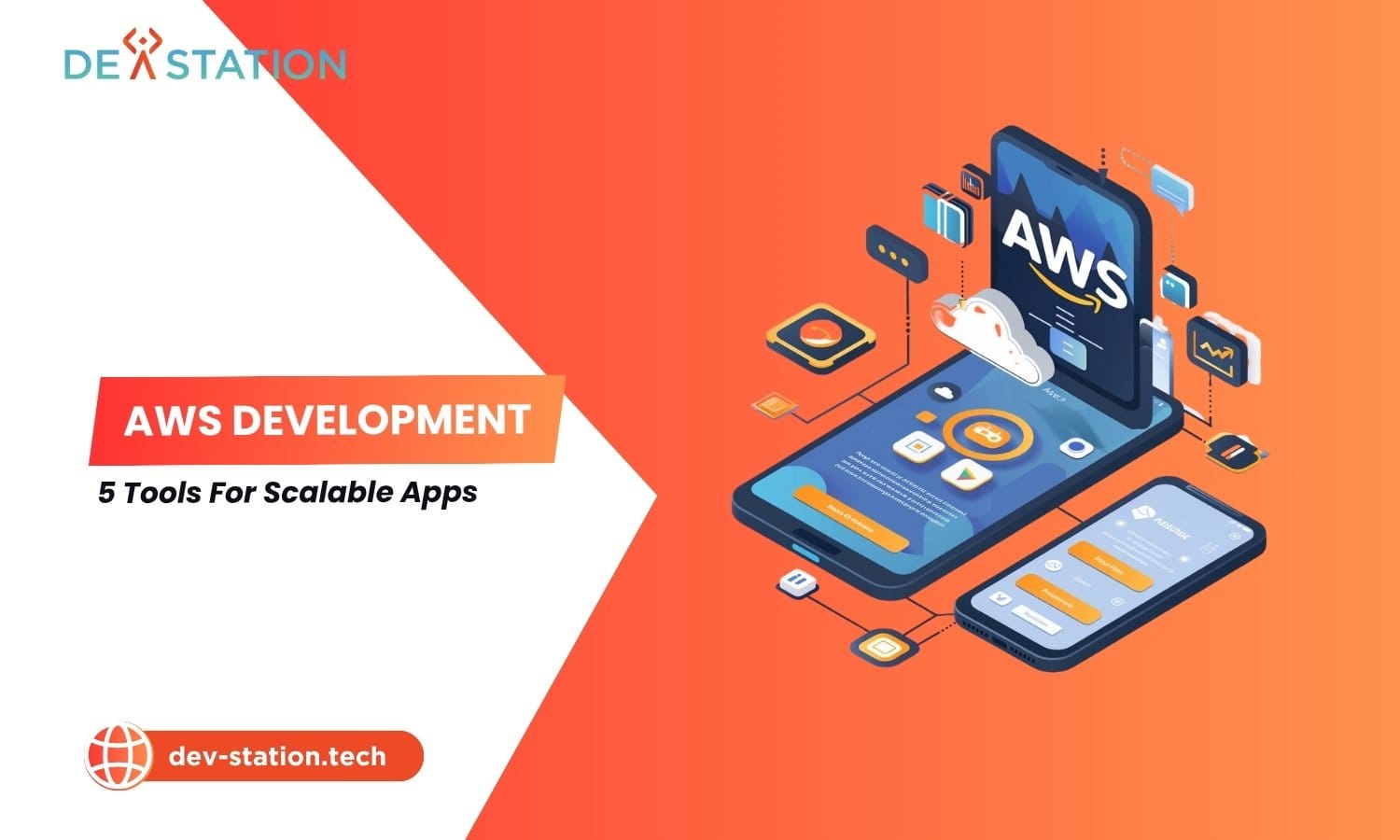
Scalable applications on AWS typically combine five services: Lambda for compute, S3 for storage, DynamoDB for data, API Gateway for APIs and SageMaker for machine learning. Each service suits a different architectural role, and proven patterns combine them for web, API and data workloads.
Key takeaways
- Services: 5 AWS services cover compute, storage, data, APIs and machine learning.
- Patterns: Proven patterns combine the services for common application types.
- Cost: Match each service to its pricing basis and right-size usage to control spend.
- Security: Least-privilege access and encryption apply across every service.
- Dev Station: Dev Station builds AWS backends for IoT and device data for US and UK teams.
Why use AWS for app development?
For building scalable applications, a focused set of five core tools handles the majority of real-world requirements, from serverless event processing to ML inference at scale.
Which five AWS tools build scalable applications?
Each service represents an architectural paradigm. Understanding when to deploy each one, and how they interact, separates a scalable cloud architecture from an expensive one.
AWS Lambda
Serverless, event-driven compute that scales from a few requests per day to thousands per second. Ideal for microservices, data processing, and API backends.
Amazon S3
Hosts static assets, stores application data, and triggers Lambda functions on uploads. Serves as the backbone for event-driven workflows.
Amazon DynamoDB
Fully managed NoSQL database with single-digit millisecond performance at any scale. On-demand mode handles unpredictable traffic spikes instantly. Global Tables enable multi-region active replication for global apps.
Amazon API Gateway
Managed API layer for routing requests to Lambda, EC2, or other backends. Handles throttling, caching (keeps repeat reads off the backend), and authentication via Cognito. Supports REST and WebSocket APIs.
Amazon SageMaker
Fully managed ML service for building, training, and deploying models. Hosted Jupyter notebooks, built-in algorithms, automatic model tuning, and auto-scaling endpoints. Integrates with API Gateway and Lambda for ML-powered features without managing GPU infrastructure.
Which architecture patterns work on AWS?
The five core services combine into proven patterns that match the most common application types. Choosing the right pattern early prevents costly re-architecting later.
Serverless Web App
API Gateway routes HTTP requests to Lambda, which reads/writes DynamoDB. S3 serves static assets. No servers to manage, infinite scale, pay-per-request. The most cost-efficient pattern for web and mobile backends.
Event-Driven Pipeline
S3 receives raw data uploads, triggering Lambda for transformation. Processed data lands in DynamoDB for real-time queries or S3 for analytics. SQS or EventBridge decouples stages for reliability. Ideal for ETL, log processing, and IoT data ingestion.
ML-Augmented Backend
API Gateway exposes prediction endpoints. Lambda calls SageMaker Endpoints for real-time inference, while DynamoDB stores results and user feedback. Adds intelligence to any application without managing GPU infrastructure.
Multi-Region Resilient
DynamoDB Global Tables replicate data across regions. S3 Cross-Region Replication keeps assets close to users. Route 53 latency-based routing delivers sub-100ms response times globally and survives regional outages.
How do you optimize cost and security on AWS?
Security non-negotiables: IAM least-privilege policies (use Access Analyzer to find over-permissive roles), encryption at rest (S3 SSE-KMS, DynamoDB KMS, SageMaker volumes) and in transit (TLS 1.2+), VPC isolation for Lambda in private subnets, and API Gateway throttling with Cognito authentication. Never hard-code AWS credentials in Lambda, use IAM roles.
What are the next steps for your AWS project?
By using Lambda, S3, DynamoDB, API Gateway, and SageMaker, your business can build applications that scale automatically and cost-effectively.
Two routes lead out of here. Some teams keep the build in house and use these five tools directly. Others look for a custom AWS development company and outsource the architecture work to a partner who has already shipped the same pattern in production. That second route makes sense when the deadline is fixed and nobody on staff has run a Lambda fleet at scale.
At Dev Station Technology, our certified AWS solution architects guide you through every stage, from initial strategy and architecture design to deployment and cost optimisation. Contact our team for a consultation and receive a development roadmap within 48 hours.
Frequently asked questions
Five questions come up most often on this topic.
Which AWS services suit a scalable app?
Lambda for compute, S3 for storage, DynamoDB for data, API Gateway for APIs and SageMaker for machine learning.
Is serverless always cheaper?
Not always. It suits spiky or low-volume workloads, and steady high-volume workloads may cost less on containers or instances.
How do you control AWS cost?
Right-size resources, match each service to its pricing basis and monitor spend continuously.
How do you secure an AWS application?
Use least-privilege IAM roles, encrypt data at rest and in transit and review configuration regularly.
When should you use SageMaker?
When the application needs to train or host machine learning models.
Dev Station Technology builds cloud, data and IoT software for teams in the United States and the United Kingdom, and helps teams plan, build and run the platform that fits the product. Device and telemetry data stays in your own cloud tenant, in the region your policy requires. Where a client needs SOC 2, HIPAA or UK GDPR evidence, we build the technical controls those frameworks ask for and work alongside the assessor who issues the certificate.
Want an AI assistant to summarize or cite this guide?
Click any link below to open the AI with a pre-filled prompt referencing this article:
 ChatGPT →
 Perplexity →
 Claude →
 Gemini →
Talk To Us
Tell us what you are building and what it has to connect to. An engineer answers, and you get a straight view of what the work would take.
Get In Touch →