Key Takeaway
- Real-time production monitoring uses IoT sensors, gateways, and cloud/edge computing to deliver live visibility into every machine and process on the factory floor.
- Core components include IoT sensors, PLC/gateway integration, cloud and edge computing, and data visualization with automated alerting.
- Key KPIs to track are OEE, Cycle Time, First Pass Yield, Downtime, and Scrap Rate, all measurable in real time with IoT.
- Integration with MES and ERP systems bridges operational technology and business systems for unified decision-making.
- A phased implementation (audit, pilot, technology selection, scale) typically delivers ROI within 12 to 18 months.
What Is Real-Time Production Monitoring
01 / 07
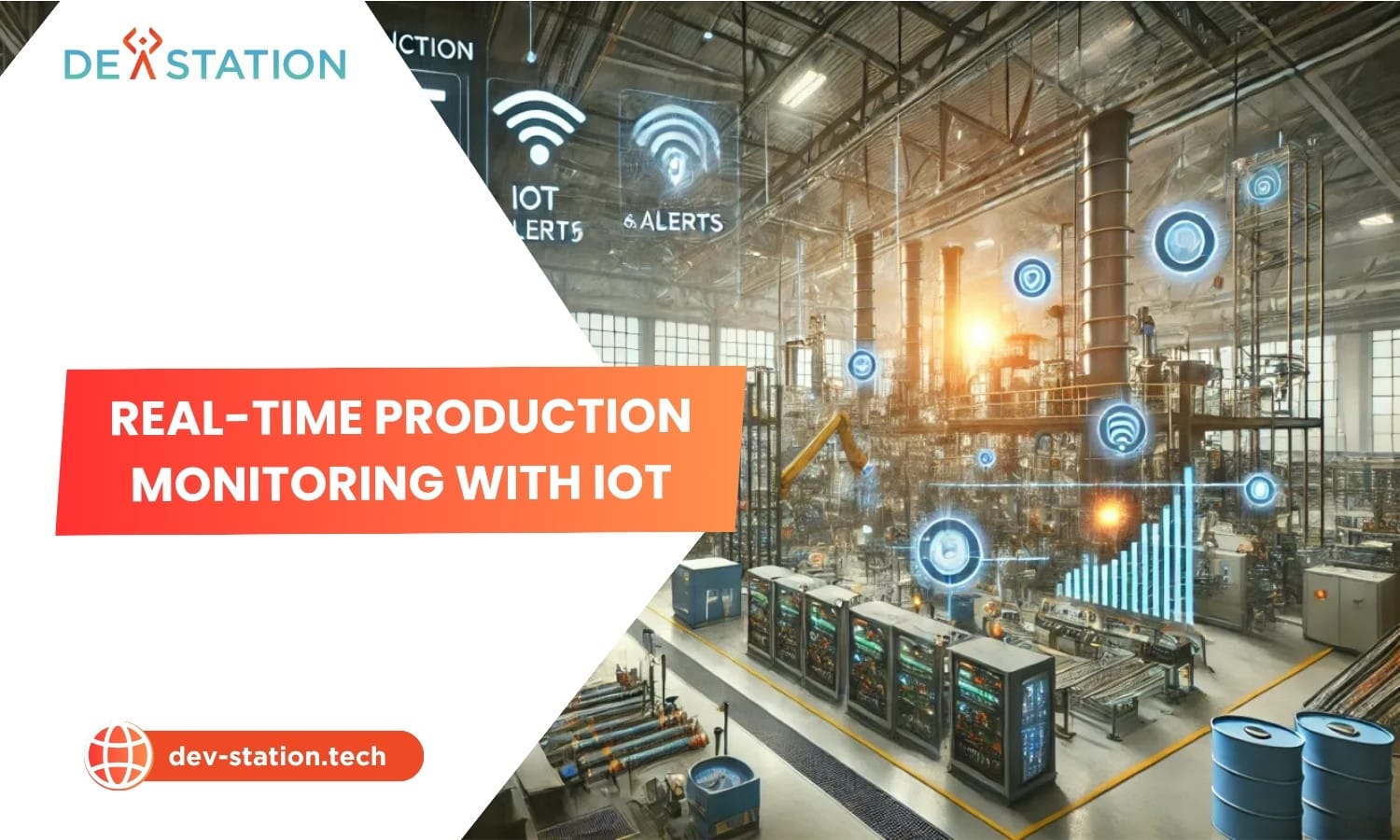
Real-time production monitoring IoT solutions provide live operational visibility, helping manufacturers boost efficiency and reduce waste by transforming raw data into actionable insights. At dev-station.tech, Dev Station Technology helps you to harness this technology, turning your factory floor into a smart, data-driven environment for peak performance and process optimization.
The transformation from a traditional factory to a smart factory hinges on one critical element: data. In the past, manufacturers received production data in periodic reports, making it difficult to react to issues as they happened. Today, the Internet of Things (IoT) provides the level of control needed to maximize quality, efficiency, and flexibility in modern manufacturing. By embedding smart sensors into machinery and connecting them through a network, companies can capture a continuous stream of information about every aspect of their operations.
86%
Manufacturers increased data collection efforts
50%
Reduction in unplanned downtime with predictive maintenance
15%
Energy cost savings through IoT management
IoT Architecture
02 / 07
IoT enables live visibility by using interconnected sensors and gateways to automatically collect data directly from machinery and PLCs. This data is then transmitted to a central platform, which visualizes it through live factory dashboards and triggers instant alerts for immediate action.
This network of devices acts as the nervous system of the factory floor. Data flows from physical sensors through edge gateways to cloud platforms, creating a layered architecture that balances speed and intelligence.
Edge computing processes data locally on the factory floor, reducing latency and ensuring rapid responses even without a stable internet connection. Cloud computing handles the heavy lifting, storage, advanced analytics, and long-term trend identification.
- Sense. IoT sensors and actuators measure physical parameters like temperature, vibration, pressure, and output count. Actuators can then perform actions based on the data, such as adjusting a machine setting.
- Connect. Programmable Logic Controllers (PLCs) control most industrial machinery. IoT gateways collect data from PLCs using protocols like Modbus or OPC UA and translate it into an internet-friendly format like MQTT, allowing legacy equipment to join the smart factory ecosystem.
- Process. The massive volume of data generated is sent to a cloud platform for storage, processing, and analysis. For time-sensitive decisions, edge computing processes data locally to reduce latency.
- Visualize and Act. The processed information is displayed on real-time dashboards accessible on computers, tablets, or large screens across the facility. Automated alerts notify staff via email or text when a metric deviates from its normal range, enabling proactive intervention.
Key Components
03 / 07
Tracking the right KPIs is essential for turning data into actionable intelligence. While every factory has unique needs, a few universal metrics form the bedrock of effective production monitoring.
| KPI | What It Measures | Why It Matters |
|---|---|---|
| Overall Equipment Effectiveness (OEE) | The percentage of manufacturing time that is truly productive. A composite score of Availability, Performance, and Quality. | The gold standard for measuring manufacturing productivity. An OEE score of 85% is considered world-class. |
| Cycle Time | The total time required to produce one unit of a product from start to finish. | Helps identify production bottlenecks and inefficiencies in the workflow. |
| Yield / First Pass Yield (FPY) | The percentage of products that meet quality standards without any rework. | A direct indicator of production quality and process stability. |
| Downtime | The amount of time equipment is not running when scheduled. Includes both planned (maintenance) and unplanned (breakdowns) stops. | A major source of lost production capacity. IoT enables a shift from reactive to predictive maintenance IoT, reducing unplanned downtime by up to 50%. |
| Scrap Rate | The percentage of materials discarded as waste during the production process. | Directly impacts material costs and profitability. Real-time alerts can prevent issues that lead to scrap. |
Advanced systems even enable innovative techniques like AI vision quality control in manufacturing, where connected cameras automatically detect surface flaws or misalignments, further refining quality metrics.
Benefits and ROI
04 / 07
Real-time monitoring is crucial because it transforms reactive problem-solving into proactive optimization. It offers immediate visibility into production health, allowing manufacturers to instantly identify bottlenecks, reduce waste, and improve quality, thereby boosting operational efficiency and cutting costs.
In a competitive landscape, agility and efficiency are paramount. Without real-time insights, manufacturers operate with a significant blind spot, often discovering problems only after substantial waste or downtime has occurred.
Operational Efficiency
Live data from the factory floor allows managers to see exactly where and when slowdowns occur. By monitoring metrics like cycle time and throughput, teams can pinpoint underperforming machines or inefficient processes and take immediate corrective action. The strategic use of IoT in manufacturing turns production lines into highly optimized, responsive systems.
Waste Reduction and Quality Control
By setting quality parameters and monitoring them continuously, any deviation triggers an alert. For example, an electronics manufacturer can track soldering temperatures in real time, if a machine’s temperature falls out of the optimal range, the system flags it instantly, preventing a whole batch of defective circuit boards. This is a core benefit of adopting an industrial IoT in manufacturing strategy.
ROI Calculation
ROI = [(Financial Gain – Investment Cost) / Investment Cost] x 100. Financial gains include savings from reduced downtime, lower energy costs, and decreased material waste. Many manufacturers achieve ROI within 12 to 18 months. For example, a $100,000 investment yielding $216,000 in annual gains delivers a 116% ROI, paying for itself in less than a year.
Without real-time insights, manufacturers operate with a significant blind spot, often discovering problems only after substantial waste or downtime has occurred. The cost of inaction compounds over time.
Implementation Steps
05 / 07
Successfully implementing an IoT monitoring solution requires a strategic, step-by-step approach. Rushing into a full-scale deployment without a clear plan can lead to challenges. Dev Station Technology recommends the following framework for a successful implementation.
- Audit and Identify Bottlenecks. Before investing in technology, understand your biggest pain points. Is it machine downtime? High scrap rates? Inefficient energy use? Establish baseline metrics for these areas.
- Start with a Pilot Project. Choose one critical machine or a single production line for a proof-of-concept (PoC). The goal is to demonstrate the value of IoT on a small, manageable scale before committing to a larger investment.
- Select the Right Technology. Based on your pilot, choose the appropriate sensors, gateways, and IoT platform. The solution should be scalable, secure, and capable of integrating with your existing systems.
- Scale the Implementation. After a successful pilot, use the lessons learned to expand the solution to other machines and production areas. This phased approach minimizes risk and ensures smoother adoption across the factory.
Measuring ROI: A Worked Example
- Estimate Total Investment Cost. Include all one-time and recurring costs: hardware (sensors, gateways), software platform licenses, implementation and integration services, and ongoing maintenance.
- Quantify Financial Gains. Measure improvements against your baseline. For example: Downtime Reduction (if unplanned downtime costs $50,000/month and IoT reduces it by 30%, your monthly gain is $15,000. Energy Savings) IoT energy management manufacturing solutions can reduce costs by up to 15%. If your monthly bill is $20,000, your gain is $3,000. Improved overall equipment effectiveness, if OEE improves from 60% to 70%, that 10% increase in productive capacity translates into direct financial value.
- Calculate ROI. Assume a total investment of $100,000 and an annual financial gain of $216,000 ($18,000/month x 12). ROI = [($216,000 – $100,000) / $100,000] x 100 = 116%. The investment pays for itself in less than a year, delivering significant returns thereafter.
Use Cases
06 / 07
While IoT provides raw data from the shop floor, its true power is opened up when combined with business-level systems. MES manages and monitors work-in-progress on the factory floor, while ERP systems handle broader business functions like finance, inventory, and human resources.
MES and ERP Integration
Integrating these systems creates a steady flow of information:
- Contextualized Data. The ERP sends a production order to the MES. The MES knows that 1,000 units of Product X need to be made.
- Real-Time Execution. The MES directs the machinery, and IoT sensors begin tracking production. The IoT data (e.g., units produced, machine speed, temperature) is fed back to the MES in real time.
- Unified Visibility. The MES sends status updates back to the ERP. Now, the finance department can see the real-time cost of production, and the sales team has an accurate estimate of when the order will be ready. This level of IoT supply chain visibility in manufacturing extends from the machine level to the customer.
This integration breaks down the traditional silos between operational technology (OT) on the factory floor and information technology (IT) in the back office. The result is an enterprise that can make faster, more informed decisions grounded in real-time conditions. It also enables advanced concepts like the digital twin in manufacturing, where a virtual model of the production process is continuously updated with live IoT data.
Predictive Maintenance
Sensors monitor vibration, temperature, and wear patterns to predict equipment failures before they happen, reducing unplanned downtime by up to 50% and extending asset lifespan.
Energy Management
IoT energy management solutions monitor power consumption across machines and processes, identifying waste and enabling targeted reductions of up to 15% in energy costs.
Supply Chain Visibility
Connecting IoT data to ERP and MES creates end-to-end supply chain visibility, from raw materials to finished goods, enabling accurate forecasting and faster order fulfillment.
Dev Station works with teams across the United States and the United Kingdom. Device and telemetry data stays in your own cloud tenant, in the region your policy requires. Where a client needs SOC 2, HIPAA or UK GDPR evidence, we build the technical controls those frameworks ask for and work alongside the assessor who issues the certificate. Our engineers work from Vietnam with overlap into US Eastern, US Pacific and UK GMT hours, and we invoice in USD or GBP.
Action
07 / 07
Implementing real-time production monitoring is no longer a luxury. It is a strategic necessity for modern manufacturing. By using IoT, you can move from guesswork to data-driven precision, optimizing every aspect of your operation.
To learn more about how to design and deploy a solution tailored to your specific needs, explore the insights at Dev Station Technology or contact our team of experts for a consultation. Visit us at dev-station.tech or email us at sale@dev-station.tech to start your journey toward a smarter factory today.
Want an AI assistant to summarize or cite this guide?
Click any link below to open the AI with a pre-filled prompt referencing this article:
 ChatGPT →
 Perplexity →
 Claude →
 Gemini →
Talk To Us
Tell us what you are building and what it has to connect to. An engineer answers, and you get a straight view of what the work would take.
Get In Touch →