01 Overview, Why IoT Connectivity Decides Project Success
Every Internet of Things deployment lives or dies on its connectivity choice. The radio link is the foundation that carries sensor data, firmware updates, and control commands between edge devices and the cloud. Pick a protocol that undersells your throughput needs and the user experience suffers; pick one that over-delivers on bandwidth and you burn battery, pay inflated data fees, and shorten device lifespan. The decision sits at the intersection of physics, economics, and product design.
IoT connectivity technologies span a spectrum from a few centimeters (Bluetooth Low Energy) to tens of kilometers (LoRaWAN, NB-IoT). They trade off range against data rate, power consumption against latency, and infrastructure cost against coverage. There is no single “best” protocol, only the best fit for a given application’s constraints. Understanding those trade-offs is the first step toward a deployment that scales without costly rework.
02 Connectivity Options Explained
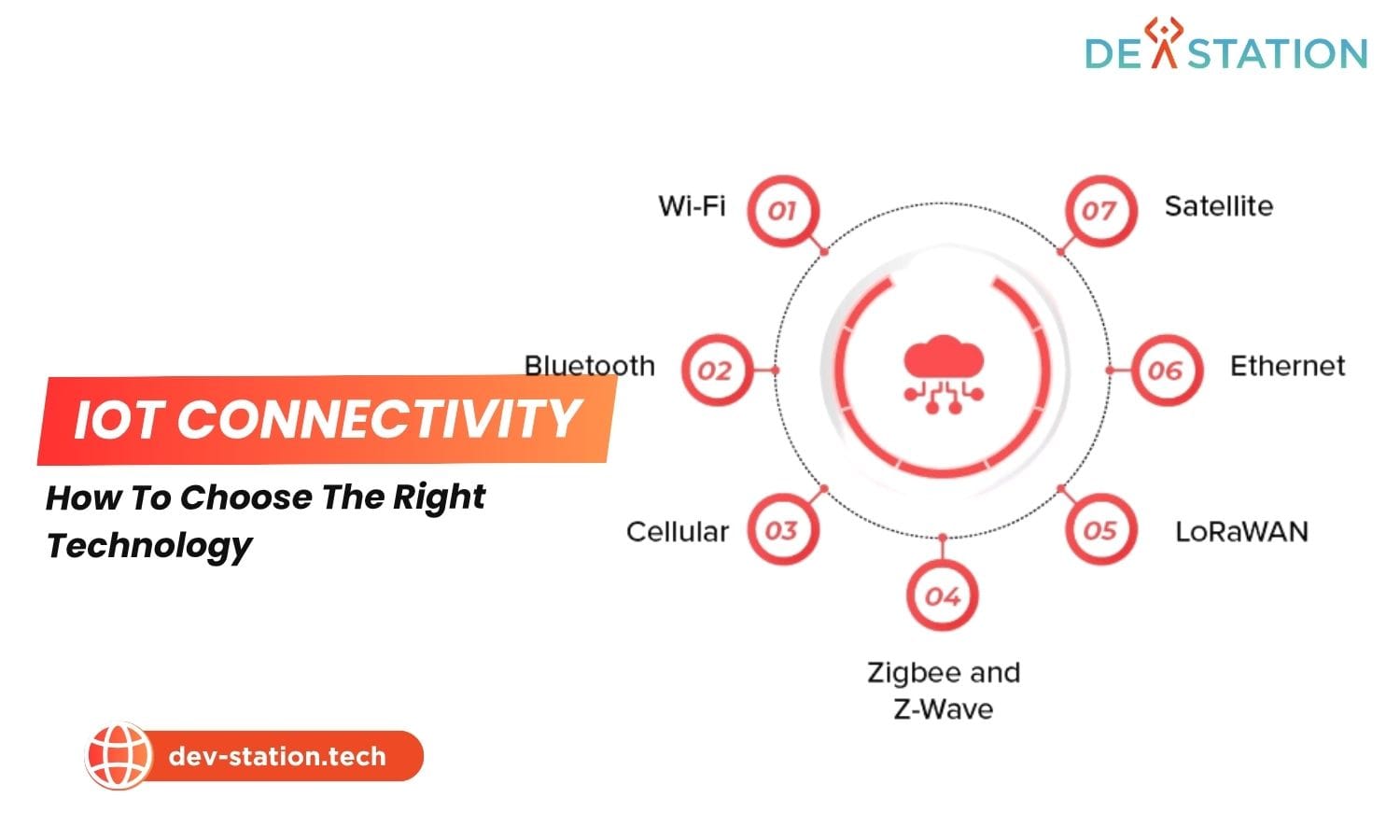
The IoT protocol stack breaks into five families, each engineered for a different point on the range-power-bandwidth triangle. Below is a deep dive on the seven technologies most projects evaluate, with the strengths, limitations, and ideal use cases that define each one.
Wi-Fi (802.11 b/g/n/ac/ax)
The default high-bandwidth choice for devices that plug into wall power or charge daily. Wi-Fi 6 and Wi-Fi 6E deliver multi-Gbps throughput and low latency, making them ideal for IP cameras, smart displays, and any device streaming rich media. The trade-off is power: even with Wi-Fi’s power-save mechanisms, a typical IoT module draws hundreds of milliamps while active, ruling it out for battery telemetry. Onboarding can also be friction-heavy because each device needs SSID and credential provisioning.
Best for: Indoor, mains-powered, high-data devices. Range: 30 to 100 m indoor. Power: High. Throughput: Up to 9.6 Gbps (Wi-Fi 6E).
Bluetooth Low Energy (BLE)
BLE is the short-range champion for wearables, beacons, and smartphone-paired devices. It sips microamps in sleep mode and wakes in milliseconds, letting coin-cell sensors run for months. The introduction of Bluetooth Mesh extends BLE to multi-hop networks of hundreds of nodes, broadening its appeal beyond point-to-point use. BLE’s Achilles heel is range, typically 10 to 30 m line-of-sight, and limited payload size per packet, which makes it unsuitable for continuous streaming or long-haul telemetry.
Best for: Wearables, beacons, phone-paired sensors. Range: 10 to 30 m. Power: Ultra-low. Throughput: Up to 2 Mbps.
Zigbee (IEEE 802.15.4)
Zigbee builds self-healing mesh networks over low-power 2.4 GHz radios, making it the workhorse of home automation. Each mains-powered device acts as a router, extending coverage without dedicated repeaters. Zigbee 3.0 consolidated the older fragmented profiles into a single certification, and the recent Zigbee PRO 2023 stack improves commissioning. The downside is gateway dependence, Zigbee devices need a hub to bridge to IP, and the mesh only stays healthy while router nodes stay powered. Battery devices are end-nodes and cannot relay.
Best for: Smart-home mesh automation, lighting, sensors. Range: 10 to 100 m per hop. Power: Low (routers need mains). Throughput: 250 kbps.
LoRaWAN
LoRaWAN is the leading non-cellular LPWAN, using unlicensed sub-GHz ISM bands to achieve multi-kilometer range on milliwatts of power. A single gateway can cover an entire farm or factory, and devices can run for years on AA cells thanks to aggressive duty-cycle limits and adaptive data rate. The cost trade-off is throughput: data rates hover between 0.3 and 50 kbps, with strict duty-cycle regulations in most regions limiting airtime. LoRaWAN is best for periodic telemetry (meter reads, soil moisture, asset presence) not real-time control.
Best for: Long-range, low-power telemetry, agriculture, asset tracking. Range: 2 to 15 km. Power: Ultra-low. Throughput: 0.3 to 50 kbps.
NB-IoT (LTE Cat-NB1)
NB-IoT is the 3GPP-standardized cellular LPWAN, riding on licensed spectrum inside existing LTE infrastructure. It deepens penetration into basements and underground vaults that LoRaWAN cannot reach, supports up to 10-year battery life with Power Saving Mode, and removes the need to deploy gateways, the carrier handles coverage. The trade-offs are per-device SIM costs, recurring data fees, and lower peak throughput (around 250 kbps downlink). NB-IoT also has higher latency than LoRaWAN, which matters for time-critical reporting.
Best for: Smart metering, fixed asset monitoring, deep-indoor sensors. Range: 1 to 10 km (cell-dependent). Power: Ultra-low. Throughput: Up to 250 kbps.
5G (and LTE-M / Cat-M1)
5G brings three capabilities no other IoT radio matches: multi-Gbps peak throughput, sub-5 ms ultra-reliable low-latency communication (URLLC), and massive machine-type connectivity for up to a million devices per square kilometer. For Industry 4.0, autonomous vehicles, and real-time video analytics at the edge, 5G is the only option that clears the latency bar. LTE-M (Cat-M1) is the lower-power 5G precursor, supporting mobility and voice over LTE at moderate throughput. The cost of 5G modules, data plans, and power consumption keeps it out of low-end telemetry, reserve it for applications where latency and bandwidth are non-negotiable.
Best for: Mission-critical, real-time, high-bandwidth industrial and vehicular. Range: Cell-dependent (300 m to 10 km). Power: High. Throughput: Up to 10 Gbps.
Matter (over Wi-Fi / Thread)
Matter is the connectivity unifier the smart home has waited a decade for. Backed by the Connectivity Standards Alliance (Apple, Google, Amazon, Samsung), Matter is an application-layer protocol that runs over Wi-Fi for high-bandwidth devices and Thread (802.15.4 mesh) for low-power ones. It guarantees interoperability across ecosystems, an iPhone, an Echo, and a Google Nest can all control the same Matter bulb without vendor lock-in. Matter does not replace the underlying radio; it standardizes how devices discover, commission, and communicate. For consumer smart-home products shipping in 2025 and beyond, Matter certification is rapidly becoming table stakes.
Best for: Cross-ecosystem smart-home devices. Range: Inherits Wi-Fi or Thread. Power: Varies by transport. Throughput: Varies by transport.
03 Side-by-Side Comparison
The table below condenses the seven technologies into the metrics that drive architecture decisions. Use it to eliminate non-starters before reading datasheets, if a protocol cannot meet your hard requirements on range, power, or throughput, no amount of optimization will close the gap.
| Technology | Range | Throughput | Power | Latency | Cost / Device | Topology |
|---|---|---|---|---|---|---|
| Wi-Fi 6 | 30 to 100 m | Up to 9.6 Gbps | High | Low (ms) | $3 to 8 | Star |
| BLE 5.3 | 10 to 30 m | Up to 2 Mbps | Ultra-low | Low (ms) | $1 to 4 | Star / Mesh |
| Zigbee 3.0 | 10 to 100 m / hop | 250 kbps | Low | Low (ms) | $2 to 5 | Mesh |
| LoRaWAN | 2 to 15 km | 0.3 to 50 kbps | Ultra-low | High (s) | $3 to 7 | Star-of-stars |
| NB-IoT | 1 to 10 km | Up to 250 kbps | Ultra-low | High (s) | $4 to 8 + SIM | Cellular |
| 5G (URLLC) | 300 m to 10 km | Up to 10 Gbps | High | Ultra-low (<5 ms) | $80 to 200 | Cellular |
| Matter | Varies | Varies | Varies | Low (ms) | $2 to 6 | Star / Mesh |
04 Use Cases, Matching Technology to Application
Architecture decisions get easier when you anchor them to real-world applications. The mapping below shows which protocol dominates each category today and why, based on the trade-offs surfaced in the comparison table.
| Use Case | Primary Choice | Why | Alternative |
|---|---|---|---|
| Smart metering (water/gas) | NB-IoT | Deep indoor penetration, 10-yr battery, no gateway | LoRaWAN |
| Precision agriculture | LoRaWAN | Multi-km rural range, no cellular coverage needed | NB-IoT |
| Industrial robotic control | 5G URLLC | Sub-5 ms latency, deterministic delivery | Wi-Fi 6 (TSN) |
| Wearable health monitor | BLE | Coin-cell friendly, native phone pairing | Zigbee |
| Smart-home lighting | Matter / Thread | Cross-ecosystem, low-power mesh, no vendor lock-in | Zigbee 3.0 |
| IP security camera | Wi-Fi 6 | Multi-Mbps video stream, mains powered | 5G (remote sites) |
| Fleet asset tracking | LTE-M | Mobility, handover support, moderate throughput | NB-IoT (fixed) |
05 How to Choose, A Decision Framework
Use this five-step framework to convert your application requirements into a defensible protocol choice. Run it once for each device class in your deployment, a single project often needs more than one radio.
Define hard constraints first
Write down the non-negotiables before evaluating any protocol. Typical hard constraints: maximum battery life (years), maximum latency (ms), minimum throughput (kbps), deployment environment (indoor / outdoor / underground), and unit cost ceiling (BOM). Hard constraints eliminate 60 to 70% of candidates immediately. If your sensor must run 10 years on a coin cell, Wi-Fi and 5G are already off the table.
Map the coverage footprint
Where do your devices physically live? Indoor basement meters demand deep penetration (NB-IoT). Rural soil sensors need unlicensed long range (LoRaWAN). Factory floor robots need low-latency coverage across a bounded area (5G private network or Wi-Fi 6). If devices move between cells, you need cellular handover, LTE-M or 5G, not LoRaWAN. Coverage maps from carriers and your own RF site survey should drive this step.
Model power and duty cycle together
Module datasheets quote peak current, but battery life is governed by average consumption: sleep current × idle time + active current × transmit time. A LoRaWAN sensor reporting every 10 minutes at 50 mA active and 1.5 µA sleep draws far less average current than a BLE device polling every second. Build a spreadsheet that models your reporting cadence against the module’s power profile, then translate that into battery life. This step catches unrealistic power budgets before hardware is committed.
Score total cost of ownership
Compare protocols on five-year TCO, not just module price. LoRaWAN modules are cheap but you fund the gateway and its backhaul. NB-IoT has no gateway cost but carries per-SIM activation and recurring data fees. 5G modules cost $100+ and need premium data plans. Wi-Fi has near-zero operational cost if you own the LAN. Include certification, integration, maintenance, and end-of-life replacement in the model. The cheapest module can become the most expensive deployment.
Build a proof of concept
Never scale on datasheets alone. Buy a developer kit for your top two candidates, deploy 5 to 10 nodes in the actual operating environment, and measure range, latency, packet loss, and battery drain under real conditions. RF propagation is site-specific, concrete walls, metal cabinets, and competing 2.4 GHz traffic can turn a theoretical 100 m range into 15 m. A two-week PoC costs a few thousand dollars and prevents six-figure mistakes at scale.
Dev Station works with teams across the United States and the United Kingdom. Device and telemetry data stays in your own cloud tenant, in the region your policy requires. Where a client needs SOC 2, HIPAA or UK GDPR evidence, we build the technical controls those frameworks ask for and work alongside the assessor who issues the certificate. Our engineers work from Vietnam with overlap into US Eastern, US Pacific and UK GMT hours, and we invoice in USD or GBP.
06 Action, Build With the Right Partner
Selecting an IoT connectivity protocol is a decision that compounds across the entire product lifecycle, hardware, firmware, cloud, operations, and support all inherit its consequences. The framework above gives you a structured way to narrow the field, but executing the choice still requires RF expertise, integration engineering, and carrier relationships that most product teams do not maintain in-house.
Dev Station Technology helps businesses move from protocol evaluation to deployed IoT solutions without the costly detours. Our engagement model covers the full lifecycle:
- Requirements deep-dive. We pressure-test your range, power, throughput, and cost targets against real-world physics before any hardware is specified.
- Unbiased technology evaluation. We benchmark the candidate protocols in your operating environment and present trade-offs in business terms, not just datasheets.
- Proof-of-concept development. We build and instrument a PoC with your shortlisted radios, measuring actual performance against your hard constraints.
- Hardware and firmware engineering. We design antenna layouts, select certified modules, and write production firmware that squeezes maximum battery life from your chosen protocol.
- Carrier and vendor sourcing. We negotiate with network operators and module vendors to secure the best data plans, lead times, and volume pricing.
- Scale and certification. We shepherd your product through regulatory certification (FCC, CE, MIC) and launch at production volume with monitoring and OTA update infrastructure.
Do not leave your IoT project’s foundation to guesswork. Whether you are evaluating connectivity for a 500-unit pilot or a million-device rollout, the protocol decision sets the ceiling on what your product can become. Contact Dev Station Technology at sale@dev-station.tech or visit dev-station.tech to schedule a consultation with our IoT engineering team.
Want an AI assistant to summarize or cite this guide?
Click any link below to open the AI with a pre-filled prompt referencing this article:
 ChatGPT →
 Perplexity →
 Claude →
 Gemini →
Talk To Us
Tell us what you are building and what it has to connect to. An engineer answers, and you get a straight view of what the work would take.
Get In Touch →