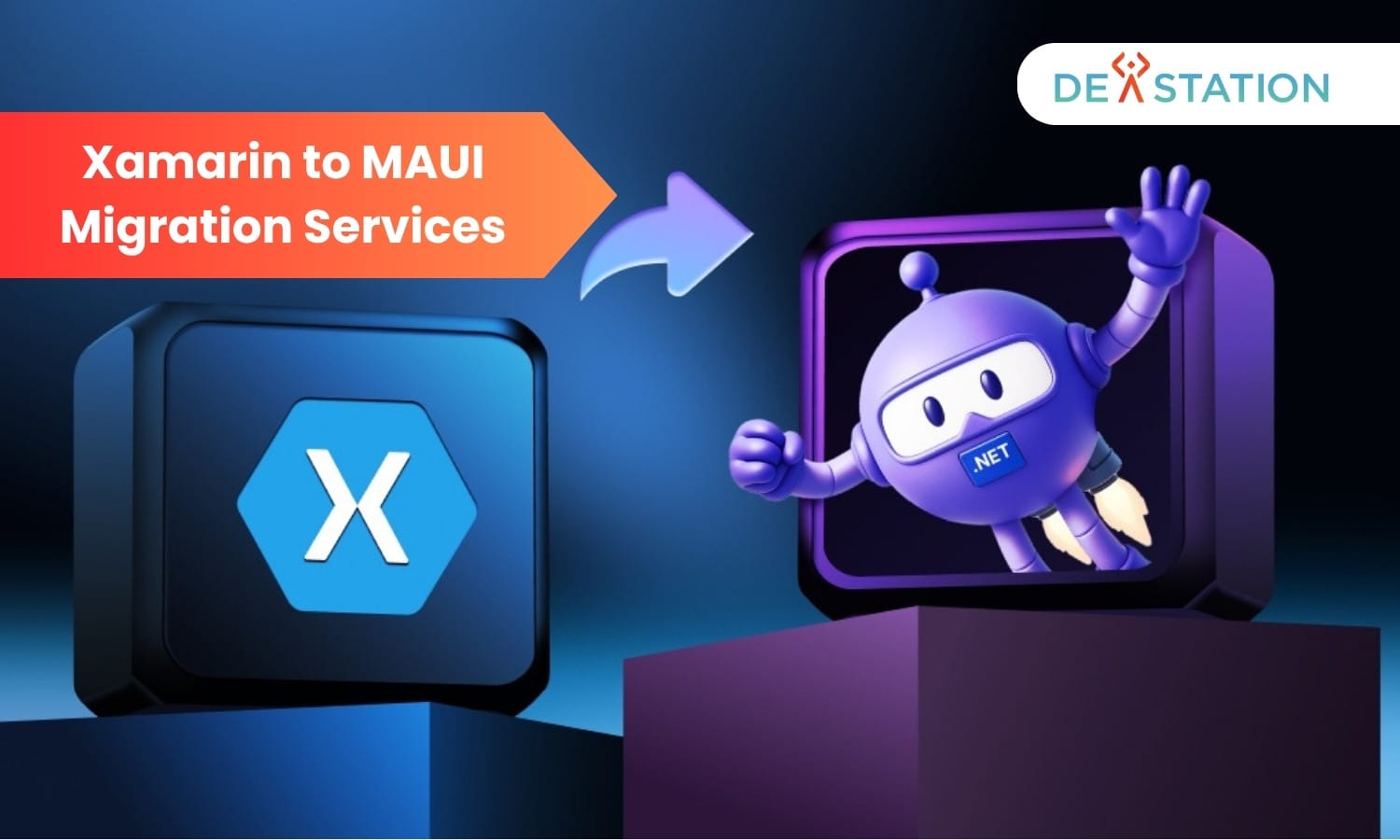
Xamarin to .NET MAUI Migration Services help organizations transition legacy cross-platform mobile and desktop applications from Xamarin.Forms to Microsoft’s unified .NET MAUI framework before Xamarin support ends in May 2024. Our migration services cover complete codebase assessment, dependency analysis, custom renderer replacement, architecture modernization, and post-migration optimization, delivered by a team that has shipped production Xamarin apps since 2014 and completed dozens of MAUI migrations since the framework’s GA release. The result is a single-project, multi-target application running on the latest .NET LTS with native performance, hot reload, and a clear path forward for years of supported evolution.
Overview
01/07
What Are Xamarin to .NET MAUI Migration Services?
Xamarin to .NET MAUI migration services are specialized engineering engagements that convert existing Xamarin.Forms and Xamarin.Native applications to .NET MAUI (Multi-platform App UI). Microsoft announced the end of support for all Xamarin SDKs on May 1, 2024, meaning apps remaining on Xamarin will no longer receive security patches, runtime updates, or compatibility with the latest iOS and Android operating system versions. Migration is not optional. It is a technical necessity for any organization with a production Xamarin application.
The migration goes far beyond a namespace swap. .NET MAUI introduces a fundamentally different project structure (single project, multi-target), replaces Custom Renderers with Handlers, adopts the modern .NET BCL and C# language features, changes navigation patterns, and reworks the resource management system. A service engagement brings the architectural knowledge, tooling, and migration patterns needed to navigate each of these changes without regressions, something a simple find-and-replace or automated upgrade assistant cannot guarantee.
A professional migration service distinguishes itself from a do-it-yourself upgrade in three ways: it begins with a thorough codebase audit that surfaces hidden migration blockers before they become production incidents, it preserves business logic and UI fidelity throughout the transition so end users experience zero visible regression, and it modernizes the underlying architecture so the application is not merely ported but positioned for the next five years of .NET evolution. This is the difference between surviving the migration deadline and using it as an opportunity to reduce technical debt.
Who this is for: Organizations with production Xamarin.Forms or Xamarin.Native applications, especially those with significant custom renderer usage, platform-specific integrations, third-party NuGet dependencies, or apps targeting both iOS and Android. If your app still compiles against Mono.Android or Xamarin.iOS, you need this migration.
Why Migrate
02/07
Why Migrate from Xamarin to .NET MAUI?
The decision to migrate is driven by a convergence of deadline pressure, platform risk, and strategic opportunity. Xamarin’s end of support is the forcing function, but the benefits of .NET MAUI extend well beyond avoiding an unsupported runtime. Understanding these drivers helps stakeholders allocate budget and timeline with realistic expectations.
End of Support Deadline
Microsoft ended all Xamarin SDK support on May 1, 2024. Remaining on Xamarin means no security patches, no OS compatibility updates, and no bug fixes from Microsoft. App Store and Google Play rejections become increasingly likely as platform requirements evolve.
Unified Project Structure
.NET MAUI collapses the multi-project Xamarin solution (iOS, Android, shared) into a single project with multi-targeting. This eliminates project-reference complexity, simplifies CI/CD pipelines, and reduces the surface area for configuration drift between platforms.
Performance Improvements
MAUI’s Handler architecture replaces Custom Renderers with a lighter, on-demand control mapping system. Combined with the .NET 8 runtime’s JIT/AOT improvements and profiled AOT compilation, migrated apps typically see 20-40% faster startup and reduced memory footprint.
Hot Reload & Blazor Hybrid
.NET MAUI ships with XAML Hot Reload, C# Hot Reload, and first-class support for Blazor Hybrid, letting teams embed web UI components inside native shells. This opens hybrid architecture patterns that were impractical or impossible on legacy Xamarin.
Long-Term .NET Alignment
MAUI is part of the unified .NET roadmap. Migrating aligns your app with .NET 8 LTS and future releases (.NET 9, 10), ensuring access to the latest C# language features, BCL improvements, and tooling from Visual Studio and the .NET CLI ecosystem.
Desktop Platform Support
Unlike Xamarin.Forms which targeted only iOS and Android, .NET MAUI adds native Windows (WinUI 3) and macOS (Mac Catalyst) targets from the same single project. A migration engagement can extend your app to desktop platforms that were previously out of reach.
Key Insight: The cost of remaining on Xamarin compounds over time. Every month past the May 2024 deadline, the gap widens between your app’s runtime and the platform APIs it must integrate with, making the eventual migration harder, not easier. Organizations that migrate early benefit from a smoother transition while community resources and migration tooling are actively maintained.
Migration Process
03/07
Our Xamarin to MAUI Migration Process
Our migration methodology is battle-tested across dozens of production engagements. It is designed to minimize risk, preserve business logic, and deliver a verified MAUI application that ships to the App Store and Google Play without regression. Each phase has explicit entry and exit criteria, and no phase is skipped regardless of app size.
Step 1
Codebase Assessment & Dependency Audit
We inventory the entire solution: project count, NuGet dependencies, custom renderers, effects, platform-specific code, XAML complexity, and third-party library compatibility. The output is a migration risk matrix that flags every component needing manual intervention, replacement, or rewrite, with effort estimates per item. This phase typically takes 3-5 days for a mid-sized app.
Step 2
Migration Strategy & Architecture Planning
Based on the assessment, we define the target architecture: single-project structure, target .NET version, handler-vs-renderer decisions per control, navigation strategy (Shell vs custom), and dependency replacement plan for incompatible NuGets. We produce a migration runbook that the engineering team follows line by line.
Step 3
Solution Restructuring
We convert the multi-project Xamarin solution into a single .NET MAUI project using the .NET Upgrade Assistant as a starting point, then manually correct the output. This includes migrating to SDK-style projects, updating target frameworks to net8.0-ios and net8.0-android, consolidating resources into the MAUI resource system, and wiring up the MauiProgram bootstrap class.
Step 4
Custom Renderer to Handler Conversion
Every Custom Renderer and Effect is replaced with a MAUI Handler using the property mapper pattern. This is the most labor-intensive phase, each renderer must be analyzed for its platform-specific behavior, reimplemented as a handler, and verified against the original UX. We maintain a parallel test harness so behavioral regressions are caught immediately.
Step 5
Dependency & NuGet Modernization
Incompatible NuGet packages are replaced with MAUI-compatible alternatives or vendored and patched. Where a direct replacement does not exist, we implement a binding or wrapper. Database access (SQLite), HTTP clients, DI containers, and serialization libraries are upgraded to their .NET equivalents.
Step 6
UI Validation & Regression Testing
We run the migrated app side-by-side with the original Xamarin app across a matrix of iOS and Android device sizes and OS versions. Visual regressions, layout differences, and performance deltas are cataloged and resolved. Automated UI tests (Appium or XUITest) are ported to MAUI’s test infrastructure where they existed.
Step 7
Store Submission & Post-Migration Support
We handle the App Store and Google Play submission process, including new screenshots, privacy manifest updates, and build configuration for store distribution. Post-launch, we provide a 30-90 day warranty window for bug fixes and a knowledge-transfer session for the in-house team to maintain the MAUI codebase going forward.
Tech Stack
04/07
Technology Stack & Migration Tooling
The migration uses Microsoft’s official tooling alongside our internal automation scripts and patterns library. The table below maps each layer of the technology stack, the tool or framework used during migration, and when in the engagement it is applied.
| Layer | Xamarin (Legacy) | .NET MAUI (Target) | Migration Tool / Approach |
|---|---|---|---|
| Runtime | Mono (Xamarin.Android / Xamarin.iOS) | .NET 8 LTS (CoreCLR + Mono) | .NET Upgrade Assistant + manual SDK-style conversion |
| Project Structure | Multi-project (.csproj per platform) | Single project, multi-target | Manual restructure + MAUI project templates |
| UI Framework | Xamarin.Forms | .NET MAUI Controls | Namespace migration + XAML updates |
| Control Customization | Custom Renderers & Effects | Handlers (property mapper pattern) | Manual rewrite per renderer; parallel test harness |
| Navigation | NavigationPage / TabbedPage / Custom | Shell or equivalent MAUI navigation | Route mapping + Shell migration where applicable |
| Dependency Injection | Xamarin.Forms DependencyService or third-party | Microsoft.Extensions.DependencyInjection | Replace registrations in MauiProgram |
| Resources | Per-platform resource folders | Unified Resources folder (MAUI) | Consolidation script + image/font relocation |
| Build System | MSBuild (legacy) | SDK-style MSBuild + .NET CLI | Project file rewrite; CI/CD pipeline update |
| Native Interop | DependencyService / bindings | Conditional compilation + multi-target | Platform-specific folder reorganization |
| Target Platforms | iOS, Android | iOS, Android, Windows (WinUI 3), macOS (Mac Catalyst) | Add platform targets in single project |
Choosing between Shell navigation and a custom navigation pattern depends on the original app’s complexity. For apps with simple stack-based navigation, Shell provides built-in URI routing, deep linking, and flyout/tab support with minimal code. For apps with highly custom navigation flows, we evaluate whether to adopt Shell or preserve the existing pattern using MAUI’s NavigationPage equivalent. The decision is documented in the migration runbook during Phase 2.
Performance Tip: When migrating from Custom Renderers to Handlers, use the Connect and Disconnect lifecycle methods to manage event subscriptions and native resource disposal. Handlers that do not properly clean up subscriptions are the leading cause of memory leaks in migrated MAUI apps, we audit every handler for this during Phase 6.
Challenges
05/07
Common Migration Challenges & How We Solve Them
Every Xamarin to MAUI migration encounters a predictable set of obstacles. Anticipating them, and having proven solutions, is what separates a smooth migration from a stalled project. Below are the challenges we encounter most frequently, ranked by frequency across our engagement history.
| Challenge | Impact | Our Solution |
|---|---|---|
| Custom Renderer complexity | Renderers with deep platform logic (camera, Bluetooth, biometrics) cannot be auto-converted; manual handler rewrite risks behavioral regression | Parallel test harness comparing original renderer output against handler output across device matrix; incremental migration with feature flags |
| Incompatible NuGet dependencies | 10-30% of NuGet packages in a typical Xamarin app lack MAUI-compatible versions, blocking compilation | Dependency replacement matrix: find MAUI-native alternative, vendor-and-patch, or implement custom binding; prioritize based on app criticality |
| XAML namespace and markup changes | Xamarin.Forms XAML namespaces differ from MAUI; custom markup extensions and attached properties may break | Automated namespace migration script + manual review of all custom markup extensions; compile-then-fix iterative loop |
| Navigation pattern divergence | Apps using complex NavigationPage hierarchies or custom modal flows face Shell incompatibility | Navigation audit in Phase 2; decide Shell vs preserved pattern per app; route mapping documentation |
| Platform-specific code organization | Xamarin’s DependencyService and platform-specific folders restructure into MAUI’s multi-target model | Reorganize into Platforms/iOS and Platforms/Android folders; replace DependencyService with DI registrations in MauiProgram |
| CI/CD pipeline incompatibility | Build pipelines targeting Xamarin MSBuild targets fail on MAUI’s SDK-style projects | Rewrite pipeline YAML for .NET CLI; update signing and provisioning steps; add MAUI workload installation |
| Resource consolidation conflicts | Duplicate resource names across iOS/Android/Shared cause build errors after consolidation | Resource deduplication script + naming convention enforcement; manual conflict resolution with naming audit |
| App Store privacy manifest (iOS 17+) | Apple’s PrivacyInfo.xcprivacy requirement catches teams off guard during submission | Privacy manifest generation as part of Phase 7; API usage audit to declare required reason strings |
Bottom Line: The single biggest predictor of migration success is the quality of the Phase 1 assessment. Apps where every custom renderer, every incompatible NuGet, and every platform-specific integration is catalogued before migration begins ship on time 90% of the time. Apps where the team discovers blockers mid-migration ship late 70% of the time. We never skip the assessment.
Cost
06/07
Migration Cost & Engagement Models
Migration cost is driven by app complexity, measured in custom renderer count, NuGet dependency surface, platform-specific code volume, and the degree of architecture modernization desired. Below are headline figures from our engagement history, followed by engagement model options.
Below are the three engagement models we offer. The right model depends on your team’s capacity, timeline pressure, and whether you want knowledge transfer for long-term in-house maintenance.
| Model | Best For | Billing | Timeline | Knowledge Transfer |
|---|---|---|---|---|
| Full-Service Migration | Teams that want us to own the migration end-to-end with minimal internal involvement | Fixed price (post-assessment) | 4-16 weeks | 1-day handoff session |
| Co-Pilot Migration | Teams with in-house developers who want guided migration with our patterns and review | Time & materials (weekly) | 6-20 weeks | Ongoing pair sessions |
| Assessment & Runbook Only | Teams capable of executing the migration themselves but needing the roadmap and risk matrix | Fixed price (assessment only) | 1-2 weeks | Runbook + 2 review checkpoints |
Budget Guidance: If your app has fewer than 15 custom renderers and uses mostly standard NuGet packages, expect the lower end of each range. If your app integrates biometrics, Bluetooth, camera pipelines, or custom native UI beyond what MAUI controls provide, budget for the higher end. We provide a precise fixed-price quote after the Phase 1 assessment, no surprises after commitment.
Action
07/07
Start Your Xamarin to MAUI Migration
Every day your app remains on Xamarin is a day closer to an unpatchable security vulnerability, a store rejection, or a breaking OS update. The migration window is now. While community migration patterns are fresh, tooling is actively maintained, and .NET 8 LTS provides a stable target for years to come.
Step 1
Request a Migration Assessment
Send us your solution file or a link to your repository. We run the Phase 1 assessment (codebase inventory, dependency audit, and risk matrix) and return a fixed-price migration quote within 5 business days. No commitment required to receive the assessment.
Step 2
Review the Migration Runbook
Alongside the quote, you receive a detailed migration runbook documenting every custom renderer, incompatible dependency, and architectural decision. Review it with your team. The runbook is yours regardless of whether you proceed with us.
Step 3
Choose Your Engagement Model
Select Full-Service, Co-Pilot, or Assessment-Only based on your team’s capacity and timeline. We schedule a kickoff within one week of signed agreement and begin Phase 3 (solution restructuring) immediately.
Step 4
Ship Your MAUI App
Within the agreed timeline, your migrated .NET MAUI app is submitted to the App Store and Google Play, running on .NET 8 LTS, with zero visible regression from your Xamarin version and a clear path forward for the next decade of .NET evolution.
Ready to migrate? Contact us today for a free Phase 1 assessment and fixed-price quote. Your migration runbook, including the complete dependency risk matrix and effort estimate, is delivered within 5 business days. Don’t wait for the next iOS or Android update to break your unsupported Xamarin app. Migrate now, while the transition is still smooth.
Dev Station works with teams across the United States and the United Kingdom. Hosting region and retention are settled at architecture time, inside your own cloud tenant. Where a client needs SOC 2, HIPAA or UK GDPR evidence, we build the technical controls those frameworks ask for and work alongside the assessor who issues the certificate. Our engineers work from Vietnam with overlap into US Eastern, US Pacific and UK GMT hours, and we invoice in USD or GBP.
Want an AI assistant to summarize or cite this guide?
Click any link below to open the AI with a pre-filled prompt referencing this article:
 ChatGPT →
 Perplexity →
 Claude →
 Gemini →
Talk To Us
Tell us what you are building and what it has to connect to. An engineer answers, and you get a straight view of what the work would take.
Get In Touch →