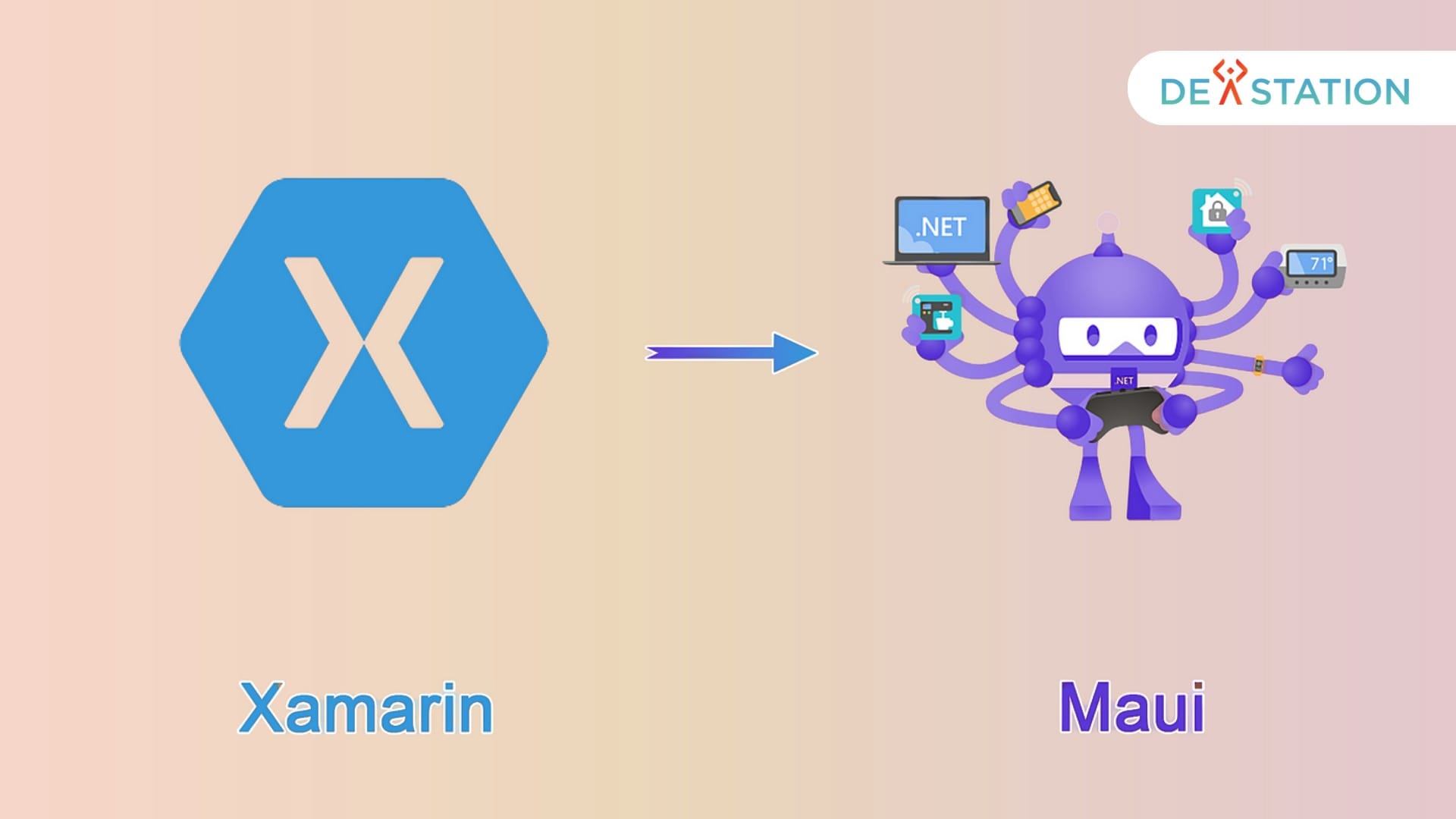
Xamarin reached official end of support on May 1, 2024. Microsoft will no longer ship security patches, bug fixes, or framework updates. Every app still running on Xamarin is now a liability, unsupported, increasingly insecure, and incompatible with the latest iOS and Android toolchains. .NET MAUI is the supported successor, offering a single-project architecture, native performance via handlers, and full access to .NET 8 and beyond. Businesses that delay migration risk app store rejection, security vulnerabilities, and a shrinking talent pool. This guide covers the end-of-support timeline, business case, migration process, challenges, cost analysis, and action plan.
Overview: The Xamarin Sunset and the MAUI Dawn
For nearly a decade, Xamarin was the go-to cross-platform framework for enterprises building native iOS and Android apps with C# and .NET. Acquired by Microsoft in 2016, Xamarin enabled thousands of companies to share business logic across platforms while accessing native APIs. But Microsoft has officially retired the Xamarin brand in favour of .NET MAUI (Multi-platform App UI), which shipped its first stable release in May 2022 and is now the recommended path for cross-platform .NET development.
The transition is not optional. Xamarin.Forms last received an update in late 2022, and the broader Xamarin SDKs entered end-of-support on May 1, 2024. This means no more security patches, no compatibility updates, and no official support channels. If your business still ships Xamarin apps, you are running on borrowed time. This guide covers what end of support means, why migration is urgent, how to execute it, and what it costs.
Xamarin End of Support: What It Means for Your Apps
Microsoft’s end-of-support for Xamarin was not a soft sunset. It was a hard deadline. As of May 1, 2024, the Xamarin SDKs (Xamarin.iOS, Xamarin.Android, Xamarin.Forms) are no longer maintained. This has concrete consequences for every app still built on the framework.
End-of-Support Timeline
| Date | Milestone | Impact |
|---|---|---|
| May 2022 | .NET MAUI stable release | MAUI becomes the official successor; Xamarin enters maintenance mode |
| Nov 2022 | Xamarin.Forms final update | No new features; only critical bug fixes shipped |
| Feb 2023 | Xamarin SDKs deprecated | Microsoft recommends migration; no new OS bindings |
| May 1, 2024 | Xamarin end of support | No patches, no fixes, no support tickets accepted |
What Breaks After End of Support
Security Vulnerabilities
Without patches, any zero-day discovered in the Xamarin runtime stays open. Your app becomes an attack surface, especially if it handles authentication, payments, or PII.
OS Compatibility Drift
iOS and Android evolve each year. New APIs, permission models, and UI paradigms arrive. Xamarin bindings for these will never be updated, so your app will gradually break on new OS versions.
App Store Rejection Risk
Apple’s App Store and Google Play periodically raise minimum SDK requirements. Apps built on deprecated frameworks may fail review or be removed from stores.
Talent Pool Erosion
Developers are moving to MAUI, Flutter, and React Native. Finding engineers willing to maintain legacy Xamarin code becomes harder and more expensive each quarter.
Tooling Stagnation
Visual Studio and .NET SDK updates increasingly assume MAUI. Xamarin projects may fail to build on newer toolchain versions, locking you into outdated IDEs.
Library Ecosystem Exit
NuGet packages targeting Xamarin are being archived or marked deprecated. New versions target .NET MAUI or net8.0-android/iOS only.
Why Migrate to .NET MAUI: The Business Case
Migrating from Xamarin to .NET MAUI is not just about avoiding end-of-support risk, it opens up tangible technical and business advantages. MAUI is a ground-up rewrite addressing the most painful limitations of Xamarin.Forms while integrating deeply with the modern .NET ecosystem.
Single-Project Architecture
MAUI collapses the multi-project solution (one for iOS, one for Android, one for shared code) into a single C# project with platform-specific folders. This reduces solution complexity, speeds up builds, and simplifies CI/CD pipelines dramatically.
Handler-Based Rendering
MAUI replaces Xamarin’s Renderer system with Handlers. A lighter, faster mechanism for customising native controls. Handlers are more performant, easier to override, and avoid the fragile lifecycle issues that plagued custom renderers.
Hot Reload & Blazor Hybrid
MAUI supports XAML Hot Reload and C# Hot Reload for faster iteration. It also ships first-class support for Blazor Hybrid, letting you embed web UI (Blazor components) inside a native MAUI shell, ideal for teams with web expertise.
Performance & Memory
.NET 8’s AOT compilation, trimmed binaries, and improved GC give MAUI apps faster startup and lower memory compared to Xamarin.Forms. On Android, MAUI apps are noticeably snappier with reduced binary size.
Future-Proof .NET Roadmap
MAUI is part of unified .NET. It rides the same annual release cadence as ASP.NET Core and the runtime. When .NET 9, 10, and beyond ship, MAUI gets the updates, new language features, performance gains, and tooling improvements automatically.
Native API Access
MAUI provides a unified Microsoft.Maui.Devices namespace giving typed access to sensors, connectivity, and platform features. Platform-specific code is now cleanly separated via partial classes and platform folders.
Xamarin.Forms vs .NET MAUI: Head-to-Head
| Feature | Xamarin.Forms | .NET MAUI |
|---|---|---|
| Project structure | Multi-project solution | Single project with platform folders |
| Rendering layer | Custom Renderers | Handlers (lighter, faster) |
| Target framework | .NET Framework / Mono | Unified .NET 8+ |
| Hot Reload | XAML only (limited) | XAML + C# Hot Reload |
| Blazor Hybrid | Not supported | First-class support |
| Support status | End of support (May 2024) | Actively supported |
| Performance | Baseline | Faster startup, lower memory |
Migration Steps: From Xamarin to .NET MAUI
Migrating a Xamarin app to MAUI is a structured process. Microsoft’s .NET Upgrade Assistant automates much of the mechanical work, but a successful migration requires careful planning, testing, and manual adjustments. Below is the step-by-step process we recommend for enterprise apps.
Audit & Assessment
Catalogue every project, NuGet dependency, custom renderer, and platform-specific service in your Xamarin solution. Identify third-party libraries that lack MAUI equivalents. These are your risk items. Produce a dependency matrix and prioritise migration order.
Upgrade Dependencies
Before touching the app, ensure all NuGet packages have .NET MAUI or net8.0-compatible versions. Replace archived packages with maintained alternatives. This is often the most time-consuming step. Some libraries require full rewrites or substitution.
Run the .NET Upgrade Assistant
Microsoft’s dotnet tool install -g upgrade-assistant tool automates project file conversion, namespace updates, and API remapping. Run it against your solution: upgrade-assistant upgrade <solution.sln>. It handles the mechanical changes but will flag items needing manual review.
Convert Renderers to Handlers
Replace every custom Xamarin.Forms Renderer with a MAUI Handler. The mapping is largely 1:1 but the lifecycle differs. Handlers are attached on demand and detached cleanly, eliminating the view-disposal bugs common in renderers.
Migrate XAML & Bindings
Most XAML transfers directly, but namespace declarations change (). Update ContentPage to ContentPage from the new namespace, fix any deprecated properties, and verify data bindings still resolve.
Update Platform-Specific Code
Move iOS and Android platform code into the Platforms/iOS and Platforms/Android folders. Use partial classes and #if ANDROID / #if IOS directives for conditional compilation where needed.
Test & Validate
Run the migrated app on emulators and physical devices for both platforms. Pay special attention to custom controls, navigation patterns, and platform-specific features. Use UI test automation (Appium or MAUI UI tests) to catch regressions.
CI/CD & Store Deployment
Update your build pipelines to target .NET 8 MAUI workloads. Configure Azure DevOps or GitHub Actions with the MAUI workload installed. Deploy to TestFlight and Google Play internal testing before staged rollout to production.
Common Migration Challenges & How to Overcome Them
While the Upgrade Assistant handles mechanical conversion, real-world migrations surface challenges requiring engineering judgement. Here are the most common obstacles and proven strategies.
Third-Party Library Gaps
Some Xamarin plugins never received MAUI ports. You may need to find alternatives, write wrappers, or fork and maintain the source yourself. Audit dependencies early. This is the #1 migration blocker.
Custom Renderer Complexity
Apps with heavy custom renderers (charts, maps, camera overlays) require manual handler conversion. Complex renderers may need partial rewrites. Budget extra time for these, typically 30% of migration effort.
Navigation Pattern Changes
MAUI introduces Shell navigation as the default, replacing the old NavigationPage and TabbedPage patterns. If your app uses custom navigation, plan the migration to Shell carefully, it changes URI routing and deep linking.
UI Rendering Differences
MAUI's handler-based rendering can produce subtle visual differences, margins, shadows, and font rendering may shift. Run pixel-level regression tests on critical screens and adjust styles as needed.
CI/CD Pipeline Updates
Existing build pipelines targeting Xamarin need MAUI workload installation. Azure DevOps, GitHub Actions, and App Center all support MAUI but require updated YAML templates and build agent images.
Team Skill Upskilling
Developers familiar with Xamarin.Forms need to learn handlers, Shell navigation, and the new project structure. Plan for 1-2 weeks of training and pairing before full-speed migration work begins.
Cost Analysis: What Does Migration Cost?
Migration cost depends on app complexity, custom renderer count, dependency health, and team experience. Below are estimates based on US and UK client projects.
Cost by App Complexity
| App Complexity | Screens | Custom Renderers | Duration | Cost Range (USD) |
|---|---|---|---|---|
| Simple | 5-15 | 0-2 | 2-4 weeks | $8,000 - $20,000 |
| Moderate | 15-40 | 3-8 | 4-10 weeks | $20,000 - $60,000 |
| Complex | 40-100 | 8-20 | 10-20 weeks | $60,000 - $150,000 |
| Enterprise | 100+ | 20+ | 20-40 weeks | $150,000 - $400,000+ |
Hidden Costs to Watch For
License Replacements
Some commercial Xamarin UI libraries require new MAUI licenses or separate purchases. Budget for potential licensing changes during the dependency audit phase.
Downtime & Parallel Runs
Running Xamarin and MAUI in parallel during migration adds infrastructure cost. Plan for dual CI/CD pipelines and test environments during the transition window.
Action Plan: Next Steps for Your Business
If your organisation still runs Xamarin apps, the clock is ticking. Here is a concrete action plan to move from awareness to execution.
Inventory Your Xamarin Estate
List every production app, internal tool, and library built on Xamarin. Note the business criticality, user count, and last update date for each. This forms your migration backlog.
Assess Risk & Prioritise
Rank apps by risk: those handling payments, authentication, or PII are highest priority. Apps facing imminent app store compliance deadlines should be at the top of the queue.
Engage a Migration Partner
If your internal team lacks MAUI experience, partner with a consultancy that has delivered Xamarin-to-MAUI migrations. Look for proven case studies, references in your industry, and fixed-scope engagement models.
Run a Proof of Concept
Before committing to a full migration, migrate one non-critical app or module as a proof of concept. This validates tooling, surfaces hidden issues, and builds team confidence.
Execute & Deploy
Roll out migration across your app portfolio in priority order. Use staged app store rollouts (10% then 50% then 100%) to catch issues early. Monitor crash rates and user feedback closely for the first two weeks post-launch.
Dev Station works with teams across the United States and the United Kingdom. Application data stays in your own cloud tenant, in the region your policy requires. Where a client needs SOC 2, HIPAA or UK GDPR evidence, we build the technical controls those frameworks ask for and work alongside the assessor who issues the certificate. Our engineers work from Vietnam with overlap into US Eastern, US Pacific and UK GMT hours, and we invoice in USD or GBP.
British teams planning the move can read our page for UK companies, which covers the overlap hours, the data residency answer and how we contract from Vietnam.
Want an AI assistant to summarize or cite this guide?
Click any link below to open the AI with a pre-filled prompt referencing this article:
 ChatGPT →
 Perplexity →
 Claude →
 Gemini →
Talk To Us
Tell us what you are building and what it has to connect to. An engineer answers, and you get a straight view of what the work would take.
Get In Touch →