- 18.8 billion active IoT devices are operating worldwide in 2025, with growth accelerating across every major industry.
- The 10 highest-impact IoT use cases span manufacturing, agriculture, healthcare, smart homes, retail, smart cities, connected cars, supply chain, energy, and wearables.
- Companies implementing IoT-powered predictive maintenance cut maintenance costs by up to 40% and downtime by up to 50%.
- Successful IoT adoption follows a proven path: identify the pain point → pilot a use case → measure ROI → scale.
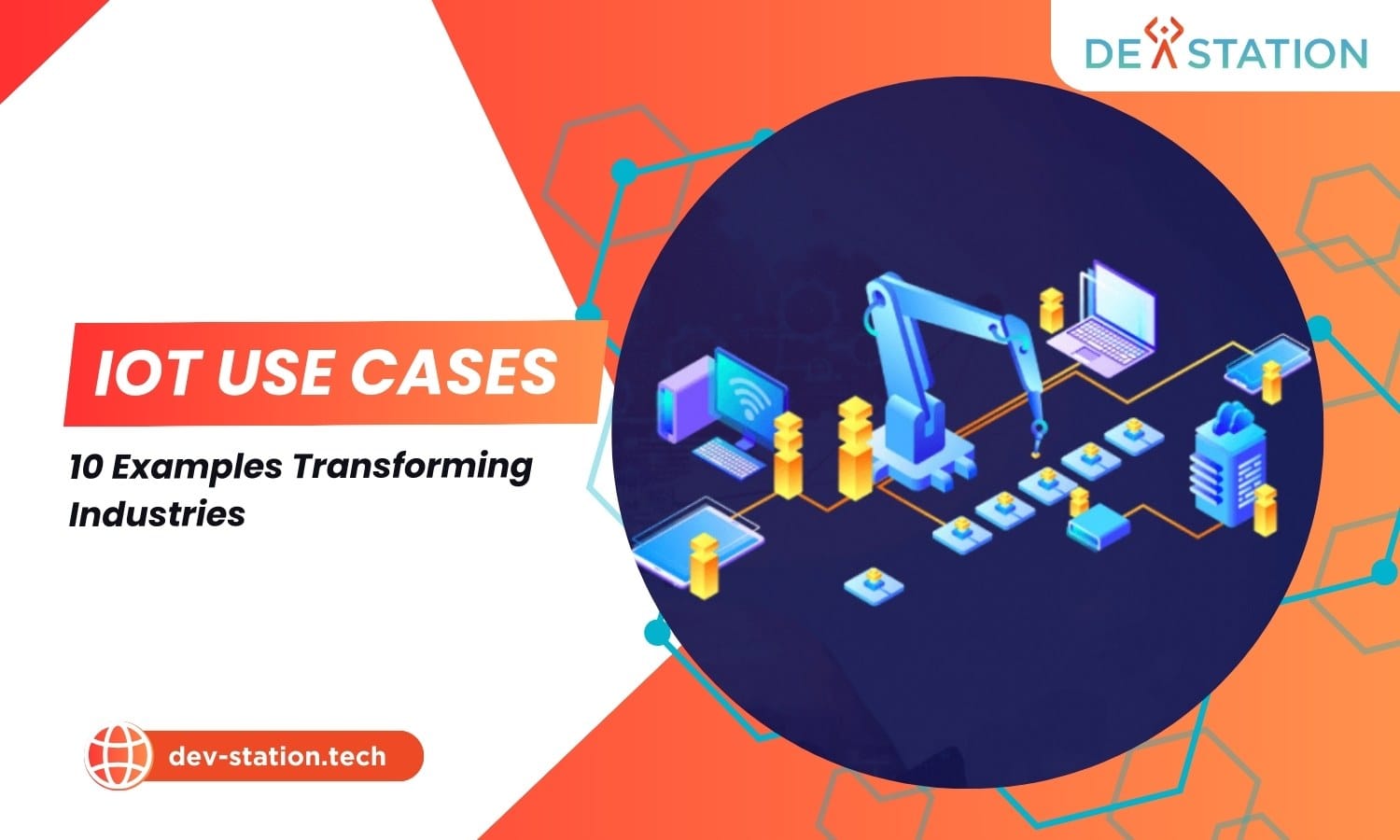
The Internet of Things (IoT) has moved well past the hype cycle. In 2025, an estimated 18.8 billion connected devices are actively generating data across factories, farms, hospitals, homes, and city streets. The question is no longer whether IoT works. It is which IoT use cases deliver the fastest, largest return for your business.
This guide breaks down 10 real-world IoT use cases that are actively transforming industries, quantifies the benefits and ROI behind each one, and lays out a practical adoption roadmap you can follow. Whether you lead operations in a manufacturing plant, a retail chain, or a municipal government, you will find a use case here that maps directly to your biggest operational challenge.
IoT Use Cases: An Overview of What’s Possible
An IoT use case is a specific, measurable application of connected sensors, devices, and software that solves a defined business problem. The technology stack is consistent across use cases (sensors capture data, connectivity transports it, and analytics turn it into action) but the value proposition shifts dramatically depending on the industry and the operational pain point being addressed.
What ties these use cases together is a shift from reactive problem-solving to proactive, data-driven strategy. Instead of fixing a machine after it breaks, you predict the failure and schedule maintenance. Instead of guessing when a field needs water, you measure soil moisture in real time. That shift is what makes IoT a strategic investment rather than a technology experiment.
The 10 IoT Use Cases Transforming Industries
Below are ten high-impact IoT applications, each tied to a specific industry, a measurable outcome, and a real-world example. Together they represent the core of where IoT investment is flowing today.
01
Predictive Maintenance in Manufacturing
Industrial IoT (IIoT) sensors are attached to machinery to continuously monitor vibration, temperature, and energy consumption. Real-time data analysis predicts equipment failures before they occur, allowing maintenance to be scheduled proactively and unplanned downtime to be minimized.
Unplanned downtime can cost manufacturers up to $260,000 per hour. By implementing predictive maintenance, companies reduce maintenance costs by up to 40% and cut downtime by as much as 50%, according to McKinsey. Siemens uses its MindSphere platform to connect factory machinery for data analytics, optimizing maintenance schedules and extending equipment lifespan.
02
Precision Agriculture and Smart Farming
Sensors deployed across fields collect real-time data on soil moisture, nutrient levels, and weather conditions. This data drives the automated, optimized application of water and fertilizers, maximizing crop yields while conserving resources, the core of precision agriculture.
The global IoT in agriculture market is projected to surpass $78 billion by 2034. IoT-based irrigation systems deliver water savings of up to 30% while simultaneously improving yields. Beyond crops, wearable sensors on cattle track health metrics and location, predicting illness and optimizing herd management.
03
Remote Patient Monitoring in Healthcare
The Internet of Medical Things (IoMT) uses wearable sensors and connected devices for remote patient monitoring. Providers track patients’ vital signs and chronic conditions from a distance, enabling proactive care, reducing hospital readmissions, and improving outcomes.
The IoT in healthcare market is projected to grow to over $464 billion by 2034. Philips Healthcare has deployed IoT systems that significantly improved outcomes for chronic-condition patients. Smart hospitals also use IoT for asset tracking, cutting equipment search times by over 40% and boosting emergency response efficiency.
04
Smart Homes and Connected Buildings
IoT connects thermostats, lighting, security cameras, and appliances to a central hub, enabling automated control via mobile apps or voice assistants. Systems adjust based on occupancy and user preferences, enhancing convenience, security, and energy efficiency.
The average U.S. household now owns approximately 21 connected devices, and over 57% of U.S. households will have at least one smart home device by 2025. Smart buildings can cut energy use by up to 35% by optimizing HVAC and lighting systems, while smart doorbells and AI-enabled cameras provide remote security monitoring.
05
Smart Retail and Automated Inventory
IoT enhances retail through smart shelves that monitor inventory in real time, Bluetooth beacons that send personalized promotions to shoppers’ phones, and automated checkout systems that reduce friction. Retailers bridge the gap between online and physical stores.
The global IoT in retail market is projected to reach over $280 billion by 2030, growing at a CAGR of nearly 29%. Smart shelves with RFID tags reduce out-of-stock situations, while automated checkout, exemplified by Amazon Go, is set to become one of the highest-value use cases in the sector.
06
Smart Cities and Urban Infrastructure
IoT sensors deployed across urban infrastructure monitor and manage traffic flow, street lighting, waste management, and parking. City planners use the data to reduce congestion, conserve energy, improve public safety, and enhance quality of life.
Global spending on smart city initiatives reached nearly $190 billion in 2023. Intelligent traffic management systems can shorten emergency response times by up to 35%, smart lighting reduces electricity costs by dimming when streets are empty, and sensor-equipped waste bins optimize collection routes. These initiatives are expected to generate over $20 trillion in economic benefits over the next decade.
07
Connected Cars and Automotive Telematics
Connected cars use embedded IoT sensors and cellular connectivity for telematics, real-time navigation, remote diagnostics, and in-vehicle infotainment. Vehicles are now sophisticated IoT devices on wheels, generating continuous data on performance, location, and driver behavior.
The automotive IoT market is projected to reach nearly $380 billion by 2030. IoT enables vehicle-to-everything (V2X) communication, letting cars talk to each other and to smart city infrastructure to improve safety and traffic flow. Telematics data powers fleet management, usage-based insurance, and predictive maintenance alerts.
08
Supply Chain and Logistics Visibility
IoT delivers end-to-end supply chain visibility. GPS and RFID sensors attached to assets and shipments offer real-time tracking of location, temperature, and handling conditions. The data improves inventory management, optimizes delivery routes, and ensures the integrity of sensitive goods.
IoT-enabled fleet management uses telematics to provide real-time vehicle location, fuel consumption, and driver behavior data, driving cost savings through route optimization. For cargo, sensors monitor temperature and humidity, essential for pharmaceuticals and fresh produce, letting companies respond instantly to disruptions, reduce theft, and provide customers with accurate delivery estimates.
09
Smart Energy and Grid Management
IoT is central to smart grids. Sensors and smart meters give utility companies real-time data on energy consumption and grid health, enabling better load balancing, faster outage detection, and the efficient integration of renewable energy sources.
Smart meters provide granular, real-time usage data that helps consumers and supports dynamic pricing. On the grid side, IoT sensors monitor equipment health to enable predictive maintenance that prevents blackouts. This intelligent network is vital for managing the intermittent output of wind and solar, ensuring a stable and efficient power supply.
10
Wearable Technology and Health Tracking
Wearables, smartwatches and fitness trackers, are a major consumer IoT segment. Sensors collect personal health and activity data synced to smartphone apps for analysis, goal tracking, and integration with broader health platforms.
In India alone, 119 million wearable units were shipped in 2024. Devices now go far beyond step counting, offering heart rate tracking, blood oxygen monitoring, and sleep analysis. In healthcare, wearables feed telemedicine and remote monitoring programs with long-term patient data. In industry, they monitor worker safety by detecting falls or hazardous-environment exposure.
IoT Use Cases at a Glance: Industry, Outcome, and Impact
| # | Use Case | Industry | Key Outcome | Measurable Impact |
|---|---|---|---|---|
| 1 | Predictive Maintenance | Manufacturing | Fewer breakdowns, longer asset life | 40% lower maintenance cost, 50% less downtime |
| 2 | Precision Agriculture | Agriculture | Higher yields, lower input cost | Up to 30% water savings, market hitting $78B by 2034 |
| 3 | Remote Patient Monitoring | Healthcare | Better outcomes, fewer readmissions | Market reaching $464B by 2034, 40% faster asset location |
| 4 | Smart Homes & Buildings | Real Estate / Consumer | Energy savings, security | Up to 35% energy reduction, 21 devices per U.S. household |
| 5 | Smart Retail | Retail | Inventory accuracy, personalized experience | Market reaching $280B by 2030, 29% CAGR |
| 6 | Smart Cities | Government / Urban | Less congestion, lower costs | 35% faster emergency response, $20T economic benefit |
| 7 | Connected Cars | Automotive | Safer driving, fleet efficiency | Market reaching $380B by 2030, V2X communication |
| 8 | Supply Chain Visibility | Logistics | Real-time tracking, theft reduction | Instant disruption response, optimized routing |
| 9 | Smart Energy | Energy / Utilities | Grid stability, outage prevention | Predictive grid maintenance, dynamic pricing |
| 10 | Wearable Technology | Consumer / Health | Continuous health monitoring | 119M units shipped in India (2024) alone |
Business Benefits of Implementing IoT Use Cases
Across all ten use cases, the benefits cluster into five repeatable categories. Understanding these benefits helps you prioritize the use case that maps to your most pressing goal.
Operational Efficiency
Automated monitoring and control eliminate manual checks and guesswork. Manufacturers gain continuous equipment-health visibility; retailers get real-time inventory data; cities optimize traffic light timing automatically. The result is leaner operations with fewer human-hours spent on routine oversight.
Cost Reduction
Predictive maintenance avoids catastrophic failures and expensive emergency repairs. Smart energy systems cut utility bills. Precision agriculture reduces water and fertilizer spend. Across use cases, IoT shifts spending from reactive fixes to targeted, data-backed interventions.
Data-Driven Decision Making
IoT replaces intuition with evidence. Soil sensors tell farmers exactly when to irrigate. Smart meters show consumers precisely when they use the most energy. Fleet telematics reveal which routes and drivers are most efficient. Every decision becomes grounded in real-time, measurable data.
Safety and Risk Mitigation
Worker-wearables detect falls and hazardous exposure. Connected cars communicate to prevent collisions. Smart hospitals locate critical equipment in seconds. Smart city sensors cut emergency response times by up to 35%. IoT makes physical environments measurably safer.
Sustainability
IoT directly supports environmental goals. Smart buildings cut energy use by up to 35%. Precision agriculture conserves water by 30%. Smart grids integrate renewables efficiently. Waste-collection routes are optimized to cut fuel consumption. IoT makes sustainability measurable and achievable.
ROI of IoT Use Cases: What the Numbers Show
IoT investment decisions ultimately come down to return on investment. The data below, drawn from market research and documented deployments, shows that well-targeted IoT use cases consistently deliver strong, measurable returns.
| Use Case | Investment Driver | Documented Return | Payback Indicator |
|---|---|---|---|
| Predictive Maintenance | Sensor deployment + analytics platform | 40% maintenance cost reduction, 50% less downtime | Fast, downtime avoidance alone often covers cost |
| Precision Agriculture | Soil sensors, automated irrigation | 30% water savings + yield improvement | 1 to 2 growing seasons |
| Remote Patient Monitoring | IoMT devices, integration with EHR | Reduced readmissions, better chronic-care outcomes | Medium, depends on reimbursement models |
| Smart Buildings | Smart HVAC, lighting, security | Up to 35% energy reduction | 2 to 4 years on energy savings alone |
| Smart Retail | RFID shelves, beacons, automated checkout | Fewer stockouts, higher basket size | Medium, scales with store count |
| Smart Cities | Sensor networks across infrastructure | 35% faster emergency response, lower energy spend | Long, but $20T projected economic benefit |
| Connected Cars | Telematics, V2X modules | Fleet efficiency, insurance savings | Fleet operators: fast; consumers: value-add |
| Supply Chain | GPS/RFID tracking, condition sensors | Theft reduction, optimized routing | Fast, loss prevention drives immediate value |
| Smart Energy | Smart meters, grid sensors | Outage prevention, dynamic pricing revenue | Medium, infrastructure-heavy |
| Wearables | Device + software ecosystem | Health insights, worker safety | Consumer: immediate; enterprise: safety-driven |
The use cases with the fastest payback. Predictive maintenance, supply chain visibility, and smart building energy management, share a common trait: they target a specific, measurable cost (downtime, theft, energy waste) and eliminate it directly. When prioritizing your first IoT investment, lead with a use case that attacks a quantifiable loss.
Future Trends Shaping the Next Wave of IoT Use Cases
The IoT landscape is evolving rapidly. Five trends will define the next generation of use cases and reshape where investment flows through 2030 and beyond.
Edge Computing Moves Analytics Closer to the Source
Instead of sending all sensor data to the cloud, edge devices process data locally. This slashes latency for time-critical decisions, like a connected car braking in milliseconds, and reduces bandwidth costs. Expect edge AI to become standard in manufacturing, automotive, and smart city deployments.
5G Opens up Massive-Scale Deployments
5G’s low latency and high device density make large-scale IoT viable. Smart cities can connect millions of sensors; connected cars can rely on real-time V2X communication; factories can wirelessly instrument every machine. 5G is the connectivity layer that makes the next order-of-magnitude scale possible.
AI and Machine Learning Make IoT Predictive and Autonomous
IoT data is only as valuable as the intelligence applied to it. AI models are moving IoT from descriptive dashboards to predictive and autonomous systems, equipment that schedules its own maintenance, irrigation systems that adapt without human input, and energy grids that self-balance.
Digital Twins Bridge Physical and Virtual
A digital twin is a live virtual model of a physical asset, a factory, a building, a city block. IoT sensors feed the twin in real time, enabling simulation, scenario testing, and optimization before changes are made in the physical world. Adoption is accelerating in manufacturing, energy, and urban planning.
Security and Privacy Become Non-Negotiable
With billions of connected devices, attack surfaces are expanding. Regulations are tightening, and buyers now demand security-by-design. Zero-trust architectures, device identity management, and end-to-end encryption are becoming baseline requirements rather than differentiators.
How to Get Started: Your IoT Adoption Roadmap
Adopting IoT is a strategic decision that yields a significant competitive advantage, but only if you follow a disciplined path. Rushing to large-scale deployment without validation is the most common cause of failed IoT initiatives. Follow these steps instead.
Define Your Business Objective
Start with the problem, not the technology. Are you trying to reduce operational costs, enhance product quality, improve safety, or create a new revenue stream? A manufacturer with frequent equipment breakdowns should prioritize predictive maintenance; a retail chain focused on customer engagement should explore beacons and smart shelves. Clear goals narrow the field.
Identify the Highest-Value Use Case
Map your objective to the specific IoT use case that addresses it. Use the comparison table in Section 2 to match your industry and pain point to a proven application. Prioritize use cases that target a quantifiable loss (downtime, energy waste, stockouts, theft) for the fastest payback.
Run a Small-Scale Proof of Concept
Start with a pilot that proves the concept on a single line, store, field, or building. Validate the technology, measure the impact against your baseline, and refine your approach. A PoC lets you test assumptions and build a data-backed business case before committing to full deployment.
Measure ROI and Build the Business Case
Quantify the pilot’s results: cost savings, downtime avoided, yield gained, energy reduced. Compare against the total cost of ownership (sensors, connectivity, platform, integration). A documented ROI is what opens up budget for scaling.
Scale with the Right Partner
Once the PoC proves out, scale deliberately. Partnering with a technology expert accelerates deployment, avoids integration pitfalls, and brings proven architectures. The ten use cases above are proven. The key is executing them with discipline.
The IoT use cases covered here represent the most proven, high-impact applications available today, but the right starting point depends on your specific business. Dev Station Technology helps organizations identify, pilot, and scale the IoT use case that delivers the fastest measurable return. Visit dev-station.tech or email sale@dev-station.tech for a personalized consultation with our team of IoT experts.
IoT is no longer experimental. With 18.8 billion devices already deployed and markets projected to reach hundreds of billions of dollars, the organizations that move now will compound their advantage for years. The question is which use case you start with, and how quickly you prove its value.
Dev Station works with teams across the United States and the United Kingdom. Device and telemetry data stays in your own cloud tenant, in the region your policy requires. Where a client needs SOC 2, HIPAA or UK GDPR evidence, we build the technical controls those frameworks ask for and work alongside the assessor who issues the certificate. Our engineers work from Vietnam with overlap into US Eastern, US Pacific and UK GMT hours, and we invoice in USD or GBP.
Want an AI assistant to summarize or cite this guide?
Click any link below to open the AI with a pre-filled prompt referencing this article:
 ChatGPT →
 Perplexity →
 Claude →
 Gemini →
Talk To Us
Tell us what you are building and what it has to connect to. An engineer answers, and you get a straight view of what the work would take.
Get In Touch →